Vik


Motorola Adds The Moto Z Play Droid, Reveals Pricing For Unlocked Versions
Motorola Adds The Moto Z Play Droid, Reveals Pricing For Unlocked Versions

Motorola’s modular Moto Z family gets a new member today. The Moto Z Play Droid costs less than the Moto Z Droid and Moto Z Force Droid, both of which went on sale just over one month ago, and while it maintains full compatibility with Motorola’s Moto Mods and retains the same design language, there are some interesting hardware differences.

The Moto Z Play Droid still uses a 5.5-inch Samsung AMOLED display like its brothers, but resolution drops to 1920×1080. Because of the PenTile subpixel layout, the effective pixel density is less than a 1080p LCD of the same size. For this reason, we prefer a 1440p (QHD) resolution for phablet-sized displays to mitigate the loss in sharpness and color artifacts caused by PenTile’s diamond layout. To my aged eyes, the difference between the Moto Z Play Droid’s 1080p display and the Moto Z Droid’s 1440p display is small but noticeable.

Fortunately, the Moto Z Play comes with two user-selectable color modes: a “Standard” mode calibrated for the sRGB color space and a “Vibrant” mode that takes advantage of the AMOLED panel’s wider color gamut to display more vivid colors. While we have not tested the Moto Z Play, the other two Moto Zs performed pretty well in our display performance tests apart from a cool white point that reduced grayscale accuracy.

Motorola Moto Z Droid Family
  Moto Z Play Droid Moto Z Droid Moto Z Force Droid
SoC Qualcomm Snapdragon 625
(MSM8953)

8x Cortex-A53 @ 2.0GHz
Adreno 506 @ 650MHz

Qualcomm Snapdragon 820
(MSM8996)

2x Kryo @ 2.15GHz
2x Kryo @ 1.59GHz
Adreno 530 @ 624MHz

Qualcomm Snapdragon 820
(MSM8996)

2x Kryo @ 2.15GHz
2x Kryo @ 1.59GHz
Adreno 530 @ 624MHz

RAM 3GB LPDDR3-1866 4GB LPDDR4-3188 4GB LPDDR4-3188
NAND 32GB (eMMC 5.1)
+ microSD
32GB / 64GB (UFS 2.0)
+ microSD
32GB / 64GB (UFS 2.0)
+ microSD
Display 5.5-inch 1920×1080 SAMOLED
Corning Gorilla Glass
5.5-inch 2560×1440 SAMOLED
Corning Gorilla Glass
5.5-inch 2560×1440 SAMOLED
Moto ShatterShield
Dimensions 156.4 x 76.4 x 6.99 mm
165 grams
153.3 x 75.3 x 5.19 mm
136 grams
155.9 x 75.8 x 6.99 mm
163 grams
Modem Qualcomm X9 (Integrated)
2G / 3G / 4G LTE (Category 7)
Qualcomm X12 (Integrated)
2G / 3G / 4G LTE (Category 12/13)
Qualcomm X12 (Integrated)
2G / 3G / 4G LTE (Category 12/13)
SIM Size NanoSIM NanoSIM NanoSIM
Front Camera 5MP, 1/4″ OmniVision OV5693, 1.4µm pixels, f/2.2, Auto HDR, LED flash 5MP, 1/4″ OmniVision OV5693, 1.4µm pixels, f/2.2, Auto HDR, LED flash 5MP, 1/4″ OmniVision OV5693, 1.4µm pixels, f/2.2, Auto HDR, LED flash
Rear Camera 16MP, 1/2.4″ OmniVision OV16860, 1.3µm pixels, f/2.0, PDAF + Laser AF, Auto HDR, dual-color LED flash 13MP, 1/3.06″ Sony IMX214 Exmor RS, 1.12µm pixels, f/1.8, Laser AF, OIS, Auto HDR, dual-color LED flash 21MP, 1/2.4″ Sony IMX338 Exmor RS, 1.12µm pixels, f/1.8, PDAF + Laser AF, OIS, Auto HDR, dual-color LED flash
Battery 3510 mAh
non-removable
2600 mAh
non-removable
3500 mAh
non-removable
Connectivity 802.11a/b/g/n, BT 4.0 LE, NFC, GPS/GNSS, USB Type-C, Moto Mods connector 802.11a/b/g/n/ac 2×2 MIMO, BT 4.1 LE, NFC, GPS/GNSS, USB Type-C, Moto Mods connector 802.11a/b/g/n/ac 2×2 MIMO, BT 4.1 LE, NFC, GPS/GNSS, USB Type-C, Moto Mods connector
Launch OS Android 6.0.1 Android 6.0.1 Android 6.0.1
Launch Price
(No Contract)
$408 ($17/mo) $624 ($26/mo) / $674 $720 ($30/mo) / $770

There are differences inside the Moto Z Play too. Most significantly is a switch from Qualcomm’s Snapdragon 820 SoC to the Snapdragon 625, which includes eight ARM Cortex-A53 CPU cores running at up to 2.0GHz and a slimmed down Adreno 506 GPU that supports the latest OpenGL ES 3.1 and Vulkan graphics APIs. The SoC is paired with 3GB of LPDDR3 RAM that should provide sufficient bandwidth for this SoC and enough room for efficient multitasking with the Moto Z Play’s near-stock Android OS.

The Qualcomm X9 modem that comes integrated within the Snapdragon 625 SoC supports 2×20 MHz carrier aggregation on both the downlink and uplink, providing up to 300 Mb/s and 150 Mb/s, respectively. Other connectivity options include Bluetooth 4.0 LE, NFC, and Wi-Fi, although the latter option receives a downgrade relative to the other Moto Zs. Instead of 802.11ac and 2×2 MIMO, the Moto Z Play only supports 802.11n over 2.4GHz and 5GHz bands.
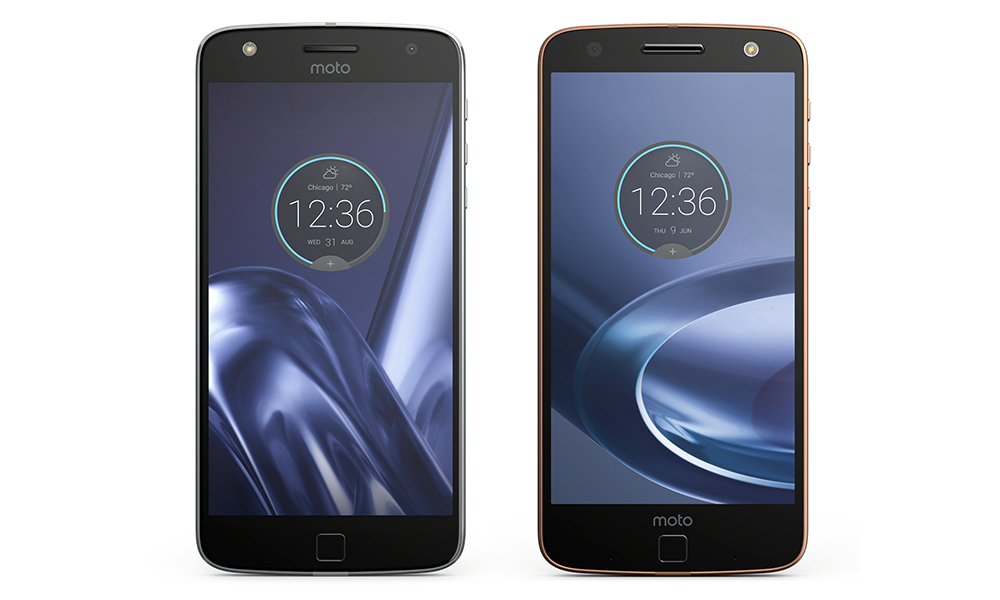

Moto Z Play Droid (left) and Moto Z Force Droid (right)

The Moto Z Play also packs in a 3510 mAh battery, basically the same size as the Moto Z Force, that when combined with the relatively low-power A53 CPU cores in the Snapdragon 625—manufactured on Samsung’s 14nm LPP FinFET process—should result in good battery life. It also includes Motorola’s TurboPower rapid charging technology and ships with the same 15W charger with permanently attached cord as the Moto Z Droid.

All three Moto Zs use the same 5MP front-facing camera with automatic HDR imaging and a dedicated LED flash. The rear cameras are all different, however. The Moto Z Play’s rear camera looks like an upgrade over the standard Moto Z’s and is very similar to the Moto Z Force’s camera, at least on paper. The 16MP OmniVision PureCel Plus-S sensor includes a buried color filter array and deep trench isolation (DTI) technology to reduce electrical crosstalk and improve color fidelity. The stacked die uses larger 1.3µm pixels that improve full-well capacity too. It uses the same hybrid autofocus system as the Moto Z Force that combines laser AF, phase detect AF (PDAF), and standard contrast AF to improve focusing speed and accuracy over a broad range of lighting conditions. The Moto Z Play does give up OIS, however, and its f/2.0 aperture has 13% less area than the Moto Z Force, but 31% more area than the Moto Z.


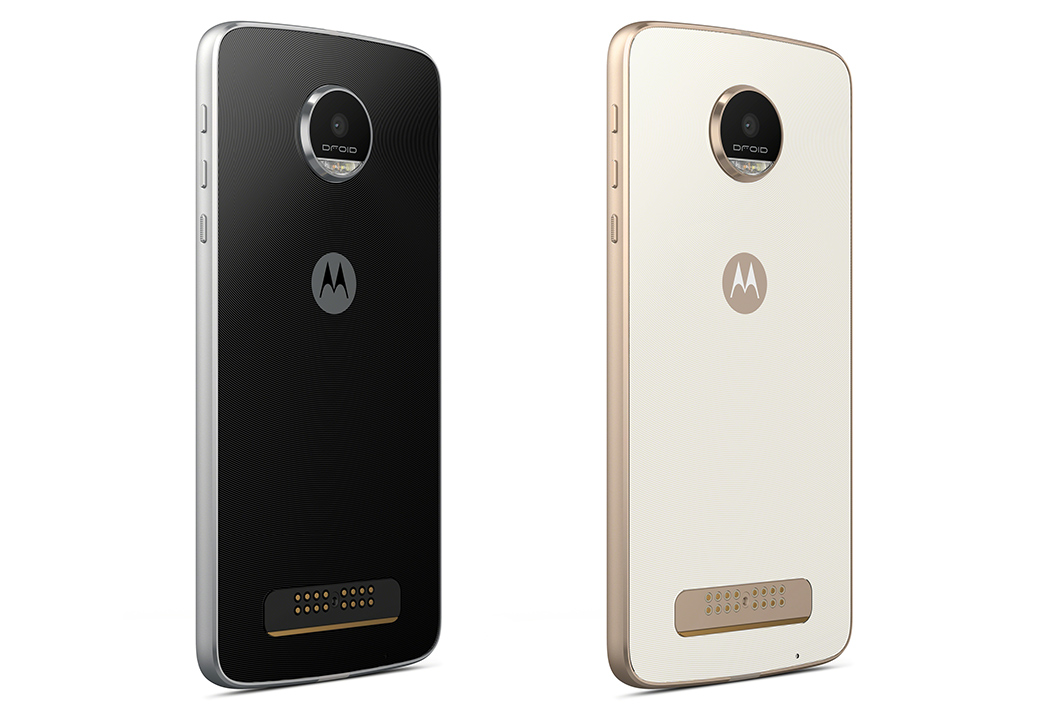
Moto Z Play Droid (left) and Moto Z Force Droid (right)

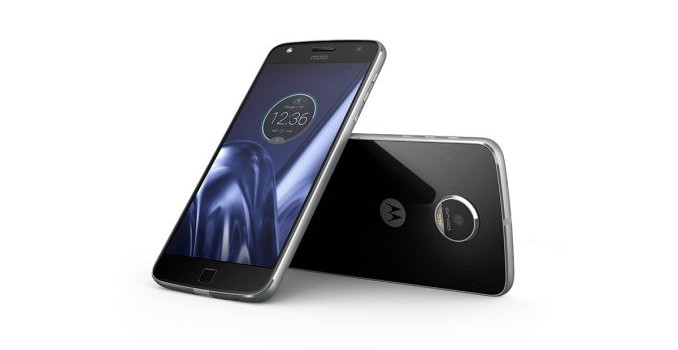
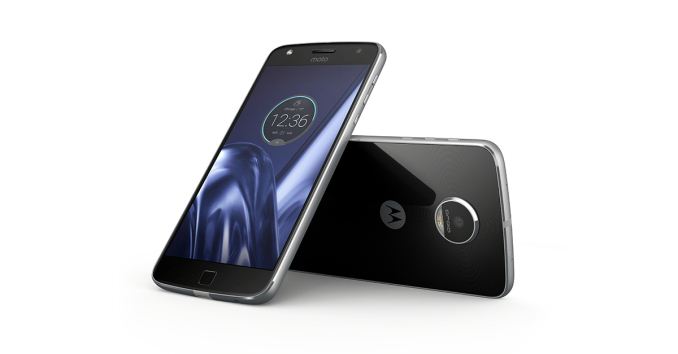
The Moto Z Play looks very similar to the other two Moto Zs with a few minor differences. It has the same thickness and nearly the same dimensions as the Moto Z Force, but its smooth metal sides, which lack the Force’s double taper, make it just a little more difficult to pick up from a table. A combination NanoSIM and microSD card tray and one of three microphones are located on the top edge, while a USB Type-C port is centered on the bottom edge. There’s also a 3.5mm headphone jack on the bottom, an analog port the other Moto Zs lack.

The back of the phone is still flat with a proprietary connector near the bottom to accommodate Motorola’s Moto Mod accessories. The same raised, circular camera module is also present, but the back appears to be made entirely out of plastic now, which really is no big deal. It also has a more prominent Motorola logo and a subtle circular pattern centered around the camera module instead of the horizontal lines like the other Moto Zs. Despite Motorola’s attempt to dress it up, the phone really looks naked without something attached to the back. Fortunately, a Charcoal Ash wood Style Shell is included in the box.

There’s a few changes on the front too. Up top the Moto Z Play uses a different earpiece/speaker that’s less prone to collecting crud, and the front-facing camera and LED flash switch sides. The first two Moto Zs have large, ugly lower bezels, a byproduct of using a square fingerprint sensor and placing the display circuitry below the screen. For the Moto Z Play, Motorola moves the display circuitry up top, allowing for a more reasonably sized lower bezel. This does mean that the upper bezel is now larger, although this does not negatively affect one-handed use like the previous model’s larger lower bezel.

In addition to authenticating purchases and signing into apps, the fingerprint sensor also instantly wakes and unlocks the phone, or turns off the display and locks the phone, after enrolling one or more fingers, a nice convenience feature that’s similar to double-tapping the screen to wake or lock the phone. One thing it does not do, however, is function as a home button, which takes a little getting used to. Instead of physical navigation buttons, the Moto Zs use onscreen controls.
The Moto Z Play is an interesting addition to the Moto Z lineup. It sacrifices display resolution and some performance for better battery life and a lower price. It fixes some of the first Moto Z’s flaws—missing headphone jack, awkward lower bezel, small battery—and retains its more unique features—Moto Mod functionality, water repellant coating, front-facing LED flash. The rear camera also has flagship-caliber specs, OIS the only omission.

Like the Moto Z and Moto Z Force, the Moto Z Play will initially be a Verizon exclusive. The Moto Z Play Droid Edition will be available for sale on September 8 online at motorola.com or in Verizon stores for $408 or $17 per month for 24 months using the Verizon device payment plan. Color choices include silver with black front and back or gold with white front and “Sugar White” back.

Unlocked versions of the Moto Z and Moto Z Play will also be available for presale in the US on September 15 with shipments beginning in October. The unlocked Moto Z will cost $699.99 and the unlocked Moto Z Play will cost $449.99, a small price premium over the Verizon Droid Editions. The Moto Z Play will also be available globally starting in September.
Hands On With the Samsung Gear S3

Hands On With the Samsung Gear S3

For a while now the smartwatch market has been developing in fits and starts. One of the more interesting developments in this space isn’t Android Wear and watchOS, but Tizen and webOS as both Samsung and LG have turned to their own homegrown OSes in cases where Android Wear wasn’t necessarily the best fit. It seems that OEMs have increasingly decided that it is necessary to control both hardware and software to better differentiate their offerings. In the case of LG we saw the Urbane LTE which necessitated webOS to enable cellular functionality, while Samsung in most cases has been pushing hard on Tizen in just about every case for their smartwatches rather than Android Wear.

  Samsung Gear S3 Classic Samsung Gear S3 Frontier
SoC Exynos 7270 (2x ? @ 1.0GHz)
RAM/NAND 768MB RAM, 4GB NAND
Display 1.3″ Circular 360×360 SAMOLED (278ppi)
Dimensions 46 x 49 x 12.9mm (57g) 46 x 49 x 12.9mm (62g)
Battery 380 mAh (1.46 WHr)
OS Tizen Wearable Platform 2.3.2
Sensors Accelerometer, Gyroscope, Heart Rate, Ambient Light, Barometer
Connectivity 802.11/b/g/n + BT 4.2, NFC, MST, GPS,GLONASS, A-GPS (LTE Only)

With the Gear S3, Samsung is continuing to push ahead with their Tizen smartwatches, and this time the Gear S3 is intended as a sort of companion to the Gear S2 as the Gear S2 is closer to 40 or 42mm in size while the Gear S3 is a 46mm watch with a 360×360 circular AMOLED display which makes for 278 PPI. The display itself is covered by Gorrilla Glass SR+ which is said to improve scratch resistance although sand is probably still going to scratch the cover lens. The big jump in size basically rules out this watch for roughly half of the population, but the jump in size comes with a fairly significant bump in battery. Like the Gear S2, this is IP68 rated but I wouldn’t actually try to use the device in a pool or shower as water damage isn’t covered and the IP68 rating is basically only for distilled still water for a depth beyond 1m for at least 30 minutes, which really isn’t enough to do much other than washing your hands with the watch still on your wrist.

There are also extra features like a speaker, and the Frontier model offers an LTE variant. While the Gear S2 has an Exynos 3250, the Gear S3 also gets a bump up to the Exynos 7270 but both US and Korean PR on-site were unable to answer what differentiated the two as both are 28nm SoCs with dual core 1 GHz CPUs. I would guess that the 7270 gets a bump to Cortex A35 or A53 but is still built on 28nm planar HKMG as it seems that it is difficult to justify the increased costs associated with either 28FDS or 14LPP/14LPC when volumes are not necessarily guaranteed in the same way that a smartphone is. Battery life with 28nm planar is said to be somewhere in the 3-4 day range for this watch, so I’m not sure people will really care all that much anyways. This battery life claim is with the always-on display feature, which is an innovation carried over from the Galaxy S7 and Note7.

In addition to the SoC, size, speaker, and other changes, the Gear S3 adds the ability to use Samsung Pay via either MST or NFC. In both cases it was noted that the phone itself much generate the token, so if you lose connection to a paired phone Samsung Pay will only work for one transaction on the watch. Authentication is done by entering a PIN when you first put on the watch and Samsung Pay is automatically disabled if the watch is removed similar to how Apple Pay works on the Apple Watch. Charging is still wireless. WiFi support is going to be limited by the nature of the device but 802.11b/g/n are supported as well as Bluetooth 4.2.

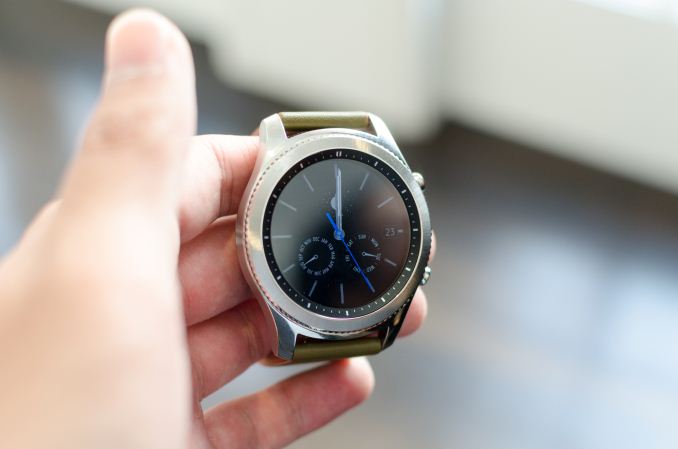
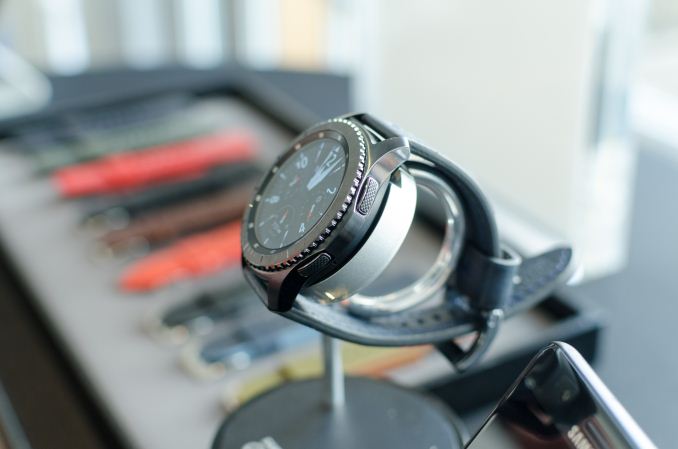
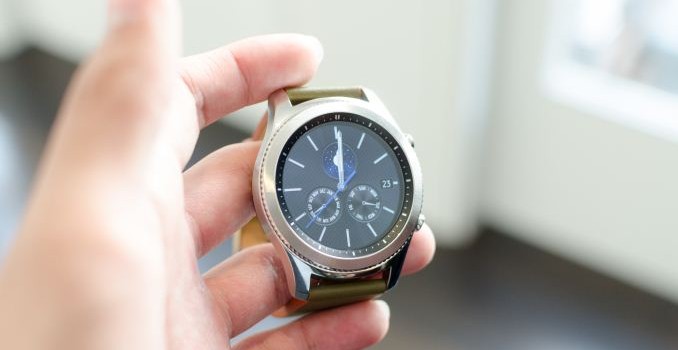
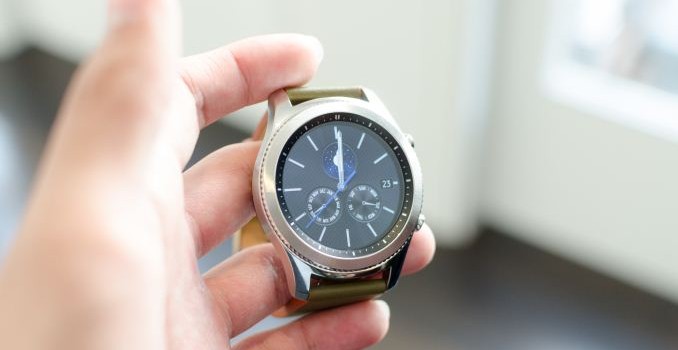
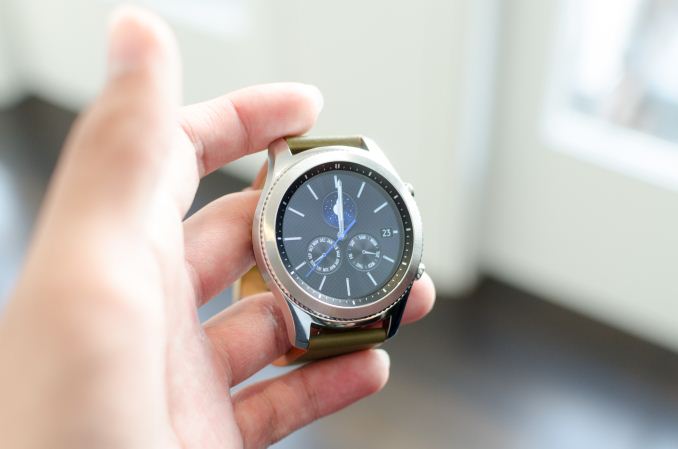
If you already know how the Gear S watches work there’s not much else to talk about, but this is actually my first encounter with the Gear S line of watches in any serious capacity. The Gear S3 in person is large, and basically is the same size as the Moto 360 in its first generation which was fairly large, but those with larger arms won’t have any issues. I haven’t really used a watch that big since then so wearing one again was a bit of a shock for me. The Gear S3 as a result feels a bit awkward and ungainly in size relative to the smaller Gear S2, but if your arms are larger than mine it should fit without issue. The design of the watch itself is impressive though, with delicate detailing that makes both the Frontier and Classic variants of the watch fit in with existing analog watch designs.

Other than this size issue the thickness of the watch is fairly respectable. The sheer size of the watch allows for the circular display to display a reasonable amount of information, and the rotating bezel remains a great way of navigating through the UI with a solid click between each detent. The side home and back buttons are a bit of a mystery when you first use them, but after pressing them once or twice you’re probably going to remember which is which. The watch is also fairly performant compared to something like the Apple Watch which is just slow by any measure. The Gear S3 also includes GPS and GLONASS support which is useful for things like turn by turn navigation and services like Uber. Where the Gear S3 allows for precise location setting and map zoom using the bezel, the Apple Watch version of this application is basically just a button with no real way to know what the pickup point is. I did notice some frame drops here and there but it’s hard to say if this was really the case without much closer examination and it’s likely that this isn’t final software.

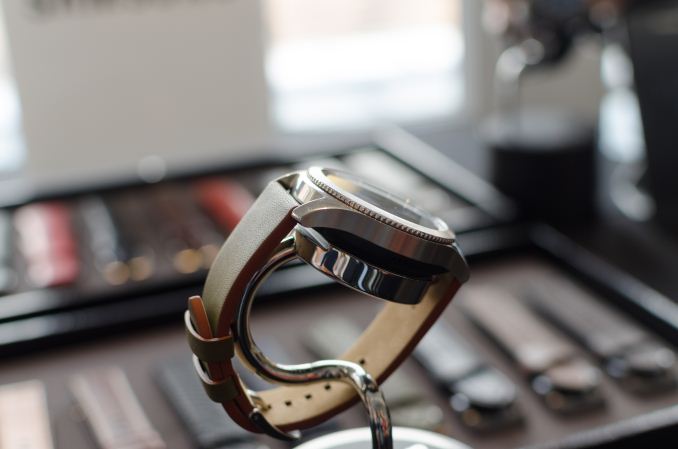
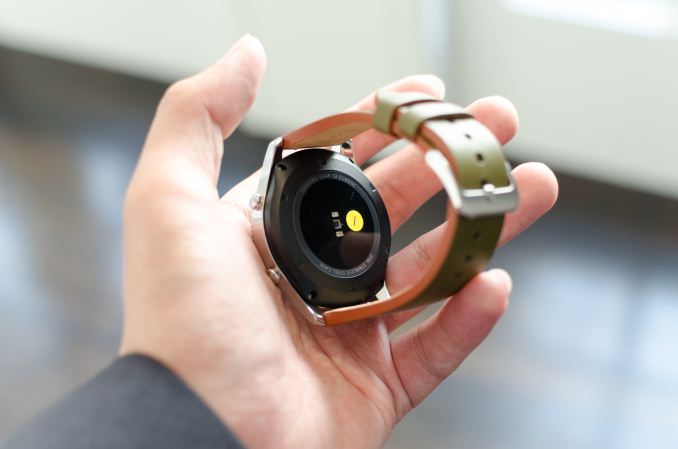
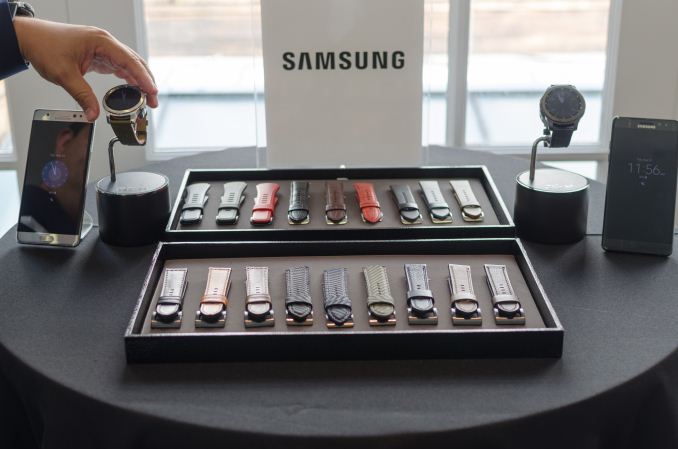
Other than this, the only thing I was really cognizant of was the band design. Generally speaking these are generic 22mm bands, but Samsung by default seems to favor very thick bands for demonstration purposes, and due to the traditional band mechanisms I found the band to be somewhat uncomfortable compared to something like the Milanese Loop bands seen in the Apple Watch. Of course, due to the standardized 22mm design anything is possible for band design, but generally speaking this is something that OEMs should really be taking care of.

The Gear S3 comes in two designs, known as the Classic and Frontier, and of the two designs the Frontier will be the only one that will come with a cellular variant. Both will come with a Bluetooth variant designed to be paired to a phone. LTE variants will only be available through operators, which are currently AT&T, T-Mobile USA, and Verizon.

Hands On With the Samsung Gear S3

Hands On With the Samsung Gear S3

For a while now the smartwatch market has been developing in fits and starts. One of the more interesting developments in this space isn’t Android Wear and watchOS, but Tizen and webOS as both Samsung and LG have turned to their own homegrown OSes in cases where Android Wear wasn’t necessarily the best fit. It seems that OEMs have increasingly decided that it is necessary to control both hardware and software to better differentiate their offerings. In the case of LG we saw the Urbane LTE which necessitated webOS to enable cellular functionality, while Samsung in most cases has been pushing hard on Tizen in just about every case for their smartwatches rather than Android Wear.

  Samsung Gear S3 Classic Samsung Gear S3 Frontier
SoC Exynos 7270 (2x ? @ 1.0GHz)
RAM/NAND 768MB RAM, 4GB NAND
Display 1.3″ Circular 360×360 SAMOLED (278ppi)
Dimensions 46 x 49 x 12.9mm (57g) 46 x 49 x 12.9mm (62g)
Battery 380 mAh (1.46 WHr)
OS Tizen Wearable Platform 2.3.2
Sensors Accelerometer, Gyroscope, Heart Rate, Ambient Light, Barometer
Connectivity 802.11/b/g/n + BT 4.2, NFC, MST, GPS,GLONASS, A-GPS (LTE Only)

With the Gear S3, Samsung is continuing to push ahead with their Tizen smartwatches, and this time the Gear S3 is intended as a sort of companion to the Gear S2 as the Gear S2 is closer to 40 or 42mm in size while the Gear S3 is a 46mm watch with a 360×360 circular AMOLED display which makes for 278 PPI. The display itself is covered by Gorrilla Glass SR+ which is said to improve scratch resistance although sand is probably still going to scratch the cover lens. The big jump in size basically rules out this watch for roughly half of the population, but the jump in size comes with a fairly significant bump in battery. Like the Gear S2, this is IP68 rated but I wouldn’t actually try to use the device in a pool or shower as water damage isn’t covered and the IP68 rating is basically only for distilled still water for a depth beyond 1m for at least 30 minutes, which really isn’t enough to do much other than washing your hands with the watch still on your wrist.

There are also extra features like a speaker, and the Frontier model offers an LTE variant. While the Gear S2 has an Exynos 3250, the Gear S3 also gets a bump up to the Exynos 7270 but both US and Korean PR on-site were unable to answer what differentiated the two as both are 28nm SoCs with dual core 1 GHz CPUs. I would guess that the 7270 gets a bump to Cortex A35 or A53 but is still built on 28nm planar HKMG as it seems that it is difficult to justify the increased costs associated with either 28FDS or 14LPP/14LPC when volumes are not necessarily guaranteed in the same way that a smartphone is. Battery life with 28nm planar is said to be somewhere in the 3-4 day range for this watch, so I’m not sure people will really care all that much anyways. This battery life claim is with the always-on display feature, which is an innovation carried over from the Galaxy S7 and Note7.

In addition to the SoC, size, speaker, and other changes, the Gear S3 adds the ability to use Samsung Pay via either MST or NFC. In both cases it was noted that the phone itself much generate the token, so if you lose connection to a paired phone Samsung Pay will only work for one transaction on the watch. Authentication is done by entering a PIN when you first put on the watch and Samsung Pay is automatically disabled if the watch is removed similar to how Apple Pay works on the Apple Watch. Charging is still wireless. WiFi support is going to be limited by the nature of the device but 802.11b/g/n are supported as well as Bluetooth 4.2.

If you already know how the Gear S watches work there’s not much else to talk about, but this is actually my first encounter with the Gear S line of watches in any serious capacity. The Gear S3 in person is large, and basically is the same size as the Moto 360 in its first generation which was fairly large, but those with larger arms won’t have any issues. I haven’t really used a watch that big since then so wearing one again was a bit of a shock for me. The Gear S3 as a result feels a bit awkward and ungainly in size relative to the smaller Gear S2, but if your arms are larger than mine it should fit without issue. The design of the watch itself is impressive though, with delicate detailing that makes both the Frontier and Classic variants of the watch fit in with existing analog watch designs.

Other than this size issue the thickness of the watch is fairly respectable. The sheer size of the watch allows for the circular display to display a reasonable amount of information, and the rotating bezel remains a great way of navigating through the UI with a solid click between each detent. The side home and back buttons are a bit of a mystery when you first use them, but after pressing them once or twice you’re probably going to remember which is which. The watch is also fairly performant compared to something like the Apple Watch which is just slow by any measure. The Gear S3 also includes GPS and GLONASS support which is useful for things like turn by turn navigation and services like Uber. Where the Gear S3 allows for precise location setting and map zoom using the bezel, the Apple Watch version of this application is basically just a button with no real way to know what the pickup point is. I did notice some frame drops here and there but it’s hard to say if this was really the case without much closer examination and it’s likely that this isn’t final software.

Other than this, the only thing I was really cognizant of was the band design. Generally speaking these are generic 22mm bands, but Samsung by default seems to favor very thick bands for demonstration purposes, and due to the traditional band mechanisms I found the band to be somewhat uncomfortable compared to something like the Milanese Loop bands seen in the Apple Watch. Of course, due to the standardized 22mm design anything is possible for band design, but generally speaking this is something that OEMs should really be taking care of.

The Gear S3 comes in two designs, known as the Classic and Frontier, and of the two designs the Frontier will be the only one that will come with a cellular variant. Both will come with a Bluetooth variant designed to be paired to a phone. LTE variants will only be available through operators, which are currently AT&T, T-Mobile USA, and Verizon.

The LG X Power Review

In the mid-range segment of the smartphone market you really have two types of products. The first are smartphones like the Moto G, which try to provide a good all-around experience. They aren’t really exceptional in any respect, but the hope is that providing a decent experience in every respect will lead to a good overall user experience. The second type of device is one that really sells itself on a single feature. Whether it be a great camera, or a great display, the phone’s identity is based on this one aspect. That doesn’t necessarily mean that the other aspects of the phone are bad, but there may not be the same balance as there is with a good all-around performer.

The smartphone I’m reviewing today falls into that second camp. It’s the LG X Power, a device that really sells itself on being a smartphone that will last far longer than any other. The LG X Power is just one device in LG’s line of smartphones that all focus on being the best at a single thing, with some other devices in the line being named the LG X Style, LG X Mach, LG X Max, and LG X Screen. The LG X Power is the first device I’ve ever reviewed that really ties itself to a single feature, so read on for the full AnandTech review.

The LG X Power Review

In the mid-range segment of the smartphone market you really have two types of products. The first are smartphones like the Moto G, which try to provide a good all-around experience. They aren’t really exceptional in any respect, but the hope is that providing a decent experience in every respect will lead to a good overall user experience. The second type of device is one that really sells itself on a single feature. Whether it be a great camera, or a great display, the phone’s identity is based on this one aspect. That doesn’t necessarily mean that the other aspects of the phone are bad, but there may not be the same balance as there is with a good all-around performer.

The smartphone I’m reviewing today falls into that second camp. It’s the LG X Power, a device that really sells itself on being a smartphone that will last far longer than any other. The LG X Power is just one device in LG’s line of smartphones that all focus on being the best at a single thing, with some other devices in the line being named the LG X Style, LG X Mach, LG X Max, and LG X Screen. The LG X Power is the first device I’ve ever reviewed that really ties itself to a single feature, so read on for the full AnandTech review.