Vik


SilverStone Introduces VT01 Mini-STX Chassis for $35

SilverStone Introduces VT01 Mini-STX Chassis for $35

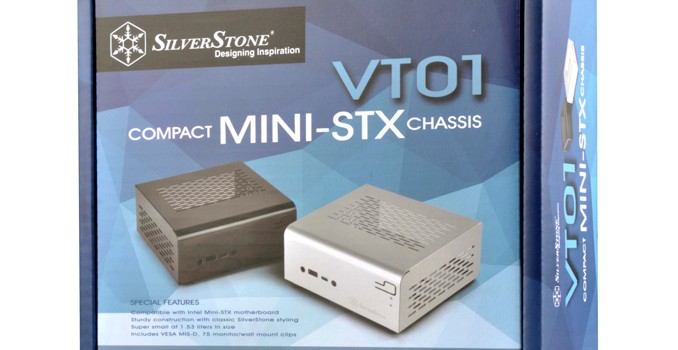
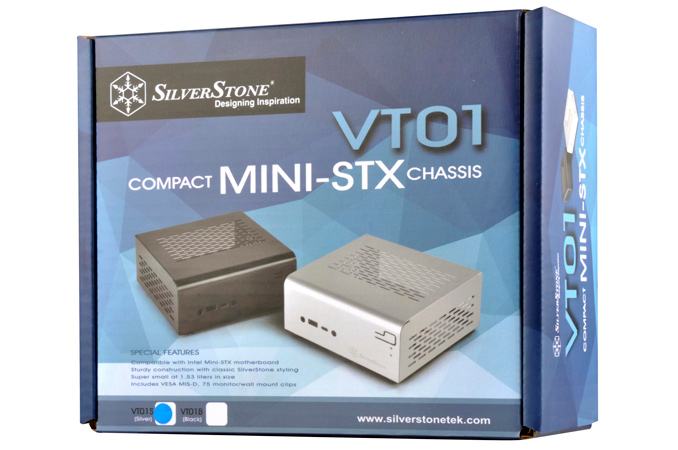
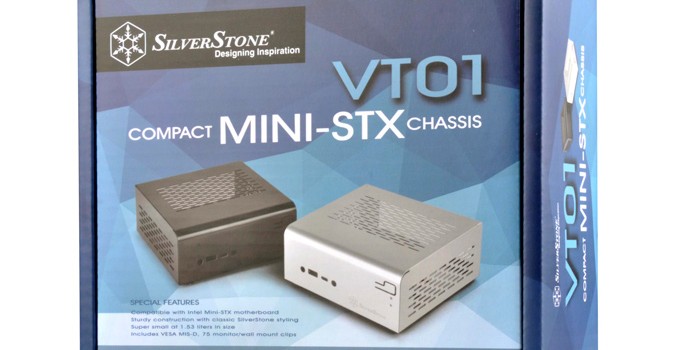
At Computex, SilverStone started to show off its early mini-STX prototype cases. This week it introduced its first commercial product, the VT01. The new PC case inherits classic design elements of SilverStone chassis and despite the fact that Mini-STX is mainly intended for system integrators, SilverStone plans to sell its VT01 in retail as well.

Mini-STX is the latest iteration of form factor for motherboards, decreasing from the 17cm x 17cm of the mini-ITX into a 12.7cm square by ditching the full-length PCIe port as well as moving the power into an external brick for a DC-input. At Computex, especially at vendors such as Silverstone and ECS (who works closely with Intel for the NUC), Mini-STX was being pushed as the platform to have in certain commercial verticals, such as digital signage, where power and adjustability are important. It aims to fit above the Core-M mini-PCs in that regard. 

While the interest for small form-factor PCs is increasing mainly because such systems are small, energy-efficient, and provide good enough level of performance, there is another reason for their growing popularity. Highly-integrated systems are usually pretty inexpensive and have additional flexibility to adjust the socketable CPU in the Mini-STX form-factor. Style, affordability and a certain degree of flexibility is what SilverStone hopes the VT01 is all about.

SilverStone VT01: Quick Specs
Dimensions (W×H×D) 155mm (W) × 152mm (D) × 65mm (H) 
1.53 Liters
Weight 582 grams
Motherboard Form-Factor Mini-STX
PSU Form-Factor External / Power Brick
3.5″ Drive Bays 0
2.5″ Drive Bays 1
System Fan None
CPU Cooler Dimensions Up to 34 mm in height
External Connectors Audio in/out, USB Type-A and USB Type-C

SilverStone’s VT01 chassis is made of 0.8 mm stainless steel and a weight just 582 grams. The case can fit in one Mini-STX motherboard with a cooler that is no higher than 34 mm as well as one 2.5” SSD or HDD. Theoretically, high-performance 34-mm coolers (such as Scythe Kodati) can support CPUs with up to 65 W TDP, hence, VT01-based Mini-STX systems can be quite powerful when paired with the appropriate hardware. The VT01 has one USB Type-A as well as one USB Type-C ports in addition to an audio in and audio out. Besides, the case has VESA mount mechanism. Initially SilverStone plans to offer the silver version of the case, but shortly it also plans to debut the black one. We also saw a blue one at Computex, which may come later.

Since the case is very small, it naturally does not cost a lot: the manufacturer intends to charge $35 for it in the U.S., once it is available in approximately three weeks from now. In Europe, the case will be available late in September.

SilverStone Introduces VT01 Mini-STX Chassis for $35

SilverStone Introduces VT01 Mini-STX Chassis for $35

At Computex, SilverStone started to show off its early mini-STX prototype cases. This week it introduced its first commercial product, the VT01. The new PC case inherits classic design elements of SilverStone chassis and despite the fact that Mini-STX is mainly intended for system integrators, SilverStone plans to sell its VT01 in retail as well.

Mini-STX is the latest iteration of form factor for motherboards, decreasing from the 17cm x 17cm of the mini-ITX into a 12.7cm square by ditching the full-length PCIe port as well as moving the power into an external brick for a DC-input. At Computex, especially at vendors such as Silverstone and ECS (who works closely with Intel for the NUC), Mini-STX was being pushed as the platform to have in certain commercial verticals, such as digital signage, where power and adjustability are important. It aims to fit above the Core-M mini-PCs in that regard. 

While the interest for small form-factor PCs is increasing mainly because such systems are small, energy-efficient, and provide good enough level of performance, there is another reason for their growing popularity. Highly-integrated systems are usually pretty inexpensive and have additional flexibility to adjust the socketable CPU in the Mini-STX form-factor. Style, affordability and a certain degree of flexibility is what SilverStone hopes the VT01 is all about.

SilverStone VT01: Quick Specs
Dimensions (W×H×D) 155mm (W) × 152mm (D) × 65mm (H) 
1.53 Liters
Weight 582 grams
Motherboard Form-Factor Mini-STX
PSU Form-Factor External / Power Brick
3.5″ Drive Bays 0
2.5″ Drive Bays 1
System Fan None
CPU Cooler Dimensions Up to 34 mm in height
External Connectors Audio in/out, USB Type-A and USB Type-C

SilverStone’s VT01 chassis is made of 0.8 mm stainless steel and a weight just 582 grams. The case can fit in one Mini-STX motherboard with a cooler that is no higher than 34 mm as well as one 2.5” SSD or HDD. Theoretically, high-performance 34-mm coolers (such as Scythe Kodati) can support CPUs with up to 65 W TDP, hence, VT01-based Mini-STX systems can be quite powerful when paired with the appropriate hardware. The VT01 has one USB Type-A as well as one USB Type-C ports in addition to an audio in and audio out. Besides, the case has VESA mount mechanism. Initially SilverStone plans to offer the silver version of the case, but shortly it also plans to debut the black one. We also saw a blue one at Computex, which may come later.

Since the case is very small, it naturally does not cost a lot: the manufacturer intends to charge $35 for it in the U.S., once it is available in approximately three weeks from now. In Europe, the case will be available late in September.

Intel’s 140GB Optane 3D XPoint PCIe SSD Spotted at IDF

Intel’s 140GB Optane 3D XPoint PCIe SSD Spotted at IDF

As part of this year’s Intel’s Developer Forum, we had half expected some more insights into the new series of 3D XPoint products that would be hitting the market, either in terms of narrower time frames or more insights into the technology. Last year was the outing of some information, including the ‘Optane’ brand name for the storage version. Unfortunately, new information was thin on the ground and Intel seemed reluctant to speak any further about the technology that what had already been said.

What we do know is that 3D XPoint based products will come in storage flavors first, with DRAM extension parts to follow in the future. This ultimately comes from the fact that storage is easier to implement and enable than DRAM, and the characteristics for storage are not as tight as those for DRAM in terms of break-neck speed, latency or read/write cycles.

For IDF, Optane was ultimately relegated to a side presentation at the same time as other important talks were going on, and we were treated to discussions about ‘software defined cache hierarchy’ whereby a system with an Optane drive can define the memory space as ‘DRAM + Optane’. This means a system with 256GB of DRAM and a 768GB Optane drive can essentially act like a system with ‘1TB’ of DRAM space to fill with a database. The abstraction layer in the software/hypervisor is aimed at brokering the actual interface between DRAM and Optane, but it should be transparent to software. This would enable some database applications to move from ‘partial DRAM and SSD scratch space’ into a full ‘DRAM’ environment, making it easier for programming. Of course, the performance compared to an all-DRAM database is lower, but the point of this is to move databases out of the SSD/HDD environment by making the DRAM space larger.
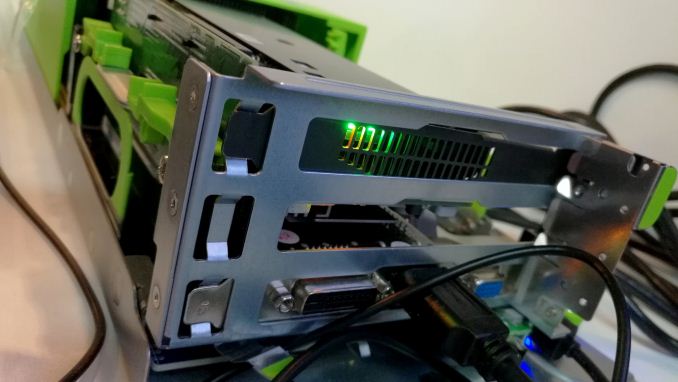
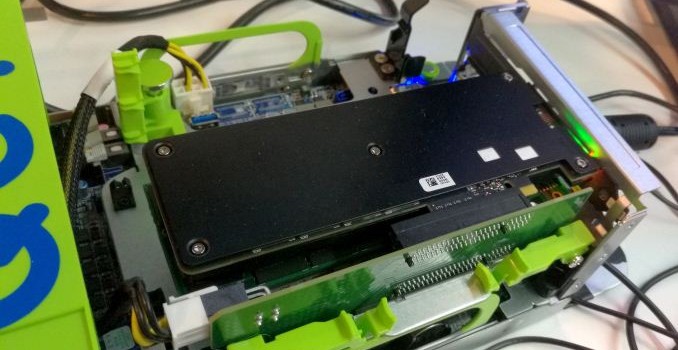
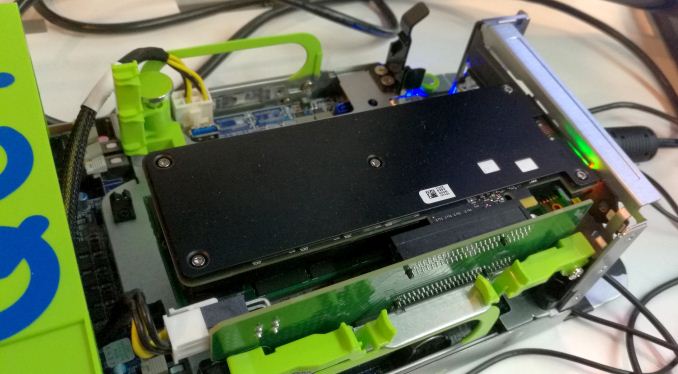
Aside from the talk, there were actually some Optane drives on the show floor, or at least what we were told were Optane. These were PCIe x4 cards with a backplate and a large heatsink, and despite my many requests neither demonstrator would actually take the card out to show what the heatsink looked like. Quite apart from which, neither drive was actually being used – one demonstration was showing a pre-recorded video of a rendering result using Optane, and the other was running a slideshow with results of Optane on RocksDB.
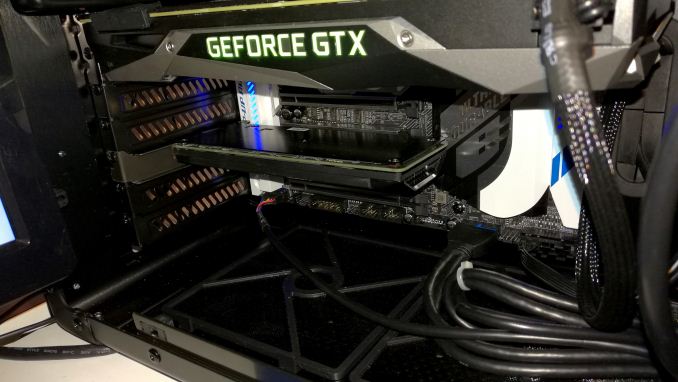
I was told in both cases that these were 140 GB drives, and even though nothing was running I was able to feel the heatsinks – they were fairly warm to the touch, at least 40C if I were to narrow down a number.  One of the demonstrators was able to confirm that Intel has now moved from an FPGA-based controller down to their own ASIC, however it was still in the development phase.
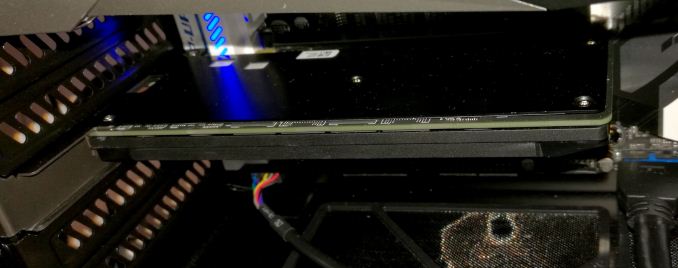

Click through for high resolution

One demo system was showing results from a previous presentation given earlier in the lifespan of Optane: rendering billions of water particles in a scene where most of the scene data was being shuffled from storage to memory and vice versa. In this case, compared to Intel’s enterprise PCIe SSDs, the rendering reduced down from 22hr to ~9hr.

It’s worth noting that we can see some BGA pads on the image above. The pads seem to be in an H shape, and there are several present, indicating that these should be the 3D XPoint ICs. Some of the pads are empty, suggesting that this prototype should be a model that offers a larger size. Given the fact that one of the benefits of 3D XPoint is density, we’re hoping to see a multi-terabyte version at some point in the distant future.
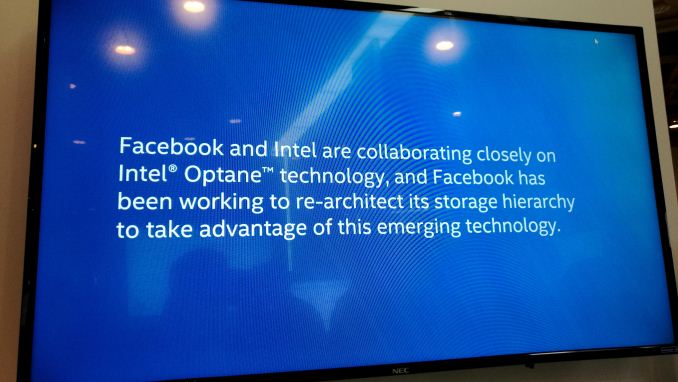
The other demo system was a Quanta / Quanta Cloud Technology system node, featuring two Xeon E5 v4 processors and a pair of PCIe slots on a riser card – the Optane drive was put into one of these slots. Again, it was pretty impossible to see more of the drive aside from its backplate, but the onscreen presentation of RocksDB was fairly interesting, especially as it mentioned optimizing the software for both the hardware and Facebook.
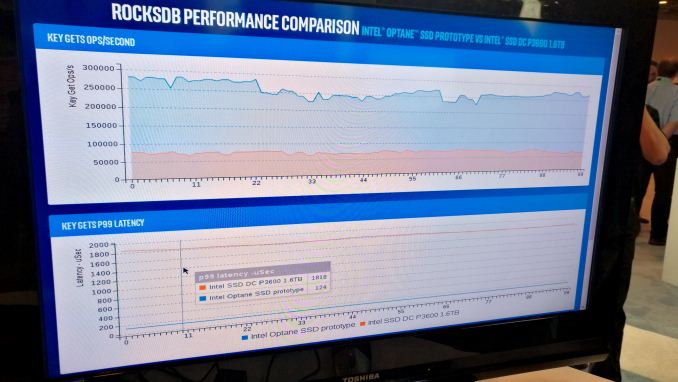
RocksDB is a high-performance key/store database designed for fast embedded storage, used by Facebook, LinkedIn and Yahoo, but the fact that Facebook was directly involved in some testing indicates that at some level the interest in 3D XPoint will brush the big seven cloud computing providers before it hits retail. In the slides on screen, the data showed a 10x reduction in latency as well as a 3x improvement in database GETs. There was a graph plotted showing results over time (not live data), with the latency metrics being pretty impressive. It’s worth noting that there were no results shown for storing key/value data pairs.

Despite these demonstrations on the show floor, we’re still crying out for more information about 3D XPoint, how it exactly work (we have a good idea but would like confirmation), Optane (price, time to market) as well as the generation of DRAM products for enterprise that will follow. With Intel being comparatively low key about this during IDF is a little concerning, and I’m expecting to see/hear more about it during Supercomputing16 in mid-November. For anyone waiting on an Optane drive for consumer, it feels like it won’t be out as soon as you think, especially if the big seven cloud providers are wanting to buy every wafer from the production line for the first few quarters.

More images in the gallery below.