Vik


A Look At QD Vision’s Color IQ And The Philips 276E6 Monitor: Quantum Dots for Wider Color Gamuts

At this year’s CES Josh and I sat down with representatives of QD Vision to discuss their quantum dot display technology, along with where they see the television and monitor market moving in the next few years. QD Vision offers a quantum dot solution for displays, which is branded as Color IQ. The interesting proposition that QD Vision brings to the table with their technology is that it’s not just usable in high end displays, but also in less expensive ones where it can be used to bring features that were traditionally limited to high end displays down to a lower price point.

After our meeting with QD Vision, we were informed that Philips would be launching a new line of monitors that use QD Vision’s Color IQ technology. Given that these are some of the first computer monitors to come to market with quantum dot technology, I was quite interested in taking a look at it. The monitor in question is the Philips 276E6 monitor, which has a 27″ panel and claims to cover 99% of the Adobe RGB color gamut. Read on for more info about Color IQ, and to find out how well the Philips 276E6 performs.

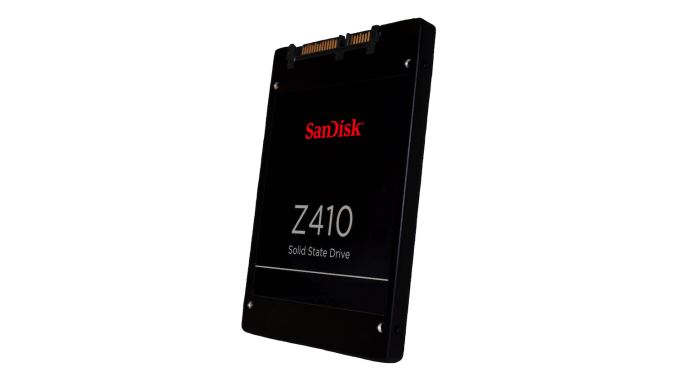
SanDisk Announces Z410 Client SSD

SanDisk Announces Z410 Client SSD

SanDisk has introduced a new low-end drive to their line of client SSDs targeted at business and OEM customers. The Z410 is positioned closely to Z400s but is not a direct replacement. Instead, the Z410 focuses on offering just the most popular capacities for mainstream PC usage while the Z400s continues to serve other markets with mSATA and M.2 versions and capacities as small as 32GB.

First announced almost a year ago as the first 15nm TLC SSD, the Z400s sought to cut costs in order to break into new parts of the embedded and client PC markets. The Silicon Motion SM2246XT controller it uses is a DRAM-less two or four channel design that limits potential performance and capacity. The SM2246XT also lacks encryption support and LDPC error correction.

The SanDisk Z410 abandons the mSATA and M.2 form factors to focus specifically on 2.5″ with capacities from 120GB to 480GB. The only significant performance difference from the Z400s is a substantial increase in sequential write speed, while sequential read speeds are rated slightly lower and random read and write specifications are similar. The Z410 does benefit from a controller upgrade that allows for LDPC error correction and SLC caching, but it seems the latter’s impact on write amplification has kept the write endurance ratings from increasing substantially. The three year warranty period on the Z410 is also shorter than the five years offered for the Z400s.

SanDisk OEM Client SSD Comparison
Drive X400 Z410 Z400s
Capacities 128GB, 256GB, 512GB, 1TB 120GB, 240GB, 480GB 32GB, 64GB, 128GB, 256GB
Controller Marvell 88SS1074 ? Silicon Motion SM2246XT
Sequential Read 545 MB/s 535 MB/s 546 MB/s
Sequential Write 520 MB/s 445 MB/s 342 MB/s
Random Read IOPS 95k 37k 37k
Random Write IOPS 75k 68k 69k
Form Factors 2.5″, M.2 2280 2.5″ 2.5″, mSATA, M.2 2242, M.2 2280
Encryption TCG Opal (optional) None None
Endurance 72-320 TBW 40-120TBW 20-72 TBW
Warranty 5 years 3 years 5 years

The introduction of the Z410 puts SanDisk in the unusual position of having three tiers of TLC NAND-based SATA SSDs. While their consumer-oriented product line still includes the MLC-based Extreme Pro, SanDisk’s business/OEM line tops out with the TLC-based X400. The X400 distinguishes itself with clearly higher performance and endurance and the availability of a 1TB capacity, but the Z400s and Z410 are close enough to cause some confusion. The Z410 will probably end up displacing the 128GB and 256GB 2.5″ Z400s while the rest of the Z400s line sticks around for the less competitive niches.

SanDisk Announces Z410 Client SSD

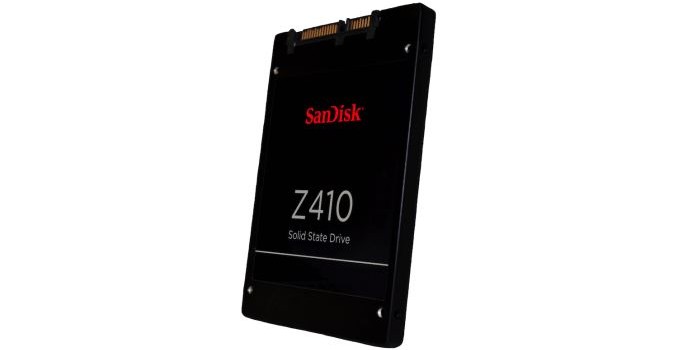
SanDisk Announces Z410 Client SSD

SanDisk has introduced a new low-end drive to their line of client SSDs targeted at business and OEM customers. The Z410 is positioned closely to Z400s but is not a direct replacement. Instead, the Z410 focuses on offering just the most popular capacities for mainstream PC usage while the Z400s continues to serve other markets with mSATA and M.2 versions and capacities as small as 32GB.

First announced almost a year ago as the first 15nm TLC SSD, the Z400s sought to cut costs in order to break into new parts of the embedded and client PC markets. The Silicon Motion SM2246XT controller it uses is a DRAM-less two or four channel design that limits potential performance and capacity. The SM2246XT also lacks encryption support and LDPC error correction.

The SanDisk Z410 abandons the mSATA and M.2 form factors to focus specifically on 2.5″ with capacities from 120GB to 480GB. The only significant performance difference from the Z400s is a substantial increase in sequential write speed, while sequential read speeds are rated slightly lower and random read and write specifications are similar. The Z410 does benefit from a controller upgrade that allows for LDPC error correction and SLC caching, but it seems the latter’s impact on write amplification has kept the write endurance ratings from increasing substantially. The three year warranty period on the Z410 is also shorter than the five years offered for the Z400s.

SanDisk OEM Client SSD Comparison
Drive X400 Z410 Z400s
Capacities 128GB, 256GB, 512GB, 1TB 120GB, 240GB, 480GB 32GB, 64GB, 128GB, 256GB
Controller Marvell 88SS1074 ? Silicon Motion SM2246XT
Sequential Read 545 MB/s 535 MB/s 546 MB/s
Sequential Write 520 MB/s 445 MB/s 342 MB/s
Random Read IOPS 95k 37k 37k
Random Write IOPS 75k 68k 69k
Form Factors 2.5″, M.2 2280 2.5″ 2.5″, mSATA, M.2 2242, M.2 2280
Encryption TCG Opal (optional) None None
Endurance 72-320 TBW 40-120TBW 20-72 TBW
Warranty 5 years 3 years 5 years

The introduction of the Z410 puts SanDisk in the unusual position of having three tiers of TLC NAND-based SATA SSDs. While their consumer-oriented product line still includes the MLC-based Extreme Pro, SanDisk’s business/OEM line tops out with the TLC-based X400. The X400 distinguishes itself with clearly higher performance and endurance and the availability of a 1TB capacity, but the Z400s and Z410 are close enough to cause some confusion. The Z410 will probably end up displacing the 128GB and 256GB 2.5″ Z400s while the rest of the Z400s line sticks around for the less competitive niches.
MSI Cubi 2 Plus vPro Skylake mini-STX PC Review

The desktop PC market has been subject to many challenges over the last few years. However, the miniaturization trend (including the introduction of the ultra-compact form factor – UCFF – NUCs) has provided some bright spots. The recent introduction o…

MSI Cubi 2 Plus vPro Skylake mini-STX PC Review

The desktop PC market has been subject to many challenges over the last few years. However, the miniaturization trend (including the introduction of the ultra-compact form factor – UCFF – NUCs) has provided some bright spots. The recent introduction o…