Vik


Microsoft Reveals Additional Details About HoloLens and Begins to Take Pre-Orders
Microsoft Reveals Additional Details About HoloLens and Begins to Take Pre-Orders

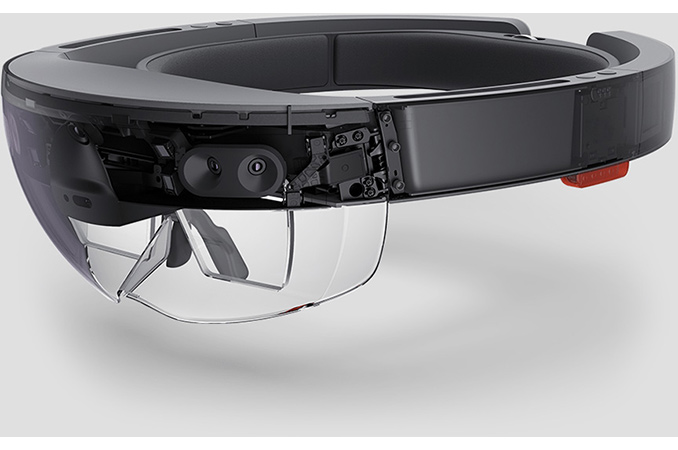
Microsoft this week began to accept applications for pre-orders for its HoloLens augmented reality device. Right now, the company offers HoloLens only to software developers looking to build applications for this new environment.Interested developers will have to pay $3000 per unit for this development kit, which is a hefty sum. Moreover, additional technical specifications of HoloLens revealed by Microsoft give us a bit of insight into what is inside this augmented reality wearable.

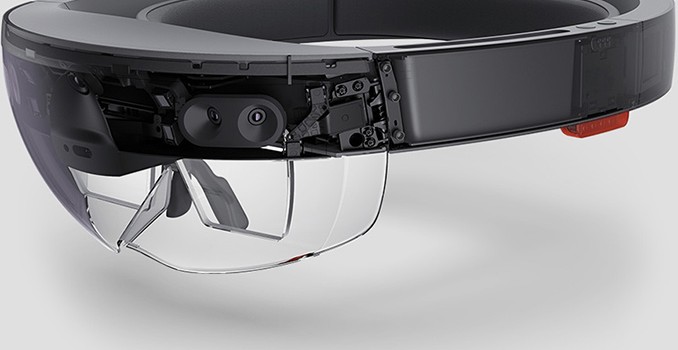
The Microsoft HoloLens is custom-built wearable personal computer running Windows 10 operating system. The HoloLens is based on an undisclosed 32-bit Intel processor and a custom-designed Microsoft holographic processing unit (HPU) that processes data from multiple sensors. In fact, the list of HoloLens’ sensors is very impressive: the device features one 2 MP video camera, an inertial measurement unit (which means, a set of accelerometers, gyroscopes and maybe even a magnetometer), one depth camera, four environment understanding cameras, four microphones, an ambient light sensor as well as mixed reality capture IC. Since the mixed-reality headset does not use any markers or extra cameras to track movement that are located outside of itself, a sophisticated set of sensors inside it is absolutely required.The HoloLens can track gaze, understand gestures and voice commands thanks to its sensors and underlying software.
The device is equipped with 2 GB of RAM (1GB for the processor and 1GB for the HPU) as well as 64 GB of NAND flash storage. The HoloLens can connect to the Internet or other devices using Wi-Fi 802.11ac and Bluetooth 4.1 LE wireless technologies. In addition, the device is equipped with a Micro-USB 2.0 port, a 3.5 mm audio jack and a surround sound system. The HoloLens can operate for two or three hours on one charge, which is not a lot, but its unlikely you would be wearing this around for a work day. It can also charge while in use, tethering it somewhat but allowing developers to test applications on it as they work.
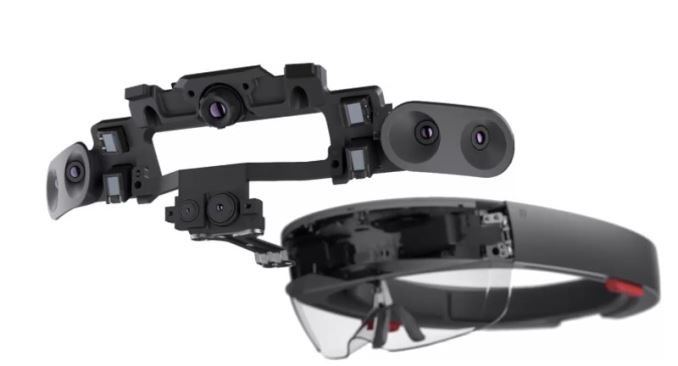
The AR headset from Microsoft uses its advanced sensors to track the position and orientation of the user’s head relative to their surroundings. The system attempts to predict position where the user’s head will be in at the exact moment and applies holograms accordingly. Microsoft makes a number of recommendations to software makers how to ensure that the hologram is added to the right place at the right time, but the system constantly monitors not only data from sensors, but also adjusts the length of the rendering pipeline.

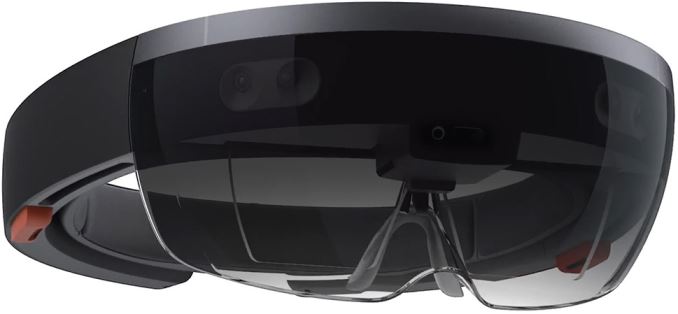
The HoloLens uses two see-through holographic lenses (each of which consists of three layers — red, green and blue) with an optical projection system to generate multi-dimensional full-color holograms. Maximum resolution that the HoloLens can render is 1268×720 (per eye), which is why actual holograms have a limited field of view. The holographic content is put at two meters distance from the viewer because Microsoft believes that this is optimal for eyes and will not cause any strain. Since augmented reality is not about maximum resolution, Microsoft puts a lot of focus on quality of each hologram because it is crucial for its usability. According the company, the lenses support holographic density of up to 2.5K radiants (the more radiants and light points there are, the brighter and richer the hologram). But while the quality is very important for AR, to ensure smooth framerate (at least 60 fps) Microsoft suggests to lower resolution of images to 634×360 in certain cases.
Because Microsoft’s HoloLens is a fully-fledged wearable PC, it has its own limitations. The CPU is certainly going to be low powered to allow it to be used mounted on a wearable, possibly Quark or Atom, but Microsoft is not disclosing this yet. Since storage of the wearable PC cannot be upgraded, Microsoft caps maximum allocated size for one application to 900 MB. Finally, the software giant warns that because certain applications may require too much processing power, the system-on-chip of the HoloLens can overheat. To prevent that, HoloLens will shut down the application if temperatures hit certain levels. Consequently, even if a developer managed to create something that uses all the resources of HoloLens, it is not guaranteed that their app will actually work in all circumstances, at least with this developer kit.

So far, Microsoft has developed a limited list of applications for HoloLens to show off capabilities of the AR to developers. The list of productivity apps includes Skype, HoloStudio and Actiongram, whereas the list of entertainment programs includes HoloTour, RoboRaid, Young Conker and Fragments. With only a limited number of programs that support holographic experience, it makes sense that this is a developer kit and not a public release.

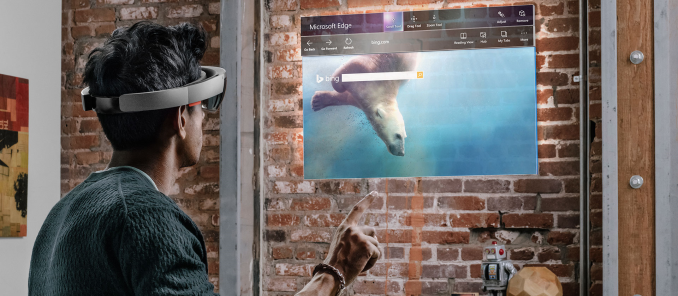
Also, the original demos of Hololens used what Microsoft called an “Air Tap” to do selections. This was not that difficult to pick up on, but to make this easier they will be offering a Bluetooth connected hand held device to let you do the clicking with that, rather than having to do the gesture. Since the Hololens supports Windows 10 and Bluetooth, there is likely opportunity here for more peripherals to do other tasks as well.

The Microsoft HoloLens Development Edition will only be available to software developers in the United States and Canada initially. The developers have to participate in the Windows Insider program. To buy the HoloLens, programmers will have to share their ideas regarding their applications with Microsoft. If the software giant likes the idea, its author will get a chance to buy the AR device. The software giant plans to ship the first batch of HoloLenses to chosen developers on March 30, 2016. When additional devices are manufactured, Microsoft will invite more applicants to purchase to the HoloLens. Interested developers may apply for a Microsoft HoloLens device here.
Sources: Microsoft, PC World.

The FSP Hydro G 750W Power Supply Review

Today we are taking a look at the other premium PSU series from FSP, the Hydro G family. Unlike the Aurum PT that we reviewed some time ago, the Hydro G is 80Plus Gold certified, but the company still boasts high performance figures and the PSU does h…

The FSP Hydro G 750W Power Supply Review

Today we are taking a look at the other premium PSU series from FSP, the Hydro G family. Unlike the Aurum PT that we reviewed some time ago, the Hydro G is 80Plus Gold certified, but the company still boasts high performance figures and the PSU does h…

ZOTAC Announces SONIX PCIe SSD Price & Availability

ZOTAC Announces SONIX PCIe SSD Price & Availability

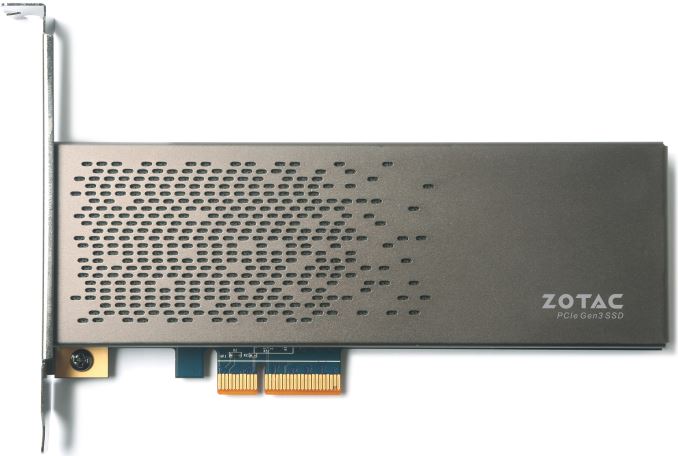
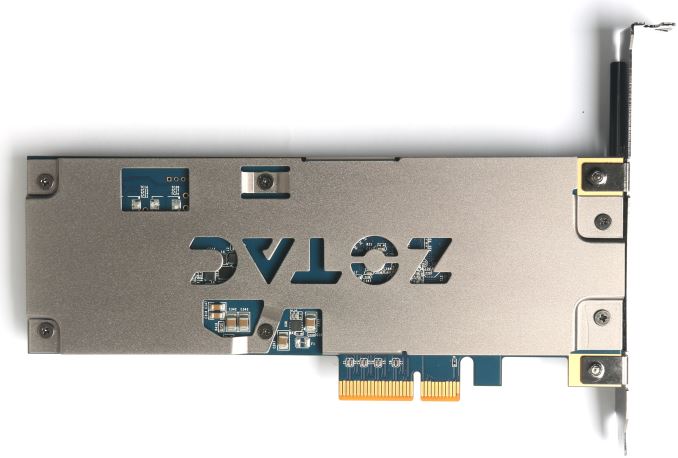
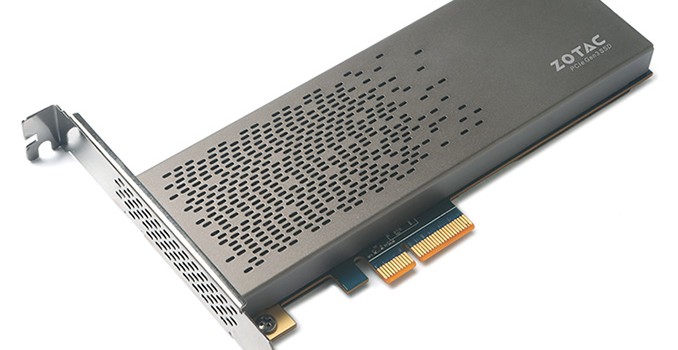
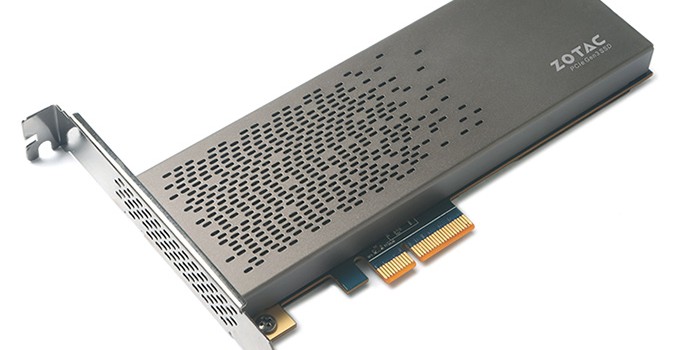
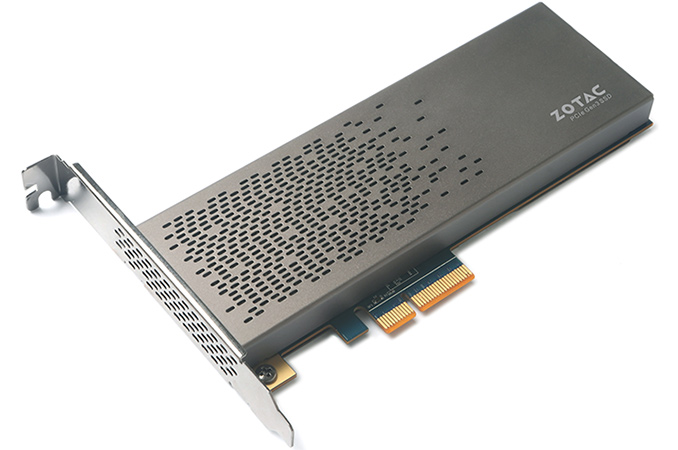
ZOTAC has formally announced its PCIe SONIX SSD, which was first demonstrated at CES earlier this year. Confirming the final specifications and design, the company said that the new drive would be available in the middle of this month at a price-point comparable to that of other PCIe-based SSDs. The availability of the ZOTAC SONIX will mark the arrival of a new breed of high-performance PCIe SSDs based on the Phison PS5007-E7 controller.

The final version of the ZOTAC SONIX will be faster than the preliminary version of the SSD demonstrated at CES, with the shipping version rated for sequential read performance of 2600 MB/s and sequential write performance of up to 1300 MB/s. The initial flavor of the ZOTAC SONIX SSD will offer 480 GB capacity, will be equipped with 512 MB of DDR3 DRAM cache and will come in half-length half-height PCI Express 3.0 x4 card form-factor. The drive will consume 5.57W when performing read operations, 7.27W while writing and 0.5W in idle mode, according to the supplier.

ZOTAC SONIX PCIe SSD Specifications
  480 GB
Controller Phison PS5007-E7
NAND Toshiba MLC
DRAM Cache 512 MB DDR3 SDRAM
Sequential Read 2600 MB/s
Sequential Write 1300 MB/s
Active Power (Read/Write) 5.57 W/7.27 W
Idle Power 0.5 W
Encryption AES-256
MTBF 2,000,000 hours
Interface and Form-Factor PCIe 3.0 x4 HHHL card

The ZOTAC SONIX SSD will be among the first solid-state drives to use Phison’s PS5007-E7 controller demonstrated in mid-2015. The chip fully supports NVMe 1.2 protocol, error correction with 120-bit/2KB BCH code, NVMe L1.2 power saving mode, end-to-end data path protection, advanced global wear-leveling, an AES-256 engine and so on. The PS5007-E7 has eight NAND flash transfer channels and can perform up to 300K random read IOPS (input/output operations per second) as well as 200K random write IOPS. As we reported back in January, the PS5007-E7 had been finalized and the final firmware was due in February.

As expected, the ZOTAC SONIX drive will use Toshiba’s multi-level cell (MLC) NAND flash memory and will be positioned as ZOTAC’s premium offering. The product will hit the market in mid-March at the price of $369.99, which is comparable to that of Kingston’s HyperX Predator M.2 480 GB SSD ($364.99) as well as Samsung’s 950 Pro M.2 512 GB SSD ($327.99).

It should be noted that Phison not only develops controllers, but sells packages consisting of a controller, NAND flash memory, firmware and even production services. The majority of Phison-based SSDs are made by a contract manufacturer under supervision of the controller developer. While the approach somewhat constraints innovation of SSD suppliers because drives based on the same Phison controller offer similar feature-set and performance, it also guarantees relatively high quality, competitive pricing and broad availability.

If ZOTAC starts to ship its SONIX PCIe SSD in mid-March, other partners of Phison, including Corsair, Kingston, Mushkin, Patriot, PNY and other will likely follow shortly. As a result, the market should have a significant number of PCIe 3.0 x4 and M.2 SSDs with up to 2600 MB/s sequential read performance based on MLC NAND memory. Competition between various suppliers will naturally affect prices of actual products, which is good for the end-user. Keeping in mind that Samsung’s 950 Pro M.2 512 GB SSD already costs $328, it looks like prices of high-end PCIe NVMe SSDs this year will get very competitive. Moreover, when and if new SSDs based on SandForce’s SF3500 controller arrive, things will get even more intense.

ZOTAC Announces SONIX PCIe SSD Price & Availability

ZOTAC Announces SONIX PCIe SSD Price & Availability

ZOTAC has formally announced its PCIe SONIX SSD, which was first demonstrated at CES earlier this year. Confirming the final specifications and design, the company said that the new drive would be available in the middle of this month at a price-point comparable to that of other PCIe-based SSDs. The availability of the ZOTAC SONIX will mark the arrival of a new breed of high-performance PCIe SSDs based on the Phison PS5007-E7 controller.

The final version of the ZOTAC SONIX will be faster than the preliminary version of the SSD demonstrated at CES, with the shipping version rated for sequential read performance of 2600 MB/s and sequential write performance of up to 1300 MB/s. The initial flavor of the ZOTAC SONIX SSD will offer 480 GB capacity, will be equipped with 512 MB of DDR3 DRAM cache and will come in half-length half-height PCI Express 3.0 x4 card form-factor. The drive will consume 5.57W when performing read operations, 7.27W while writing and 0.5W in idle mode, according to the supplier.

ZOTAC SONIX PCIe SSD Specifications
  480 GB
Controller Phison PS5007-E7
NAND Toshiba MLC
DRAM Cache 512 MB DDR3 SDRAM
Sequential Read 2600 MB/s
Sequential Write 1300 MB/s
Active Power (Read/Write) 5.57 W/7.27 W
Idle Power 0.5 W
Encryption AES-256
MTBF 2,000,000 hours
Interface and Form-Factor PCIe 3.0 x4 HHHL card

The ZOTAC SONIX SSD will be among the first solid-state drives to use Phison’s PS5007-E7 controller demonstrated in mid-2015. The chip fully supports NVMe 1.2 protocol, error correction with 120-bit/2KB BCH code, NVMe L1.2 power saving mode, end-to-end data path protection, advanced global wear-leveling, an AES-256 engine and so on. The PS5007-E7 has eight NAND flash transfer channels and can perform up to 300K random read IOPS (input/output operations per second) as well as 200K random write IOPS. As we reported back in January, the PS5007-E7 had been finalized and the final firmware was due in February.

As expected, the ZOTAC SONIX drive will use Toshiba’s multi-level cell (MLC) NAND flash memory and will be positioned as ZOTAC’s premium offering. The product will hit the market in mid-March at the price of $369.99, which is comparable to that of Kingston’s HyperX Predator M.2 480 GB SSD ($364.99) as well as Samsung’s 950 Pro M.2 512 GB SSD ($327.99).

It should be noted that Phison not only develops controllers, but sells packages consisting of a controller, NAND flash memory, firmware and even production services. The majority of Phison-based SSDs are made by a contract manufacturer under supervision of the controller developer. While the approach somewhat constraints innovation of SSD suppliers because drives based on the same Phison controller offer similar feature-set and performance, it also guarantees relatively high quality, competitive pricing and broad availability.

If ZOTAC starts to ship its SONIX PCIe SSD in mid-March, other partners of Phison, including Corsair, Kingston, Mushkin, Patriot, PNY and other will likely follow shortly. As a result, the market should have a significant number of PCIe 3.0 x4 and M.2 SSDs with up to 2600 MB/s sequential read performance based on MLC NAND memory. Competition between various suppliers will naturally affect prices of actual products, which is good for the end-user. Keeping in mind that Samsung’s 950 Pro M.2 512 GB SSD already costs $328, it looks like prices of high-end PCIe NVMe SSDs this year will get very competitive. Moreover, when and if new SSDs based on SandForce’s SF3500 controller arrive, things will get even more intense.