Vik


ASUS Launches 970 Pro Gaming/Aura Motherboard: USB 3.1 and M.2 to AMD FX Platform
ASUS Launches 970 Pro Gaming/Aura Motherboard: USB 3.1 and M.2 to AMD FX Platform

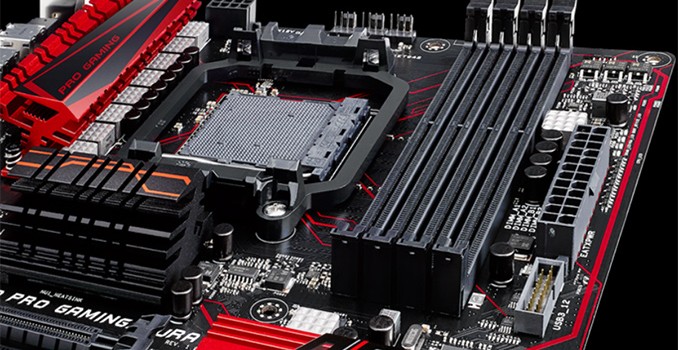
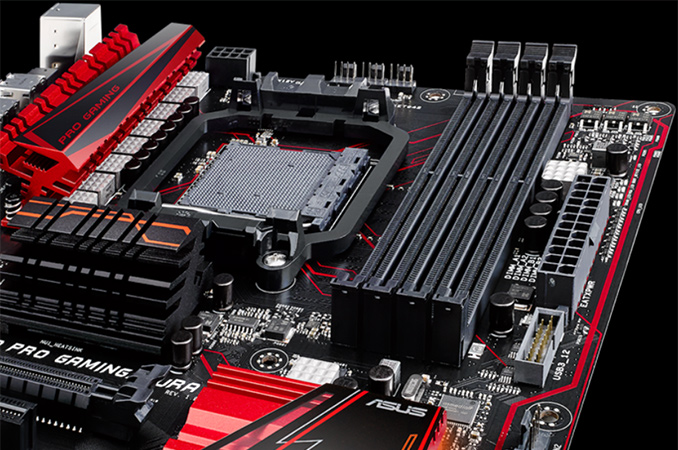
ASUS has introduced its latest motherboard for AMD FX microprocessors that brings up-to-date features to the platform. The ASUS 970 Pro Gaming/Aura belongs to a new class of AMD FX (socket AM3+) mainboards that support USB 3.1 peripherals as well as M.2 solid-state drives. In addition, the platform is also equipped with various gaming-oriented features available on the latest platforms from the company.

The ASUS 970 Pro Gaming/Aura is based on the AMD 970 + SB950 chipset, which is not AMD’s top-of-the-range core-logic for the FX processors, but which is pretty affordable for mainstream motherboards. The AMD 970 did not officially support any multi-GPU technology when it was released five years ago. AMD has removed this limitation since then and modern AMD 970-based mainboards, such as the 970 Pro Gaming/Aura, can run more than one video card. The motherboard has two PCI Express slots for graphics cards operating in PCIe 2.0 x8 mode and officially supporting both AMD CrossFire and NVIDIA SLI. In addition, the new mainboard features two PCIe 2.0 x1 and two PCI slots for add-in cards.

AMD 900 Series Chipsets
  990FX + SB950 990X + SB950 970 + SB950
Code Name RD990 RD980 RX980
Released Q2 2011 Q2 2011 Q2 2011
PCIe Lanes 42 PCIe 2.0 lanes 26 PCIe 2.0 lanes 26 PCIe 2.0 lanes
CrossFire x16 + x16
x8 + x8 + x8 + x8
x8 + x8 x16 + x4
x8 + x8 + x4
SLI x16 + x16
x16 + x8 + x8
x8 + x8 + x8 + x8
x8 + x8 x8 + x8
NB TDP 19.6W 14W 13.6W
HyperTransport (MHz) 2600 2600 2400
SATA 6 Gb/s 6 6 6
RAID 0, 1, 5, 10 0, 1, 5, 10 0, 1, 5, 10
USB 2.0 14 14 14
PCI Yes Yes Yes
SB950 TDP 6W 6W 6W

The ASUS 970 Pro Gaming/Aura supports all AMD FX processors in AM3+ form-factor with up to 125W TDP as well as their predecessors, such as the Phenom II, the Athlon II and the Sempron 100-series chips (but advised against using the 220W FX-9000 series). The new motherboard has upgraded 8-phase power delivery and similar to other ASUS designs the 970 Pro Gaming/Aura uses the company’s Digi+ custom power controller. The motherboard features four memory slots and supports up to 32 GB of DDR3-2133 memory.
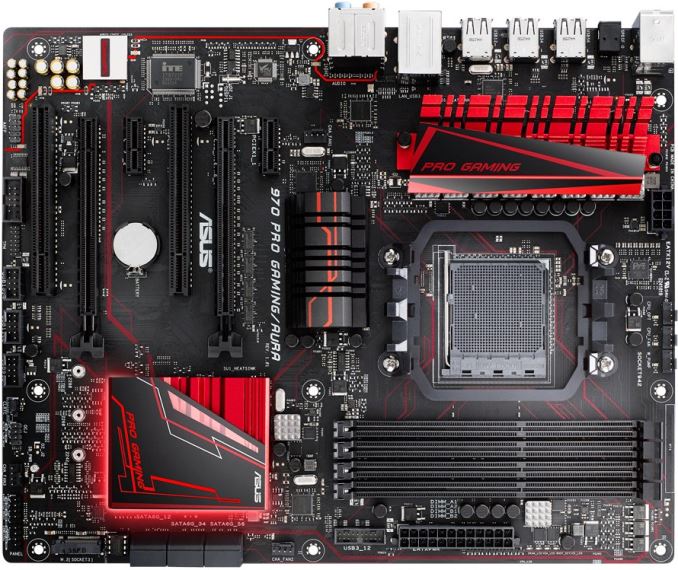
The 970 Pro Gaming/Aura comes with six SATA 6 Gb/s ports with RAID 0, 1, 5 and 10 support as well as an M.2 slot for SSDs (2242/2260/2280 form-factors are supported) that operates in PCIe 2.0 x4 mode and supports data-rates of up to 20 GT/s, making it suitable for drives such as the Samsung XP941. The UEFI/BIOS of the motherboard fully supports NVMe protocol and therefore the platform can take advantage of modern SSDs, such as Samsung 950 Pro. However it is unclear whether the M.2 slot uses PCIe lanes from the AMD970 or the SB950 controller. The platform also comes bundled with RAMcache software to speed up launches of frequently used applications.

Meanwhile for USB functionality the motherboard is equipped with ASMedia’s ASM1142 USB 3.1 controller that enables two USB 3.1 type-A connectors on the rear panel. In addition, the mainboard supports two USB 3.0 ports (also using an ASMedia controller) and 14 USB 2.0 ports.
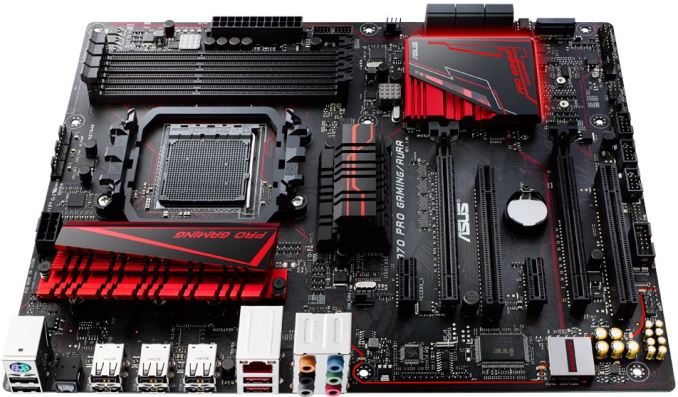
For other functionality we get Intel’s I211-AT Gigabit Ethernet controller with the GameFirst software for network traffic prioritization as well as LANGuard ESD and power surge protection. Audio comes through ASUS’ SupremeFX, their upgraded Realtek ALC1150 codec solution, with EM shielding, PCB separation of analog/digital signal and support for up to 300 ohms headphones.

The motherboard is designed for low-cost gaming systems, though that hasn’t stopped ASUS from adding a set of overclocking features into its BIOS and the components necessary to drive it. The aim is to get a full system price that is competitive. For example, the AMD FX-8320 featuring four Piledriver modules and unlocked multiplier can be purchased for $145, which is comparable to the price of Intel’s dual-core Core i3 processors. Once overclocked, the FX-8320 chip can offer rather decent performance for its price (see our results of the FX-8370E overclocked to 4.8 GHz here). The mainboard also supports AMD CrossFireX, NVIDIA SLI, as well as USB 3.1 and M.2/NVMe, which should attract attention of people seeking for the latest technologies and an easy upgrade path (at least, for graphics).

As an added flair for users that are interested, the ASUS 970 Pro Gaming/Aura also features Aura RGB LED on the south bridge, which can produce various lighting effects, such as pulsating, strobing, fading and so on. The motherboard is clearly not the first affordable platform to offer LED lighting, but ASUS just had to include the technology into the package simply because a number of competing offerings come with LEDs. They can also be switched off if needed.
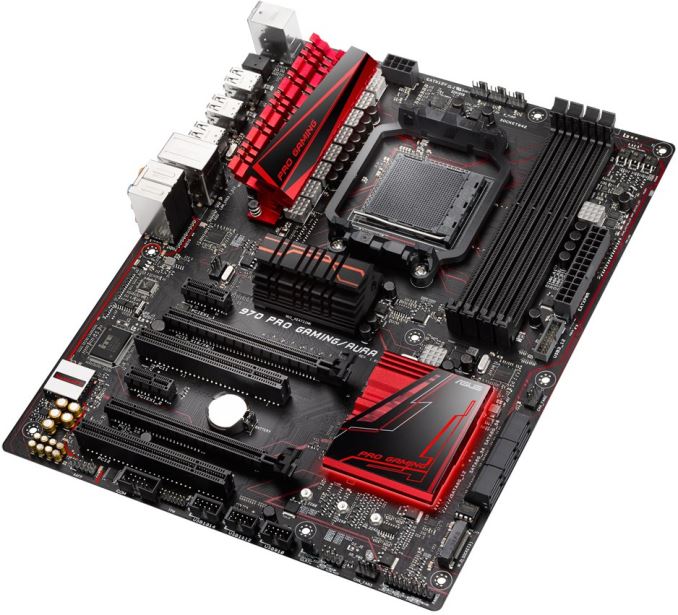
The ASUS 970 Pro Gaming/Aura has not yet reached retailers, however Newegg already has a listing up for $119.99.


AMD Launches Excavator on Desktop: The 65W Athlon X4 845 for $70

AMD Launches Excavator on Desktop: The 65W Athlon X4 845 for $70

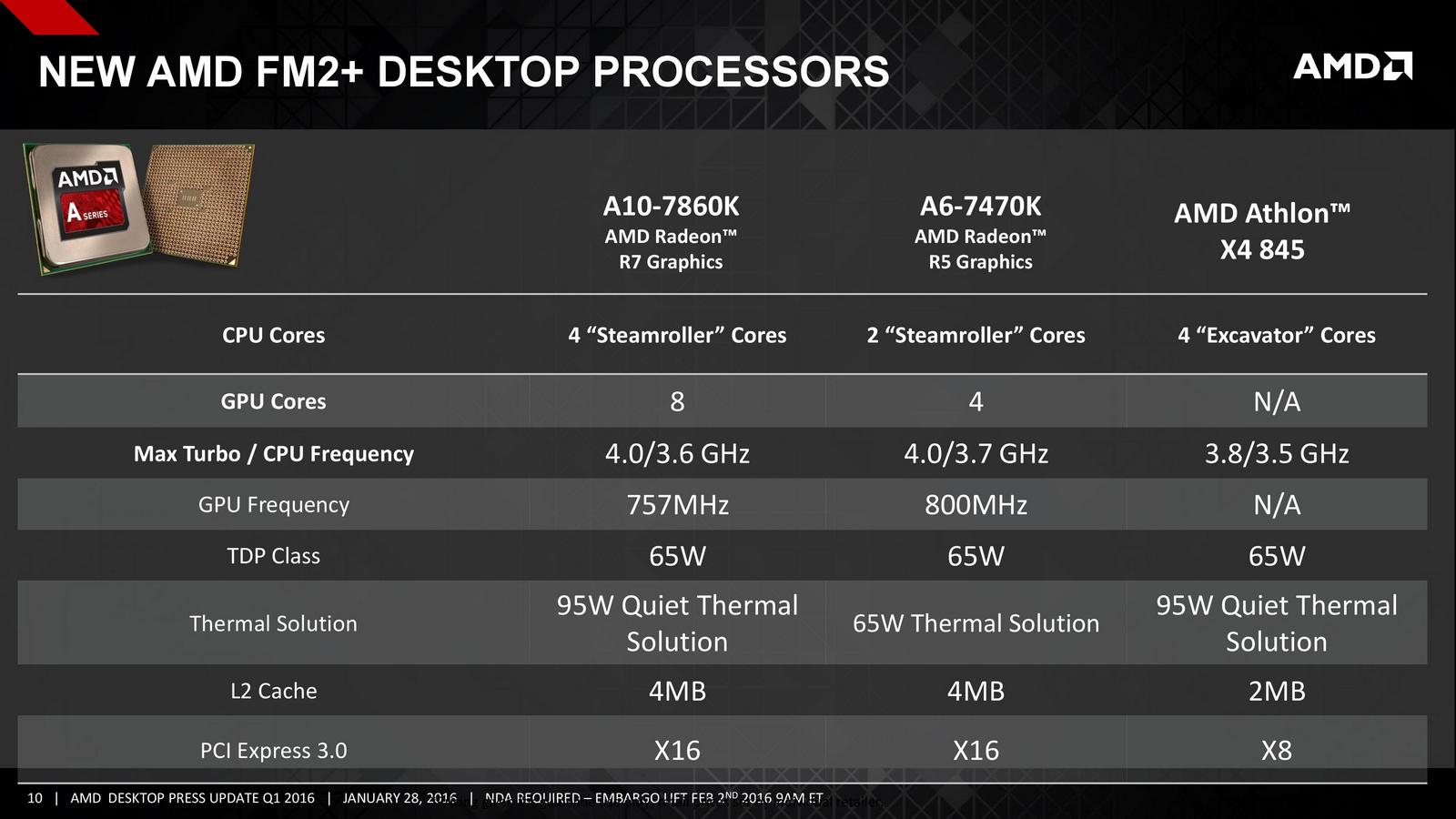
As part of today’s launch AMD released two new Kaveri based APUs as part of the FM2+ platform, the A10-7860K and the A6-7470K, as well as clarifying the way the new 125W Wraith stock cooler would be distributed at this time. What went under the radar almost was the release of a third part, the Athlon X4 845 CPU, featuring no integrated graphics but AMD’s newest architecture instead.

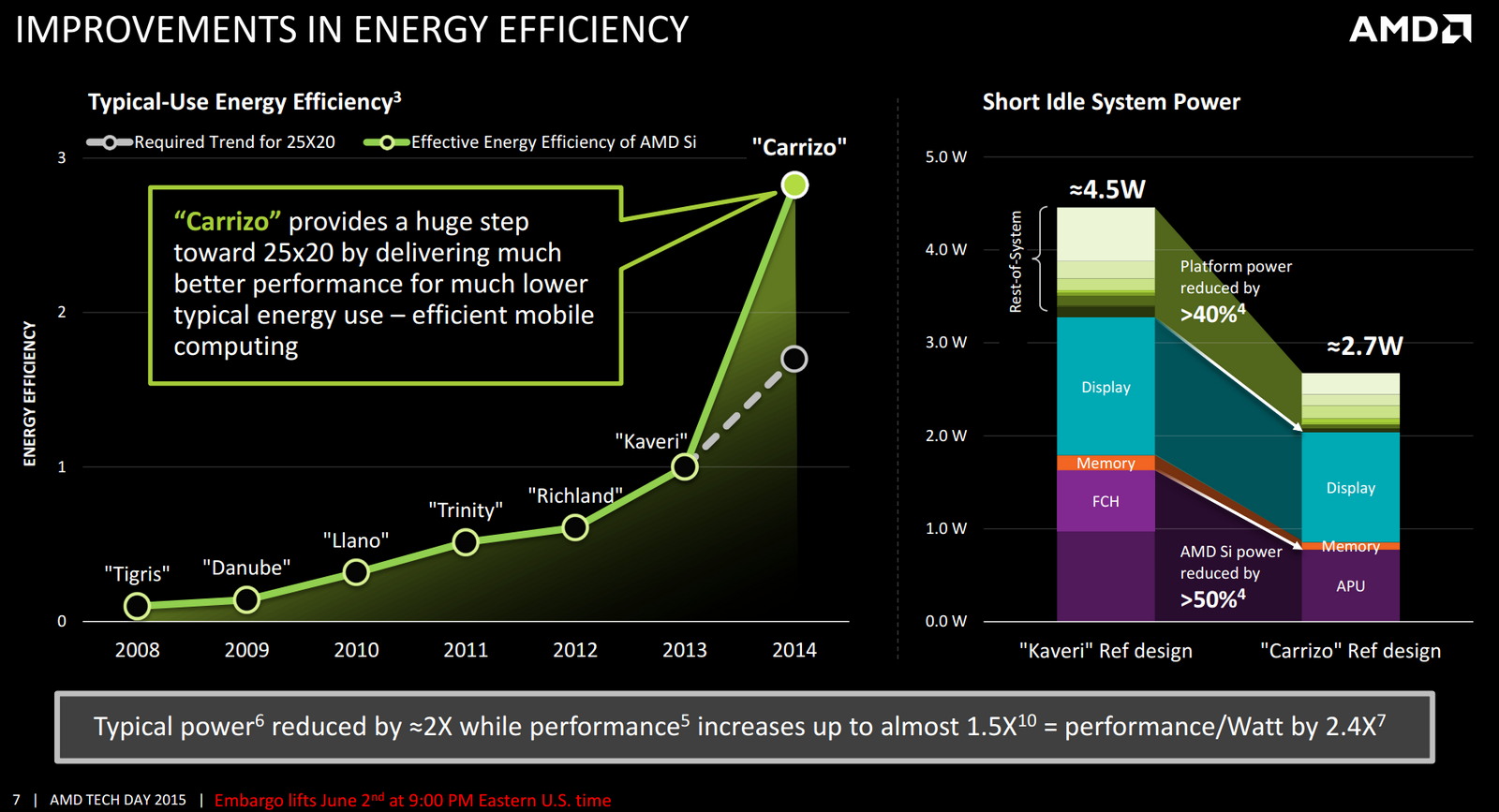
This makes good timing, because our review of AMD’s Carrizo, the mobile platform using the latest AMD architecture is set to go up in the next couple of days. AMD’s Excavator cores were the poignant part of AMD’s Tech Day in mid-2015, where the new Excavator architecture was discussed and especially in relation to the previous generation Steamroller cores.

The goal of Excavator, as we were told at the time, was to develop a series of big steps into improving the efficiency of the base Bulldozer microarchitecture through high density libraries, better metal stacks in production, more on-chip analysis to save power, more power planes to regulate those chances and everything in-between. We were told we wouldn’t see the Excavator core on the desktop in its desktop form because the design focused on the 15W-35W power window, rather than the 45W+ on the desktop.

Fast forward to today and there seems to be a slight reversal here. The new AMD Athlon X4 845 is a pair of Excavator modules in a desktop package, designed to slot right in where the Steamroller design through Kaveri has been sitting for a couple of years. Why the change? And why a single SKU at 65W, way off the 15W-35W range quoted as ‘ideal’ back at the Tech Day?

AMD Excavator Based Lineup
  A12 PRO-
8800B
FX-
8800P
A10-
8700P
A8-
8600P
A6-PRO
8500B
Athlon X4
845
Platform Mobile Mobile Mobile Mobile Mobile Desktop
Modules 2 2 2 2 1 2
Threads 4 4 4 4 2 4
Core Freq. (GHz) 2.1-3.4 2.1-3.4 1.8-3.2 1.6-3.0 1.6-3.0 3.5-3.8
Compute Units 4+8 4+8 4+6 4+6 2+4 4+0
Streaming
Processors
512 512 384 384 256 N/A
IGP Freq. (MHz) 800 800 800 720 800 N/A
TDP 15-35W 15-35W 15W 15W 15W 65W
DRAM
Frequency
2133 2133 2133 2133 1600 2133
L2 Cache 2x1MB 2x1MB 2x1MB 2x2MB 2x1MB 2x1MB

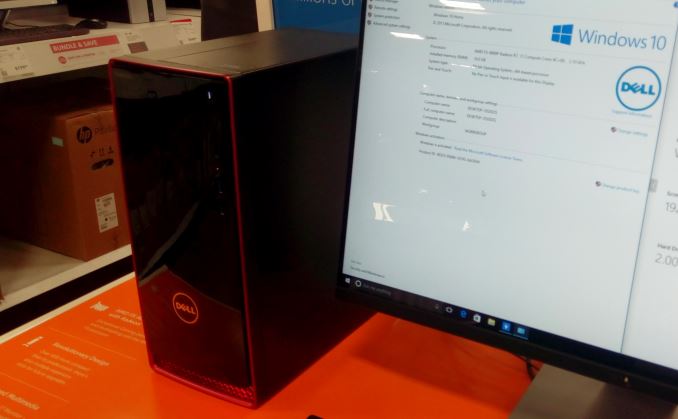
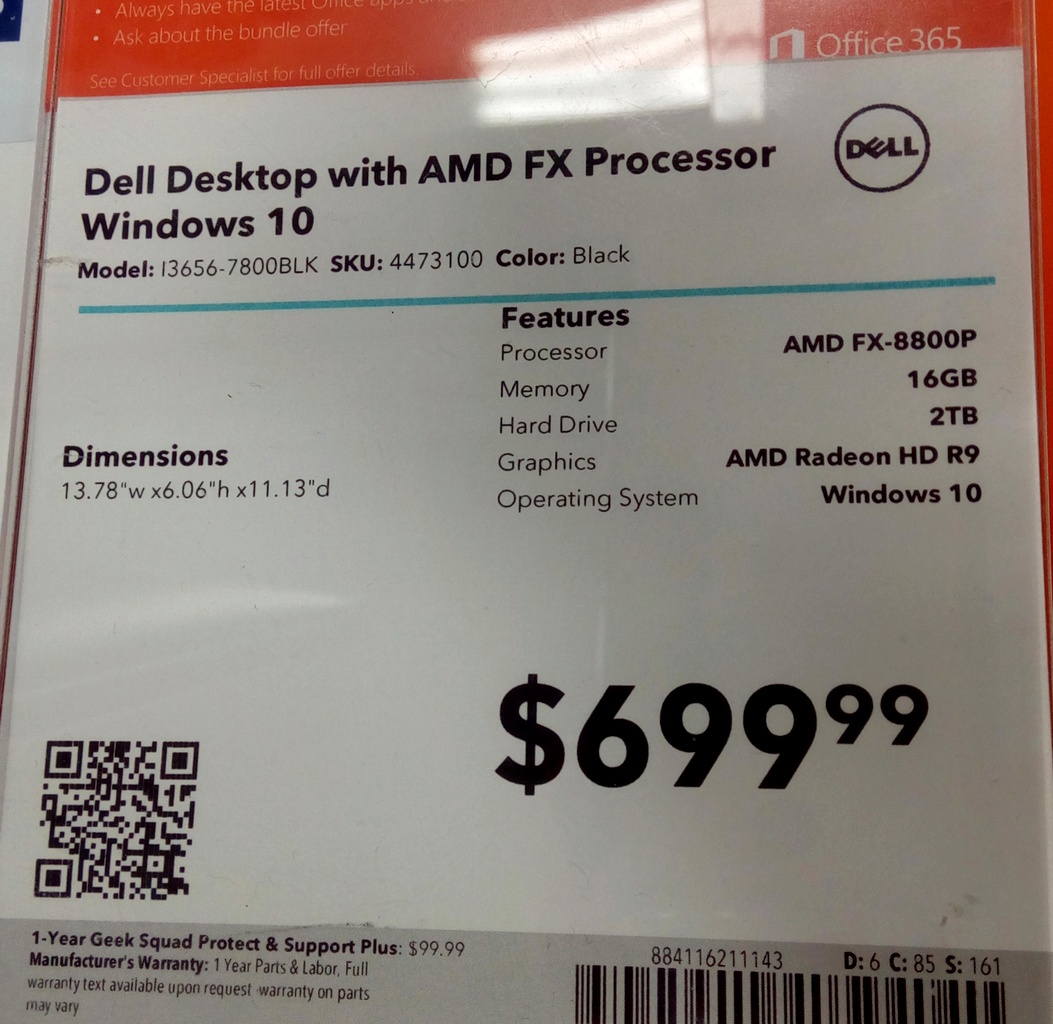
One thing that was made perfectly clear in AMD’s briefing on the new Athlon was that this is not a performance part – due to the nature of Excavator the new CPU would be purely an efficiency play, allowing customers to take advantage of the latest architecture in the desktop if they didn’t need the full-fat performance. Arguably you could already find Excavator in the desktop, through Dell’s Inspiron 3656 range which uses a mobile part in a desktop case with a discrete graphics card.

With the new Athlon, the fact that there is no graphics part to the FM2+ processor does raise several questions. Is this a new die specifically for the Excavator on desktop, which might run into the tens of millions of dollars to produce, or is it repurposed mobile silicon put into a desktop package. Instinct tells us it’s the latter, perhaps better binned parts to show that the core can do 3.8 GHz at 65W, but at the expense of the integrated graphics, or due to production issues the integrated graphics on die are unusable.  One of the interesting things is also the L2 cache situation, because the Excavator modules in Carrizo were designed with 1MB of L2 per module, rather than the 2MB of L2 cache per module in desktop Kaveri. This is somewhat balanced by the larger L1 data cache in Excavator, but because there is no L3 cache either, it has to rely on other Excavator enhancements (better prefetch, wider prefetch windows) in order to bring it up to speed.

The PCIe 3.0 lanes are also at x8, which is another mobile limitation rather than the result of the PCIe root complex being half-disabled.

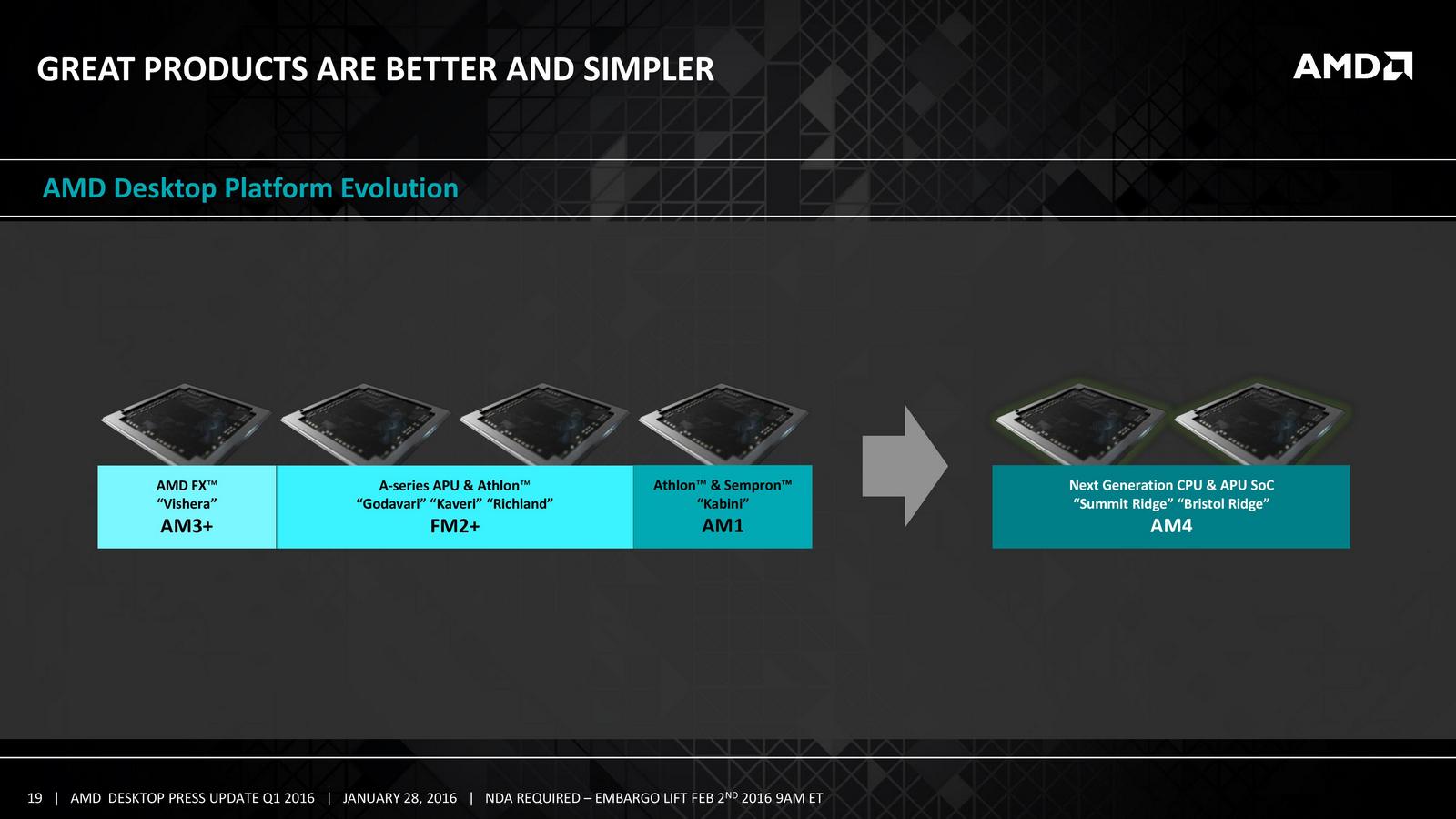
AMD has already stated that the next generation of AMD APUs will be on the AM4 platform, code named Bristol Ridge and Summit Ridge. We assume Bristol Ridge to be Excavator based, because there has to be something between now and Zen, but it would seem to suggest that the Excavator memory controller has support for DDR3 and DDR4, similar to what was suggested when AMD announced their DDR4-capable R-series APUs for embedded late last year. This may mean that AM4 supports both DDR3 and DDR4 as a result, which would not be unsurprising given how most DRAM transitions go.

We have asked for samples when they start to circulate. The Athlon X4 845 will have a MSRP of $70.

Source: AMD

Additional, 3rd Feb: We have been told by AMD that ‘The Athlon X4 845 is based on the “Carrizo” die with the GPU and FCH disabled. [T]he Athlon X4 845 supports DDR3 memory at speeds up to 2133MHz.’. Also, despite the focus on efficiency, the X4 845 will not have a configurable TDP.

AMD Launches Excavator on Desktop: The 65W Athlon X4 845 for $70

AMD Launches Excavator on Desktop: The 65W Athlon X4 845 for $70

As part of today’s launch AMD released two new Kaveri based APUs as part of the FM2+ platform, the A10-7860K and the A6-7470K, as well as clarifying the way the new 125W Wraith stock cooler would be distributed at this time. What went under the radar almost was the release of a third part, the Athlon X4 845 CPU, featuring no integrated graphics but AMD’s newest architecture instead.

This makes good timing, because our review of AMD’s Carrizo, the mobile platform using the latest AMD architecture is set to go up in the next couple of days. AMD’s Excavator cores were the poignant part of AMD’s Tech Day in mid-2015, where the new Excavator architecture was discussed and especially in relation to the previous generation Steamroller cores.

The goal of Excavator, as we were told at the time, was to develop a series of big steps into improving the efficiency of the base Bulldozer microarchitecture through high density libraries, better metal stacks in production, more on-chip analysis to save power, more power planes to regulate those chances and everything in-between. We were told we wouldn’t see the Excavator core on the desktop in its desktop form because the design focused on the 15W-35W power window, rather than the 45W+ on the desktop.

Fast forward to today and there seems to be a slight reversal here. The new AMD Athlon X4 845 is a pair of Excavator modules in a desktop package, designed to slot right in where the Steamroller design through Kaveri has been sitting for a couple of years. Why the change? And why a single SKU at 65W, way off the 15W-35W range quoted as ‘ideal’ back at the Tech Day?

AMD Excavator Based Lineup
  A12 PRO-
8800B
FX-
8800P
A10-
8700P
A8-
8600P
A6-PRO
8500B
Athlon X4
845
Platform Mobile Mobile Mobile Mobile Mobile Desktop
Modules 2 2 2 2 1 2
Threads 4 4 4 4 2 4
Core Freq. (GHz) 2.1-3.4 2.1-3.4 1.8-3.2 1.6-3.0 1.6-3.0 3.5-3.8
Compute Units 4+8 4+8 4+6 4+6 2+4 4+0
Streaming
Processors
512 512 384 384 256 N/A
IGP Freq. (MHz) 800 800 800 720 800 N/A
TDP 15-35W 15-35W 15W 15W 15W 65W
DRAM
Frequency
2133 2133 2133 2133 1600 2133
L2 Cache 2x1MB 2x1MB 2x1MB 2x2MB 2x1MB 2x1MB

One thing that was made perfectly clear in AMD’s briefing on the new Athlon was that this is not a performance part – due to the nature of Excavator the new CPU would be purely an efficiency play, allowing customers to take advantage of the latest architecture in the desktop if they didn’t need the full-fat performance. Arguably you could already find Excavator in the desktop, through Dell’s Inspiron 3656 range which uses a mobile part in a desktop case with a discrete graphics card.

With the new Athlon, the fact that there is no graphics part to the FM2+ processor does raise several questions. Is this a new die specifically for the Excavator on desktop, which might run into the tens of millions of dollars to produce, or is it repurposed mobile silicon put into a desktop package. Instinct tells us it’s the latter, perhaps better binned parts to show that the core can do 3.8 GHz at 65W, but at the expense of the integrated graphics, or due to production issues the integrated graphics on die are unusable.  One of the interesting things is also the L2 cache situation, because the Excavator modules in Carrizo were designed with 1MB of L2 per module, rather than the 2MB of L2 cache per module in desktop Kaveri. This is somewhat balanced by the larger L1 data cache in Excavator, but because there is no L3 cache either, it has to rely on other Excavator enhancements (better prefetch, wider prefetch windows) in order to bring it up to speed.

The PCIe 3.0 lanes are also at x8, which is another mobile limitation rather than the result of the PCIe root complex being half-disabled.

AMD has already stated that the next generation of AMD APUs will be on the AM4 platform, code named Bristol Ridge and Summit Ridge. We assume Bristol Ridge to be Excavator based, because there has to be something between now and Zen, but it would seem to suggest that the Excavator memory controller has support for DDR3 and DDR4, similar to what was suggested when AMD announced their DDR4-capable R-series APUs for embedded late last year. This may mean that AM4 supports both DDR3 and DDR4 as a result, which would not be unsurprising given how most DRAM transitions go.

We have asked for samples when they start to circulate. The Athlon X4 845 will have a MSRP of $70.

Source: AMD

Additional, 3rd Feb: We have been told by AMD that ‘The Athlon X4 845 is based on the “Carrizo” die with the GPU and FCH disabled. [T]he Athlon X4 845 supports DDR3 memory at speeds up to 2133MHz.’. Also, despite the focus on efficiency, the X4 845 will not have a configurable TDP.