Vik


Intel Expands Compute Stick Family with Cherry Trail and Core M Models
Intel Expands Compute Stick Family with Cherry Trail and Core M Models

The desktop PC market is seeing growth only in two areas – the gaming high-end and the mini-PCs (in the NUC form factor). Intel has been strengthening its offerings in the latter space as a system vendor. The NUC has been extremely popular and Intel’s partners such as Zotac and GIGABYTE are also enjoying a lot of success with similarly sized systems.

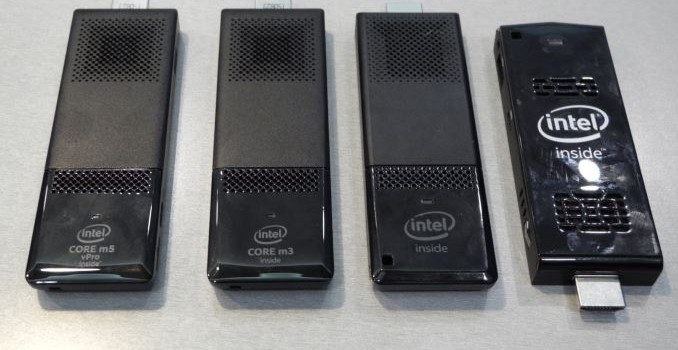
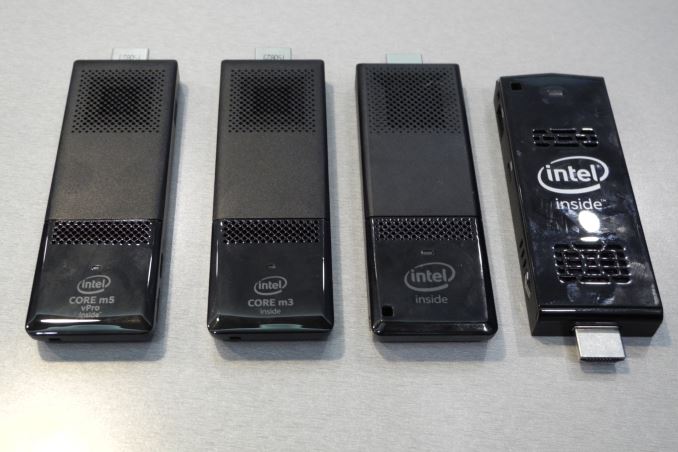
ARM SoC vendors started the trend of HDMI sticks, but Intel joined the game in CES 2015 with the Bay Trail Compute Stick. The first iteration was, to put it kindly, a bit underwhelming, but Intel showed its commitment to the form factor by announcing three new Compute Stick models at CES 2016.

Cherry Trail Compute Stick

This is a straight-on follow-up to the Bay Trail model from last year. The I/O ports and hardware construction are similar, except that the Cherry Trail model is slightly longer and includes a USB 3.0 port in addition to the previously existing single USB 2.0 port.
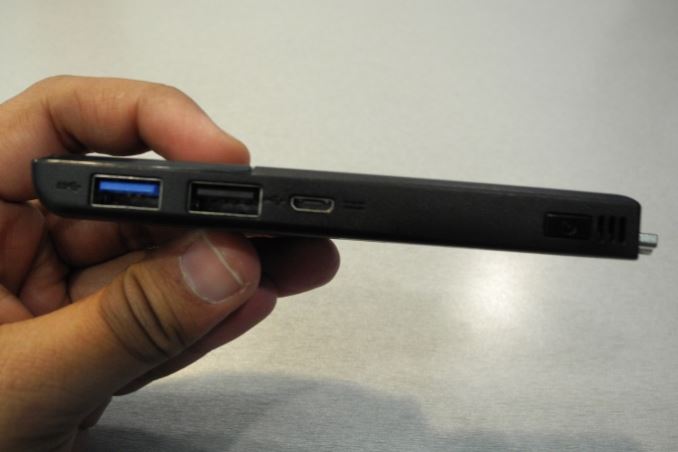
Other improved aspects include the use of Intel’s own 802.11ac Wi-Fi chipset instead of the Realtek one found in the Bay Trail version. Obviously, Cherry Trail’s GPU is better than Bay Trail’s. However, the cooling fan still remains part of the hardware. The eMMC capacity is only 32GB and the RAM is only 2GB – two aspects that have an artificial limitation imposed on them by Intel’s decision to pre-install Windows 10 Home. Even though the information is not public, it is likely that Microsoft mandates neutering of a PC’s hardware specifications in exchange for a lower price for the Windows 10 OEM license.

Skylake Core M Compute Sticks

While the Cherry Trail Compute Stick was more or less expected, the Core M-based Compute Sticks were a real surprise. Later this year, Intel will launch two Compute Stick models with a Core m3 and Core m5 vPro configuration respectively. The OS will not be pre-installed, and this means that we don’t need the storage or RAM to be limited by anything other than what the hardware design allows. In terms of available ports, the design retains the microSD slot from the other Compute Stick models. However, there is only one USB 3.0 port on the unit itself. Power to the unit is delivered by a USB Type-C connector.
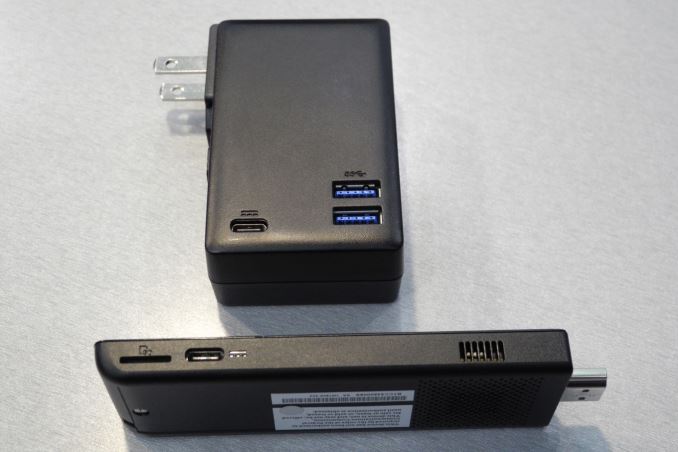
The USB Type-C power adapter also includes two USB 3.0 ports. This is a very novel use of the USB Type-C power delivery mechanism. Intel mainly expects the Core M Compute Sticks to be popular amongst businesses and enterprises (thanks to the availability of vPro).

NUCs

Intel has been shipping the Skylake NUCs for a couple of months now. They had one on display at their booth. Interesting aspects include the presence of a SDXC slot as well as a full-sized HDMI port in the rear panel.

They also talked about the upcoming ‘Skull Canyon’ mini-PC featuring a 45W TDP Skylake H CPU with Iris Pro graphics. It will not be in the NUC form factor, but will be a slightly larger rectangle with height similar to the current NUCs which don’t support 2.5″ drives. The unit is still a work in progress, but we expect it to launch in the second half of this year. Unfortunately, Intel didn’t allow us to take photographs of the Skull Canyon mini-PC.

On the whole, Intel is showing strong commitment to the mini-PC market segment. This will keep x86 relevant in the home computing space even as ARM continues to strengthen its hold in mobile computing.
Hisense at CES: Affordable and Feature-Packed 4K TVs for HTPCs

Hisense at CES: Affordable and Feature-Packed 4K TVs for HTPCs

We usually don’t cover televisions in detail here at AnandTech. However, the current flux in the market when it comes to 4K displays for HTPCs made CES 2016 an interesting destination for us to look at what vendors will be offering in the near future. Consumers looking for the best possible picture quality and not concerned about the price have a number of models to choose from in the Smasung SUHDTV series and the Sony XBR series TVs.

Vizio and Hisense 4K TVs are perfect for those on a tight budget. However, a limited budget also means that one can’t afford to be an early adopter and be stuck with an outdated television early on. In June 2014, we covered the launch of the Hisense 50H7GB 4K TV. In that article, we covered the minimum features that a 4K HTPC display needed to support in order to not become obsolete within a couple of years. The 50H7GB 50″ 4K TV was launched at $600. It supported HDMI 2.0 and HDCP 2.2, with the only disappointing factor being the absence of HDR capabilities. Consumers considering this model obviously have price, and not picture quality, at the top of their purchase factors. In late August 2015, Hisense had launched the H10 series ULED TV with full-array local dimming and quantum dot technologoy for a wider color gamut (the 65″ model is currently available for $2500).

At CES 2016, we stopped by Hisense’s booth to get an idea of what they had in store for consumers over the rest of the year and what they are working on for future products. The good news is that all the four 4K TV lineups get updated with HDR processing capability – the H7, H8, H9 and H10.

  • The new H10 will be similar to the one currently available on Amazon with all the Smart TV and Wi-Fi features, but Hisense hopes to get THX certification for this high-end curved model.
  • The H9 (55″, $1000, February 2016) gets all the features of the new H10 except that it will not have 3D or quantum dot technology.
  • The H8 (50″ – $600, 55″ – $700, April 2016) is not a curved model. But, Hisense indicates that it will not have the vibrant picture quality of the H9 and H10.
  • The H7 (43″ – $400, 50″ – $550, 55″ – $650, 65″ – $1300, February 2016) doesn’t have the full-array local dimming present in the other models, but carries forward other features from the H8.

It is exciting to see that HDR is making an appearance at mainstream price points. However, wider color gamut is absolutely essential to better appreciate the right 4K content. It might be worthwhile to take a look at the complete specification sheets of the above models before making a purchase decision. Important aspects to track down would be the panel type and panel bitwidth, color gamut coverage and black levels.

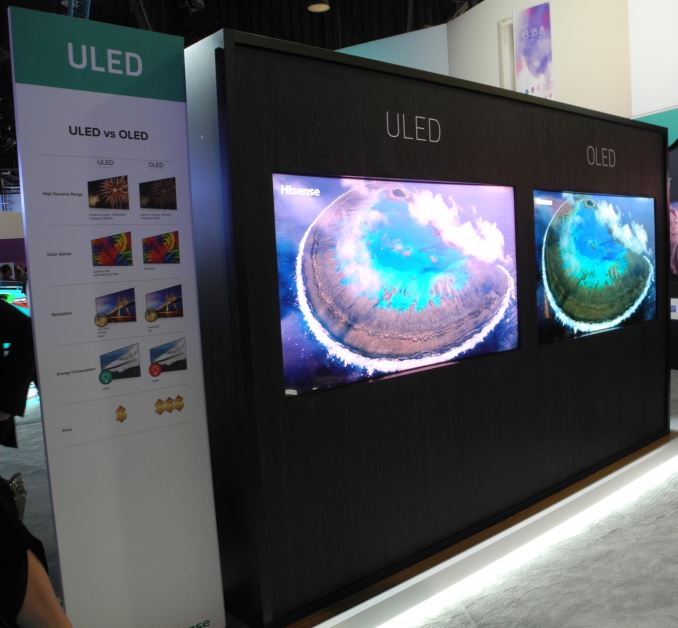
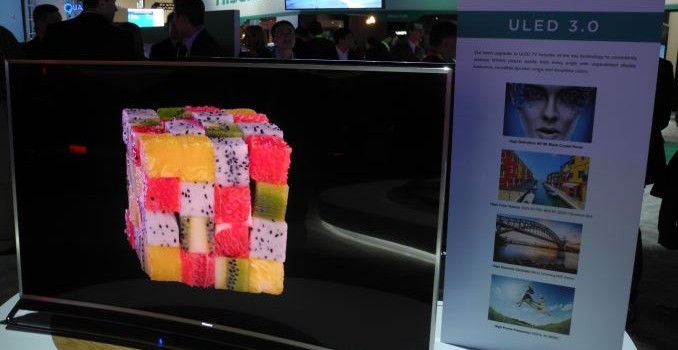
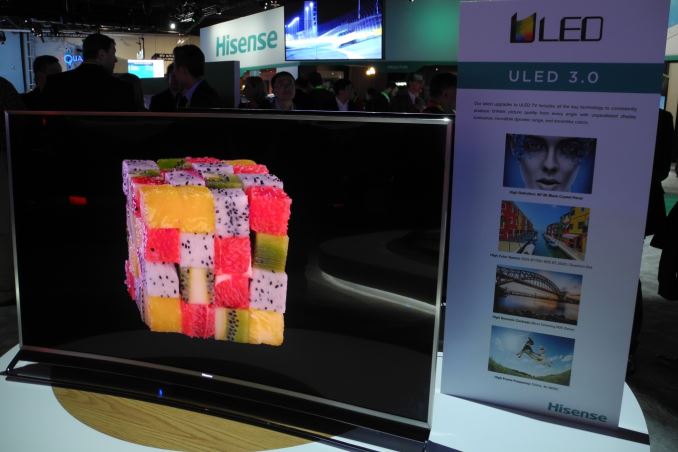
Hisense believes that there is a big tussle going on between ULED technology and OLED. To give consumers their perspective, they had the same clip running on a ULED TV as well as an OLED TV side by side in their booth.

To be frank, the OLED TV playback was more pleasing to the eye. However, a side chart indicated that OLEDs have trouble reaching brightness levels that can be achieved via ULED technology. In addition, the quantum dots technology being used in ULED TVs can deliver 106% of the NTSC color gamut, while the best OLEDs can only reach 85% of the NTSC color gamut. While the ULED TV on display was consuming 280W, the equivalent sized OLED TV was consuming 500W. Finally, the OLED TV on display currently costs three times as much as the ULED TV. It would be nice if ULED TVs could further evolve to get some of the more desirable features of OLED TVs – particularly in terms of black levels.

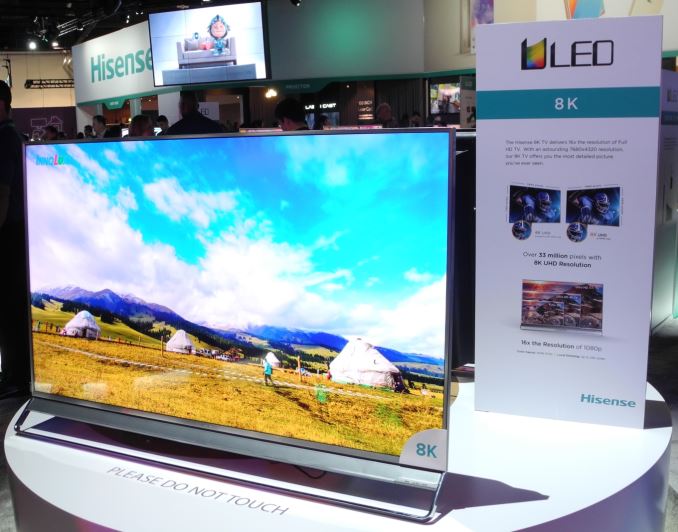
Looking further into the future, Hisense also had a static demo of a 8K model in their booth. Other than the resolution (7680×4320), there was no other information about the television or expected release dates.

As part of their press releases, Hisense also indicated that the Sharp brand is going to be alive and well, and will be around as a premium brand. The N9000, a 70″ flat-screen 4K TV with other specifications similar to the H10 series, will come to the market in July for $3000.

Netgear Updates Networking Lineup at CES

Netgear Updates Networking Lineup at CES

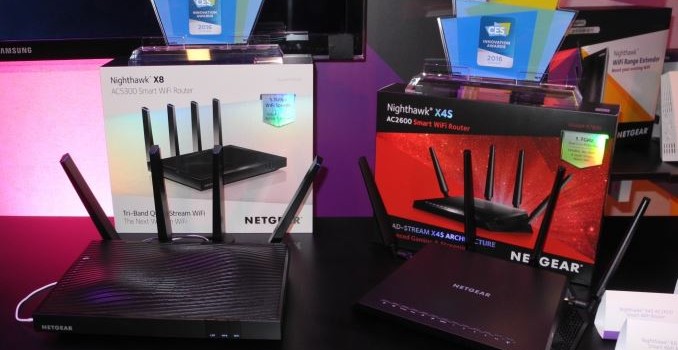
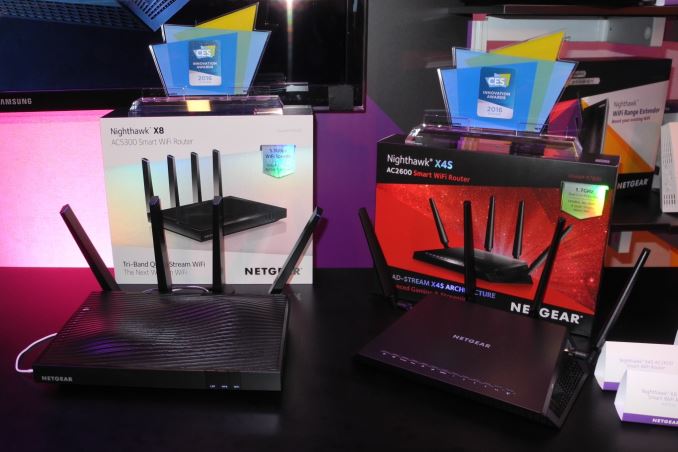
Netgear’s flagship router – the Nighthawk X8 (R8500) – was launched in October. At CES, Netgear took the opportunity to upgrade the Nighthawk X4 line. Interestingly, the original X4 – the R7500 – was launched with Quantenna radios and a Qualcomm IPQ SoC, and promised MU-MIMO support in a future firmware update. However, Netgear decided to enable MU-MIMO only with a hardware upgrade – the R7500 v2 with full MU-MIMO support became an all-Qualcomm Atheros affair. The R7500 v2 is being replaced by the Nighthawk X4S at the same price point.

The Nighthawk X4S (R7800) comes with an IPQ8065 dual-core SoC at 1.7GHz and the QCA9984 radio. Unlike the AC2400-class routers introduced towards the middle of last year, this 4×4 design supports 160 MHz (either contiguous or 80MHz + 80 MHz) and MU-MIMO out of the box. Client support is needed in order to take full advantage of both these features. The router has a MSRP of $270 and is available now.

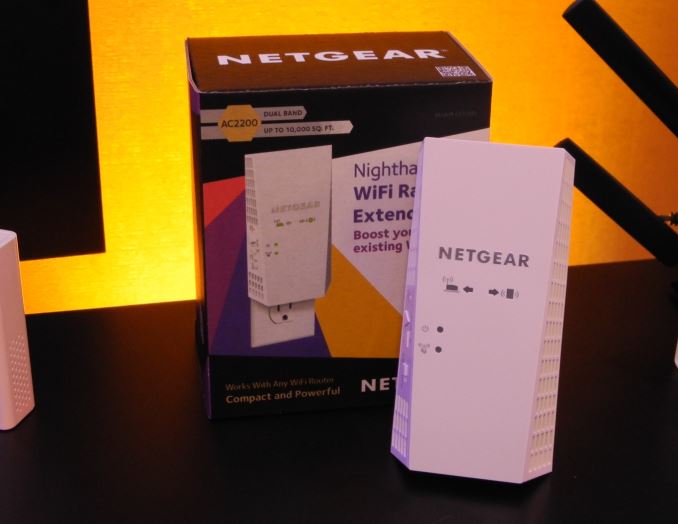
EX7300 AC2200 Nighthawk X4 WiFi Range Extender

A wall-plug Wi-Fi extender with MU-MIMO capability (EX7300) was also launched at CES. It belongs to the AC2200 class – 4×4 1733Mbps in the 5 GHz band and 3×3 450 Mbps in the 2.4 GHz band. The antennae are internal and the unit also has a GbE RJ-45 port. The extender is available for purchase now and is priced at $170. At the $140 price point, Netgear is launching the EX6400, a AC1900-class extender with 3×3 spatial streams in both the 2.4 GHz and 5 GHz bands. 256-QAM support exists for the 2.4 GHz band. The EX6400 can also be used as a Wi-Fi access point.

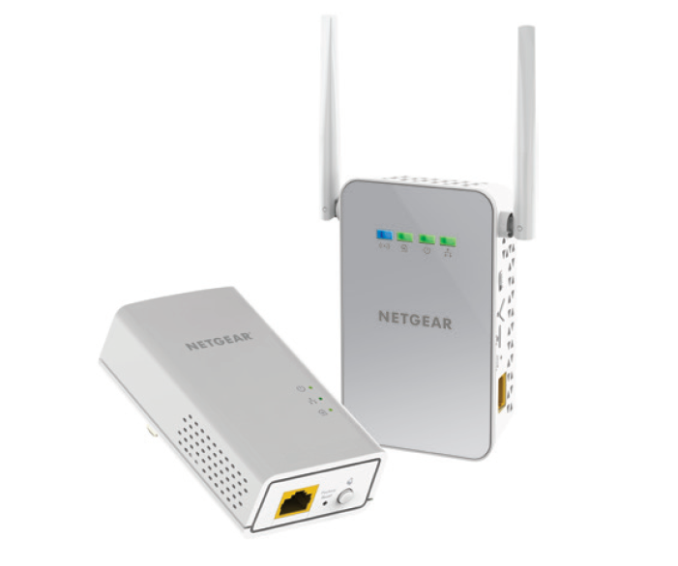
Powerline WiFi 1000 (PLW1000 Kit)

On the PLC side, Netgear has introduced the PLW1000, which combines powerline technology with Wi-Fi. Based on the HomePlug AV2 standard, this adapter can support up to 1 Gbps of theoretical throughput. In addition, the PLW1000 also creates a Wi-Fi hotspot at the place of installation. While not explicitly specified, we believe this is a 1×1 configuration for both 2.4 GHz and 5 GHz bands. It is marketed as a 802.11ac access point. The PLW1000 is priced at $120 and is available now.

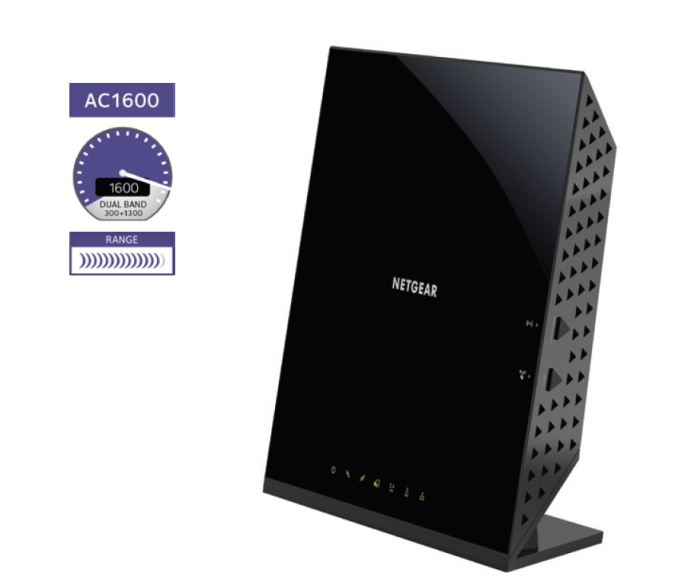
C6250 AC1600 WiFi Cable Modem Router

Netgear also launched the C6250 Wi-Fi cable modem router. The DOCSIS 3.0 modem supports bonding of 16 downstream and 4 upstream channels. The Wi-Fi side is AC1600, i.e, 2×2 in the 2.4 GHz band (300 Mbps) and 3×3 in the 5 GHz band (1300 Mbps). The C6250 has a MSRP of $170 and will be available for purchase soon.

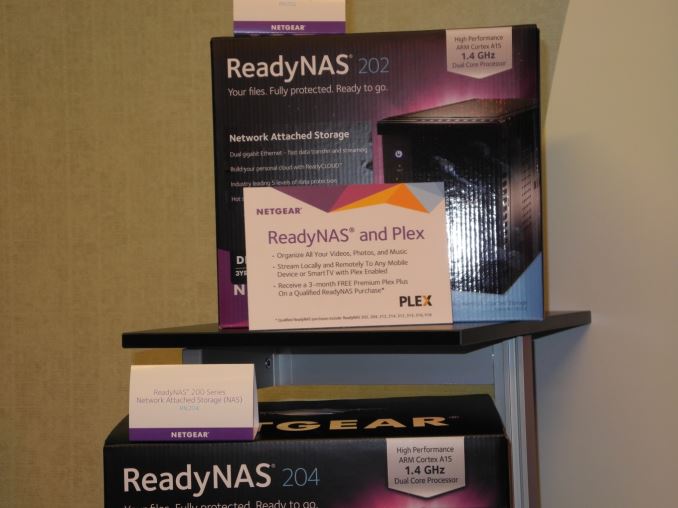
In ReadyNAS news, Netgear had the RN20x and 21x series on display. One of the interesting aspects was the tie-up with Plex. On purchase of models such as the RN202, RN204, RN212, RN214, RN312, RN314, RN316 and RN516, customers can obtain three free months of Premium PLEX Plus.

CES 2016: ASUS Product Tour

CES 2016: ASUS Product Tour

It’s almost hard to believe that ASUS started as primarily just a motherboard company. Their CES showcase for 2016 had a huge array of products, including of course motherboards, but also smart home, smartwatches, phones, laptops, all-in-one sys…

Linksys Expands Max-Stream Networking Lineup at CES

Linksys Expands Max-Stream Networking Lineup at CES

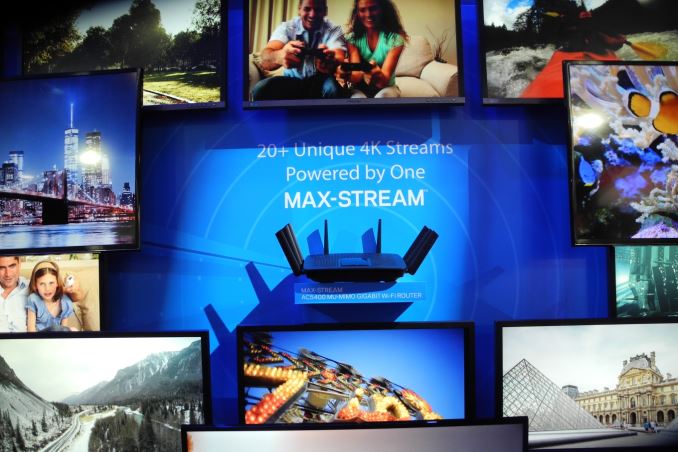
Linksys was one of the first vendors to jump on to the MU-MIMO bandwagon last year with the launch of the EA8500 AC2400-class 802.11ac router. The Max-Stream branding is used by Linksys to promote their routers. At CES, they introduced a host of new products to expand this lineup.

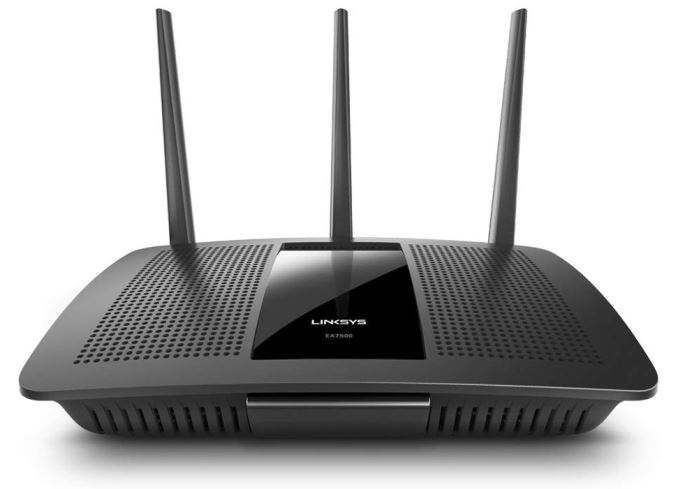
EA7500 – AC1900-class with MU-MIMO

The EA7500 is a 3×3 dual-band router based on a Qualcomm Atheros platform (1.4GHz IPQ8064 SoC, QCA8337-AL3C switch, and QCA9982 and QCA9983 radios). This one enables 256-QAM to deliver 600 Mbps in the 2.4GHz band. The 5 GHz band still delivers 1300 Mbps theoretical throughput.

Priced at $200 and slated to come to the market next month, it will go against the Netgear Nighthawk R7000 with similar speeds, but come with MU-MIMO enabled. The latter is an important selling point as more and more MU-MIMO clients  come to the market. More information can be found on the Linksys product page.

EA9500 – AC5400-class with MU-MIMO

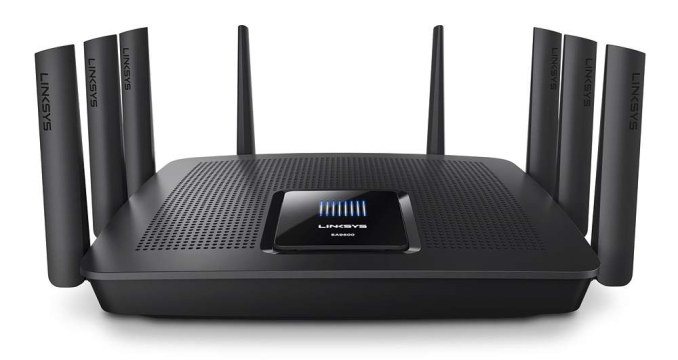
The EA9500 is based on the Broadcom Tri-Band Wi-Fi platform (two 4×4 5GHz SSIDs and one 4×4 2.4GHz SSID). This is the same platform as the AC5300 Nighthawk X8 router released by Netgear in October 2015. Compared to the Nighthawk X8, this one comes with 8 LAN and 1 WAN port and 8 external antennae. There doesn’t seem to be any link aggregation capabilities out of the box, but that is just a firmware feature.

Priced at $400, availability is slated for April. The delay is due to the fact that Broadcom is yet to bring MU-MIMO capability to the platform in the firmware (the hardware is claimed to be MU-MIMO capable).

Miscellaneous Products

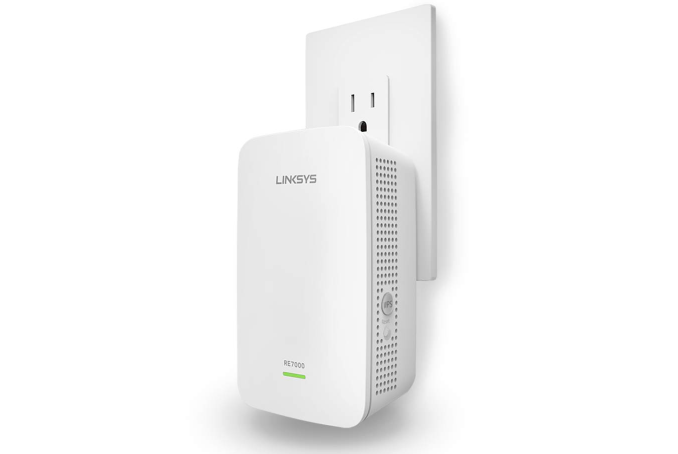
The RE7000 is a MU-MIMO-capable Wi-Fi range extender in the plug-in form factor. It is AC1900 class, but, instead of having the same spatial stream configuration for both 2.4GHz and 5 GHz bands, the product does 4×4 in the 5GHz and 2×2 in the 2.4GHz channels. It comes with a single GbE port. Priced at $150, it will come to market in Spring 2016.

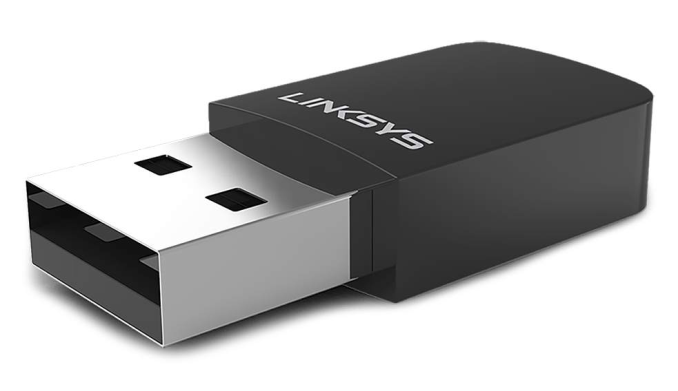
The AC600 USB MU-MIMO adapter (WUSB6100M) finally brings MU-MIMO to USB WLAN adapters. With a 1×1 configuration (433 Mbps in 5GHz and 150 Mbps in 2.4 GHz), it needs only a USB 2.0 interface to connect to the host PC. The big draw here is the MU-MIMO capability which helps improve overall system performance when used alongside other MU-MIMO clients and a MU-MIMO-capable router.

On the cable modem side, the CM3008 (DOCSIS 3.0, 8 downstream / 4 upstream channel bonding, 343 Mbps down / 120 Mbps up, $70, Spring 2016) and the CM3024 (DOCSIS 3.0, 24 downstream / 8 upstream channel bonding, 960 Mbps down / 240 Mbps up, $130, Spring 2016) were on display. There is also a growing trend to integrate the Wi-Fi router and cable modem in one (particularly from a service provider perspective). To address this market, Linksys is also introducing the CG7500 which combines the CM3024 24×8 DOCSIS 3.0 platform with a AC1900 (1300 Mbps + 600 Mbps) wireless router platform. The unit comes with four RJ-45 GbE ports and one USB 2.0 port. The antennae are all internal. It will be priced at $250 and be available in Spring 2016.

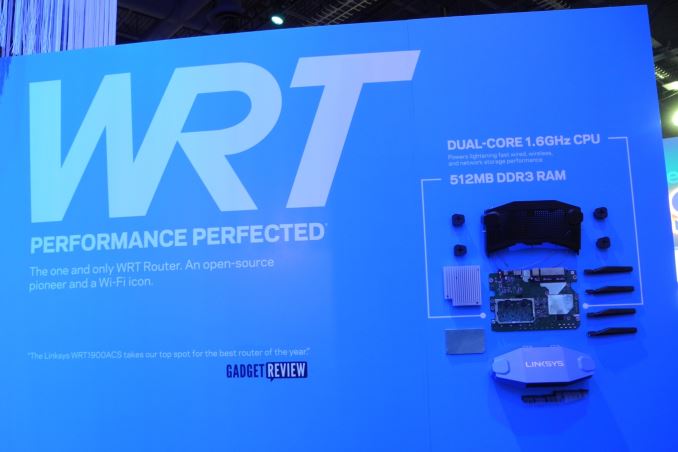
Linksys also took the opportunity at CES to announce DD-WRT support for the routers based on Marvell silicon (WRT1900AC, WRT1200AC and WRT1900ACS).