Vik


Qualcomm renames Snapdragon 618,620 to 650,652

Qualcomm renames Snapdragon 618,620 to 650,652

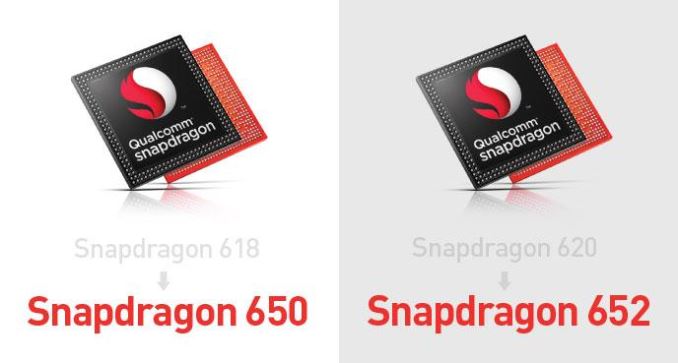
Earlier in the year we were able to cover Qualcomm’s announcement of the Snapdragon 618 and 620 mid-range SoCs. We haven’t heard much about the SoCs since the original news, but today Qualcomm made the new announcement that there will be a product renaming. From now on, the Snapdragon 618 becomes the Snapdragon 650 and the Snapdragon 620 becomes the new Snapdragon 652. It seems that Qualcomm saw possibility of product lineup confusion between the existing Snapdragon 61x models and the new parts, and because the new models represent a significant boost in performance to previous generation A53-only SoCs, repositioned the parts with new higher numeric names that allows them to better differentiate themselves.

Qualcomm 2016 Mid- to High-End
SoC Snapdragon 650
(MSM8952)
Snapdragon 652
(MSM8976)
Snapdragon 820
(MSM8996)
CPU 4x Cortex A53 @1440MHz

2x Cortex A72 @1804MHz

4x Cortex A53 @1440MHz

4x Cortex A72 @1804MHz

2x Kryo @1598MHz

2x Kryo @2150MHz

Memory 2x 32-bit @ 931MHz
LPDDR3

14.9GB/s b/w

2x 32-bit @ 1803MHz
LPDDR4

28.8GB/s b/w

GPU Adreno 510
@ 550MHz
Adreno 530
@ 624MHz
Encode/
Decode
2160p30, 1080p90
H.264 & HEVC
2160p30 (p60 decode),
1080p60
H.264 & HEVC
Camera/ISP Dual ISP
21MP
Dual ISP
25MP
Integrated
Modem
“X8 LTE” Cat. 7
300Mbps DL 100Mbps UL

2x20MHz C.A. 
(DL & UL)

“X12 LTE” Cat. 12/13 
600Mbps DL 150Mbps UL

3x20MHz C.A. (DL)
2x20MHz C.A. (UL)

Mfc. Process 28nm HPm 14nm LPP

As a reminder, the Snapdragon 650 and 652 are big.LITTLE SoCs based on ARM’s Cortex A72 acting as the big cores running at 1804MHz, and along with them comes ARM’s Cortex A53 clocked at 1440MHz. While both SoCs have 4 little cores, the Snapdragon 652 sports 4 A72 cores while the smaller brother sports only 2.

As a GPU we find an Adreno 510 clocked in at 550MHz. We still don’t have much more information on how this new part will be able to perform compared to its predecessors, but we should be expecting levels along the line of the Adreno 418 in the current Snapdragon 808.

The biggest difference between the Snapdragon 650/652 and the high end flagship, the Snapdragon 820 will be in terms of manufacturing node as we’ll be seeing the former parts made on a mature 28nm HPm node while the Snapdragon 820 enjoys the more high-end 14nm LPP manufacturing process. 

At the time we expected the new parts to ship in devices by the end of the year but as we’re closing in on the holiday season it looks like we’ll have to wait for early 2016 until we can get our hands on the new products, so hopefully we’ll be seeing announcements in the following months with availability shortly after.
Sapphire Readies Nitro R9 Fury: Custom Design and Enhanced Performance

Sapphire Readies Nitro R9 Fury: Custom Design and Enhanced Performance

Sapphire Technology is preparing to release its new graphics card — the Nitro R9 Fury — based on AMD’s Fiji graphics processing unit that features its own custom printed circuit board. Sapphire claims that the new Nitro R9 Fury will feature enhanced durability and slightly higher performance. In addition, it is logical to expect the adapter to offer greater overclocking potential compared to reference boards.

Sapphire is affiliated with PC Partner, a large Hong Kong-based holding, and is among the largest makers of graphics cards on the planet. The company works exclusively with AMD, which is why it offers a very comprehensive AMD Radeon product family. Sapphire’s lineup includes numerous unique products designed in-house that are not available from other manufacturers. However, when it comes to AMD’s Radeon R9 Fury family, Sapphire decided not to initially develop its own version of the more affordale R9 Fury (vanilla), unlike some other companies. The company tells us that they intentionally made the decision to introduce a Radeon R9 Fury featuring AMD’s reference design and a custom cooler that is both silent and efficient instead of developing its own PCB.

PC Partner often acts as a contract manufacturer for AMD — it produces AMD FirePro and reference AMD Radeon R9 boards, which are then sold under various brands. As a result, unlike its rivals, Sapphire is less economically motivated to develop its own designs of printed circuit boards (PCBs) and transfer manufacturing to its own facilities as soon as possible to cut its costs down. This is another reason why Sapphire decided not to alter PCB design of the Radeon R9 Fury in mid-2015. Nonetheless, the company was not standing still and has developed its custom Nitro R9 Fury video card, which is expected to hit the market in January 2016.
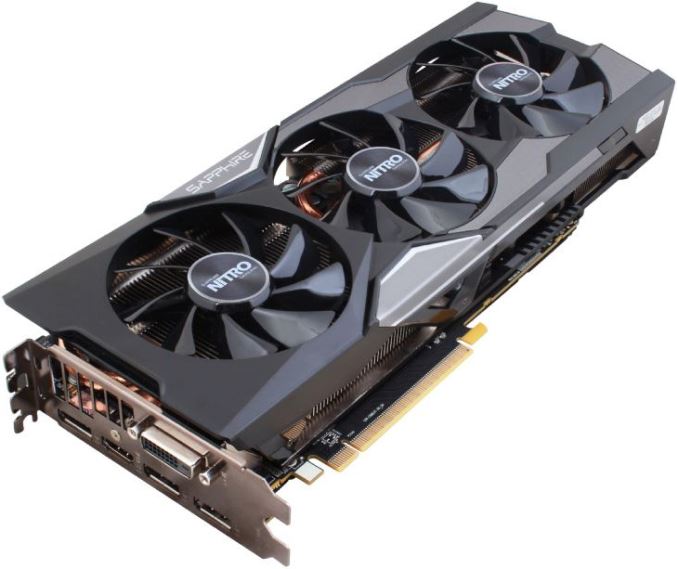
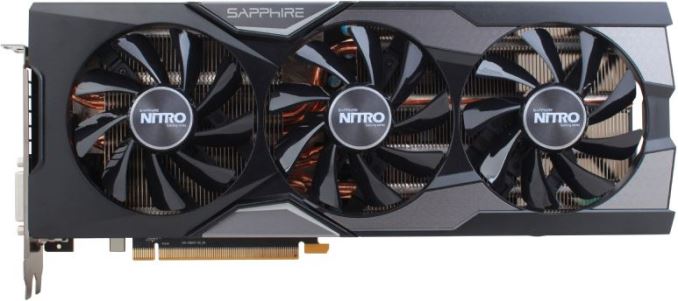
Sapphire’s Nitro R9 Fury features the maker’s own printed circuit board (PCB), which is noticeably different compared to AMD’s reference design. The PCB is significantly taller and longer than that developed by AMD, and features six-phase GPU voltage regulator module (VRM) that uses Sapphire’s own “Black Diamond” solid-state inductors with integrated heatsinks as well as high-quality tantalum 16K capacitors.
The new VRM provides cleaner and more stable power to the graphics processing unit, according to Sapphire. Moreover, the revamped voltage regulator module is rated to deliver around 20% higher current than the reference, which should enable better overclocking potential for the GPU. Components of the VRM are placed in a way to ensure their efficient cooling, which is why maximum temperature of the power delivery circuitry is at least 15% lower under high load compared to that on the reference graphics card, claims the developer.

The Sapphire Nitro N9 Fury retains AMD’s dual UEFI BIOS technology, hence, it should be possible for enthusiasts to relatively safely play with power limits or even try to unlock disabled stream processors. One of the BIOS settings allows increasing power and temperature limits to 300W and 80°C for greater overclocking potential

The Sapphire Nitro R9 Fury utilizes the company’s massive triple-fan Tri-X cooler with seven heatpipes, intelligent fan control, an aluminum backlplate and die-cast mounting plate for great cooling and additional reliability. Since the Tri-X cooler is large, the Sapphire Nitro R9 Fury will require 12” of space inside PC cases. Just like the regular Radeon R9 Fury video cards, the new board will need two 8-pin PCIe auxiliary power connectors.
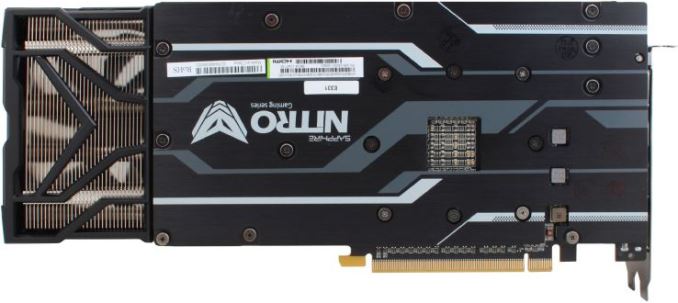
Sapphire’s Nitro N9 Fury will sport one dual-link DVI connector, which should please owners of older displays. In addition, the card features three DisplayPort 1.2 and one HDMI 1.4 outputs.

The Sapphire Nitro R9 Fury is based on a cut down version of AMD’s Fiji GPU, with 3584 stream processors, 224 texture units as well as 64 ROPs. The GPU will run at 1050MHz, which is slightly above AMD’s recommendations, but owners will be able to overclock the chip further. Just like other Fiji-based offerings, the Nitro R9 Fury comes with 4GB of high-bandwidth (HBM) memory clocked at 1000MHz and providing 512GB/s of bandwidth.

Sapphire yet has to announce the final price of the Nitro R9 Fury, but PC Games Hardware reports that the card will cost about the same amount of money as boards featuring AMD’s reference design.

Sapphire Readies Nitro R9 Fury: Custom Design and Enhanced Performance

Sapphire Readies Nitro R9 Fury: Custom Design and Enhanced Performance

Sapphire Technology is preparing to release its new graphics card — the Nitro R9 Fury — based on AMD’s Fiji graphics processing unit that features its own custom printed circuit board. Sapphire claims that the new Nitro R9 Fury will feature enhanced durability and slightly higher performance. In addition, it is logical to expect the adapter to offer greater overclocking potential compared to reference boards.

Sapphire is affiliated with PC Partner, a large Hong Kong-based holding, and is among the largest makers of graphics cards on the planet. The company works exclusively with AMD, which is why it offers a very comprehensive AMD Radeon product family. Sapphire’s lineup includes numerous unique products designed in-house that are not available from other manufacturers. However, when it comes to AMD’s Radeon R9 Fury family, Sapphire decided not to initially develop its own version of the more affordale R9 Fury (vanilla), unlike some other companies. The company tells us that they intentionally made the decision to introduce a Radeon R9 Fury featuring AMD’s reference design and a custom cooler that is both silent and efficient instead of developing its own PCB.

PC Partner often acts as a contract manufacturer for AMD — it produces AMD FirePro and reference AMD Radeon R9 boards, which are then sold under various brands. As a result, unlike its rivals, Sapphire is less economically motivated to develop its own designs of printed circuit boards (PCBs) and transfer manufacturing to its own facilities as soon as possible to cut its costs down. This is another reason why Sapphire decided not to alter PCB design of the Radeon R9 Fury in mid-2015. Nonetheless, the company was not standing still and has developed its custom Nitro R9 Fury video card, which is expected to hit the market in January 2016.

Sapphire’s Nitro R9 Fury features the maker’s own printed circuit board (PCB), which is noticeably different compared to AMD’s reference design. The PCB is significantly taller and longer than that developed by AMD, and features six-phase GPU voltage regulator module (VRM) that uses Sapphire’s own “Black Diamond” solid-state inductors with integrated heatsinks as well as high-quality tantalum 16K capacitors.

The new VRM provides cleaner and more stable power to the graphics processing unit, according to Sapphire. Moreover, the revamped voltage regulator module is rated to deliver around 20% higher current than the reference, which should enable better overclocking potential for the GPU. Components of the VRM are placed in a way to ensure their efficient cooling, which is why maximum temperature of the power delivery circuitry is at least 15% lower under high load compared to that on the reference graphics card, claims the developer.

The Sapphire Nitro N9 Fury retains AMD’s dual UEFI BIOS technology, hence, it should be possible for enthusiasts to relatively safely play with power limits or even try to unlock disabled stream processors. One of the BIOS settings allows increasing power and temperature limits to 300W and 80°C for greater overclocking potential

The Sapphire Nitro R9 Fury utilizes the company’s massive triple-fan Tri-X cooler with seven heatpipes, intelligent fan control, an aluminum backlplate and die-cast mounting plate for great cooling and additional reliability. Since the Tri-X cooler is large, the Sapphire Nitro R9 Fury will require 12” of space inside PC cases. Just like the regular Radeon R9 Fury video cards, the new board will need two 8-pin PCIe auxiliary power connectors.

Sapphire’s Nitro N9 Fury will sport one dual-link DVI connector, which should please owners of older displays. In addition, the card features three DisplayPort 1.2 and one HDMI 1.4 outputs.

The Sapphire Nitro R9 Fury is based on a cut down version of AMD’s Fiji GPU, with 3584 stream processors, 224 texture units as well as 64 ROPs. The GPU will run at 1050MHz, which is slightly above AMD’s recommendations, but owners will be able to overclock the chip further. Just like other Fiji-based offerings, the Nitro R9 Fury comes with 4GB of high-bandwidth (HBM) memory clocked at 1000MHz and providing 512GB/s of bandwidth.

Sapphire yet has to announce the final price of the Nitro R9 Fury, but PC Games Hardware reports that the card will cost about the same amount of money as boards featuring AMD’s reference design.

The Logitech MX Anywhere 2 Mouse: Portable Performance

The Logitech MX Anywhere 2 Mouse: Portable Performance

If you are like me, you prefer to use a mouse over a trackpad. Part of this stems back to being comfortable with a desktop PC, and part of it has to do with the inconsistent quality of trackpads over the years. I find myself more productive when I use…

The Logitech MX Anywhere 2 Mouse: Portable Performance

The Logitech MX Anywhere 2 Mouse: Portable Performance

If you are like me, you prefer to use a mouse over a trackpad. Part of this stems back to being comfortable with a desktop PC, and part of it has to do with the inconsistent quality of trackpads over the years. I find myself more productive when I use…