
Vik


Micron acquires SSD Controller Designer Tidal Systems, Inc.

Micron acquires SSD Controller Designer Tidal Systems, Inc.

A year ago, several veterans of SSD controller design firms SandForce and Link_A_Media Devices formed a new startup called Tidal Systems, Inc. to focus on developing NVMe SSD controllers. Tidal has spent the past year operating in stealth mode, and their website has almost no information about the company’s work.

Over this past week, during a financial call to investors, it was announced that Tidal has now been acquired by Micron. There are no details available regarding the acquisition and Micron reported their quarterly results just before the acquisition so we won’t get any more information soon. On the technical side, Micron plans to fold Tidal into their Advanced Controller Group and use Tidal controllers in client PCIe SSDs.

While the news that the acquisition has been floating around for a few days, we wanted more and so contacted Micron’s PR to get further information about the acquisition. Ultimately we were told very little as the details are being kept under wraps for the time being. We were told that the acquisition includes Tidal’s “inventory, equipment and intellectual property rights”; not mentioned in our discussions with Micron were the key people involved in developing Tidal’s technology. Some amount of staff turnover during an acquisition is normal, and we’ll have to wait and see who stays with Micron or gets put up the chain. Neither company has given an indication of how close to market Tidal’s controller/controllers (we don’t even know how many are involved here) may be, so it is difficult to gauge how much of an impact, both in terms of technology and personnel, this acquisition will have.

This acquisition is motivated by Micron’s desire to develop high-end client SSDs without being dependent on third-party controllers from Marvell or others. This would give Micron more opportunity for product differentiation and keep more of the design in-house. This is becoming important as consolidation takes place – vertical integration of the SSD business has been working out very well for Samsung and Intel, and the industry has seen a lot of the consolidation ethos in recent years. Micron’s acquisition leaves SanDisk as the only NAND manufacturer that doesn’t do in-house controller design for the client SSD market, so it’s likely that they’re is sizing up the remaining independent SSD controller vendors.
ASUS Announces ROG PG279Q & PG27AQ Gaming Monitors

ASUS Announces ROG PG279Q & PG27AQ Gaming Monitors

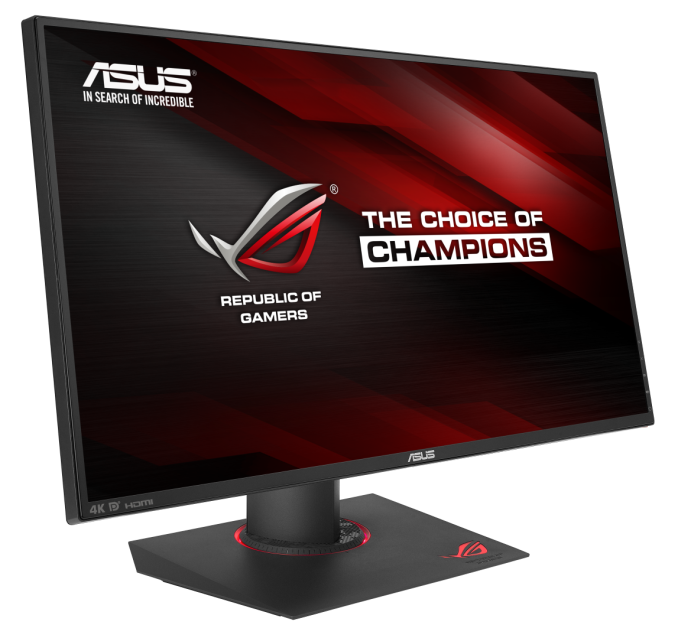
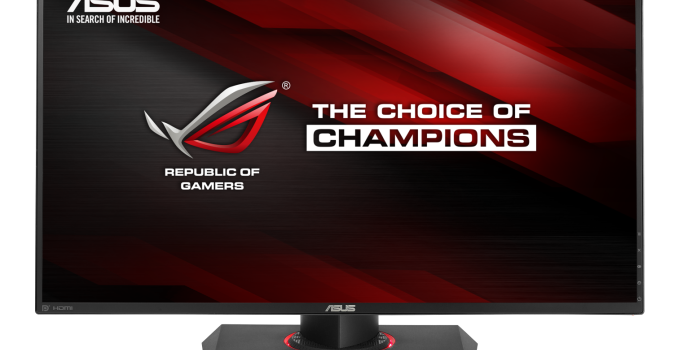
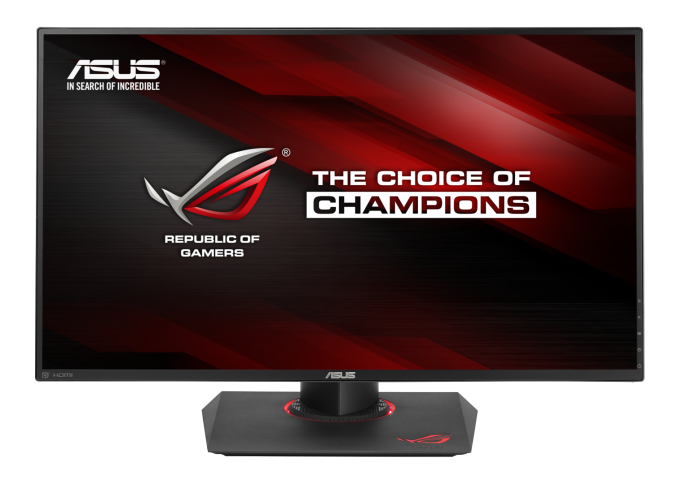
Today ASUS announced two new gaming monitors at their Republic of Gamers Unleashed event in San Francisco. Both displays are 27″ IPS panels, although there are some significant differences between the two that make each one appeal more or less for certain genres of games. Below you can find all the relevant specifications for both of ASUS’s new monitors.

  ASUS PG279Q ASUS PG27AQ
Resolution 2560×1440 3840×2160
Panel Size 27″
Panel Type WLED + IPS
Refresh Rate 144Hz (OC 165Hz) 60Hz
Contrast Ratio 1000:1
Peak Brightness 350 nits 300 nits
Response Time (GtG) 4ms
Viewing Angle (H/V) 178° / 178°
Inputs and Outputs DisplayPort 1.2
HDMI 1.4
2x USB 3.0
3.5mm audio
Color Depth 16.7 million (8bit) 1.07 billion (10bit)
Speakers 2x 2W Stereo
Other Features NVIDIA G-Sync
NVIDIA Ultra Low Motion Blur
NVIDIA G-Sync
Price $799 N/A

Starting with the PG279Q, we see that it’s a 27″ WQHD IPS panel with a refresh rate of 144Hz. This monitor is definitely targeted more toward gamers who play games like first person shooters where a high refresh rate is a greater asset than a higher resolution. When paired with a GTX 960 or faster NVIDIA GPU the display’s refresh rate can be boosted up to 165Hz, and ASUS has even included a button on the monitor to switch between the two refresh rates on command. This is actually more useful then it sounds, because a user can easily move to 165Hz while gaming, and stick with 144Hz in typical use which will also eliminate telecine judder in 24fps video content.

As for the PG27AQ, I would imagine that gamers who play RTS and simulation games would choose it over the PG279Q for its higher resolution. It’s a 27″ UHD panel with a refresh rate of 60Hz, and a greater 10bit color depth than the PG279Q’s 8bit color. It shares most of the remaining specifications with the PG279Q, including a contrast ratio of 1000:1, a 4ms grey to grey response time, a 178 degree viewing angle on both axis, and the inputs and outputs listed above.

Both of these new monitors feature NVIDIA’s G-Sync adaptive refresh rate technology. Even on the PG27AQ this can be useful despite it only being a 60Hz panel, as it will produce a much more fluid image if a game’s frame rate drops below 60fps than a non G-Sync / FreeSync display. However, only the PG279Q has NVIDIA’s Ultra Low Motion Blur technology which uses a strobing backlight to reduce motion blur. It’s worth noting that G-Sync and ULMB are mutually exclusive and you need to choose which one you want a game to use based on whether or not you can maintain the PG279Q’s native refresh rate of 144/165Hz.

The ASUS PG279Q will be available in November, with a starting price of $799 in the United States. Pricing and availability for the PG27AQ is currently unknown, but I would imagine that the price will be in the same realm as the PG279Q.

ASUS Announces ROG PG279Q & PG27AQ Gaming Monitors

ASUS Announces ROG PG279Q & PG27AQ Gaming Monitors

Today ASUS announced two new gaming monitors at their Republic of Gamers Unleashed event in San Francisco. Both displays are 27″ IPS panels, although there are some significant differences between the two that make each one appeal more or less for certain genres of games. Below you can find all the relevant specifications for both of ASUS’s new monitors.

  ASUS PG279Q ASUS PG27AQ
Resolution 2560×1440 3840×2160
Panel Size 27″
Panel Type WLED + IPS
Refresh Rate 144Hz (OC 165Hz) 60Hz
Contrast Ratio 1000:1
Peak Brightness 350 nits 300 nits
Response Time (GtG) 4ms
Viewing Angle (H/V) 178° / 178°
Inputs and Outputs DisplayPort 1.2
HDMI 1.4
2x USB 3.0
3.5mm audio
Color Depth 16.7 million (8bit) 1.07 billion (10bit)
Speakers 2x 2W Stereo
Other Features NVIDIA G-Sync
NVIDIA Ultra Low Motion Blur
NVIDIA G-Sync
Price $799 N/A

Starting with the PG279Q, we see that it’s a 27″ WQHD IPS panel with a refresh rate of 144Hz. This monitor is definitely targeted more toward gamers who play games like first person shooters where a high refresh rate is a greater asset than a higher resolution. When paired with a GTX 960 or faster NVIDIA GPU the display’s refresh rate can be boosted up to 165Hz, and ASUS has even included a button on the monitor to switch between the two refresh rates on command. This is actually more useful then it sounds, because a user can easily move to 165Hz while gaming, and stick with 144Hz in typical use which will also eliminate telecine judder in 24fps video content.

As for the PG27AQ, I would imagine that gamers who play RTS and simulation games would choose it over the PG279Q for its higher resolution. It’s a 27″ UHD panel with a refresh rate of 60Hz, and a greater 10bit color depth than the PG279Q’s 8bit color. It shares most of the remaining specifications with the PG279Q, including a contrast ratio of 1000:1, a 4ms grey to grey response time, a 178 degree viewing angle on both axis, and the inputs and outputs listed above.

Both of these new monitors feature NVIDIA’s G-Sync adaptive refresh rate technology. Even on the PG27AQ this can be useful despite it only being a 60Hz panel, as it will produce a much more fluid image if a game’s frame rate drops below 60fps than a non G-Sync / FreeSync display. However, only the PG279Q has NVIDIA’s Ultra Low Motion Blur technology which uses a strobing backlight to reduce motion blur. It’s worth noting that G-Sync and ULMB are mutually exclusive and you need to choose which one you want a game to use based on whether or not you can maintain the PG279Q’s native refresh rate of 144/165Hz.

The ASUS PG279Q will be available in November, with a starting price of $799 in the United States. Pricing and availability for the PG27AQ is currently unknown, but I would imagine that the price will be in the same realm as the PG279Q.

Western Digital My Cloud Mirror Gen 2 Review

Western Digital is well known to the average consumer as a hard drive manufacturer. By extension, it also opens up the network-attached storage (NAS) market to them. In 2014, the company unified their embedded Linux-based offerings under the My Cloud …

Western Digital My Cloud Mirror Gen 2 Review

Western Digital is well known to the average consumer as a hard drive manufacturer. By extension, it also opens up the network-attached storage (NAS) market to them. In 2014, the company unified their embedded Linux-based offerings under the My Cloud …