Vik


Synology Launches RC18015xs+ / RXD1215sas High-Availability Cluster Solution
Synology Launches RC18015xs+ / RXD1215sas High-Availability Cluster Solution

Synology is no stranger to high-availability (HA) systems. Synology High Availability is touted as one of the features that differentiate Synology’s NAS units from other vendors’ for small business and enterprise usage. Put simply, Synology HA allows two NAS units (same model) to be connected to each other directly through their LAN ports, while also being connected to the main network through their other LAN ports. One of the NAS units is designated as the active unit, while the other passively tracks updates made to that unit. In case of any failure in the active unit, the other one can seamless take over without any downtime.

Synology is now extending this concept to a high-availability cluster. The products being introduced today are the RackStation RC18015xs+ compute node and the 12-bay RXD1215sas expansion unit.

Unlike Synology’s traditional RackStation products, the compute node doesn’t come with storage bays. They are just 1U servers sporting a Xeon E3-1230 v2 (4C / 8T Ivy Bridge running at 3.3 GHz) CPU. The specifications of the RC18015xs+ are provided below.

The PCIe 3.0 x8 slot allows for installation of 10 GbE adapters, if required. The compute node is priced at $4000. The expansion unit comes with the following specifications, and it is priced at $3500.

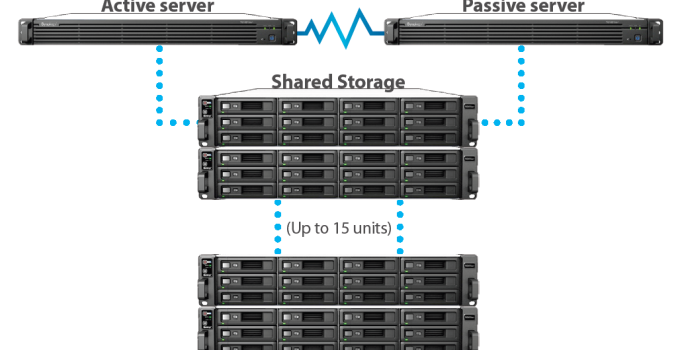
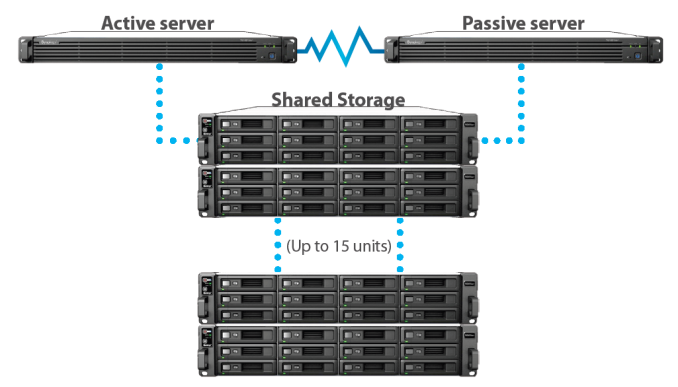
In order to set up a high-availability cluster, two compute nodes and at least one expansion unit is needed (as shown in the diagram on top). The operation of the cluster and high-availability features are similar to Synology HA. Performance numbers are of the order of 2,300 MBps and 330K IOPS using dual 10G adapters. All DSM (v5.2) features such as SSD caching and virtualization certifications are available. High-availability is also ensured with redundancy of hardware components (PSUs / SAS connectors / fans etc.).

The other important aspect of today’s announcement is the usage of btrfs for the file system. As of now, the only COTS NAS units with btrfs support in this market segment have been those from Netgear and Thecus. So, it is heartening to see Synology also adopting it. btrfs brings along many advantages, including snapshots with minimal overhead and protection against bit-rot. The unfortunate aspect is that it is currently only available in this high-availability cluster solution. We hope it becomes an option for other NAS models soon.

Coming to the pricing aspect, we see that consumers need to buy two compute nodes and one expansion unit at the minimum, bringing the cost of a diskless configuration to $11500. This is pretty steep, considering that Quanta’s cluster-in-a-box solutions (with similar computing performance) can be had along with Windows Server licenses for around half the price. Synology’s products have always carried a premium (deservedly so for the ease of setup and maintenance), so it is not a surprise to see the pricing strategy here.
Phanteks Computex 2015 Booth Tour

Phanteks Computex 2015 Booth Tour

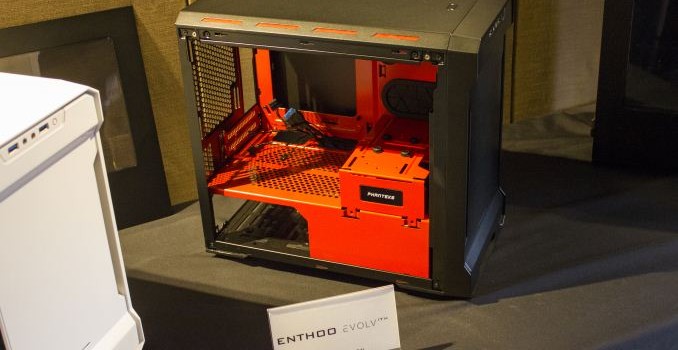
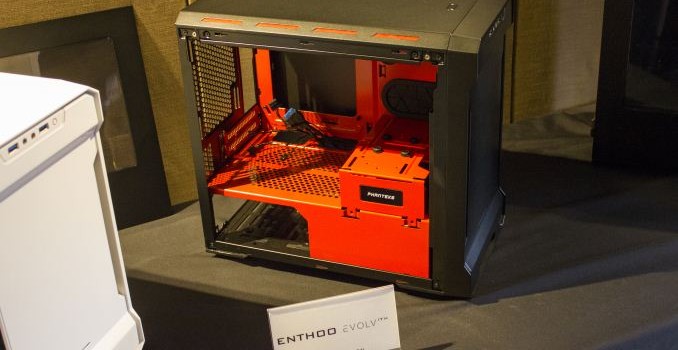
Phanteks had its new Enthoo EVOLV series cases in both mini-ITX and full ATX form factors on display in its suite at Computex. The mini-ITX version is made out of steel and available in two color schemes (white-black & red-black). There’s a single 200mm fan installed in the front with room for two 120/140mm fans at the top and one at the back. It can take a 330mm GPU and a 200mm CPU cooler, so you can build a fairly powerful system. One of the more special aspects of Phanteks’ cases is the PSU cover, which essentially hides the PSU cables to create the clean look that many desire.

The ATX version is fully made out of 3mm thick aluminum (despite the side window). For some reason the design and overall build remind me of the original Mac Pro, which isn’t a bad thing at all. 

One of the unique aspects in the case are fully modular hard drive bays. I have to say I really like the concept because typically many ATX cases easily have +5 irremovable bays, but in reality most users probably won’t use more than one or two. Phanteks includes three with the case, but obviously the user can buy extra ones if needed. 

There are actually two hard drive bays and SSD brackets behind the main chamber, so in most cases the user won’t even need the modular HDD bays and can thus maximize airflow by not having anything between the fans and motherboard. 

Phanteks also had a prototype of a dual-system case that can take a full ATX motherboard and a mini-ITX one. The interesting part is that Phanteks is working on a power splitter, so the two systems could be powered by a single PSU to save on space and cost. As you can see, the concept isn’t really final yet because Phanteks needs to some custom cabling in order to be able to close the case since right now the cables come off too much. It’s a niche product for sure, but the idea of running two full systems inside a decent size case is definitely alluring. See the gallery for more shots of the prototype and other cases Phanteks had to show!

Phanteks Computex 2015 Booth Tour

Phanteks Computex 2015 Booth Tour

Phanteks had its new Enthoo EVOLV series cases in both mini-ITX and full ATX form factors on display in its suite at Computex. The mini-ITX version is made out of steel and available in two color schemes (white-black & red-black). There’s a single 200mm fan installed in the front with room for two 120/140mm fans at the top and one at the back. It can take a 330mm GPU and a 200mm CPU cooler, so you can build a fairly powerful system. One of the more special aspects of Phanteks’ cases is the PSU cover, which essentially hides the PSU cables to create the clean look that many desire.

The ATX version is fully made out of 3mm thick aluminum (despite the side window). For some reason the design and overall build remind me of the original Mac Pro, which isn’t a bad thing at all. 

One of the unique aspects in the case are fully modular hard drive bays. I have to say I really like the concept because typically many ATX cases easily have +5 irremovable bays, but in reality most users probably won’t use more than one or two. Phanteks includes three with the case, but obviously the user can buy extra ones if needed. 

There are actually two hard drive bays and SSD brackets behind the main chamber, so in most cases the user won’t even need the modular HDD bays and can thus maximize airflow by not having anything between the fans and motherboard. 

Phanteks also had a prototype of a dual-system case that can take a full ATX motherboard and a mini-ITX one. The interesting part is that Phanteks is working on a power splitter, so the two systems could be powered by a single PSU to save on space and cost. As you can see, the concept isn’t really final yet because Phanteks needs to some custom cabling in order to be able to close the case since right now the cables come off too much. It’s a niche product for sure, but the idea of running two full systems inside a decent size case is definitely alluring. See the gallery for more shots of the prototype and other cases Phanteks had to show!

Lian Li Computex 2015 Booth Tour

Lian Li Computex 2015 Booth Tour

Lian Li had close to a dozen new or prototype-level cases on display at Computex. I’ve added most in the gallery at the end of this post, but I’ll go through a few of the highlights here as well.

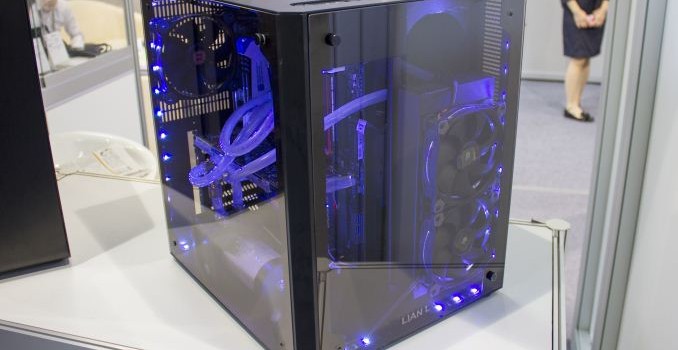
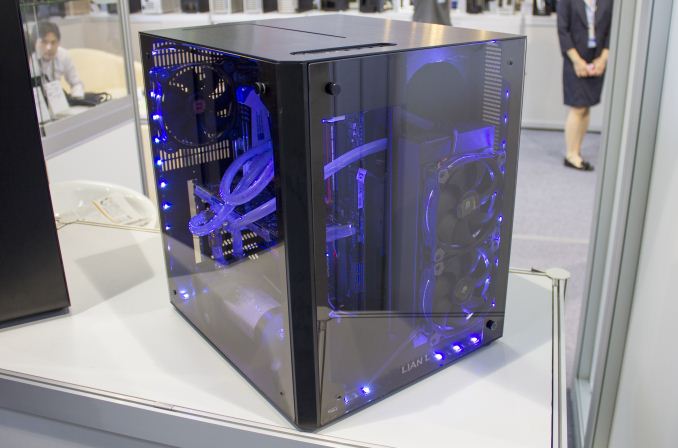
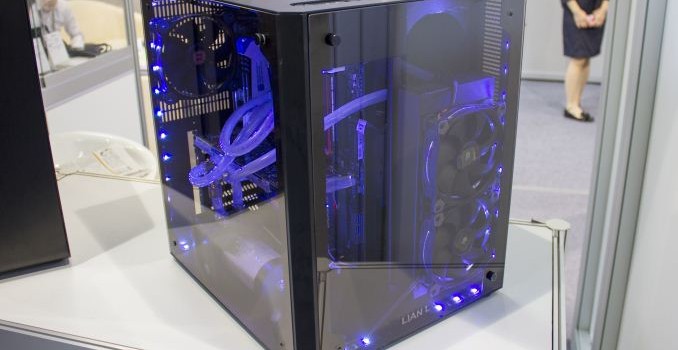
The first one is the PC-V33A, which is a box-like case in which the motherboard is mounted horizontally. The top cover is made out of single piece of aluminum, but it opens up for easy installation. 

The case above is more of a conceptual prototype where Lian Li is playing around with a taller case design. Instead of having hard drive bays next to the motherboard, there’s room for four hard drives in the top chamber, which allows for better airflow in the main chamber. 

One of the more down to earth designs is the PC-K621, which is also Lian Li’s first non-aluminum case. Traditionally Lian Li has kept the Lancool brand for value cases, but it seems that the company is trying to consolidate everything under a single brand now. The PC-K621 is made out of steel and plastic, but it does feel very sturdy and despite the fact that the front panel is made out of plastic, it has a metal-like look in it. Pricing will be about $70, so while it’s not exactly a value case it’s still considerably cheaper than the rest of the Lian Li cases.

One minor change Lian Li has made to its cases is changing the power button material from plastic to aluminum. The company received many complaints of the power button not having the same feel as the rest of the case, so as any respectable company Lian Li listened to its customers and made the change. 

And obviously no Lian Li booth tour is complete without the computer desk case. Lian Li has modified the design a bit so that one can now easily sit with legs under the table, which was one of the issues the earlier cases had (note: that’s Kip Hartwell, Lian Li’s marketing rep, in the photo, not me). The desk is still expensive, though, and Lian Li doesn’t really have any plans of making a value model, but it’s a relatively small niche anyway.

Check out the gallery above if you’re interested in seeing what else Lian Li had to offer!

Lian Li Computex 2015 Booth Tour

Lian Li Computex 2015 Booth Tour

Lian Li had close to a dozen new or prototype-level cases on display at Computex. I’ve added most in the gallery at the end of this post, but I’ll go through a few of the highlights here as well.

The first one is the PC-V33A, which is a box-like case in which the motherboard is mounted horizontally. The top cover is made out of single piece of aluminum, but it opens up for easy installation. 

The case above is more of a conceptual prototype where Lian Li is playing around with a taller case design. Instead of having hard drive bays next to the motherboard, there’s room for four hard drives in the top chamber, which allows for better airflow in the main chamber. 

One of the more down to earth designs is the PC-K621, which is also Lian Li’s first non-aluminum case. Traditionally Lian Li has kept the Lancool brand for value cases, but it seems that the company is trying to consolidate everything under a single brand now. The PC-K621 is made out of steel and plastic, but it does feel very sturdy and despite the fact that the front panel is made out of plastic, it has a metal-like look in it. Pricing will be about $70, so while it’s not exactly a value case it’s still considerably cheaper than the rest of the Lian Li cases.

One minor change Lian Li has made to its cases is changing the power button material from plastic to aluminum. The company received many complaints of the power button not having the same feel as the rest of the case, so as any respectable company Lian Li listened to its customers and made the change. 

And obviously no Lian Li booth tour is complete without the computer desk case. Lian Li has modified the design a bit so that one can now easily sit with legs under the table, which was one of the issues the earlier cases had (note: that’s Kip Hartwell, Lian Li’s marketing rep, in the photo, not me). The desk is still expensive, though, and Lian Li doesn’t really have any plans of making a value model, but it’s a relatively small niche anyway.

Check out the gallery above if you’re interested in seeing what else Lian Li had to offer!