
Vik


Western Digital Seeks To Intervene In Toshiba's Sale Of Memory Business

Western Digital Seeks To Intervene In Toshiba’s Sale Of Memory Business

Western Digital, through its SanDisk subsidiary, is seeking arbitration to prevent Toshiba from selling off its stake in their flash memory joint venture without the consent of Western Digital. Toshiba has been suffering financially due to crippling losses incurred by its nuclear power division, and to offset those losses Toshiba has been working to sell off its memory business. Toshiba’s memory business is one of the most successful parts of the company and the Toshiba-SanDisk flash memory joint venture is one of the four major manufacturers of NAND flash memory.

When Toshiba announced in March their intentions to raise cash by selling a stake in their memory business, a bidding war emerged. Western Digital, Micron and SK Hynix all sought to expand their share of the NAND flash market, but Toshiba was reluctant to sell to a competitor, hoping to avoid a prolonged anti-trust regulatory approval process. The Japanese government also does not want to see the NAND flash business sold to a Chinese-controlled company. This left private equity firms as the bidders Toshiba was most receptive to, but other technology companies like Broadcom and Foxconn are bidding.

After failing to meet their goal of selling a 20% stake by the end of March, and as revised estimates made it clear that 20% would not cover Toshiba’s nuclear losses, Toshiba’s plans shifted toward a complete spin-off and sale of their Toshiba Memory division. As of February, Toshiba valued this unit at around $18B. In late March it was reported that Broadcom and Silver Lake Partners had jointly bid to buy Toshiba Memory for about that amount, then in early April Foxconn reportedly offered $27B. Broadcom has since increased their bid to $28B. SK Hynix and Bain Capital are reported to be jointly bidding up to $13.5B for a majority stake in Toshiba Memory.

The bids for Toshiba Memory have reached prices that are difficult but not necessarily impossible for Western Digital to match. Western Digital would need to fund an acquisition with significant debt, and other analysts have speculated that it may be better for Western Digital to pursue acquiring a majority stake in Toshiba Memory rather than a complete acquisition.

Western Digital does have leverage in their preexisting relationship with Toshiba as co-owner of their flash memory joint venture. Western Digital is alleging that Toshiba is required to obtain Western Digital’s consent before spinning off or selling Toshiba Memory, and that Toshiba’s actions so far have violated their agreements with Western Digital. Western Digital has initiated arbitration proceedings against Toshiba, seeking to block further action without Western Digital’s consent and to reverse the Toshiba Memory spin-off.

These arbitration proceedings are undoubtedly a major frustration to Toshiba, who badly want to close a deal two months ago. Instead, they are now faced with complicated litigation over the terms of at least three joint venture agreements with SanDisk that are now controlled by Western Digital. So far, Toshiba does not appear to have responded to the arbitration demand and Western Digital claims that Toshiba has indicated they have no intention to obtain consent before selling Toshiba Memory to the highest bidder. It is not clear how long this dispute could take to settle, but there is an initial 30-day window for Toshiba to respond before the conflict escalates. If Toshiba does agree to Western Digital’s arbitration request, estimates range from six months to two years for that process to resolve.

By stalling or blocking competing bids, Western Digital seems to be running out the clock on Toshiba with the goal of forcing them to accept a bid from Western Digital that would not be able to win in an open auction. The longer Western Digital can prevent Toshiba from closing a deal, the more desperate Toshiba will get to raise enough cash to keep the company as a whole afloat. Western Digital has not said whether they will file for an injunction if Toshiba does not agree to participate in arbitration, so there is still a lot of uncertainty about how severe this dispute will get and how long it will last. Analysts at J.P. Morgan are optimistic about Western Digital’s prospects in this dispute and are among several analysts to have upgraded their ratings of Western Digital in recent months.

Despite the dispute over corporate ownership rights, the day to day operations of the Toshiba/Western Digital NAND joint venture have been largely unaffected. Both Toshiba and Western Digital are in the process of bringing products to market using their 64-layer 3D NAND flash, which has a lower cost per bit and much higher density than their 15nm planar NAND. Western Digital predicts that 40% of their wafer output this year will be 3D NAND and 75% of that will be the 64-layer generation. Due to the ongoing industry-wide NAND flash shortage, all of the NAND produced by Toshiba and Western Digital is quite profitable and the companies are being judicious in allocating supply to the most lucrative market segments. There has been some speculation that as the dispute escalates Toshiba might deny Western Digital employees access to their fabs in Yokkaichi, Japan, but Western Digital says Toshiba has not taken any such action and Western Digital employees are continuing to work alongside Toshiba employees in research and development, manufacturing, and testing.


Western Digital Seeks To Intervene In Toshiba's Sale Of Memory Business

Western Digital Seeks To Intervene In Toshiba’s Sale Of Memory Business

Western Digital, through its SanDisk subsidiary, is seeking arbitration to prevent Toshiba from selling off its stake in their flash memory joint venture without the consent of Western Digital. Toshiba has been suffering financially due to crippling losses incurred by its nuclear power division, and to offset those losses Toshiba has been working to sell off its memory business. Toshiba’s memory business is one of the most successful parts of the company and the Toshiba-SanDisk flash memory joint venture is one of the four major manufacturers of NAND flash memory.

When Toshiba announced in March their intentions to raise cash by selling a stake in their memory business, a bidding war emerged. Western Digital, Micron and SK Hynix all sought to expand their share of the NAND flash market, but Toshiba was reluctant to sell to a competitor, hoping to avoid a prolonged anti-trust regulatory approval process. The Japanese government also does not want to see the NAND flash business sold to a Chinese-controlled company. This left private equity firms as the bidders Toshiba was most receptive to, but other technology companies like Broadcom and Foxconn are bidding.

After failing to meet their goal of selling a 20% stake by the end of March, and as revised estimates made it clear that 20% would not cover Toshiba’s nuclear losses, Toshiba’s plans shifted toward a complete spin-off and sale of their Toshiba Memory division. As of February, Toshiba valued this unit at around $18B. In late March it was reported that Broadcom and Silver Lake Partners had jointly bid to buy Toshiba Memory for about that amount, then in early April Foxconn reportedly offered $27B. Broadcom has since increased their bid to $28B. SK Hynix and Bain Capital are reported to be jointly bidding up to $13.5B for a majority stake in Toshiba Memory.

The bids for Toshiba Memory have reached prices that are difficult but not necessarily impossible for Western Digital to match. Western Digital would need to fund an acquisition with significant debt, and other analysts have speculated that it may be better for Western Digital to pursue acquiring a majority stake in Toshiba Memory rather than a complete acquisition.

Western Digital does have leverage in their preexisting relationship with Toshiba as co-owner of their flash memory joint venture. Western Digital is alleging that Toshiba is required to obtain Western Digital’s consent before spinning off or selling Toshiba Memory, and that Toshiba’s actions so far have violated their agreements with Western Digital. Western Digital has initiated arbitration proceedings against Toshiba, seeking to block further action without Western Digital’s consent and to reverse the Toshiba Memory spin-off.

These arbitration proceedings are undoubtedly a major frustration to Toshiba, who badly want to close a deal two months ago. Instead, they are now faced with complicated litigation over the terms of at least three joint venture agreements with SanDisk that are now controlled by Western Digital. So far, Toshiba does not appear to have responded to the arbitration demand and Western Digital claims that Toshiba has indicated they have no intention to obtain consent before selling Toshiba Memory to the highest bidder. It is not clear how long this dispute could take to settle, but there is an initial 30-day window for Toshiba to respond before the conflict escalates. If Toshiba does agree to Western Digital’s arbitration request, estimates range from six months to two years for that process to resolve.

By stalling or blocking competing bids, Western Digital seems to be running out the clock on Toshiba with the goal of forcing them to accept a bid from Western Digital that would not be able to win in an open auction. The longer Western Digital can prevent Toshiba from closing a deal, the more desperate Toshiba will get to raise enough cash to keep the company as a whole afloat. Western Digital has not said whether they will file for an injunction if Toshiba does not agree to participate in arbitration, so there is still a lot of uncertainty about how severe this dispute will get and how long it will last. Analysts at J.P. Morgan are optimistic about Western Digital’s prospects in this dispute and are among several analysts to have upgraded their ratings of Western Digital in recent months.

Despite the dispute over corporate ownership rights, the day to day operations of the Toshiba/Western Digital NAND joint venture have been largely unaffected. Both Toshiba and Western Digital are in the process of bringing products to market using their 64-layer 3D NAND flash, which has a lower cost per bit and much higher density than their 15nm planar NAND. Western Digital predicts that 40% of their wafer output this year will be 3D NAND and 75% of that will be the 64-layer generation. Due to the ongoing industry-wide NAND flash shortage, all of the NAND produced by Toshiba and Western Digital is quite profitable and the companies are being judicious in allocating supply to the most lucrative market segments. There has been some speculation that as the dispute escalates Toshiba might deny Western Digital employees access to their fabs in Yokkaichi, Japan, but Western Digital says Toshiba has not taken any such action and Western Digital employees are continuing to work alongside Toshiba employees in research and development, manufacturing, and testing.
Western Digital Seeks To Intervene In Toshiba's Sale Of Memory Business

Western Digital Seeks To Intervene In Toshiba’s Sale Of Memory Business

Western Digital, through its SanDisk subsidiary, is seeking arbitration to prevent Toshiba from selling off its stake in their flash memory joint venture without the consent of Western Digital. Toshiba has been suffering financially due to crippling losses incurred by its nuclear power division, and to offset those losses Toshiba has been working to sell off its memory business. Toshiba’s memory business is one of the most successful parts of the company and the Toshiba-SanDisk flash memory joint venture is one of the four major manufacturers of NAND flash memory.

When Toshiba announced in March their intentions to raise cash by selling a stake in their memory business, a bidding war emerged. Western Digital, Micron and SK Hynix all sought to expand their share of the NAND flash market, but Toshiba was reluctant to sell to a competitor, hoping to avoid a prolonged anti-trust regulatory approval process. The Japanese government also does not want to see the NAND flash business sold to a Chinese-controlled company. This left private equity firms as the bidders Toshiba was most receptive to, but other technology companies like Broadcom and Foxconn are bidding.

After failing to meet their goal of selling a 20% stake by the end of March, and as revised estimates made it clear that 20% would not cover Toshiba’s nuclear losses, Toshiba’s plans shifted toward a complete spin-off and sale of their Toshiba Memory division. As of February, Toshiba valued this unit at around $18B. In late March it was reported that Broadcom and Silver Lake Partners had jointly bid to buy Toshiba Memory for about that amount, then in early April Foxconn reportedly offered $27B. Broadcom has since increased their bid to $28B. SK Hynix and Bain Capital are reported to be jointly bidding up to $13.5B for a majority stake in Toshiba Memory.

The bids for Toshiba Memory have reached prices that are difficult but not necessarily impossible for Western Digital to match. Western Digital would need to fund an acquisition with significant debt, and other analysts have speculated that it may be better for Western Digital to pursue acquiring a majority stake in Toshiba Memory rather than a complete acquisition.

Western Digital does have leverage in their preexisting relationship with Toshiba as co-owner of their flash memory joint venture. Western Digital is alleging that Toshiba is required to obtain Western Digital’s consent before spinning off or selling Toshiba Memory, and that Toshiba’s actions so far have violated their agreements with Western Digital. Western Digital has initiated arbitration proceedings against Toshiba, seeking to block further action without Western Digital’s consent and to reverse the Toshiba Memory spin-off.

These arbitration proceedings are undoubtedly a major frustration to Toshiba, who badly want to close a deal two months ago. Instead, they are now faced with complicated litigation over the terms of at least three joint venture agreements with SanDisk that are now controlled by Western Digital. So far, Toshiba does not appear to have responded to the arbitration demand and Western Digital claims that Toshiba has indicated they have no intention to obtain consent before selling Toshiba Memory to the highest bidder. It is not clear how long this dispute could take to settle, but there is an initial 30-day window for Toshiba to respond before the conflict escalates. If Toshiba does agree to Western Digital’s arbitration request, estimates range from six months to two years for that process to resolve.

By stalling or blocking competing bids, Western Digital seems to be running out the clock on Toshiba with the goal of forcing them to accept a bid from Western Digital that would not be able to win in an open auction. The longer Western Digital can prevent Toshiba from closing a deal, the more desperate Toshiba will get to raise enough cash to keep the company as a whole afloat. Western Digital has not said whether they will file for an injunction if Toshiba does not agree to participate in arbitration, so there is still a lot of uncertainty about how severe this dispute will get and how long it will last. Analysts at J.P. Morgan are optimistic about Western Digital’s prospects in this dispute and are among several analysts to have upgraded their ratings of Western Digital in recent months.

Despite the dispute over corporate ownership rights, the day to day operations of the Toshiba/Western Digital NAND joint venture have been largely unaffected. Both Toshiba and Western Digital are in the process of bringing products to market using their 64-layer 3D NAND flash, which has a lower cost per bit and much higher density than their 15nm planar NAND. Western Digital predicts that 40% of their wafer output this year will be 3D NAND and 75% of that will be the 64-layer generation. Due to the ongoing industry-wide NAND flash shortage, all of the NAND produced by Toshiba and Western Digital is quite profitable and the companies are being judicious in allocating supply to the most lucrative market segments. There has been some speculation that as the dispute escalates Toshiba might deny Western Digital employees access to their fabs in Yokkaichi, Japan, but Western Digital says Toshiba has not taken any such action and Western Digital employees are continuing to work alongside Toshiba employees in research and development, manufacturing, and testing.
Acer Predator Z35P Available for Order: Curved 35" with 3440×1440@120 Hz and G-Sync

Acer Predator Z35P Available for Order: Curved 35″ with 3440×1440@120 Hz and G-Sync

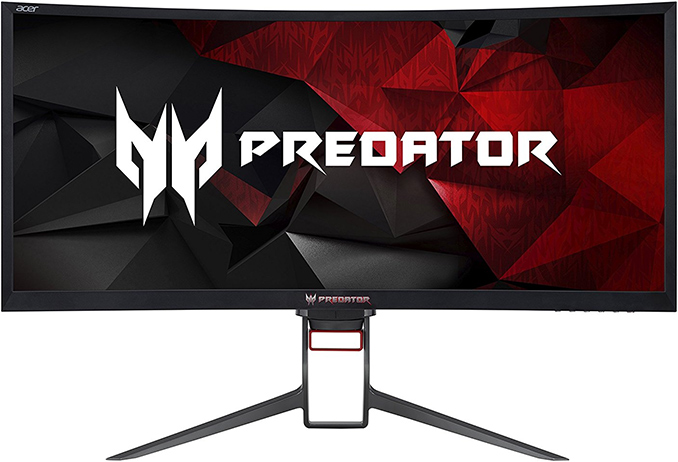
Acer has quietly launched yet another curved ultra-wide Predator display for gamers seeking a large diagonal, a high resolution and an ultra-high refresh rate. The Predator Z35P resembles its predecessor launched a couple of years ago, but has a higher resolution and a better contrast ratio. The new monitor is available for pre-orders now.

Acer’s Predator Z35 was one of the first large ultra-wide curved displays featuring a very high refresh rate when it was introduced in mid-2015. Its large dimensions, along with a 144-200 Hz refresh rate, and accompanied by NVIDIA’s G-Sync technology, made it well known among demanding gamers – but its resolution of 2560×1080 was not high enough. The relatively low resolution was justified by the fact that in 2015 only ultra-high-end graphics cards could hit 200 fps in demanding titles at 2560×1080. In the mean time, graphics cards have come a long way in two years and it is time for Acer’s large curved ultra-wide monitor to get a resolution upgrade.

The new Acer Predator Z35P is based on a 35” VA panel offering a 3440×1440 resolution (2.39:1 aspect ratio), a maximum brightness of 300 nits, a 2500:1 contrast ratio, a 100 Hz refresh rate, 178°/178° viewing angles, a 4 ms response time, and 1800R curvature. According to TFT Central, the refresh rate of the panel can be overclocked from 100 Hz to 120 Hz, which is not as high as the 200 Hz possible on the original Z35, but which is well beyond what non-gaming monitors can offer.

When it comes to connectivity, the Acer Predator Z35P monitor has one HDMI 1.4 port, a DisplayPort 1.2 port, four USB Type-A headers (with one USB-B input) and a 3.5-mm audio jack to drive two 9 W integrated speakers.

Acer Predator Z35P Specifications
  Z35P bmiphz
UM.CZ1AA.P01
Panel 35″ AMVA+
Native Resolution 3440 × 1440
Maximum Refresh Rate 100 – 120 Hz
Response Time 4 ms GTG
Brightness 300 cd/m²
Contrast 2500:1
Viewing Angles 178°/178° horizontal/vertical
Curvature 1800R
Color Gamut 100% sRGB (?)
Dynamic Refresh Rate Tech NVIDIA G-Sync
Pixel Pitch 0.2382 mm × 0.242 mm (?)
Pixel Density 106 PPI
Inputs 1 × DP 1.2
1 × HDMI 1.4
Audio 3.5 mm input/output
2 × 9 W speakers
USB Hub 4 × USB 3.0 Type-A connectors
1 × USB 3.0 Type-B input
Power Consumption Idle: 0.5 W
Active: 65 W

The new Predator Z35P does not seem to have many rivals on the market that can offer a similar combination of features: dimensions (35″), resolution (3440×1440), curvature, a very high refresh rate (up to 120 Hz), G-Sync support and so on. In fact, there are only two of them: the AOC Agon AG352UCG as well as the HP Omen X, if we do not consider slightly smaller 34″-class ASUS ROG Swift PG348Q and Acer Predator X34 (this one uses an IPS panel with 60 Hz, but it is overclockable to 100 Hz).

The Acer Predator Z35P is expected to be available in the U.S. in the coming weeks for $1099.99. Amazon is taking pre-orders on the display with ETA in one to three weeks.

Related Reading:

Acer Predator Z35P Available for Order: Curved 35" with 3440×1440@120 Hz and G-Sync

Acer Predator Z35P Available for Order: Curved 35″ with 3440×1440@120 Hz and G-Sync

Acer has quietly launched yet another curved ultra-wide Predator display for gamers seeking a large diagonal, a high resolution and an ultra-high refresh rate. The Predator Z35P resembles its predecessor launched a couple of years ago, but has a higher resolution and a better contrast ratio. The new monitor is available for pre-orders now.

Acer’s Predator Z35 was one of the first large ultra-wide curved displays featuring a very high refresh rate when it was introduced in mid-2015. Its large dimensions, along with a 144-200 Hz refresh rate, and accompanied by NVIDIA’s G-Sync technology, made it well known among demanding gamers – but its resolution of 2560×1080 was not high enough. The relatively low resolution was justified by the fact that in 2015 only ultra-high-end graphics cards could hit 200 fps in demanding titles at 2560×1080. In the mean time, graphics cards have come a long way in two years and it is time for Acer’s large curved ultra-wide monitor to get a resolution upgrade.

The new Acer Predator Z35P is based on a 35” VA panel offering a 3440×1440 resolution (2.39:1 aspect ratio), a maximum brightness of 300 nits, a 2500:1 contrast ratio, a 100 Hz refresh rate, 178°/178° viewing angles, a 4 ms response time, and 1800R curvature. According to TFT Central, the refresh rate of the panel can be overclocked from 100 Hz to 120 Hz, which is not as high as the 200 Hz possible on the original Z35, but which is well beyond what non-gaming monitors can offer.

When it comes to connectivity, the Acer Predator Z35P monitor has one HDMI 1.4 port, a DisplayPort 1.2 port, four USB Type-A headers (with one USB-B input) and a 3.5-mm audio jack to drive two 9 W integrated speakers.

Acer Predator Z35P Specifications
  Z35P bmiphz
UM.CZ1AA.P01
Panel 35″ AMVA+
Native Resolution 3440 × 1440
Maximum Refresh Rate 100 – 120 Hz
Response Time 4 ms GTG
Brightness 300 cd/m²
Contrast 2500:1
Viewing Angles 178°/178° horizontal/vertical
Curvature 1800R
Color Gamut 100% sRGB (?)
Dynamic Refresh Rate Tech NVIDIA G-Sync
Pixel Pitch 0.2382 mm × 0.242 mm (?)
Pixel Density 106 PPI
Inputs 1 × DP 1.2
1 × HDMI 1.4
Audio 3.5 mm input/output
2 × 9 W speakers
USB Hub 4 × USB 3.0 Type-A connectors
1 × USB 3.0 Type-B input
Power Consumption Idle: 0.5 W
Active: 65 W

The new Predator Z35P does not seem to have many rivals on the market that can offer a similar combination of features: dimensions (35″), resolution (3440×1440), curvature, a very high refresh rate (up to 120 Hz), G-Sync support and so on. In fact, there are only two of them: the AOC Agon AG352UCG as well as the HP Omen X, if we do not consider slightly smaller 34″-class ASUS ROG Swift PG348Q and Acer Predator X34 (this one uses an IPS panel with 60 Hz, but it is overclockable to 100 Hz).

The Acer Predator Z35P is expected to be available in the U.S. in the coming weeks for $1099.99. Amazon is taking pre-orders on the display with ETA in one to three weeks.

Related Reading: