Vik


Qualcomm Reports FY 2015 Q2 Results: Strong Q2 But Lower Forecast For 2015
Qualcomm Reports FY 2015 Q2 Results: Strong Q2 But Lower Forecast For 2015

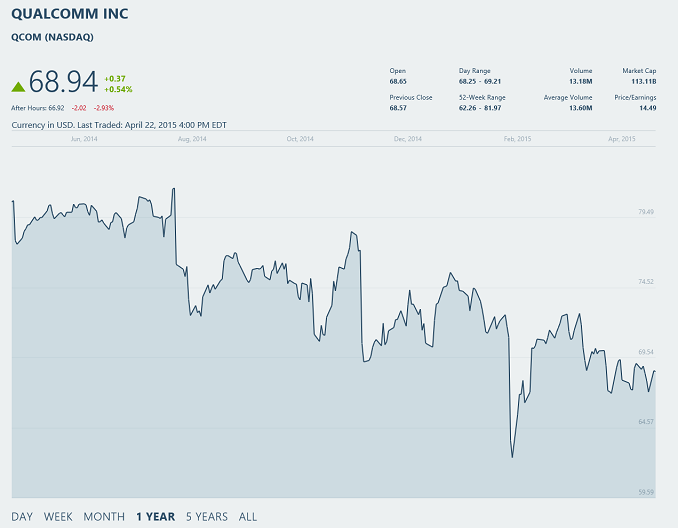
Qualcomm released their Q2 financial results today, and they had another strong quarter. Revenues increased 8% from Q2 2014, coming in at $6.9 billion. On a GAAP basis, operating Income took a nose dive to $1.3 billion, down from $2.0 billion last year and $2.1 billion last quarter. This of course means that net income is also much lower, with $1.1 billion being reported for Q2 2015, which is down 46% from last year and 47% from last quarter. GAAP earnings per share came in at $0.63, down from $1.14 last year and $1.17 last quarter.

Qualcomm Q2 2015 Financial Results (GAAP)
  Q2’2015 Q1’2015 Q2’2014
Revenue $6.894B $7.099B $6.367B
Gross Margin 19.4% 29.1% 31.3%
Operating Income $1.336B $2.064B $1.990B
Net Income $1.053B $1.972B $1.959B
Earnings Per Share $0.63 $1.17 $1.31

The reason for the large hit to operating income, net income, and EPS is due to Qualcomm having to pay out $975 million to the China National Development and Reform Commission or NDRC. This charge is the resolution that was enacted due to Qualcomm falling afoul of China’s Anti-Monopoly Law, and as such it is a one-time fee. As such, Qualcomm has also released Non-GAAP results which exclude this one time hit to get a better look at how the business is operating. On a Non-GAAP basis, operating income was up 16% year-over-year to $2.7 billion, which is also a 7% gain over last quarter. Net income was up 4% at $2.3 billion, and EPS came in at $1.40 for Q2, as compared to $1.31 last year and $1.34 last quarter.

Qualcomm Q2 2015 Financial Results (Non-GAAP)
  Q2’2015 Q1’2015 Q2’2014
Revenue $6.894B $7.099B $6.367B
Gross Margin 39.3% 35.7% 36.7%
Operating Income $2.707B $2.531B $2.337B
Net Income $2.339B $2.263B $2.255B
Earnings Per Share $1.40 $1.34 $1.31

Qualcomm actually had negative cash flow for the quarter. The already mentioned fine paid to China accounted for some of it, and Qualcomm also performed a prepayment of $950 million to secure long-term capacity from one of their suppliers. Those two hits resulted in a $0.7 billion shortfall in cash flow. Last year, they had $1.8 billion in positive cash flow, and last quarter it was $2.4 billion.

For the second quarter, Qualcomm shipped 233 million MSM chips, which is up 24% year-over-year, but down from the 270 million shipped in Q1. Total device sales from Qualcomm licencees was $75.8 billion for the quarter, up 14% year-over-year and up 34% quarter-over-quarter. The company is estimating that 384-388 million 3G/4G devices shipped in Q2, which is up 30% over Q2 2014 and up 35% over Q1 2015. Average Selling Price of 3G/4G devices was $193-$199, which is down 13% year-over-year and 1% from last quarter, as the market moves towards lower cost devices.

Qualcomm Devices
  Q2’2015 Q1’2015 Q2’2014
MSM Chip Shipments 233M 270M 188M
Total Reported Device Sales $75.8B $56.4B $66.5B
Est. reported 3G/4G device shipments 384-388M 284-288M 295-299M
3G/4G Device Average Selling Price $193-$199 $194-$200 $221-$227

Qualcomm repurchased 27.8 million shares in Q2, plus paid out $0.42 per share, returning $2.6 billion to shareholders of the company. On March 9th, they announced a new $15 billion stock repurchasing program which includes $10 billion in shares to be bought back in the next twelve months. Additionally, they will be paying out $0.48 per share on June 24th to any shareholder of record as of June 3rd, which is 14% more than last quarter’s payout.

However not everything to come out of the results was good news. Qualcomm has lowered their outlook for the semiconductor business for the second half of FY 2015. Greater competition has reduced Qualcomm’s market share in the SoC space, especially within flagship phones. The two largest phone makers, Samsung and Apple, both use their own designs in their flagship products. This will change Qualcomm’s product mix more heavily towards modem chipsets. There has also been some uncertainly created due to the existing licensing agreements Qualcomm has in place in China due to the resolution with the NDRC. With the case now concluded, the company is hopeful that these arrangements can be sorted out, as they believe that not all devices sold in calendar year 2014 were reported to them.

For Q3, the estimate is that revenues will decline by 9-21% over Q3 2014, which will drop EPS 31% to 41% on a Non-GAAP basis, or 37% to 49% based on GAAP reporting. For FY 2015, Qualcomm is estimating revenue to be between negative 6% and positive 2%.

Source: Qualcomm

Google Unveils Project Fi: A Network for the Nexus 6

Google Unveils Project Fi: A Network for the Nexus 6

Today Google officially announced their previously rumored entry into the world of wireless service. This new endeavor is known as Project Fi, and it’s exclusive to owners of the Nexus 6 who live in the United States. While carriers have offered branded mobile devices at times, the entry of a company making mobile phones into the business of providing the wireless service for their own devices is unprecedented. But unlike Google Fiber, Project Fi is not Google’s attempt to build a new wireless network in the United States. Rather, they will be acting as a Mobile Virtual Network Operator (MVNO) running on the T-Mobile and Sprint networks, as well as piggybacking off of open WiFi hotspots.

On a typical carrier you will pay for some bucket of data alongside your calling minutes and texts, and if you don’t use all that data during the month then it disappears. Some carriers like T-Mobile USA have played with this by allowing data to roll over to another month, much like how many prepaid carriers allow minutes to roll over to the next month if they are unused. But in general, you often end up paying for more data then you actually need to avoid overage charges. With Project Fi, Google starts plans at $20 per month for unlimited domestic calling and unlimited domestic + international texting. On top of that you can select how much data you believe you will need, with the cost being $10/GB.

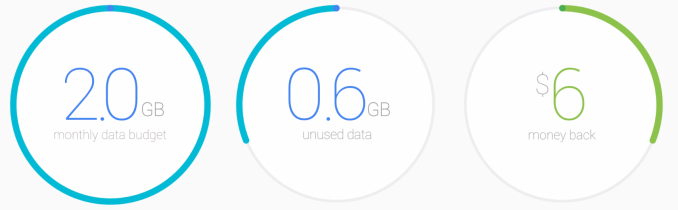
The unique aspect of Project Fi when compared to other network operators is how Google is changing the situation with unused data. Rather than rolling it over or having it disappear, Google simply credits you for the difference. For example, a user who pays $30 for 3GB per month may only use 1.4GB that month. In that situation, Google will credit them $16 for the data they did not use. Effectively, this means that Google only charges users for the data they use, but not at the typically ridiculous rates for pay as you need data on other carriers. What I don’t understand is why Google even has data tiers in the first place. Given the rounding, they might as well just charge $1 for every 100MB used, as any overages are charged as the same rate as the data in the plan itself.

Google is also taking much of the pain out of roaming in other nations. The data you purchase for your Project Fi plan is usable in 120 different countries, although it’s limited to a speed of 256Kbps. Google’s network also extends beyond cellular carriers, with Google’s network configured to automatically utilize public hotspots as part of the network itself. WiFi calling is supported, and so the transition between cellular and WiFi should be seamless in theory. Google is also promising that information will be encrypted so that users can have their privacy preserved when using public WiFi.

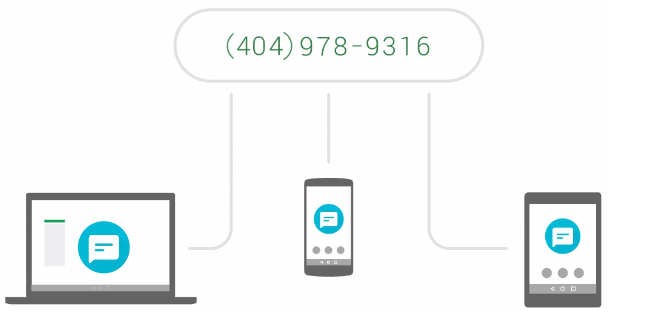
The last really interesting part of Project Fi is how it will be able to integrate with Hangouts. Since your phone number “lives in the cloud”, Google can push texts and phone calls to any devices that have the Google Hangouts application installed. This extends from your Nexus 6, to your Chromebook, to your iPad, to your Windows PC.

Project Fi is currently beginning as an early access program. Users who are interested and who own the Nexus 6 can check out Google’s sign up page to apply to be one of the first users of this new network. Google’s blog post in the source below has a bit more information as well as a video about this new project

Intel PPSTCK1A32WFC Bay Trail-T Compute Stick Review

The success of UCFF PCs have made vendors realize that small and power-efficient computing platforms are here to stay. ARM SoC manufacturers, finding that the tablet market had reached saturation, kick-started a new product category in the form of ‘HDMI sticks’. As a computing platform, they were smaller than the ultra-compact form factor PCs – just looking like an oversized USB key. Intel announced the Compute Stick at CES to bring one of the first Wintel platforms into this space. Late last month, Google also introduced a Chrome OS-based HDMI stick. Both of these point to the ‘stick’ computing platform being more than just a passing fad. The Intel Compute Stick we are reviewing today comes with Windows 8.1 with Bing (32-bit) pre-installed, making it ready to roll right out of the box. Read on for a performance review and our thoughts on the product.

The Moto E (2015) Review

During the past couple of years we’ve seen a dramatic shift in Motorola’s strategy for competing in the smartphone market. As one of the earliest producers of Android devices, the company needed to let go of ideas and strategies from years that had since past. Producing exclusive devices for carriers like Verizon was no longer going to work with the iPhone finally freed from exclusivity on AT&T, and Motorola’s hardware and software design had begun to show a great deal of age.

That brings us to today, at a point where Motorola has more or less found their new approach to making smartphones. It’s a very simple and understandable approach. Consistency across the design of the hardware, consistency across the design of the software, and a yearly line of phones that can easily be divided into budget, mid-range, and flagship categories based on a single letter in their name. This review takes a look at the newest version of Motorola’s budget device, the 2015 Moto E. Read on for our full review of Motorola’s newest smartphone.

Samsung Introduces New 8" and 9.7" Galaxy Tab A Tablets

Samsung Introduces New 8″ and 9.7″ Galaxy Tab A Tablets

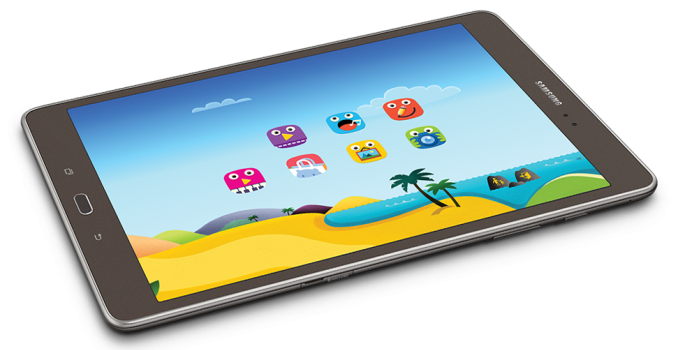
Today Samsung Electronics America announced two new tablets that are coming to market in the United States. Samsung’s new Galaxy Tab A tablets come in 8.0″ and 9.7″ sizes, and Samsung is marketing them as tablets that are well suited for keeping in touch with friends and family. The specs of both tablets are laid out in the chart below.

  Samsung Galaxy Tab A 8.0″ Samsung Galaxy Tab A 9.7″
SoC Snapdragon 410 (APQ8016) 4x 1.2GHz Cortex A53,
400MHz Adreno 306 GPU
RAM/NAND 16/32GB NAND + MicroSDXC, 1.5GB RAM
Display 8.0″ 1024×768 PLS LCD 9.7″ 1024×768 PLS LCD
Dimensions 208.4 x 137.9 x 7.5mm, 313g 242.5 x 166.8 x 7.5mm, 449g
Camera 5MP Rear Facing, 2MP Front Facing
Battery 4200 mAh (15.96 Whr) 6000 mAh (22.8 Whr)
OS Android 5.0 Lollipop
Connectivity 802.11 a/b/g/n + BT 4.0, microUSB2.0

Both tablets have very similar specifications. They are both distinctly mid-range tablets, with Qualcomm’s Snapdragon 410 at their heart, 1.5GB of RAM, and a 1024×768 PLS display. They’re really only differentiated by the size of their displays, and subsequently their dimensions and battery capacity. I think it may be difficult for Samsung to charge a price premium for the 9.7″ model when it doesn’t have any improvements to display resolution or internal hardware over the 8.0″ model.

What makes these new tablets stand out from Samsung’s previous tablet offerings are their sizes and their design. Both tablets have a 4:3 aspect ratio, which is a significant departure from the 16:10 tablets that Samsung has produced in the past. Both tablets also have a full metal chassis, which will be an enormous improvement over the plastic construction of Samsung’s other tablets. I am very interested to see what Samsung can do with this type of design on a high end tablet with flagship specifications.

Update: This article previously stated that he Galaxy Tab A tablets have a metal chassis. According to Samsung this is not actually the case.

Both Galaxy Tab A models are available for preorder now, and they’ll begin to ship on May 1st in the United States. Both models are available in white, titanium, and blue finishes. The 8.0″ model costs at $229, while the 9.7″ model costs $299. There will also be a version of the 9.7″ model with Samsung’s S-pen included for $349. Through Samsung’s new app partnership with Microsoft, the new tablets will come with Microsoft’s Office for Android applications preinstalled, and buyers will receive 100GB of OneDrive storage for two years.