Vik


WD Adds Helium-Filled 10 TB NAS HDDs to WD Red, WD Red Pro Lineups
WD Adds Helium-Filled 10 TB NAS HDDs to WD Red, WD Red Pro Lineups

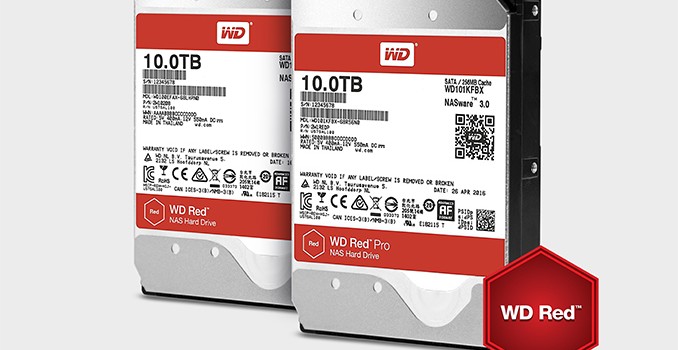
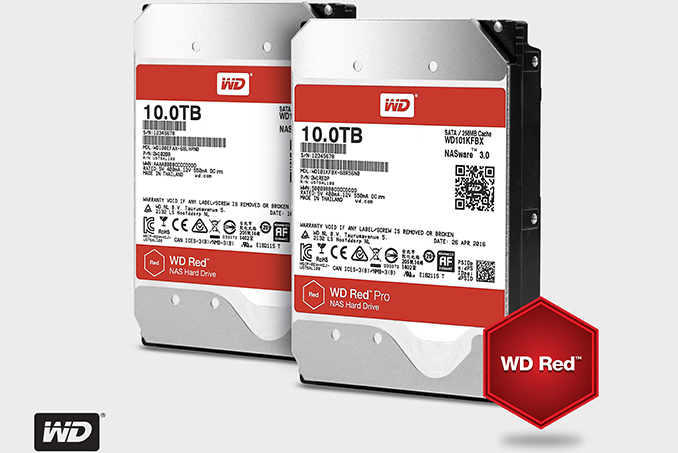
Western Digital has announced two new helium-filled hard drives targeting consumer and business NAS applications. The new WD Red and WD Red Pro HDDs increase capacity of WD’s NAS drives to 10 TB, boost their performance and also reduce their power consumption. Therefore, the new drives enable makers of NAS units to increase capacities of their products to 80 TB (or 160TB) while increasing speeds and cutting down power.

After introducing its first hermetically sealed helium-filled NAS and video-surveillance HDDs with 8 TB capacity and six platters last year, Western Digital is refreshing its Red and Purple lineups with more advanced drives offering 10 TB capacity and using seven 1.42 TB platters. The new WD Red and WD Red Pro with 10 TB capacity are based on revamped 5400 RPM and 7200 RPM HelioSeal platforms that can support a higher number of platters. The drives also feature increased areal density and 256 MB of cache, enabling ~17% higher sequential read/write performance compared to its predecessors, as well as a lower power consumption compared to previous-gen helium WD Red hard drives. Other than that, Western Digital does not really disclose the feature set of its platform for helium-filled HDDs for NAS applications.

The WD Pro 10 TB drive is engineered for personal or small business NAS systems with up to eight bays, is optimized for mixed workloads and has a 5400 RPM spindle speed. By contrast, the WD Red Pro 10 TB is aimed at medium business and enterprise-class NAS systems up to 16 bays, which is why the HDD features additional protection against vibrations as well as improved random read performance due to both 7200 RPM spindle speed and firmware tuning.  Just like their predecessors, the new WD Red/WD Red Pro hard drives come with SATA 6 Gbps interface.

Comparison of Western Digital’s Helium-Filled NAS HDDs
  WD Red
WD100EFAX
WD Red
WD80EFZX
WD Red Pro
WD101KFBX
WD Red Pro
WD8001FFWX
Capacity 10 TB 8 TB 10 TB 8 TB
RPM 5400 RPM 7200 RPM
Interface SATA 6 Gbps
DRAM Cache 256 MB 128 MB 256 MB 128 MB
Data Transfer Rate (host to/from drive) 210 MB/s 178 MB/s 240 MB/s 205 MB/s
MTBF 1 million hours
Rated Workload (read and write) 180 TB/year 300 TB/year
Acoustics (Seek) 29 dBA 29 dBA 36 dBA
Power Consumption Sequential read/write 6.2 W 6.4 W 5.7 W 8.3 W
Idle 2.8 W 5.7 W 2.8 W 5.2 W
Sleep 0.5 W 0.7 W 0.5 W 0.7 W
Warranty 3 Years 5 Years
Price (as of May 2017) $494 $266.25 $533 $359.99
$0.049 per GB $0.033 per GB $0.05 per GB $0.045 per GB
20 GB per $ 30 GB per $ 18.76 GB per $ 22.2 GB per $

It is interesting to note that WD has improved the power consumption of the 10TB drives over the older 8TB drives. We are asking how exactly WD is doing that, as details were not given with the press release.

The 10TB WD Red and 10TB WD Red Pro are available in the U.S. from select retailers and distributors. The WD Red 10 TB is covered by a three-year warranty and has a price tag of $494. The more advanced WD Red Pro 10 TB features a five-year warranty and has a $533 MSRP.

Related Reading:
WD Adds Helium-Filled 10 TB NAS HDDs to WD Red, WD Red Pro Lineups

WD Adds Helium-Filled 10 TB NAS HDDs to WD Red, WD Red Pro Lineups

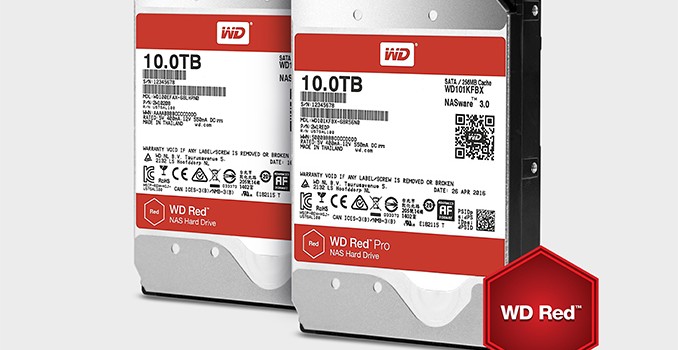
Western Digital has announced two new helium-filled hard drives targeting consumer and business NAS applications. The new WD Red and WD Red Pro HDDs increase capacity of WD’s NAS drives to 10 TB, boost their performance and also reduce their power consumption. Therefore, the new drives enable makers of NAS units to increase capacities of their products to 80 TB (or 160TB) while increasing speeds and cutting down power.

After introducing its first hermetically sealed helium-filled NAS and video-surveillance HDDs with 8 TB capacity and six platters last year, Western Digital is refreshing its Red and Purple lineups with more advanced drives offering 10 TB capacity and using seven 1.42 TB platters. The new WD Red and WD Red Pro with 10 TB capacity are based on revamped 5400 RPM and 7200 RPM HelioSeal platforms that can support a higher number of platters. The drives also feature increased areal density and 256 MB of cache, enabling ~17% higher sequential read/write performance compared to its predecessors, as well as a lower power consumption compared to previous-gen helium WD Red hard drives. Other than that, Western Digital does not really disclose the feature set of its platform for helium-filled HDDs for NAS applications.

The WD Pro 10 TB drive is engineered for personal or small business NAS systems with up to eight bays, is optimized for mixed workloads and has a 5400 RPM spindle speed. By contrast, the WD Red Pro 10 TB is aimed at medium business and enterprise-class NAS systems up to 16 bays, which is why the HDD features additional protection against vibrations as well as improved random read performance due to both 7200 RPM spindle speed and firmware tuning.  Just like their predecessors, the new WD Red/WD Red Pro hard drives come with SATA 6 Gbps interface.

Comparison of Western Digital’s Helium-Filled NAS HDDs
  WD Red
WD100EFAX
WD Red
WD80EFZX
WD Red Pro
WD101KFBX
WD Red Pro
WD8001FFWX
Capacity 10 TB 8 TB 10 TB 8 TB
RPM 5400 RPM 7200 RPM
Interface SATA 6 Gbps
DRAM Cache 256 MB 128 MB 256 MB 128 MB
Data Transfer Rate (host to/from drive) 210 MB/s 178 MB/s 240 MB/s 205 MB/s
MTBF 1 million hours
Rated Workload (read and write) 180 TB/year 300 TB/year
Acoustics (Seek) 29 dBA 29 dBA 36 dBA
Power Consumption Sequential read/write 6.2 W 6.4 W 5.7 W 8.3 W
Idle 2.8 W 5.7 W 2.8 W 5.2 W
Sleep 0.5 W 0.7 W 0.5 W 0.7 W
Warranty 3 Years 5 Years
Price (as of May 2017) $494 $266.25 $533 $359.99
$0.049 per GB $0.033 per GB $0.05 per GB $0.045 per GB
20 GB per $ 30 GB per $ 18.76 GB per $ 22.2 GB per $

It is interesting to note that WD has improved the power consumption of the 10TB drives over the older 8TB drives. We are asking how exactly WD is doing that, as details were not given with the press release.

The 10TB WD Red and 10TB WD Red Pro are available in the U.S. from select retailers and distributors. The WD Red 10 TB is covered by a three-year warranty and has a price tag of $494. The more advanced WD Red Pro 10 TB features a five-year warranty and has a $533 MSRP.

Related Reading:
Western Digital Launches HGST Ultrastar SS300 SSDs: 3D NAND for Data Centers

Western Digital Launches HGST Ultrastar SS300 SSDs: 3D NAND for Data Centers

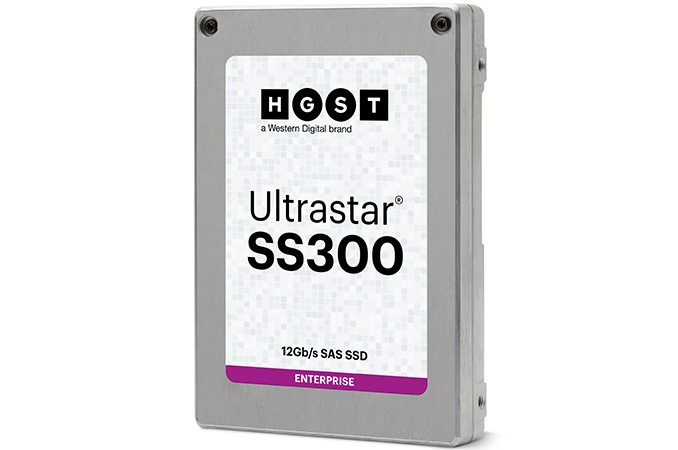
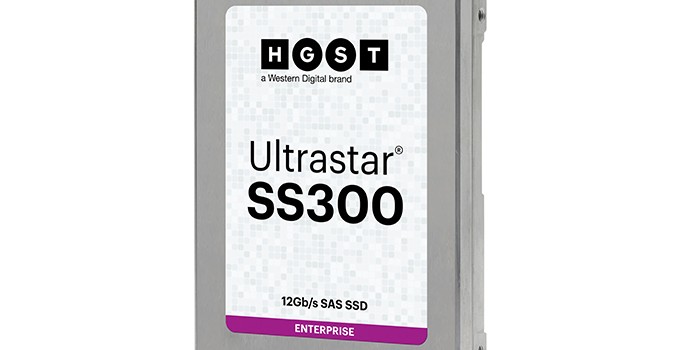
Western Digital has officially introduced its first data center-class SSDs using 3D NAND flash. The new HGST Ultrastar SS300 SSDs are designed for SAS applications with mixed workloads that demand drives with endurance but are not the highest performance possible. The new drives were co-developed with Intel, so they do not have various proprietary SanDisk technologies, such as the Guardian (as some previous-gen Ultrastar SS), but support numerous new features instead.

The Ultrastar SS300 drives use Intel’s 3D NAND memory – which we suspect is their recent 64-layer TLC & MLC – as well as a proprietary controller that was presumably co-designed with Intel. HGST does not disclose many details regarding the chip, but it might be the same controller that powers the recently launched Intel SSD DC P4500 and P4600 drives, albeit featuring a different configuration and a different firmware. From the feature set, the Ultrastar SS300 controller supports extended error correction code (ECC with a 1×10^-17 bit error rate) to enable higher performance and data integrity, exclusive-OR (XOR) parity (in case a whole NAND die fails) as well as parity-checked internal data paths. In addition, the Ultrastar SS300 complies with the T10 Data Integrity Field (DIF) standard, which requires all interconnect buses to have parity protection (on the system level), as well as a special power loss data management feature that does not use supercapacitors. Western Digital will offer various Ultrastar SS300 models with features like TCG encryption, TCG+FIPS, and instant secure erase to comply with different security requirements.

The HGST Ultrastar SS300 SSDs are aimed at various market segments, including financial transactions, e-commerce, virtualization, database analytics, etc. that generate read-intensive and mixed-use workloads and thus need both performance and reliability. The new SSDs come in a 2.5”/15 mm form-factor with SAS 12 Gb/s interface and are drop-in compatible with existing servers. Meanwhile, when compared to direct predecessors, the Ultrastar SS200, the new SS300 offer similar capacities — from 400 GB to 7.68 TB, but the new drives excel the ancestors in most possible metrics (endurance, performance, power, etc.).

When it comes to performance, the HGST Ultrastar SS300 features sequential read speeds of up to 2100 MB/s (+20% vs. the SS200) as well as sequential write speeds of up to 2050 MB/s (3D MLC, +105%) or 1250 MB/s (3D TLC, +25%). Random read performance of the Ultrastar SS300 is up to 400K (+60%), while random write performance is rated at 170-200K for 3D MLC-based performance/endurance-optimized models as well as 115K-130K for capacity-optimized 3D TLC-powered drives. Interestingly, in addition to 9 W and 11 W power envelopes supported by the predecessor, the SS300 also supports a 14 W mode that unlocks “additional performance capabilities” (i.e., IOPS) as well as an ultra-low power setting.

HGST Ultrastar SS300 Series Specifications
  3D MLC NAND-Based 3D TLC NAND-Based
Capacities 400 GB
800 GB
1,600 GB
3,200 GB
480 GB
960 GB
1,920 GB
3,840 GB
7,680 GB
1,920 GB
3,840 GB
7,680 GB
Form Factor 2.5″/15mm
Interface SAS 6/12 Gb/s, dual port for 12 Gb/s
Controller Proprietary
NAND 3D MLC NAND 64-layer 512 Gb
3D TLC NAND
Sequential Read 2100 MB/s
Sequential Write 2050 MB/s 1250 MB/s 1200 MB/s
Random Read (4 KB) IOPS 400,000
Random Write (4 KB) IOPS 200,000 170,000 120,000 80,000
Mixed Random R/W (70:30 R:W, 4KB)
Max IOPS
285,000 265,000 130,000 115,000
Write Latency 512 B 85 ms unknown
Power Idle 3.7 W (<3.2 TB) – 4.7 W (>3.2 TB)
Operating 9 W, 11 W, 14 W (configurable)
Endurance DPWD 10 3 ~1 ~0.5
Max. PB 400GB: 7PB
800GB: 15PB
1.6TB: 29PB
3.2TB: 59PB
400GB: 2PB
800GB: 4.5PB
1.6TB: 8.5PB
3.2TB: 17.5PB
480GB: 0.9PB
960GB: 1.75PB
1.92TB: 3.5PB
3.84TB: 7PB
7.68TB: 14PB
1.92TB: 1.8PB
3.84TB: 3.5PB
7.68TB: 7PB
Encryption AES-256 (?)
Power Loss Protection Yes
MTBF 2.5 million hours
Warranty Five years or max PB written (whichever occurs first)
Models HUSMM3232ASS20x
HUSMM3216ASS20x
HUSMM3280ASS20x
HUSMM3240ASS20x
HUSMR3232ASS20x
HUSMR3216ASS20x
HUSMR3280ASS20x
HUSMR3240ASS20x
HUSTR7676ASS20x
HUSTR7638ASS20x
HUSTR7619ASS20x
HUSTR7696ASS20x
HUSTR7648ASS20x
HUSTV1576ASS20x
HUSTV1538ASS20x
HUSTV1519ASS20x
Legend for Model Numbers H = HGST
U = Ultrastar
S = Standard
MM = NAND type/endurance
(MM=MLC/mainstream endurance, MR=MLC/read-intensive,
TR=TLC/read intensive TV=TLC very read intensive)
32 = Full capacity (3.2TB)
32 = Capacity of this model
(76=7.6TB, 38=3.84TB 32=3.2TB, 19=1.92TB, 16=1.2TB,
96=960GB, 80=800GB, 48=480GB, 40=400GB)
A = Generation code
S = Small form factor (2.5″ SFF)
S2 = Interface, SAS 12Gb/s

x in Model Number denotes Encryption level:
0 = Instant Secure Erase
1 = TCG Encryption
4 = No Encryption, Secure Erase
5 = TCG + FIPS

As for endurance, various versions of the HGST Ultrastar SS300 support 0.5, 1, 3 or 10 writes per day, thus extending addressable markets of the Ultrastar SS-series to applications that require extra endurance at 10 DPWD. All the Ultrastar SS300 SSDs are rated for 2.5 million hours MTBF and are covered with a five-year limited warranty (or the max PB written, whichever occurs first).

Western Digital has already started to ship its SS300 SSDs to select OEM partners, including Oracle. The company does not announce pricing of the drives since they depend on configurations, volume purchasing and other factors.

Related Reading:

Western Digital Launches HGST Ultrastar SS300 SSDs: 3D NAND for Data Centers

Western Digital Launches HGST Ultrastar SS300 SSDs: 3D NAND for Data Centers

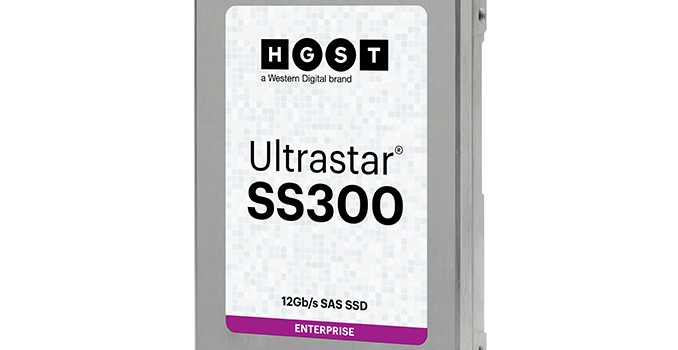
Western Digital has officially introduced its first data center-class SSDs using 3D NAND flash. The new HGST Ultrastar SS300 SSDs are designed for SAS applications with mixed workloads that demand drives with endurance but are not the highest performance possible. The new drives were co-developed with Intel, so they do not have various proprietary SanDisk technologies, such as the Guardian (as some previous-gen Ultrastar SS), but support numerous new features instead.

The Ultrastar SS300 drives use Intel’s 3D NAND memory – which we suspect is their recent 64-layer TLC & MLC – as well as a proprietary controller that was presumably co-designed with Intel. HGST does not disclose many details regarding the chip, but it might be the same controller that powers the recently launched Intel SSD DC P4500 and P4600 drives, albeit featuring a different configuration and a different firmware. From the feature set, the Ultrastar SS300 controller supports extended error correction code (ECC with a 1×10^-17 bit error rate) to enable higher performance and data integrity, exclusive-OR (XOR) parity (in case a whole NAND die fails) as well as parity-checked internal data paths. In addition, the Ultrastar SS300 complies with the T10 Data Integrity Field (DIF) standard, which requires all interconnect buses to have parity protection (on the system level), as well as a special power loss data management feature that does not use supercapacitors. Western Digital will offer various Ultrastar SS300 models with features like TCG encryption, TCG+FIPS, and instant secure erase to comply with different security requirements.

The HGST Ultrastar SS300 SSDs are aimed at various market segments, including financial transactions, e-commerce, virtualization, database analytics, etc. that generate read-intensive and mixed-use workloads and thus need both performance and reliability. The new SSDs come in a 2.5”/15 mm form-factor with SAS 12 Gb/s interface and are drop-in compatible with existing servers. Meanwhile, when compared to direct predecessors, the Ultrastar SS200, the new SS300 offer similar capacities — from 400 GB to 7.68 TB, but the new drives excel the ancestors in most possible metrics (endurance, performance, power, etc.).

When it comes to performance, the HGST Ultrastar SS300 features sequential read speeds of up to 2100 MB/s (+20% vs. the SS200) as well as sequential write speeds of up to 2050 MB/s (3D MLC, +105%) or 1250 MB/s (3D TLC, +25%). Random read performance of the Ultrastar SS300 is up to 400K (+60%), while random write performance is rated at 170-200K for 3D MLC-based performance/endurance-optimized models as well as 115K-130K for capacity-optimized 3D TLC-powered drives. Interestingly, in addition to 9 W and 11 W power envelopes supported by the predecessor, the SS300 also supports a 14 W mode that unlocks “additional performance capabilities” (i.e., IOPS) as well as an ultra-low power setting.

HGST Ultrastar SS300 Series Specifications
  3D MLC NAND-Based 3D TLC NAND-Based
Capacities 400 GB
800 GB
1,600 GB
3,200 GB
480 GB
960 GB
1,920 GB
3,840 GB
7,680 GB
1,920 GB
3,840 GB
7,680 GB
Form Factor 2.5″/15mm
Interface SAS 6/12 Gb/s, dual port for 12 Gb/s
Controller Proprietary
NAND 3D MLC NAND 64-layer 512 Gb
3D TLC NAND
Sequential Read 2100 MB/s
Sequential Write 2050 MB/s 1250 MB/s 1200 MB/s
Random Read (4 KB) IOPS 400,000
Random Write (4 KB) IOPS 200,000 170,000 120,000 80,000
Mixed Random R/W (70:30 R:W, 4KB)
Max IOPS
285,000 265,000 130,000 115,000
Write Latency 512 B 85 ms unknown
Power Idle 3.7 W (<3.2 TB) – 4.7 W (>3.2 TB)
Operating 9 W, 11 W, 14 W (configurable)
Endurance DPWD 10 3 ~1 ~0.5
Max. PB 400GB: 7PB
800GB: 15PB
1.6TB: 29PB
3.2TB: 59PB
400GB: 2PB
800GB: 4.5PB
1.6TB: 8.5PB
3.2TB: 17.5PB
480GB: 0.9PB
960GB: 1.75PB
1.92TB: 3.5PB
3.84TB: 7PB
7.68TB: 14PB
1.92TB: 1.8PB
3.84TB: 3.5PB
7.68TB: 7PB
Encryption AES-256 (?)
Power Loss Protection Yes
MTBF 2.5 million hours
Warranty Five years or max PB written (whichever occurs first)
Models HUSMM3232ASS20x
HUSMM3216ASS20x
HUSMM3280ASS20x
HUSMM3240ASS20x
HUSMR3232ASS20x
HUSMR3216ASS20x
HUSMR3280ASS20x
HUSMR3240ASS20x
HUSTR7676ASS20x
HUSTR7638ASS20x
HUSTR7619ASS20x
HUSTR7696ASS20x
HUSTR7648ASS20x
HUSTV1576ASS20x
HUSTV1538ASS20x
HUSTV1519ASS20x
Legend for Model Numbers H = HGST
U = Ultrastar
S = Standard
MM = NAND type/endurance
(MM=MLC/mainstream endurance, MR=MLC/read-intensive,
TR=TLC/read intensive TV=TLC very read intensive)
32 = Full capacity (3.2TB)
32 = Capacity of this model
(76=7.6TB, 38=3.84TB 32=3.2TB, 19=1.92TB, 16=1.2TB,
96=960GB, 80=800GB, 48=480GB, 40=400GB)
A = Generation code
S = Small form factor (2.5″ SFF)
S2 = Interface, SAS 12Gb/s

x in Model Number denotes Encryption level:
0 = Instant Secure Erase
1 = TCG Encryption
4 = No Encryption, Secure Erase
5 = TCG + FIPS

As for endurance, various versions of the HGST Ultrastar SS300 support 0.5, 1, 3 or 10 writes per day, thus extending addressable markets of the Ultrastar SS-series to applications that require extra endurance at 10 DPWD. All the Ultrastar SS300 SSDs are rated for 2.5 million hours MTBF and are covered with a five-year limited warranty (or the max PB written, whichever occurs first).

Western Digital has already started to ship its SS300 SSDs to select OEM partners, including Oracle. The company does not announce pricing of the drives since they depend on configurations, volume purchasing and other factors.

Related Reading:

Western Digital Launches HGST Ultrastar SS300 SSDs: 3D NAND for Data Centers

Western Digital Launches HGST Ultrastar SS300 SSDs: 3D NAND for Data Centers

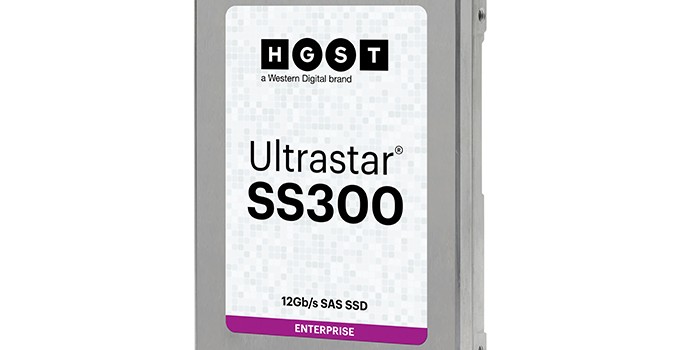
Western Digital has officially introduced its first data center-class SSDs using 3D NAND flash. The new HGST Ultrastar SS300 SSDs are designed for SAS applications with mixed workloads that demand drives with endurance but are not the highest performance possible. The new drives were co-developed with Intel, so they do not have various proprietary SanDisk technologies, such as the Guardian (as some previous-gen Ultrastar SS), but support numerous new features instead.

The Ultrastar SS300 drives use Intel’s 3D NAND memory – which we suspect is their recent 64-layer TLC & MLC – as well as a proprietary controller that was presumably co-designed with Intel. HGST does not disclose many details regarding the chip, but it might be the same controller that powers the recently launched Intel SSD DC P4500 and P4600 drives, albeit featuring a different configuration and a different firmware. From the feature set, the Ultrastar SS300 controller supports extended error correction code (ECC with a 1×10^-17 bit error rate) to enable higher performance and data integrity, exclusive-OR (XOR) parity (in case a whole NAND die fails) as well as parity-checked internal data paths. In addition, the Ultrastar SS300 complies with the T10 Data Integrity Field (DIF) standard, which requires all interconnect buses to have parity protection (on the system level), as well as a special power loss data management feature that does not use supercapacitors. Western Digital will offer various Ultrastar SS300 models with features like TCG encryption, TCG+FIPS, and instant secure erase to comply with different security requirements.

The HGST Ultrastar SS300 SSDs are aimed at various market segments, including financial transactions, e-commerce, virtualization, database analytics, etc. that generate read-intensive and mixed-use workloads and thus need both performance and reliability. The new SSDs come in a 2.5”/15 mm form-factor with SAS 12 Gb/s interface and are drop-in compatible with existing servers. Meanwhile, when compared to direct predecessors, the Ultrastar SS200, the new SS300 offer similar capacities — from 400 GB to 7.68 TB, but the new drives excel the ancestors in most possible metrics (endurance, performance, power, etc.).

When it comes to performance, the HGST Ultrastar SS300 features sequential read speeds of up to 2100 MB/s (+20% vs. the SS200) as well as sequential write speeds of up to 2050 MB/s (3D MLC, +105%) or 1250 MB/s (3D TLC, +25%). Random read performance of the Ultrastar SS300 is up to 400K (+60%), while random write performance is rated at 170-200K for 3D MLC-based performance/endurance-optimized models as well as 115K-130K for capacity-optimized 3D TLC-powered drives. Interestingly, in addition to 9 W and 11 W power envelopes supported by the predecessor, the SS300 also supports a 14 W mode that unlocks “additional performance capabilities” (i.e., IOPS) as well as an ultra-low power setting.

HGST Ultrastar SS300 Series Specifications
  3D MLC NAND-Based 3D TLC NAND-Based
Capacities 400 GB
800 GB
1,600 GB
3,200 GB
480 GB
960 GB
1,920 GB
3,840 GB
7,680 GB
1,920 GB
3,840 GB
7,680 GB
Form Factor 2.5″/15mm
Interface SAS 6/12 Gb/s, dual port for 12 Gb/s
Controller Proprietary
NAND 3D MLC NAND 64-layer 512 Gb
3D TLC NAND
Sequential Read 2100 MB/s
Sequential Write 2050 MB/s 1250 MB/s 1200 MB/s
Random Read (4 KB) IOPS 400,000
Random Write (4 KB) IOPS 200,000 170,000 120,000 80,000
Mixed Random R/W (70:30 R:W, 4KB)
Max IOPS
285,000 265,000 130,000 115,000
Write Latency 512 B 85 ms unknown
Power Idle 3.7 W (<3.2 TB) – 4.7 W (>3.2 TB)
Operating 9 W, 11 W, 14 W (configurable)
Endurance DPWD 10 3 ~1 ~0.5
Max. PB 400GB: 7PB
800GB: 15PB
1.6TB: 29PB
3.2TB: 59PB
400GB: 2PB
800GB: 4.5PB
1.6TB: 8.5PB
3.2TB: 17.5PB
480GB: 0.9PB
960GB: 1.75PB
1.92TB: 3.5PB
3.84TB: 7PB
7.68TB: 14PB
1.92TB: 1.8PB
3.84TB: 3.5PB
7.68TB: 7PB
Encryption AES-256 (?)
Power Loss Protection Yes
MTBF 2.5 million hours
Warranty Five years or max PB written (whichever occurs first)
Models HUSMM3232ASS20x
HUSMM3216ASS20x
HUSMM3280ASS20x
HUSMM3240ASS20x
HUSMR3232ASS20x
HUSMR3216ASS20x
HUSMR3280ASS20x
HUSMR3240ASS20x
HUSTR7676ASS20x
HUSTR7638ASS20x
HUSTR7619ASS20x
HUSTR7696ASS20x
HUSTR7648ASS20x
HUSTV1576ASS20x
HUSTV1538ASS20x
HUSTV1519ASS20x
Legend for Model Numbers H = HGST
U = Ultrastar
S = Standard
MM = NAND type/endurance
(MM=MLC/mainstream endurance, MR=MLC/read-intensive,
TR=TLC/read intensive TV=TLC very read intensive)
32 = Full capacity (3.2TB)
32 = Capacity of this model
(76=7.6TB, 38=3.84TB 32=3.2TB, 19=1.92TB, 16=1.2TB,
96=960GB, 80=800GB, 48=480GB, 40=400GB)
A = Generation code
S = Small form factor (2.5″ SFF)
S2 = Interface, SAS 12Gb/s

x in Model Number denotes Encryption level:
0 = Instant Secure Erase
1 = TCG Encryption
4 = No Encryption, Secure Erase
5 = TCG + FIPS

As for endurance, various versions of the HGST Ultrastar SS300 support 0.5, 1, 3 or 10 writes per day, thus extending addressable markets of the Ultrastar SS-series to applications that require extra endurance at 10 DPWD. All the Ultrastar SS300 SSDs are rated for 2.5 million hours MTBF and are covered with a five-year limited warranty (or the max PB written, whichever occurs first).

Western Digital has already started to ship its SS300 SSDs to select OEM partners, including Oracle. The company does not announce pricing of the drives since they depend on configurations, volume purchasing and other factors.

Related Reading: