News


Synology DS415+ Review: DSM on Intel Rangeley

Synology recently launched the DS415+, their first Intel Rangeley-based NAS. This 4-bay NAS, targeted towards SMBs and SOHOs, finally brings about hardware accelerated encryption capabilities to DSM in the desktop tower form factor. The Rangeley platform also provides a host of other advantages in a storage device. Read on for our review of the DS415+ to identify what Synology’s DSM can do in conjunction with one of the latest Atom-based storage platform SoCs from Intel.

Microsoft Launches Microsoft Health And The Microsoft Band

Microsoft Launches Microsoft Health And The Microsoft Band

Today Microsoft launched a new platform called Microsoft Health, and to accompany this they are officially launching the long rumored health and fitness band, called, well, Microsoft Band. And to satisfy the new cross platform initiatives by the company, Microsoft Health is compatible with several fitness tracking services such as UP by Jawbone, MapMyFitness, MyFitnessPal, and Runkeeper. The Microsoft Band will be compatible with iOS, Android, and Windows Phone, which should satisfy most smartphone owners, and there is a Heath app available for each platform as well.

Microsoft Health is described as a cloud based service which can unite data from different health and fitness devices and services into a single secure location. This will allow a more holistic picture of your health and fitness activities to be monitored. Microsoft Health will track things such as steps, calories, heart rate, and other data, where it can then be analyzed by the Microsoft Intelligence Engine which will let the user know things such as which exercise they performed that burned the most calories during a workout, and how much restful versus restless sleep they are getting. Over time, and if you allow it access to more data, it will be able to extrapolate if eating breakfast helps you run faster, or if the number of meetings during a day impacts how you sleep, as examples. You can also opt in to connect Microsoft Health data with the already existing HealthVault to share your data with a medical provider. It is early days yet, but as a platform this seems to be where the health and fitness industry is heading. If you can get over the big brother aspects of having all of your movements and activities tracked, there may be some real insights gained in how your work, fitness, and leisure activities affect your health and wellbeing.

Microsoft is planning a steady release of information regarding Microsoft Health over the next while, including additional device and service partnerships and SDK availability.

It has long been rumored that Microsoft would re-enter the smart watch game, but over time the rumors morphed into a fitness band. The Microsoft Band is a smart band designed to be worn continuously, 24 hours a day. It includes 10 smart sensors for heart rate monitoring, calorie burn measurement, sleep quality tracking, and more. It will also include guided workouts which are curated by well-known fitness experts. In addition, it will provide some of the smart watch capabilities such as notifications as well as access to Cortana if you are connected to Windows Phone 8.1. The Microsoft Band is available starting October 30th for $199 from the Microsoft Store.

Microsoft Health
Microsoft Band
Band Material Thermal plastic elastomer with adjustable fit clasp
Display 11mm x 33mm 1.4″ TFT Capacitive full color display, 320 x 106 resolution
Battery Life 48 hours of normal use; advanced functionality like GPS use will impact battery performance
Average Charge Time Full chage in less than 1.5 hours
Battery Type Dual 100mAh rechargeable lithium-ion polymer batteries
Operating temperature ranges -10°C to 40°C (14°F to 104°F)
Maximum operating altitude approximately 12,000m
Sensors Optical heart rate sensor
3-axis accelerometer/gyro
Gyrometer
GPS
Ambient light sensor
Skin temperature sensor
UV sensor
Capacitive sensor
Galvanic skin response
Microphone
Additional technology Haptic vibration motor
Connectivity Bluetooth 4.0 LE
Operating System Support Windows Phone 8.1
iOS 7.1 and later
Android 4.3-4.4 phones with Bluetooth
Water Resistance Dust and Splash resistant
Warranty 1 year limited
Price $199

The wearables market is certainly in its infancy, so it is exciting to see the different array of devices appearing. Whether the market will tolerate them has yet to be decided, but companies such as Fitbit have proven that there is certainly a market for the health and fitness band. Microsoft has a relatively affordable offering here which is both cross platform, and a capable smart device. Microsoft Health as a platform is the bigger play here. Allowing access from many vendors is a great way to get initial buy-in from users, and once the fitness data is up in the Microsoft Cloud, I am sure Microsoft is hoping to capture some of these users for their other cloud offerings.

Microsoft Launches Microsoft Health And The Microsoft Band

Microsoft Launches Microsoft Health And The Microsoft Band

Today Microsoft launched a new platform called Microsoft Health, and to accompany this they are officially launching the long rumored health and fitness band, called, well, Microsoft Band. And to satisfy the new cross platform initiatives by the company, Microsoft Health is compatible with several fitness tracking services such as UP by Jawbone, MapMyFitness, MyFitnessPal, and Runkeeper. The Microsoft Band will be compatible with iOS, Android, and Windows Phone, which should satisfy most smartphone owners, and there is a Heath app available for each platform as well.

Microsoft Health is described as a cloud based service which can unite data from different health and fitness devices and services into a single secure location. This will allow a more holistic picture of your health and fitness activities to be monitored. Microsoft Health will track things such as steps, calories, heart rate, and other data, where it can then be analyzed by the Microsoft Intelligence Engine which will let the user know things such as which exercise they performed that burned the most calories during a workout, and how much restful versus restless sleep they are getting. Over time, and if you allow it access to more data, it will be able to extrapolate if eating breakfast helps you run faster, or if the number of meetings during a day impacts how you sleep, as examples. You can also opt in to connect Microsoft Health data with the already existing HealthVault to share your data with a medical provider. It is early days yet, but as a platform this seems to be where the health and fitness industry is heading. If you can get over the big brother aspects of having all of your movements and activities tracked, there may be some real insights gained in how your work, fitness, and leisure activities affect your health and wellbeing.

Microsoft is planning a steady release of information regarding Microsoft Health over the next while, including additional device and service partnerships and SDK availability.

It has long been rumored that Microsoft would re-enter the smart watch game, but over time the rumors morphed into a fitness band. The Microsoft Band is a smart band designed to be worn continuously, 24 hours a day. It includes 10 smart sensors for heart rate monitoring, calorie burn measurement, sleep quality tracking, and more. It will also include guided workouts which are curated by well-known fitness experts. In addition, it will provide some of the smart watch capabilities such as notifications as well as access to Cortana if you are connected to Windows Phone 8.1. The Microsoft Band is available starting October 30th for $199 from the Microsoft Store.

Microsoft Health
Microsoft Band
Band Material Thermal plastic elastomer with adjustable fit clasp
Display 11mm x 33mm 1.4″ TFT Capacitive full color display, 320 x 106 resolution
Battery Life 48 hours of normal use; advanced functionality like GPS use will impact battery performance
Average Charge Time Full chage in less than 1.5 hours
Battery Type Dual 100mAh rechargeable lithium-ion polymer batteries
Operating temperature ranges -10°C to 40°C (14°F to 104°F)
Maximum operating altitude approximately 12,000m
Sensors Optical heart rate sensor
3-axis accelerometer/gyro
Gyrometer
GPS
Ambient light sensor
Skin temperature sensor
UV sensor
Capacitive sensor
Galvanic skin response
Microphone
Additional technology Haptic vibration motor
Connectivity Bluetooth 4.0 LE
Operating System Support Windows Phone 8.1
iOS 7.1 and later
Android 4.3-4.4 phones with Bluetooth
Water Resistance Dust and Splash resistant
Warranty 1 year limited
Price $199

The wearables market is certainly in its infancy, so it is exciting to see the different array of devices appearing. Whether the market will tolerate them has yet to be decided, but companies such as Fitbit have proven that there is certainly a market for the health and fitness band. Microsoft has a relatively affordable offering here which is both cross platform, and a capable smart device. Microsoft Health as a platform is the bigger play here. Allowing access from many vendors is a great way to get initial buy-in from users, and once the fitness data is up in the Microsoft Cloud, I am sure Microsoft is hoping to capture some of these users for their other cloud offerings.

Skyera Releases skyHawk FS All-Flash Array: Up to 136TB of NAND in 1U

Skyera Releases skyHawk FS All-Flash Array: Up to 136TB of NAND in 1U

Our enterprise storage coverage has mainly been focused on individual enterprise SSDs from the likes of Intel and Micron, but there’s a lot of interesting action in the storage array space. I met with most of the big names in the array business at Flash Memory Summit this year, so with a better understanding of the market and with the right contacts, I think it’s logical that we expand our enterprise storage content to cover arrays as well.

Since we haven’t covered storage arrays or the companies involved in the past, I’ll start with a brief introduction of Skyera. While Skyera is a relatively new company, the company is filled with experience and knowledge of storage and non-volatile memory industries. The founders of Skyera, Radoslav Danilak and Rod Mullendore, both worked at SandForce before founding Skyera in 2010. Mr. Danilak was actually the co-founder and CTO of SandForce, whereas Mr. Mullendore served as the Chief Hardware Architect. 

While Mr. Danilak and Mr. Mullendore bring a lot of system-level hardware design knowledge to the company, what really separates Skyera from the rest is the NAND expertise. This is especially thanks to the CEO, Frankie Roohparvar, who was one of the founders of Micron Quantum Technologies in the early 90s. Micron Quantum Technologies was a manufacturer of NOR flash that was then acquired by Micron and basically formed the foundation of Micron’s NAND business. Before joining Skyera in 2012, Mr. Roohparvar served at Micron for 13 years with his most recent position being the Vice President and General Manager of the OEM Division of Micron’s NAND Solutions Group. 

Skyera’s approach to flash array design is to start from the lowest level, i.e. the NAND silicon. Obviously the company doesn’t manufacture its own NAND but Micron, Toshiba, and SK Hynix are all investors in the company, which ensures a steady supply of NAND and also gives Skyera much deeper access to NAND than what typical customers get. What this means is that Skyera can run its own validation and ‘trimming’ (optimizing the read/write parameters etc.) process on the NAND to boost the endurance. The benefit is lower cost because Skyera’s own process can increase the endurance of normal MLC NAND from ~3,000 P/E cycles to over 30,000 P/E cycles (or so I was told), whereas most companies are limited to buying off-the-shelf NAND, which either means cheap but low endurance cMLC or expensive eMLC. 

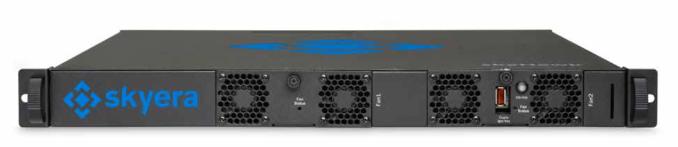
With the brief introduction of Skyera out of the way, let’s focus on the skyHawk FS. It’s offered in raw capacities of 16, 32, 68 and 136TB with all models utilizing the same 1U form factor. The final usable capacity depends on the provisioning of the array as well as the compressibility of the data since the skyHawk FS does compression in hardware (similar to what SandForce does). For comparison, Pure Storage, which is one of the leading all-flash array suppliers, only offers up to 11TB in 2U form factor, so Skyera has an enormous advantage in terms of density.  

EDIT: Skyera doesn’t actually do de-duplication like I initially said, so sorry for the mix up. The compression is still there, though.

The density advantage comes from Skyera’s NAND expertise because the company builds its own drives (or blades as they are usually called) and can utilize the latest NAND lithographies available. While Skyera didn’t specify the exact NAND that is used in the skyHawk FS due to the fact that there are multiple suppliers, I was told that the die capacity is 128Gbit and Micron’s 16nm is one of the processes that is used. For the record, Crucial’s MX100 and Micron’s M600 are the only other products that I know of that use 16nm NAND right now and I know for sure that 16nm isn’t available to the public in volume yet, so Skyera has an enormous advantage thanks to the close relations with the NAND manufacturers.

Software wise the skyHawk FS uses Skyera’s own SEoS that has been designed solely for NAND. The vertically integrated business model allows Skyera to build the whole software stack around NAND, which enables a more global and adaptive Flash Translation Layer (FTL) for instance (i.e. the FTL can be managed at the system level instead of drive level). The design also allows the load to be split between the master controllers and the individual controllers in the blades for higher and more efficient performance, whereas with third party drives the drives would be doing their own management and the global/host management would be left for the master controller, resulting in a less efficient design. 

In terms of performance, Skyera is rating the skyHawk FS at 2.4GB/s throughput and 400K IOPS with microsecond latencies, but unfortunately the IO sizes and queue depth are unspecified, so it’s hard to draw any conclusions or comparisons from the numbers. The skyHawk FS has three 10Gbit Ethernet ports for connectivity and both iSCSI and NFS v3 protocols are supported. The skyHawk FS carries a 3-year warranty with no write endurance limitation, which is yet another advantage of Skyera’s NAND knowhow. 

The skyHawk FS is available immediately and is priced at $2.99 per raw gigabyte (i.e. with compression the real cost per gigabyte will come down).

Since this was our first flash array news post, I’d like to hear your feedback in the comments below. Would you like to see more content like this from us in the future? And if so, are there any specific topics or companies that you would like us to cover? The enterprise storage space is rather complex and there are a lot of companies involved, but we want to do our best to cover it (even in a limited matter) in the future, so let us know your thoughts.


Skyera Releases skyHawk FS All-Flash Array: Up to 136TB of NAND in 1U

Skyera Releases skyHawk FS All-Flash Array: Up to 136TB of NAND in 1U

Our enterprise storage coverage has mainly been focused on individual enterprise SSDs from the likes of Intel and Micron, but there’s a lot of interesting action in the storage array space. I met with most of the big names in the array business at Flash Memory Summit this year, so with a better understanding of the market and with the right contacts, I think it’s logical that we expand our enterprise storage content to cover arrays as well.

Since we haven’t covered storage arrays or the companies involved in the past, I’ll start with a brief introduction of Skyera. While Skyera is a relatively new company, the company is filled with experience and knowledge of storage and non-volatile memory industries. The founders of Skyera, Radoslav Danilak and Rod Mullendore, both worked at SandForce before founding Skyera in 2010. Mr. Danilak was actually the co-founder and CTO of SandForce, whereas Mr. Mullendore served as the Chief Hardware Architect. 

While Mr. Danilak and Mr. Mullendore bring a lot of system-level hardware design knowledge to the company, what really separates Skyera from the rest is the NAND expertise. This is especially thanks to the CEO, Frankie Roohparvar, who was one of the founders of Micron Quantum Technologies in the early 90s. Micron Quantum Technologies was a manufacturer of NOR flash that was then acquired by Micron and basically formed the foundation of Micron’s NAND business. Before joining Skyera in 2012, Mr. Roohparvar served at Micron for 13 years with his most recent position being the Vice President and General Manager of the OEM Division of Micron’s NAND Solutions Group. 

Skyera’s approach to flash array design is to start from the lowest level, i.e. the NAND silicon. Obviously the company doesn’t manufacture its own NAND but Micron, Toshiba, and SK Hynix are all investors in the company, which ensures a steady supply of NAND and also gives Skyera much deeper access to NAND than what typical customers get. What this means is that Skyera can run its own validation and ‘trimming’ (optimizing the read/write parameters etc.) process on the NAND to boost the endurance. The benefit is lower cost because Skyera’s own process can increase the endurance of normal MLC NAND from ~3,000 P/E cycles to over 30,000 P/E cycles (or so I was told), whereas most companies are limited to buying off-the-shelf NAND, which either means cheap but low endurance cMLC or expensive eMLC. 

With the brief introduction of Skyera out of the way, let’s focus on the skyHawk FS. It’s offered in raw capacities of 16, 32, 68 and 136TB with all models utilizing the same 1U form factor. The final usable capacity depends on the provisioning of the array as well as the compressibility of the data since the skyHawk FS does compression in hardware (similar to what SandForce does). For comparison, Pure Storage, which is one of the leading all-flash array suppliers, only offers up to 11TB in 2U form factor, so Skyera has an enormous advantage in terms of density.  

EDIT: Skyera doesn’t actually do de-duplication like I initially said, so sorry for the mix up. The compression is still there, though.

The density advantage comes from Skyera’s NAND expertise because the company builds its own drives (or blades as they are usually called) and can utilize the latest NAND lithographies available. While Skyera didn’t specify the exact NAND that is used in the skyHawk FS due to the fact that there are multiple suppliers, I was told that the die capacity is 128Gbit and Micron’s 16nm is one of the processes that is used. For the record, Crucial’s MX100 and Micron’s M600 are the only other products that I know of that use 16nm NAND right now and I know for sure that 16nm isn’t available to the public in volume yet, so Skyera has an enormous advantage thanks to the close relations with the NAND manufacturers.

Software wise the skyHawk FS uses Skyera’s own SEoS that has been designed solely for NAND. The vertically integrated business model allows Skyera to build the whole software stack around NAND, which enables a more global and adaptive Flash Translation Layer (FTL) for instance (i.e. the FTL can be managed at the system level instead of drive level). The design also allows the load to be split between the master controllers and the individual controllers in the blades for higher and more efficient performance, whereas with third party drives the drives would be doing their own management and the global/host management would be left for the master controller, resulting in a less efficient design. 

In terms of performance, Skyera is rating the skyHawk FS at 2.4GB/s throughput and 400K IOPS with microsecond latencies, but unfortunately the IO sizes and queue depth are unspecified, so it’s hard to draw any conclusions or comparisons from the numbers. The skyHawk FS has three 10Gbit Ethernet ports for connectivity and both iSCSI and NFS v3 protocols are supported. The skyHawk FS carries a 3-year warranty with no write endurance limitation, which is yet another advantage of Skyera’s NAND knowhow. 

The skyHawk FS is available immediately and is priced at $2.99 per raw gigabyte (i.e. with compression the real cost per gigabyte will come down).

Since this was our first flash array news post, I’d like to hear your feedback in the comments below. Would you like to see more content like this from us in the future? And if so, are there any specific topics or companies that you would like us to cover? The enterprise storage space is rather complex and there are a lot of companies involved, but we want to do our best to cover it (even in a limited matter) in the future, so let us know your thoughts.