News


Samsung Releases Firmware Update to Fix the SSD 840 EVO Read Performance Bug
Samsung Releases Firmware Update to Fix the SSD 840 EVO Read Performance Bug

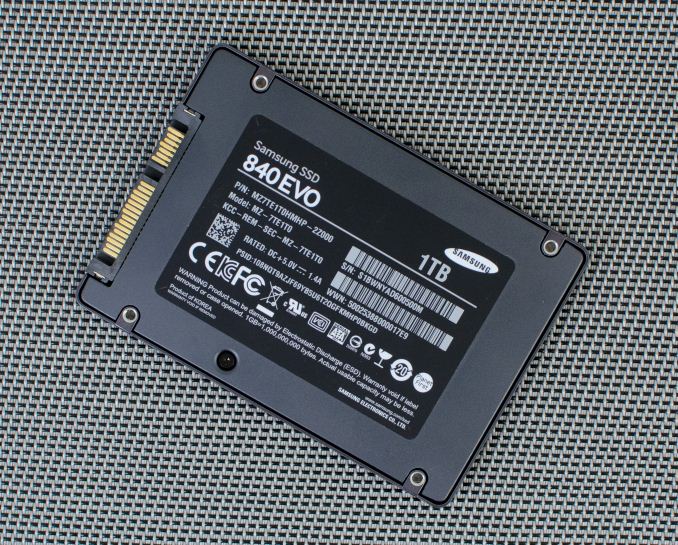
The news of Samsung’s SSD 840 EVO read performance degradation started circulating around the Internet about a month ago. Shortly after this, Samsung announced that they have found the fix and a firmware update is expected to be released on October 15th. Samsung kept its promise and delivered the update yesterday through its website (download here). 

The fix is actually a bit more than just a firmware update. Because the bug specifically affects the read speed of old data, simply flashing the firmware isn’t enough. The data in the drive has to be rewritten for the changes in the new firmware to take place. Thus the fix comes in the form of a separate tool, which Samsung calls Performance Restoration Software. 

For now the tool is limited to the 840 EVO (both 2.5″ and mSATA) and will only work under Windows. An OS-independent tool will be available later this month for Mac and Linux users, but currently there is no word on whether the ‘vanilla’ 840 and the OEM versions will get the update. Samsung told me that they’ve only seen the issue in the 840 EVO, although user reports suggested that the ‘vanilla’ 840 is affected as well. I’ll provide an update as soon as I hear more from Samsung.
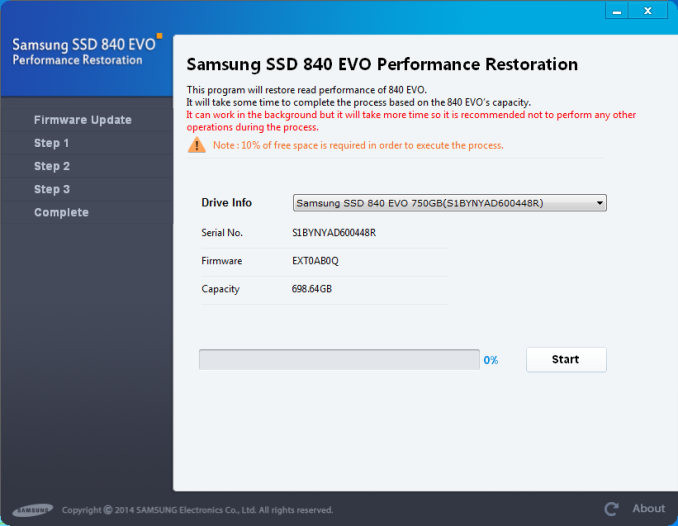
The performance restoration process itself is simple and doesn’t require any input from the user once started. Basically, the tool will first update the firmware and ask for a shut down after the update has been completed. Upon the next startup the tool will run the actual three-step restoration process, although unfortunately I don’t have any further information about what these steps actually do. What I do know is that all data in the drive will be rewritten and thus the process can take a while depending on how much data you have stored in your drive. Note that the process isn’t destructive if completed successfully, but since there is always a risk of data loss when updating the firmware, I strongly recommend that you make sure that you have an up-to-date backup of your data before starting the process.

The restoration tool has a few limitations, though. First, it will require at least 10% of free space or the tool won’t run at all, and there is no way around the 10% limitation other than deleting or moving files to another drive before running the tool. Secondly, only NTFS file system is supported at this stage, so Mac and Linux users will have to wait for the DOS version of the tool that is scheduled to be available by the end of this month. Thirdly, the tool doesn’t support RAID arrays, meaning that if you are running two or more 840 EVOs in a RAID array, you’ll need to delete the array and switch back to AHCI mode before the tool can be run. Any hardware encryption (TCG Opal 2.0 & eDrive) must be disabled too.

In regards to driver and platform support, the tool supports both Intel and AMD chipsets and storage drivers as well as the native Microsoft AHCI drivers. The only limitation is with AMD storage drivers where the driver must be the latest version, or alternatively you can temporarily switch to the Microsoft driver by uninstalling the AMD driver. Samsung has a detailed installation guide that goes through the driver switch process along with the rest of the performance restoration process. 

Explaining the Bug

Given the wide spread of the issue, there has been quite a bit of speculation about what is causing the read performance to degrade over time. I didn’t officially post my theory here, although I did Tweet about it and also mentioned it in the comments of the original news post. It turns out that my theory ended up being pretty much spot on as Samsung finally disclosed some details of the source of the bug.
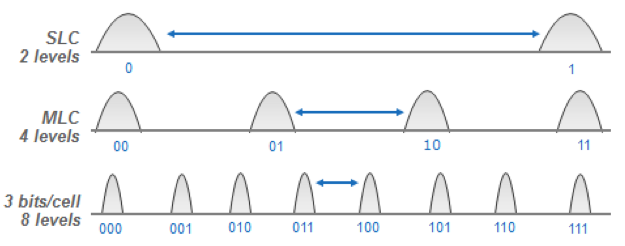
As most of you likely know already, the way NAND works is by storing a charge in the floating gate. The amount of charge determines the voltage state of the cell, which in turn translates to the bit output. Reading a cell basically works by sensing the cell voltage, which works by increasing the threshold voltage until the cell responds.
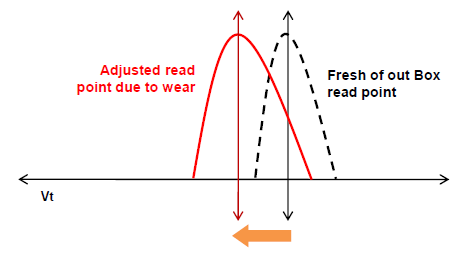
 

However, the cell charge is subject to multiple variables over time. Electron leakage through the tunnel oxide reduces the cell charge over time and may result in a change in the voltage state. The neighboring cells also have an impact through cell-to-cell interference in the form of floating gate coupling, which is at its strongest when programming a neighbor (or just a nearby) cell. That will affect the charge in the cell and the effect becomes stronger over time if the cell isn’t erased and reprogrammed for a long time (i.e. more neighbor cell programs = more interference = bigger shift in cell charge). 

Because cell voltage change is a characteristic of NAND, all SSDs and other NAND-based devices utilize NAND management algorithm that takes the changes into account. The algorithm is designed to adjust the voltage states based on the variables (in reality there are far more than the two I mentioned above) so that the cell can be read and programmed efficiently.

In case of the 840 EVO, there was an error in the algorithm that resulted in an aggressive read-retry process when reading old data. With TLC NAND more sophisticated NAND management is needed due to the closer distribution of the voltage states. At the same time the wear-leveling algorithms need to be as efficient as possible (i.e. write as little as possible to save P/E cycles), so that’s why the bug only exists on the 840 and 840 EVO. I suspect that the algorithm didn’t take the change in cell voltage properly into account, which translated into corrupted read points and thus the read process had to be repeated multiple times before the cell would return the correct value. Obviously it takes more time if the read process has to be performed multiple times, so the user performance suffered as a result.

Unfortunately I don’t have an 840 EVO that fits the criterion of the bug (i.e. a drive with several months old data), so I couldn’t test more than the restoration process itself (which was smooth, by the way). However, PC Perspective’s and The Tech Report’s tests confirm that the tool restores the performance back to the original speeds. It’s too early to say whether the update fixes long-term performance, but Samsung assured that the update does actually fix the NAND management algorithm and should thus be a permanent fix. 

The EVO has been the most popular retail SSD so far, so it’s great to see Samsung providing a fix in such a short time. None of the big SSD manufacturers have been able to avoid widespread bugs (remember the 8MB bug in the Intel SSD 320 and the 5,000-hour bug in the Crucial m4?) and I have to give Samsung credit for handling this well. In the end, this bug never resulted in data loss, so it was more of an annoyance than a real threat.
Thin is the New Thin: Hands On with the 5.15mm KAZAM Tornado 348

Thin is the New Thin: Hands On with the 5.15mm KAZAM Tornado 348

My take on thin phones is not a positive one. This comes from two main areas. Firstly I like my phone to have some form of bulk – this way I know it is in my pocket and I would notice if it went missing. Secondly, going thin often brings about several compromises, namely performance (due to heat dissipation), camera quality (due to z-height restrictions) and battery life. As a reference point, my daily driver is a 5.9-inch display with a 3300 mAh battery that measures 10.9mm and weighs 217g, so that device probably will not go missing unnoticed and I get a good range in performance and battery life.

At a MediaTek conference this week in London, as part of MediaTek’s strategy to educate the mobile media and analyst community about their strategy and goals, they invited Kazam’s CEO Michael Coombs to show and formally announce the MediaTek powered Tornado 348, the world’s slimmest smartphone. Kazam is a smartphone maker based in Europe formed by a number of former senior sales and marketing executives from bigger mobile companies. The company was founded earlier this year and have several models on the market already. The Tornado 348 is their latest model, with pre-launch stock already sold to distributors.

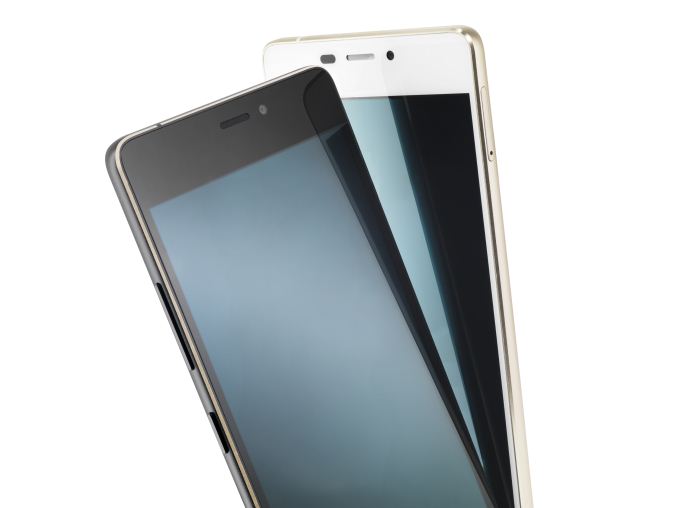
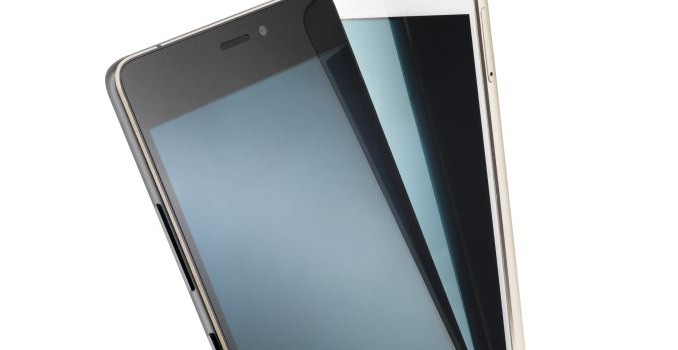
The phone itself is rather surprising. Despite being as thin as it is, it was relatively sturdy with no obvious issues by opposing pressure on opposite corners despite the metal frame design. The white model I played with felt comfortable in the hand with a rounded edge, using fixed android buttons on the bottom bezel (which I prefer) and a 4.8-inch 1280×720 AMOLED screen that came across as rather vibrant. Under the hood is MediaTek’s ‘True Octa-core’ MT6592, with eight Cortex-A7s at 1.7 GHz and a Mali 450-MP4 for graphics. Normally if you hear ‘eight Cortex A7’ it seems odd to combine eight power efficient cores together for performance, especially in such a thin device. Kazam’s CEO said that they initially wanted to run with one of MediaTek’s 4-core, but the 8-core ended up more efficient in tasks as by using MediaTek’s CorePilot they are able to keep control of enabling cores and frequencies but overall performance reasonable. The proof will be in the pudding for sure.

While Android 4.4.2 version the device had on the day was the near-final version for the device, and scrolling felt snappy and program selection felt responsive. There was a little stuttering when quickly swiping between screens, and the settings menu was in a different place than what I was used to, but at the end of the day this is not aimed at the high end flagship market. The device comes with 1 GB of DRAM and 16 GB of storage, but due to the stock (or near-stock) Android used in the final version, space should be suitable. Due to the size of the device there is no SD card slot, and the 2050 mAh lithium polymer battery is fixed into the device. Perhaps surprisingly, it requires a micro-SIM rather than a nano-SIM. With the battery, Kazam is quoting 6 hours of talk time.

The main camera is good for 8MP and 1080p30, with the rear camera being a 5MP fixed-focus device. One area Kazam wants to push ahead of their rivals on is the 12-month screen protection service with the Tornado 348, allowing one free screen replacement in those 12-months. Users will have to log in and send their device away for a week or so, but it is reassuring to know that this service comes free with the device.

Overall device dimensions come in at 139.8mm x 67.5mm x 5.15mm and 95g weight (compared to the iPhone’s 138.1 x 67 x 6.9 and 129g), although only GSM 850/900/1800/1900 and 3G 900/2100 are supported – no LTE here due to the mid-range it aims for. Kazam’s CEO told me that due to Mediatek’s structure for customers like Kazam it allowed him to get a handset from idea to market in only a few months, rather than the 9/12/18 month cycle required going through someone else.

The Tornado 348 is due out in November, with pricing in the UK around £250. At that price it pushes against that mid to high barrier albeit without 4G, wireless charging, more storage or a better camera design that has crept down from the high end over the last few quarters. This might limit the device in terms of future-proofing, but in the brief time I held it and used it, I could see it being used as a daily driver for many of my family members. I will look into it further if I get an opportunity to hook one up to the internet and download our testing tools. However, from the few moments I used the device I was suitably impressed.

Thin is the New Thin: Hands On with the 5.15mm KAZAM Tornado 348

Thin is the New Thin: Hands On with the 5.15mm KAZAM Tornado 348

My take on thin phones is not a positive one. This comes from two main areas. Firstly I like my phone to have some form of bulk – this way I know it is in my pocket and I would notice if it went missing. Secondly, going thin often brings about several compromises, namely performance (due to heat dissipation), camera quality (due to z-height restrictions) and battery life. As a reference point, my daily driver is a 5.9-inch display with a 3300 mAh battery that measures 10.9mm and weighs 217g, so that device probably will not go missing unnoticed and I get a good range in performance and battery life.

At a MediaTek conference this week in London, as part of MediaTek’s strategy to educate the mobile media and analyst community about their strategy and goals, they invited Kazam’s CEO Michael Coombs to show and formally announce the MediaTek powered Tornado 348, the world’s slimmest smartphone. Kazam is a smartphone maker based in Europe formed by a number of former senior sales and marketing executives from bigger mobile companies. The company was founded earlier this year and have several models on the market already. The Tornado 348 is their latest model, with pre-launch stock already sold to distributors.

The phone itself is rather surprising. Despite being as thin as it is, it was relatively sturdy with no obvious issues by opposing pressure on opposite corners despite the metal frame design. The white model I played with felt comfortable in the hand with a rounded edge, using fixed android buttons on the bottom bezel (which I prefer) and a 4.8-inch 1280×720 AMOLED screen that came across as rather vibrant. Under the hood is MediaTek’s ‘True Octa-core’ MT6592, with eight Cortex-A7s at 1.7 GHz and a Mali 450-MP4 for graphics. Normally if you hear ‘eight Cortex A7’ it seems odd to combine eight power efficient cores together for performance, especially in such a thin device. Kazam’s CEO said that they initially wanted to run with one of MediaTek’s 4-core, but the 8-core ended up more efficient in tasks as by using MediaTek’s CorePilot they are able to keep control of enabling cores and frequencies but overall performance reasonable. The proof will be in the pudding for sure.

While Android 4.4.2 version the device had on the day was the near-final version for the device, and scrolling felt snappy and program selection felt responsive. There was a little stuttering when quickly swiping between screens, and the settings menu was in a different place than what I was used to, but at the end of the day this is not aimed at the high end flagship market. The device comes with 1 GB of DRAM and 16 GB of storage, but due to the stock (or near-stock) Android used in the final version, space should be suitable. Due to the size of the device there is no SD card slot, and the 2050 mAh lithium polymer battery is fixed into the device. Perhaps surprisingly, it requires a micro-SIM rather than a nano-SIM. With the battery, Kazam is quoting 6 hours of talk time.

The main camera is good for 8MP and 1080p30, with the rear camera being a 5MP fixed-focus device. One area Kazam wants to push ahead of their rivals on is the 12-month screen protection service with the Tornado 348, allowing one free screen replacement in those 12-months. Users will have to log in and send their device away for a week or so, but it is reassuring to know that this service comes free with the device.

Overall device dimensions come in at 139.8mm x 67.5mm x 5.15mm and 95g weight (compared to the iPhone’s 138.1 x 67 x 6.9 and 129g), although only GSM 850/900/1800/1900 and 3G 900/2100 are supported – no LTE here due to the mid-range it aims for. Kazam’s CEO told me that due to Mediatek’s structure for customers like Kazam it allowed him to get a handset from idea to market in only a few months, rather than the 9/12/18 month cycle required going through someone else.

The Tornado 348 is due out in November, with pricing in the UK around £250. At that price it pushes against that mid to high barrier albeit without 4G, wireless charging, more storage or a better camera design that has crept down from the high end over the last few quarters. This might limit the device in terms of future-proofing, but in the brief time I held it and used it, I could see it being used as a daily driver for many of my family members. I will look into it further if I get an opportunity to hook one up to the internet and download our testing tools. However, from the few moments I used the device I was suitably impressed.