News


Sony Announces the Xperia Z3v for Verizon

Sony Announces the Xperia Z3v for Verizon

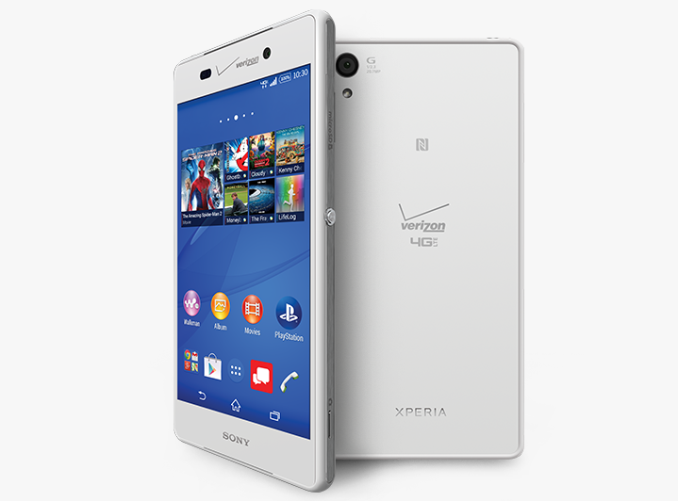
Consumers in the United States have typically been unable to purchase Sony smartphones if their carrier is Verizon. The carrier’s lineup has been devoid of any Xperia offerings for quite some time. One exception was the Xperia Play which launched exclusively on Verizon in the United States 3 years ago. Since then we haven’t seen much in the way of collaboration between the two companies beyond a few tablet launches. That ends today with the launch of the Sony Xperia Z3v on Verizon.

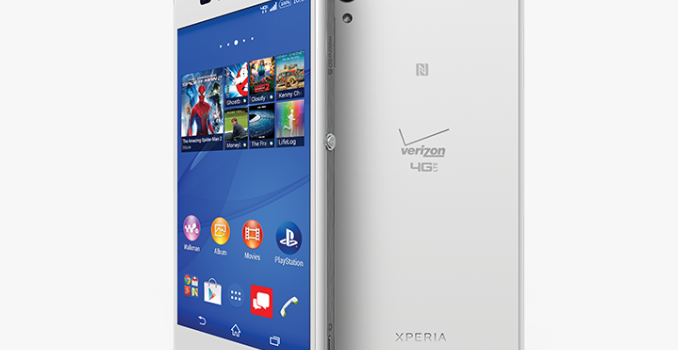
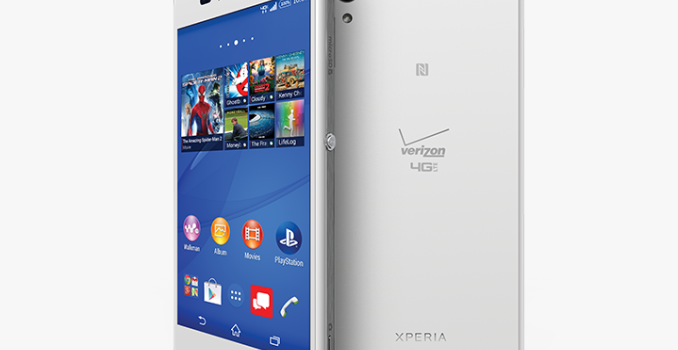
At its core, the Z3v is the same as the Xperia Z3 that Sony unveiled earlier this year at IFA. It’s Sony’s flagship smartphone, with a 5.2″ 1920×1080 IPS display, 3GB of RAM, 32GB of NAND with 128GB MicroSDXC expansion, a 20.7MP camera, and Qualcomm’s MSM8974AC with 4 Krait 400 cores at 2.5GHz.

There are a few changes with the Verizon exclusive Z3v. The design of the chassis has some alterations. The sides of the phone in particular are flatter than the international Z3, and because of this the Z3v looks more visually similar to the Xperia Z2 than the Z3. The phone also has a couple of improvements over the Z3. The first is the addition of Qi inductive charging, and the other is a small boost in battery capacity from 11.78Whr to 12.16Whr. 

The Z3v will be launching on October 23 for $199 on a 2 year term. Users who are interested in more information can check out Verizon’s sign up page for the new device.

Sony Announces the Xperia Z3v for Verizon

Sony Announces the Xperia Z3v for Verizon

Consumers in the United States have typically been unable to purchase Sony smartphones if their carrier is Verizon. The carrier’s lineup has been devoid of any Xperia offerings for quite some time. One exception was the Xperia Play which launched exclusively on Verizon in the United States 3 years ago. Since then we haven’t seen much in the way of collaboration between the two companies beyond a few tablet launches. That ends today with the launch of the Sony Xperia Z3v on Verizon.

At its core, the Z3v is the same as the Xperia Z3 that Sony unveiled earlier this year at IFA. It’s Sony’s flagship smartphone, with a 5.2″ 1920×1080 IPS display, 3GB of RAM, 32GB of NAND with 128GB MicroSDXC expansion, a 20.7MP camera, and Qualcomm’s MSM8974AC with 4 Krait 400 cores at 2.5GHz.

There are a few changes with the Verizon exclusive Z3v. The design of the chassis has some alterations. The sides of the phone in particular are flatter than the international Z3, and because of this the Z3v looks more visually similar to the Xperia Z2 than the Z3. The phone also has a couple of improvements over the Z3. The first is the addition of Qi inductive charging, and the other is a small boost in battery capacity from 11.78Whr to 12.16Whr. 

The Z3v will be launching on October 23 for $199 on a 2 year term. Users who are interested in more information can check out Verizon’s sign up page for the new device.

HTC Silently Adds HTC One (M8 EYE) To Chinese Store

HTC Silently Adds HTC One (M8 EYE) To Chinese Store

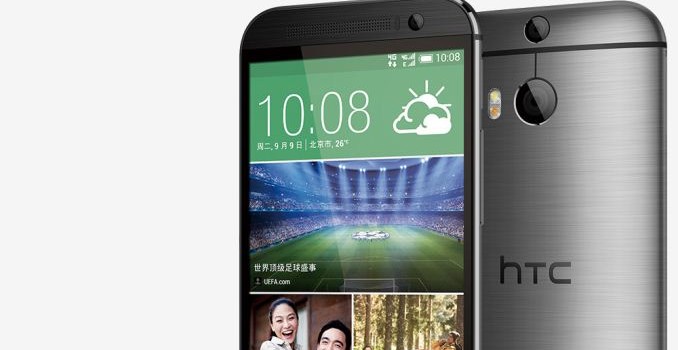
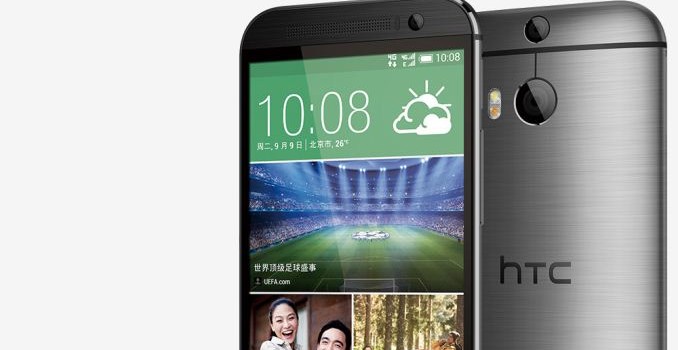
At HTC’s Double Exposure event in New York we saw the launch of the Desire EYE, a smartphone with a serious focus on the camera. HTC has silently put a listing for the HTC One (M8 EYE) on their chinese web store. The HTC One (M8 EYE) is essentially the same as the HTC One (M8) that launched earlier this year, but with one major hardware difference. HTC’s 4MP UltraPixel sensor has been replaced by Sony’s 13MP IMX214, the same sensor used on the HTC Butterfly 2 and the HTC Desire EYE. Unlike the Desire EYE, the front-facing camera is still a 5MP sensor.

Based on the photos on the website, the HTC One (M8 EYE) also has the new HTC EYE Experience features like Face Fusion, HTC Split Capture, and advanced face tracking features for conferencing.

The fact that this is a fairly silent launch from HTC seems to suggest that this may be a device destined only for the Chinese market. 

HTC Silently Adds HTC One (M8 EYE) To Chinese Store

HTC Silently Adds HTC One (M8 EYE) To Chinese Store

At HTC’s Double Exposure event in New York we saw the launch of the Desire EYE, a smartphone with a serious focus on the camera. HTC has silently put a listing for the HTC One (M8 EYE) on their chinese web store. The HTC One (M8 EYE) is essentially the same as the HTC One (M8) that launched earlier this year, but with one major hardware difference. HTC’s 4MP UltraPixel sensor has been replaced by Sony’s 13MP IMX214, the same sensor used on the HTC Butterfly 2 and the HTC Desire EYE. Unlike the Desire EYE, the front-facing camera is still a 5MP sensor.

Based on the photos on the website, the HTC One (M8 EYE) also has the new HTC EYE Experience features like Face Fusion, HTC Split Capture, and advanced face tracking features for conferencing.

The fact that this is a fairly silent launch from HTC seems to suggest that this may be a device destined only for the Chinese market. 

ASRock Releases X99 Extreme11: So I Heard You Like Storage

ASRock Releases X99 Extreme11: So I Heard You Like Storage

We reviewed the X79 Extreme11 back in September 2012. The concept was simple: divert eight PCIe lanes into an LSI SAS chip for eight more SATA ports with SAS compatibility. Then ASRock released the Z87 Extreme11 which combined the LSI chip with a port multiplier, upping the total from 8+6 to 16+6. The X79 required two PLX8747 chips to also enable x16/x16/x16/x16 + LSI, whereas the Z87 only used one PLX8747 for x8/x8/x8/x8 + LSI.
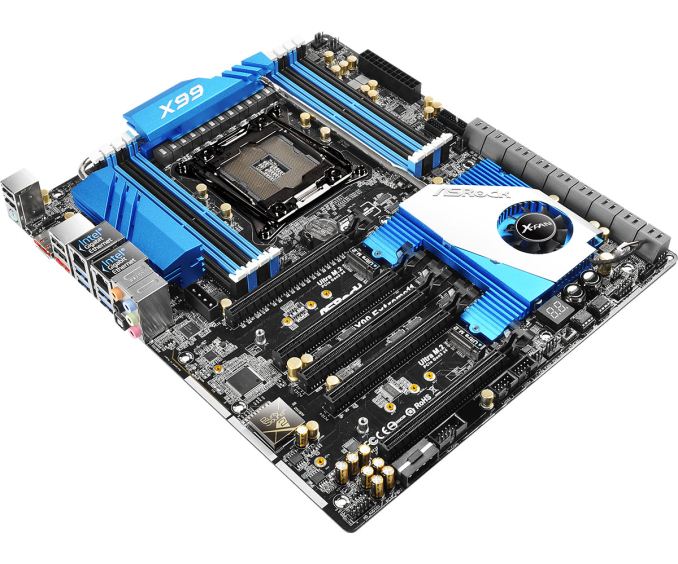
Now insert the X99 version of the Extreme11. It gets a bit tricky here, because SATA is not the only storage around. Add into the mix that the chipset supports 10 SATA ports on its own then there is the potential for something silly, or awesome, or perhaps a little of both. The X99 Extreme11 uses the same LSI SAS 3008 without the port multiplier, but add in the 10 chipset ports X99 already provides and it gives a total of 18. This LSI chip uses eight PCIe 3.0 lanes and supports RAID 0/1 only, but still allows ASRock to publish 6.1 GBps peak read/write when top end SATA drives are connected to each port.

The X99 Extreme11, similar to the Z87, uses two PLX chips to achieve x16/x16/x16/x16 support along with the LSI chip. To throw some more into the mix, the motherboard also has two Ultra M.2 slots, with both supporting PCIe 3.0 x4 connectivity and 22×110 sized drives. These M.2 x4 slots are still good for 2.8 GBps according to ASRock, and while they won’t be RAID capable in hardware, a software layer might provide an interesting project.
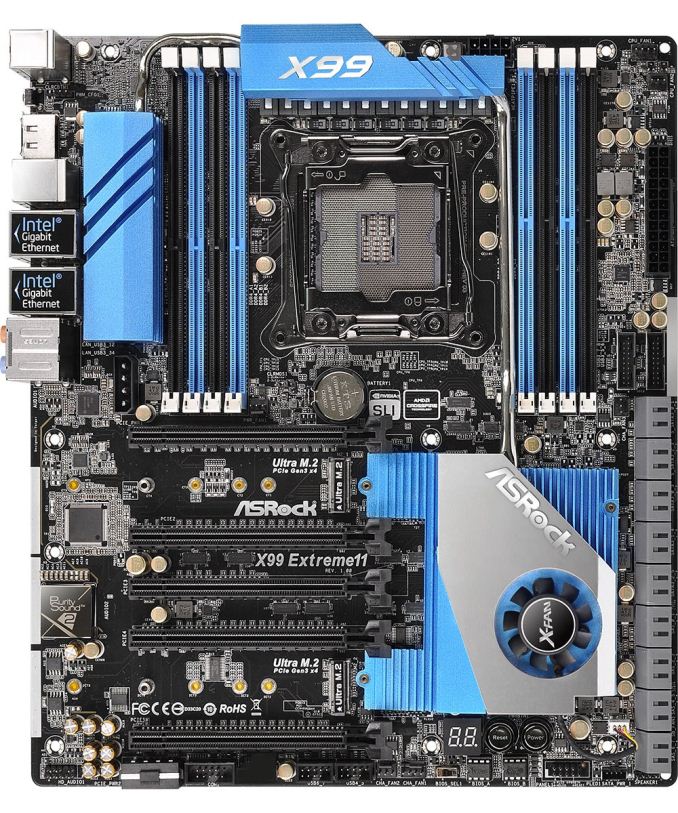
The motherboard will support Xeons with either UDIMMs or RDIMMs, along with ECC support. Networking is provided by two Intel NICs, the I218-V and I211-AT, with support for Teaming. The PCIe slots will support x16/x16/x16/x16 even with the 28-lane i7-5820K, although using that CPU will disable the second M.2 x4 due to the lack of bandwidth.

ASRock is keen to promote their 12-phase power design, which we see paired with large heatsinks. A heatpipe connects all three heatsinks, with the heatsink on the left there only to provide extra surface area. The chipset heatsink is also dealing with the LSI controller, hence the size and the active cooling. Users in the past often express concern about small fans like this, although it can be disconnected if the user has their own sufficient cooling.

The board has eight USB 3.0 ports, six from the chipset and two from an ASMedia controller powering two of the rear IO ports. Also onboard is a COM header, seven fan headers (only two are 4-pin), Realtek ALC1150 audio in Purity Sound 2 and a dual BIOS topology. Because of the use of 4-way PCIe, there are two connectors on board for additional VGA power, although these are molex connectors which I disapprove of. One of them is to the left of the middle of the board, making cable management a nightmare.
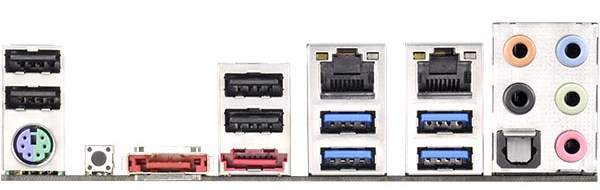
The Rear IO has two eSATA ports, both of which are shared with specific SATA ports on the motherboard, meaning only one can work at one time. The back panel also has a PS/2 combination connector, four USB 2.0 ports, four USB 3.0 ports, the two Intel network ports and audio.

In ASRock’s YouTube video promoting the motherboard, they paired the system with an 18-core E5-2699 v3, 128GB of DRAM, four GTX 780 Ti cards, two M.2 x4 drives and 18 SSDs. See you later, I need to sell a kidney and perhaps a lung as well.

I would not be surprised if the X99 Extreme11 ends up being the most expensive X99 motherboard on the market. The two PLX 8747 chips, as well as the LSI 3008, are not cheap for the end-user. Though if a user wants to wire up a large Xeon, a ton of memory, four GPUs, a dozen or more storage devices or any combination therein, then the price of the motherboard might be quite low down on the list. The X79 Extreme11 retailed for $600, so I suspect that this motherboard will be in the same ballpark.

I have requested a review sample, and hopefully we can delve into the interesting PCIe arrangement under the hood. It will be interesting to see how everything is wired up. A full specification list can be found on ASRock’s X99 Extreme11 page.