News


Bykski Announces Real-Time Temperature Monitoring Fittings for Watercooling

Bykski Announces Real-Time Temperature Monitoring Fittings for Watercooling

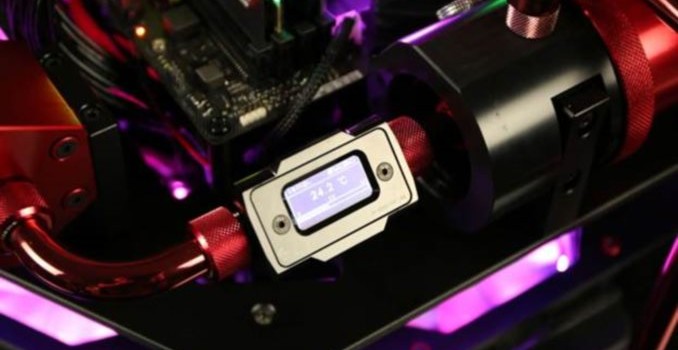
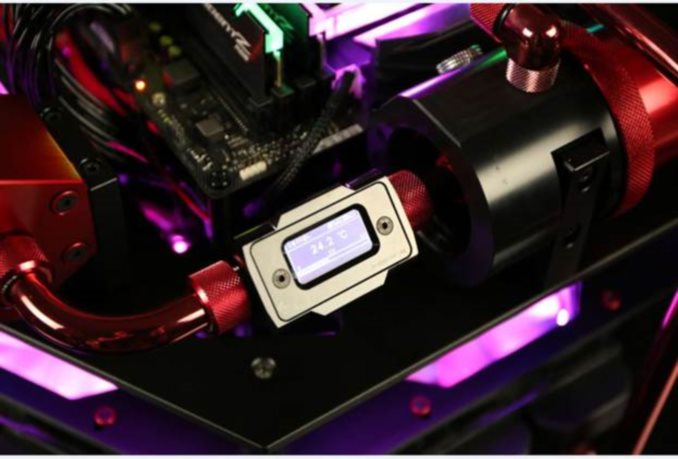
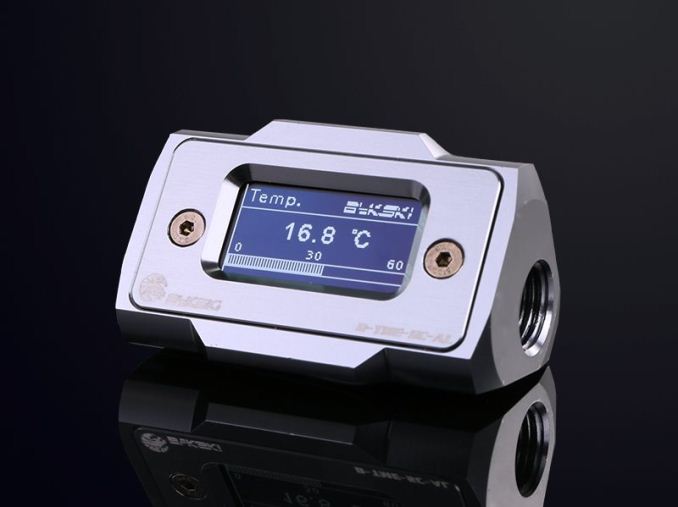
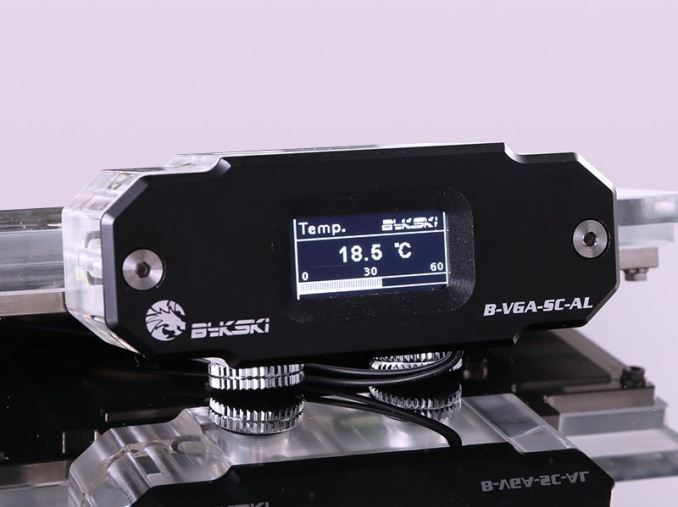
Bykski has unveiled two new real-time temperature sensor monitors, both featuring LCD displays capable of displaying real-time temperature information on its screen to the users. The Bykski B-TME-SE-AL and B-VGA-SC-AL both are added inline to your water cooling loop to allow for instant monitoring of the water loop fluid temperature right from its screen. Aside from temperature monitoring, it can add a unique touch to a user’s loop. Typically temperature readings are handled by software or much larger devices that fit in the 5 1/4″ bays. 


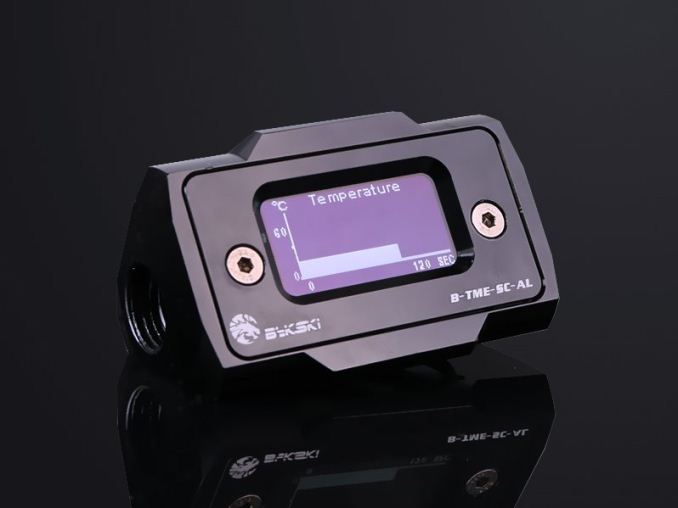
The B-TME-SE-AL is an inline device designed for use on the main loop tubing and features an OLED display showing real-time temperature information. It is able to get this information through a thermistor in the inlet screw which reads the liquids current temperature when passing through the device. Users are able to present the information in a curve display or progress bar on the screen. The TME is constructed of aircraft-grade aluminum and is available in black and grey colors with a smooth finish. 

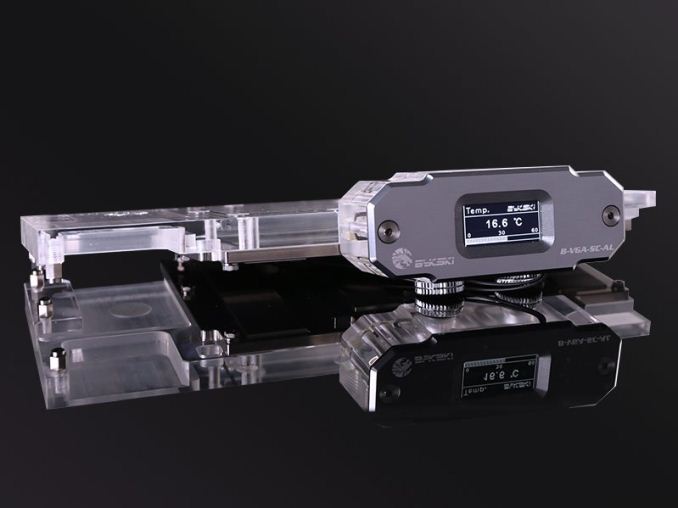
The B-VGA-SC-AL, on the other hand, is intended for use with VGA blocks and mounts to the VGA block itself. Like the TME, the VGA version works the same way with an integrated thermistor in the inlet screw reading temperatures. Like the TME, a curve display or progress bar are also options on its OLED screen. The VGA is made out of aluminum + acrylic and comes in two colors, black and grey, which should blend in with many VGA blocks on the market.

Both devices use a standard G ¼” threads so users are able to connect their own fittings and integrate the temperature monitors in the loop. These are made out of aluminum and we are unsure if there is a nickel coating. Be aware of potentially mixing metals inside your loop. Bykski stands by these two products with 3-year warranty. 

Bykski B-TME-SE-AL and B-VGA-SC-AL
  B-TME-SE-AL B-VGA-CD-AL
Color Black / Grey
Material Aluminum Aluminum + Acrylic
Process Anodized
Pattern Smooth
Thread Size G 1/4″
Annex No
Warranty 3 Years

Both are available now with the B-VGA-SC-AL block found at AliExpress.com for $35.95 and the B-TME-SE-AL found at sgshop.com for $47.27. I have to admit I would have expected these to cost more, regardless if they are a bit limited in functionality (temps only). Availability of the devices appear limited to the above sites overseas as a cursory search to find these anywhere local for the US/EU contingent turned up without results. That said, both websites above do ship internationally. 

Related Reading:

Intel Announces Q1 FY 2018 Results: Another Record

Intel Announces Q1 FY 2018 Results: Another Record

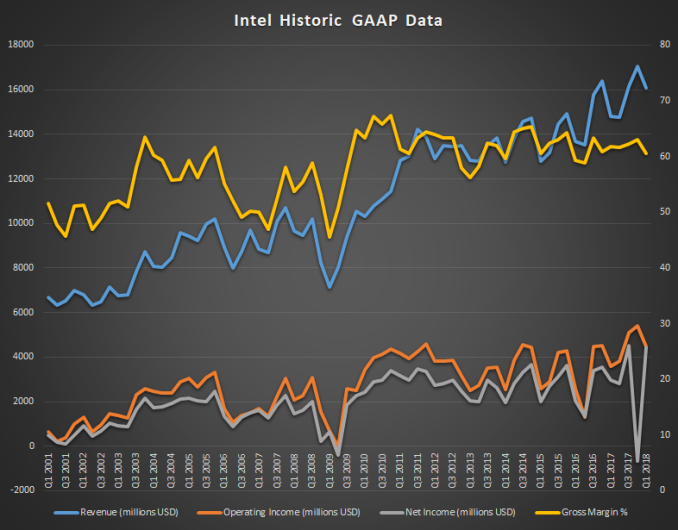
This afternoon, Intel announced their earnings for the first quarter of their 2018 fiscal year, and once again, the company has set new records, with revenue for the quarter of $16.1 billion, up 9% from a year ago. Intel is always a company built on strong margins, and although they were down 1.3% from last year, at 60.6% they are still quite strong. Operating income was up 23% to $4.5 billion, and net income was up 50% to $4.5 billion, which is the same as their operating income because they had gains on equity of $643 million, and they paid only 11.1% in taxes for the quarter. Earnings per share came in at $0.93, up 53%.

With numbers like that, it shouldn’t be a surprise that all of Intel’s business units improved their revenue year-over-year, including the Client Computing Group, which had revenues of $8.2 billion for the quarter, which was up 3%. It’s not a huge gain, but in a shrinking PC market, and stronger competition, they were able to scratch out some growth.

Intel Q1 2018 Financial Results (GAAP)
  Q1’2018 Q4’2017 Q1’2017
Revenue $16.1B $17.1B $14.8B
Operating Income $4.5B $5.4B $4.5B
Net Income $4.5B -$0.7B $3.0B
Gross Margin 60.6% 63.1% 61.9%
Client Computing Group Revenue $9.0B -8.9% +3%
Data Center Group Revenue $5.2B -4.4% +24%
Internet of Things Revenue $840M +3.5% +17%
Non-Volatile Memory Solutions Group $1B +12.5% +20%
Programmable Solutions Group $498M -12.3% +17%

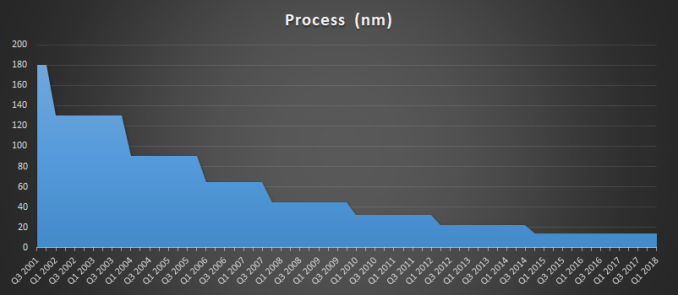
Ryan’s going to go more into this in another piece, but Intel also made it official that they are not going to have any volume shipments of 10 nm until 2019. Intel is currently shipping low-volume on 10 nm, but continued struggles in getting the new process up to speed mean that any 10 nm products that were in the works are now going to be delayed again. Intel is going to continue to improve their 14 nm node for this year.

Intel classifies the Client Computing Group as “PC-Centric” and you can see that it’s still the bread and butter of their revenue, but it’s also been stagnant for a while. They classify all of their other business as “Data-Centric” which includes the Data Center Group, IoT group, Non-Volatile Storage, Programable Solutions Group. This Data-Centric aspect is why Intel is growing again.

The Data Center Group had revenues of $5.2 billion, which is up 24% year-over-year. As we saw in AMD’s earnings, EPYC hasn’t really made an impact on their earnings yet, but Intel continues to dominate in this segment.

IoT is closing in on the billion-dollar revenue for a quarter, with growth of 17% year-over-year to $840 million. Although Intel missed out on mobile, IoT has the potential to quickly surpass mobile, and they’ve committed to this space early, and are seeing strong growth.

Non-Volatile Memory Solutions, which is Intel’s NAND flash and Optane group, had revenues of $1.0 billion for the quarter, which is up 20% year-over-year. They’ve focused a lot on the datacenter with their solutions, and there is higher margins there, so it’s not a surprise to see them focus in on that market.

Programmable Solutions had revenues of $498 million for the quarter, up 17% year-over-year. This is another strong growth segment for Intel, and we’ve seen a lot of the cloud infrastructure trying to find ways to offload work onto FPGAs in an attempt for more efficient workloads.

Thanks to the strong start, Intel has already raised their full-year expectations to $67.5 billion, which is an increase of $2.5 billion over their last forecast. Intel has traditionally led with their fabs, so it’s interesting to see them growing with such vigour when their fabs advances are completely stalled, but such is the growth of cloud computing.

Source: Intel Investor Relations

Intel Outs Z390 & X399 PCHs for Cannon Lake & Coffee Lake CPUs

Intel Outs Z390 & X399 PCHs for Cannon Lake & Coffee Lake CPUs

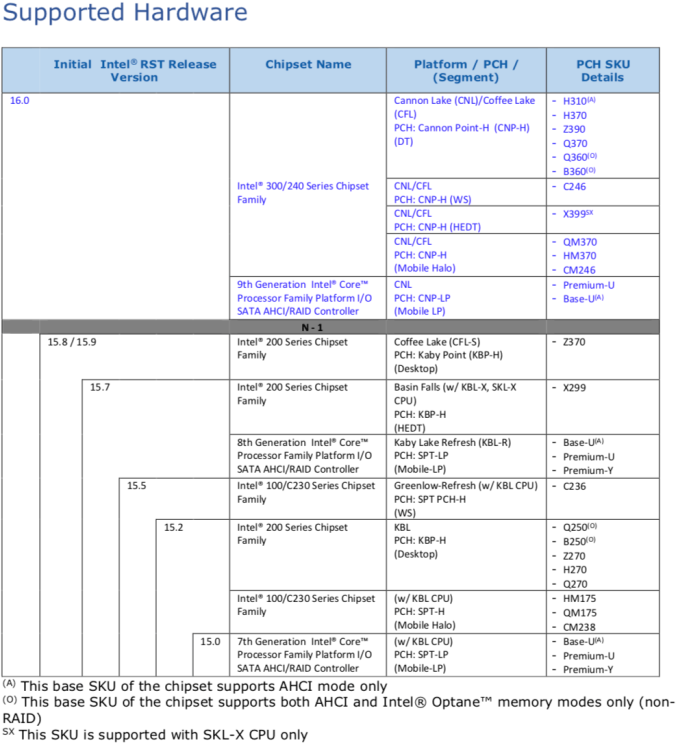
Intel this week released its new Rapid Storage Technologies drivers, and thanks to their associated release notes, Intel has indirectly confirmed their upcoming Z390 and X399 PCHs. The drivers’ release notes also shed some light on Intel’s 9th Generation Core processors as well as features of Intel’s future HEDT platform.

Intel’s new and upcoming platforms for desktops and workstations rely on the company’s Cannon Point-H (CNP-H) PCH silicon in various configurations and with various differentiators, according to release notes for the Intel RST version 16.0 driver. The CNP-H chip itself is already in high volume production and is sold to PC makers under the CM246, HM370, QM370, H370, H310, Q370, and B360 SKUs. Said chipsets power high-performance laptops based on mobile Coffee Lake processors as well as new motherboards for consumer and corporate desktops. Going forward, Intel’s Cannon Point-H PCH will also be used for various desktops (under the Z390, H310, H370, Q370, Q360, B360 model numbers), workstations (under the C246 model number), and high-end desktops (under the X399 SKU).

It is noteworthy that the Intel X399 PCH will be validated only with the Skylake-X CPUs (at least initially), leaving the unusual Kaby Lake-X family notably absent. It remains to be seen whether Intel plans to rebrand Skylake-X processors for the X399 platform in a bid to emphasize possible new features of the platform, but typically the company does not do anything like this in the HEDT segment.

Intel’s upcoming low-power laptop platforms running the 9th Generation Core “Cannon Lake-U” SoCs will use a different PCH known as the Cannon Point-LP. The document does not say anything about usage of non-Cannon Lake silicon in the 9th Gen Core family for low-power notebooks, so it looks like the said platforms will rely solely on Intel’s CPUs made using its 10 nm process technology. At the same time, it is also noteworthy that Intel does not list any Cannon Lake-Y SoCs in the release notes, so the destiny of such products remains unknown.

Intel’s 300-Series and 240-Series PCHs
Chipset SKU Silicon Supported CPUs Application
Z390 Cannon Point-H
CNP-H
Cannon Lake
Coffee Lake-S
Enthusiast Desktops
H370 Desktops
H310
Q370
Q360
B360
C246 Workstations
CM246 Cannon Lake
Coffee Lake-H
Mobile Workstations
QM370 High-End Laptops
HM370
X399 Skylake-X High-End Desktops
9th Gen Core Platform I/O Controller Cannon Point-LP
CNP-LP
Cannon Point-U Low-Power Laptops

Since release notes for the drivers are not meant to announce precise product specifications, it is impossible to say what exactly to expect from the Z390 or the X399 PCHs. Meanwhile, general specs of the Q370, H370 SKUs and other PCHs based on the CNP-H silicon are well known, so the base functionality of the upcoming chipsets is more or less obvious

Intel’s 300-series PCH
  Z370 H370 Q370 B360 H310
Launch Oct ’17 Apr ’18 Apr ’18 Apr ’18 Apr ’18
Market Consumer
Consumer
Corporate

Corporate
Consumer
Corporate
Consumer
ME Firmware 11 12 12 12 12
HSIO Lanes 30 30 30 24 14
Total USB 14 14 14 12 10
Max USB 3.1 G2 4 6 4 0
Max USB 3.1 G1 10 10 8 6 4
SATA 6 Gbps 6 6 6 6 4
PCH PCIe 3.0 Lanes 24 20 24 12
PCH PCIe 2.0 Lanes 6
Max RST PCIe Storage 3 2 3 1 0
Supports Optane Y Y Y Y N
Integrated 802.11ac N Y Y Y Y
Intel Smart Sound Y Y Y Y N
Intel vPro N N Y N N
TDP 6 W 6 W 6 W 6 W 6 W

Intel does not comment on unreleased products, so we cannot get you any official information at this point.

Related Reading:

Philips Unveils 43-Inch 4K Gaming LCD with DisplayHDR 1000, DCI-P3, FreeSync

Philips Unveils 43-Inch 4K Gaming LCD with DisplayHDR 1000, DCI-P3, FreeSync

Philips has announced its new large gaming display that brings together an ultra-high-definition resolution panel, VESA’s DisplayHDR 1000 certification, and AMD’s FreeSync dynamic refresh rate technology. In addition to being the only ultra-large gaming monitor to support the aforementioned features (among those announced to date), the Philips 436M6VBPAB also supports USB Type-C docking, which is going to please users of laptops that feature only USB-C ports.

A Gaming Display with Quantum Dots, Ambiglow, and a Remote

The Philips 436M6VBPAB relies on a 43-inch 8-bit + FRC VA panel featuring a 3840×2160 resolution, 600 – 1000 nits brightness, a high contrast ratio (since it is a VA panel, we are probably talking about something like 2000:1 or better), a 4 ms response time, a 60 Hz optimum refresh rate, 178°/178° viewing angles, and so on. The backlighting is outfitted with a Quantum Dot-enhancement film that enables it to cover an above-average 97.6% of the DCI-P3 color gamut.
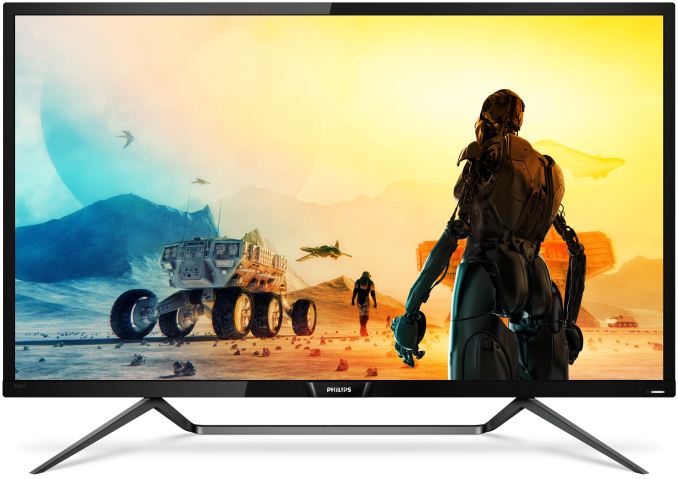
In addition to accurate colors and HDR support, the 436M6VBPAB supports Philips’ Ambiglow technology, which produces LED lighting effects to match ambient lighting with what is happening on the screen. This is not a programmable RGB lighting found on gaming displays from companies like ASUS, but it adds visual effects that are useful practically and bring additional immersion to games.

Speaking of gaming, it is noteworthy that the ultra-large monitor from Philips takes a page from AOC’s book and supports the so-called Low Input Lag mode that reduces input lag by bypassing “most of the display’s internal processing.” This is not particularly surprising since both AOC- and Philips-branded LCDs are made by TPV.
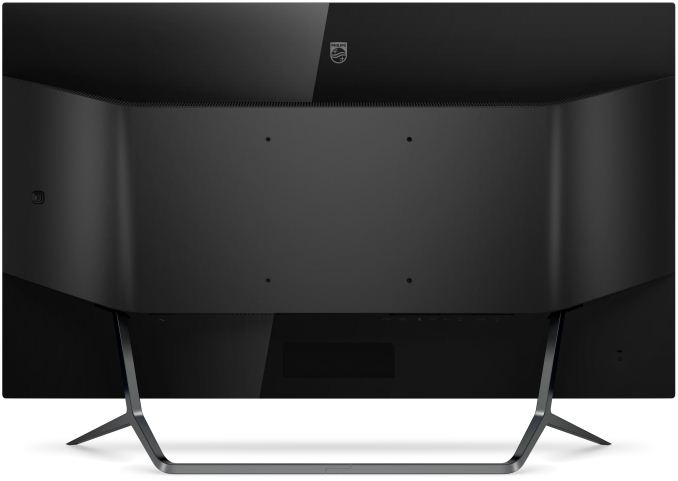
Moving on to connectivity of the 436M6VBPAB. The monitor has four display inputs: 1x DisplayPort 1.2, 1x Mini DisplayPort 1.2, 1x HDMI 2.0, and 1x USB Type-C that can be used both for display connectivity and as an upstream port for a USB 3.0 hub. The LCD supports Picture-in-Picture and Picture-by-Picture capabilities from two sources. As for audio, the display features a 3.5-mm audio input, 3.5-mm audio output as well as two built-in 7-W speakers with the DTS Sound badge.

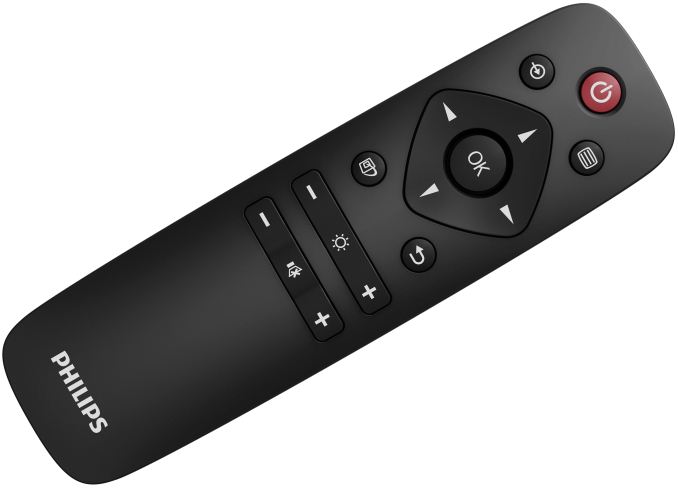
Another important feature of the Philips 436M6VBPAB monitor is bundled remote controller that can be used to control the monitor as well as other devices connected using HDMI (e.g., media players, game consoles, etc.). The remote is going to be quite handy because the 43-incher can be used like a TV when connected to various media streamers or players (or even a TV tuner!). Now, a disadvantage of this size is that the 436M6VBPAB does not come with a stand that can regulate its height or tilt. To partly solve this, it does have VESA mounts.
FreeSync Meets HDR

The new monitor from Philips belongs to the brand’s Momentum lineup of LCDs aimed at gamers and multimedia enthusiasts. Given the target market, the key features of the Philips 436M6VBPAB besides its dimensions and Quantum Dot-enhanced backlighting are AMD’s FreeSync technology and VESA’s DisplayHDR 1000 badge, a rather odd combination considering the fact that FreeSync 2 is a technology that is supposed to bring HDR to gaming displays. There is an explanation to this combination.

AMD’s FreeSync 2 mandates monitors to support a number of features: they have to support the tech on the logical level (i.e., let games tone map directly to the native color space of a display), they have to cover at least 90% of the DCI-P3 color space, and they have to support a dynamic refresh rate with Low Framerate Compensation. In case of the 436M6VBPAB, the LCD supports a wide color gamut and a dynamic refresh, but not direct tone mapping and LFC, which is why it cannot get an appropriate AMD certification. In fact, it yet has to get a FreeSync certification, which is why Philips uses the term ‘Adaptive Sync for AMD GPUs’. Philips does not disclose dynamic refresh range of the monitor, but given its maximum refresh rate, we don’t expect the minimum refresh rate to be much below 45Hz.

Update 6:15 PM ET: Philips Australia has published official specifications of the 436M6VBPAB monitor on its website. The specs list 3840 × 2160 at 60 Hz as “optimum” resolution and refresh rate of the display. At the same time, the LCD supports a 23 – 80 Hz scanning frequency for DisplayPort and HDMI inputs, which looks like the FreeSync range. Considering that 80 Hz is an odd refresh rate, it is highly likely that the monitor overclocks itself from 60 Hz to 80 Hz in certain situations. In the meatime, since display supports a 23 – 80 Hz scanning frequency, it is more than enough for LFC.

Update 4/27: AMD confirmed on Friday that the Philips 436M6VBPAB display is FreeSync certified.

As for the DisplayHDR 1000 logo, the VESA’s highest HDR has a rather strict requirements for brightness (600 nits full-screen long duration minimum, 1000 nits full-screen flash minimum) and black levels. The VESA does not mandate local dimming for this standard, yet it does not believe that corner maximum limit of 0.05 nits and tunnel maximum limit of 0.1 nits are achievable without local dimming. That said, while the Philips 436M6VBPAB does not support FALD (full array local dimming), it does support some kind of local dimming and therefore should feature a good contrast ratio.

The Philips Momentum 43″ 4K HDR display with Ambiglow
  436M6VBPAB
Panel 43″ MVA
Native Resolution 3840 × 2160
Maximum Refresh Rate 60 Hz (normal)
80 Hz (overclocked)
Response Time 4 ms GtG
Brightness 720 cd/m² (typical)
1000 cd/m² (peak)
Contrast 4000:1
Backlighting LED with quantum dots
Viewing Angles 178°/178° horizontal/vertical
Aspect Ratio 16:9
Color Gamut 100% sRGB/BT.709
97.6% DCI-P3
HDR HDR10
DisplayHDR Tier 1000
Dynamic Refresh Rate Tech AMD FreeSync
23.976 – 80 Hz
Pixel Pitch 0.2479 mm²
Pixel Density 102 PPI
Inputs 1 × DisplayPort 1.2
1 × Mini DisplayPort 1.2
1 × HDMI 2.0
1 × USB Type-C
Audio 3.5 mm input/output
2 × 7 W DTS Sound speakers
USB Hub 2 × USB 3.0 Type-A connectors
1 × USB 3.0 Type-C input
VESA Mount 200 × 200 mm
MSRP Europe: €799
UK: £699
US: $799 without VAT (unconfirmed)

Pricing and Availability

Philips plans to start selling the 436M6VBPAB this May for €799/£699 in Europe. As production of the unit ramps up, its availability will get more widespread in June, but the manufacturer does not explicitly say when it plans to start its sales in the U.S.

Related Reading:

CPU Design Guru Jim Keller Joins Intel; Completes CPU Grand Tour

CPU Design Guru Jim Keller Joins Intel; Completes CPU Grand Tour

For long-time AnandTech readers, Jim Keller is a name many are familiar with. The prolific microarchitectural engineer has been involved in a number of high-profile CPU & SoC projects over the years, including AMD’s K8 and Zen CPUs and Apple’s early A-series SoCs. Now after a stint over as Tesla for the past couple of years, Intel has announced that they have hired Keller to lead their silicon engineering efforts.

After rumors on the matter overnight, in a press release that has gone out this morning, Intel confirmed that they have hired Jim Keller as a Senior Vice President. There, Keller will be heading up the 800lb gorilla’s silicon engineering group, with an emphasis on SoC development and integration. Beyond this, Intel’s press release is somewhat cryptic – especially as they tend not to be very forward about future processor developments. But it’s interesting to note that in a prepared statement included with the press release, Dr. Murthy Renduchintala – Intel’s Chief Engineering Officer – said that the company has “embarked on exciting initiatives to fundamentally change the way we build the silicon as we enter the world of heterogeneous process and architectures,” which may been seen as a hint of Intel’s future direction.

What is known for sure is that for most of the last decade, Keller’s engineering focus has been on low-power hardware. This includes not only his most recent stint at Tesla working on low voltage hardware, but also his time at Apple and PA Semiconductor developing Apple’s mobile SoCs, and even AMD’s Zen architecture is arguably a case of creating an efficient, low-power architecture that can also scale up to server CPU needs. So Keller’s experience would mesh well with any future development plans Intel has for developing low-power/high-efficiency hardware. Especially as even if Intel gets its fab development program fully back on track, there’s little reason to believe they’re going to be able to duplicate the manufacturing-derived performance gains they’ve reaped over the past decade.

As for any specific impact Keller might have on Intel’s efforts, that is a curiosity that remains to be seen. Keller’s credentials are second to none – he’s overseen a number of pivotal products – but it bears mentioning that modern processor engineering teams are massive groups working on development cycles that span nearly half a decade. A single rock star engineer may or may not be able to greatly influence an architecture, but at the same time I have to imagine that Intel has tapped Keller more for his leadership experience at this point. Especially as a company the size of Intel already has a number of good engineers at their disposal, and unlike Keller’s second run at AMD, the company isn’t recovering from a period of underfunding or trying to catch up to a market leader. In other words, I don’t expect that Intel is planning on a moment of Zen for Keller and his team.


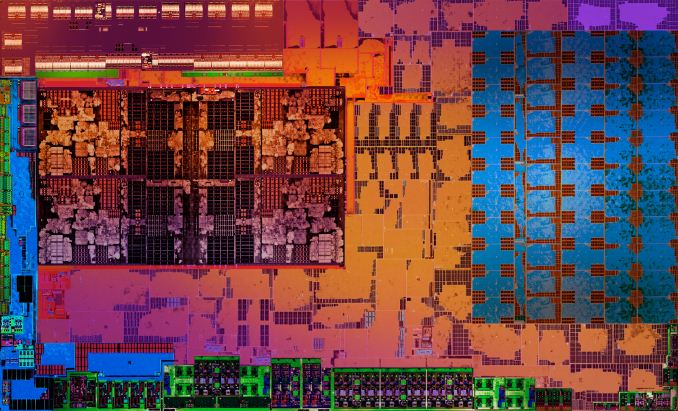
One of Jim Keller’s Many Children: AMD’s Raven Ridge APU

Though with his shift to Intel, it’s interesting to note that Jim Keller has completed a de facto grand tour of the high performance consumer CPU world. In the last decade he’s worked for Apple, AMD, and now Intel, who are the three firms making the kind of modern ultra-wide high IPC CPU cores that we see topping our performance charts. Suffice it to say, there are very high-profile engineers of this caliber that these kind of companies will so openly court and/or attempt to pull away from the competition.

For those keeping count, this also marks the second high-profile architect from AMD to end up at Intel in the last 6 months. Towards the end of last year Intel picked up Raja Koduri to serve as their chief architect leading up their discrete GPU development efforts, and now Jim Keller is joining in a similar capacity (and identical SVP title) for Intel’s silicon engineering. Coincidentally, both Kodrui and Keller also worked at Apple for a time before moving to AMD, so while they haven’t been on identical paths – or even working on the same products – Keller’s move to Intel isn’t wholly surprising considering the two never seem to be apart for too long. So it will be exciting to see what Intel is doing with their engineering acquisitions over the coming years.