
News


AUO to Ship 8K UHD TV Panels in Coming Months

AUO to Ship 8K UHD TV Panels in Coming Months

AU Optronics this week has announced plans to start shipments of 8K panels for large UHDTVs in the first half of 2018. The panels will enable TV manufacturers to produce “Super UHD” 8K TVs to compete against LG and Samsung later this year.

The lineup of panels featuring a 7680×4320 resolution will be aimed at ultra-high-end TVs and sizes will range from 65 to 85 inches, said Liao Wei-Lun, president of AUO’s video products business group, at a press conference. The high-ranking executive did not disclose other specifications of the panels, such as luminance and contrast ratio, but given their positioning, it is logical to expect their characteristics to be comparable to 8K UHDTVs to be offered by LG and Samsung.

Multiple TV makers demonstrated various 8K UHDTVs at various trade shows in the recent years, but so far no one has started to sell them. Given the lack of content, it is hard to expect high demand for 8K televisions in the next couple of years, aside from the halo factor – nonetheless, AUO expects 8K panels to account for 10% of its ’65-inch and above’ panel shipments in 2020. The presumably high-cost of the panels would indicate that in terms of unit shipments this might still be a low-ish number. However, as with 4K displays, someone has to release 8K TVs to stimulate content providers to offer appropriate material. At this year’s CES, Samsung demonstrated its Q9S, its first commercial 8K TV-set, but it did not announce its pricing or availability timeframe. LG and Sony also demonstrated their 8K TVs at CES 2018, but nothing is clear about their plans regarding these products.

Since AUO intends to start mass production of the 8K panels for UHDTVs in the coming months, it is highly likely that it has customers willing to use them for their products already. Because we are talking about volume manufacturing, it is likely that AUO’s partners have already developed their UHDTVs based on the early development panels and we are going to see AUO-based 8K UHDTVs later this year.

With Samsung, LG, Sony and various AUO partners onboard, it looks like 8K UHDTVs will finally start to be commercialized this year.

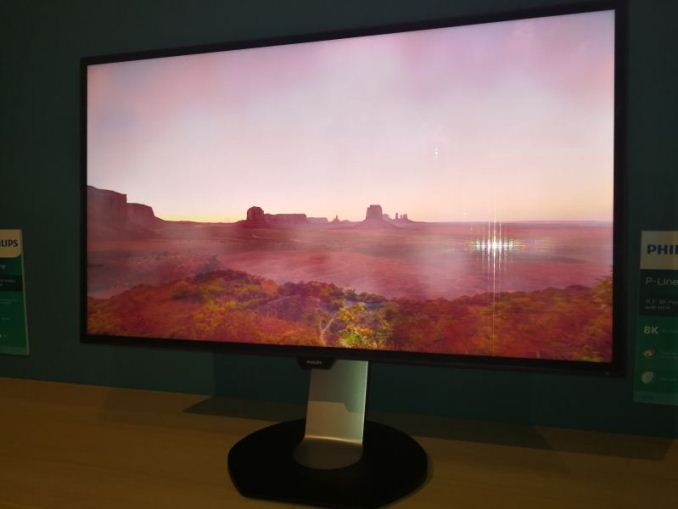
As for 8K displays for PCs, Dell is currently the only company to offer an 8K monitor (this one is based on a panel from LG, so the latter might introduce its own 8K display at some point). Philips last year promised to start shipments 328P8K monitor in 2018, so expect the product to hit the market in the coming months too.

We saw a number of the 8K PC displays last year at various shows:

 
Left: Dell 8K, Right: Philips 8K

Related Reading

CEVA Announces PentaG 5G NR Modem IP Platform

CEVA Announces PentaG 5G NR Modem IP Platform

Today’s announcement marks a key change for CEVA’s business model, as for the first time we see the introduction of a complete modem platform for licensing. The PentaG platform is not a single piece of IP, but rather a collection of soluti…

Samsung 30.72 TB SSDs: Mass Production of PM1643 Begins

Samsung 30.72 TB SSDs: Mass Production of PM1643 Begins

Update 2/21: Adding power consumption figures for the PM1643 drive, new features.

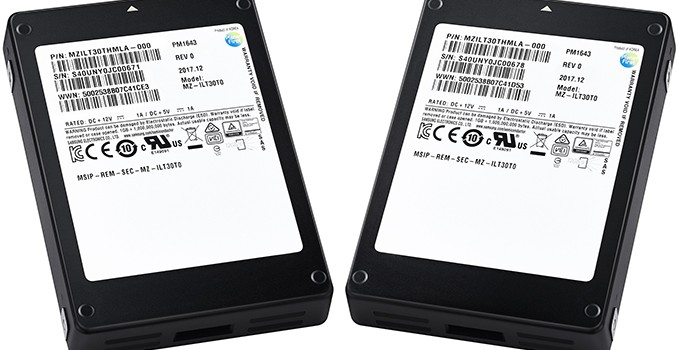
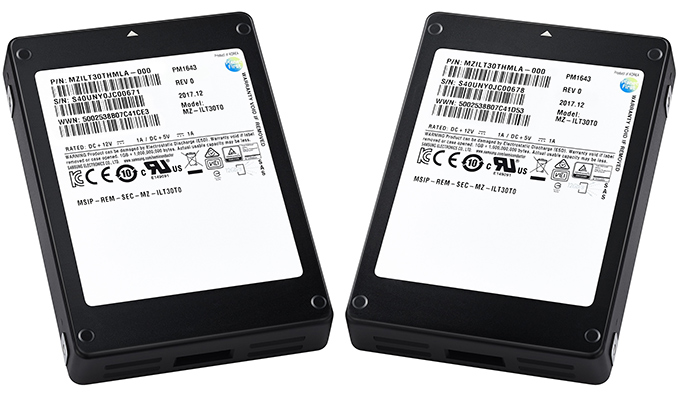
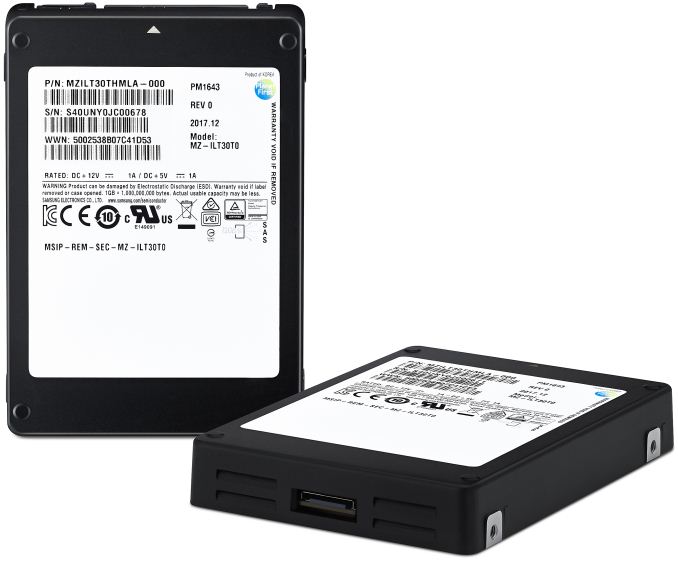
Samsung this week announced that it has started mass production of its PM1643-series SSDs. These are monstrous data storage devices, with up to 30.72 TB capacity each. The new drives use Samsung’s 64-layer 512Gb TLC V-NAND memory chips stacked in 1 TB packages. Later this year Samsung plans to expand the PM1643 lineup with SSDs featuring other capacities.

Samsung’s PM1643 30.72 TB SSD is the company’s highest-capacity mass-produced drive to date. It is designed primarily for read-intensive workloads, and features an SAS-12 Gbps interface. Samsung rates its PM1643 for one DWPD (drive write per day) throughout five years, which indicates a very high endurance of roughly 56 PB for the drive. The choice of the interface and robust endurance rating naturally suggest that we are dealing with a drive for mission-/business-critical applications. Some of the features of the PM1643 that Samsung is willing to discuss right now (metadata protection, power loss protection, data recovery, end-to-end data protection, encryption, etc.) confirm that the drives are indeed aimed at servers that require advanced reliability.

The PM1643 is based on Samsung’s proprietary controller architecture as well as 512 Gb 64-layer TLC V-NAND memory chips – 16 of them are stacked together to create 1 TB packages, over 40 of such packages are used for the 30.72 TB drive, giving sizeable overprovisioning. The new SSDs also carry 40 GB of stacked DDR4 memory (8 Gb DRAM chips interconnected using TSVs), which is in line with the configurations of other drives.

When compared to the previous-generation PM1633a SSDs released in 2016, the new PM1643 offers both double the capacity and also considerably on-paper higher performance. Samsung claims that the PM1643 30.72 TB SSD features sequential read and write speeds of up to 2100 MB/s and 1700 MB/s, respectively. As for peak random read/write performance, the new PM1643 drive is rated for 400K and 50K IOPS, respectively. Samsung yet has to announce sustained sequential and random performance numbers, but it is clear that the new SSDs are intended faster than their direct predecessors.

The Samsung PM1643 SSDs will come in a 2.5-inch form factor, but at 15mm. The new drives support configurable run-time power consumption options of 9W ~ 13.5W (the lower consumption means lower performance), which allows to choose between power and performance per system and application. Since the drives consume an exact same amount of power as the PM1633a 15.36 TB, it is drop in compatible with systems that use the PM1633-series drives. Furthermore, GB-per-Watt consumption of the new drives is at least two times lower when compared to the PM1633a 15.36 TB model.

General Specifications of Samsung PM1643 and PM1633a SSDs
  PM1643 30.72 TB PM1633a 15.36 TB
Controller Samsung proprietary controller
NAND Samsung’s 512 Gb
64-layer TLC NAND
Samsung’s 256 Gb
48-layer TLC NAND
DRAM Cache 40 GB DDR4 SDRAM 16 GB DDR3 SDRAM
Sequential Read 2100 MB/s 1200 MB/s
Sequential Write 1700 MB/s ?
Random Read 4KB 400K 200K
Random Write 4KB 50K 32K
Endurance 1 DWPD (Drive Write Per Day)
56 PB over 5 years 28 PB over 5 years
Interface and Form-Factor 2.5″/15mm SAS-12 Gbps

Samsung started mass production of its PM1643 SSDs in January and has already shipped the first batch to an undisclosed customer. Pricing of individual 30.72 TB drives remains unknown, but we expect it to be thousands of dollars per unit, even at bulk. Later this year Samsung plans to introduce additional capacity points to the PM1643 lineup: the family will include drives featuring 15.36 TB, 7.68 TB, 3.84 TB, 1.92 TB, 960 GB and 800 GB of usable NAND flash.

Related Reading

The AnandTech Podcast, Episode 45: GlobalFoundries and Fab 8

In early February, GlobalFoundries did something completely unexpected: for the second time in ten years, they invited a few select press and analysts to visit one of their fabrication plants (‘fabs’), where they make AMD processors, IBM s…

New EKWB Threadripper X399 Monoblocks for GIGABYTE and MSI

New EKWB Threadripper X399 Monoblocks for GIGABYTE and MSI

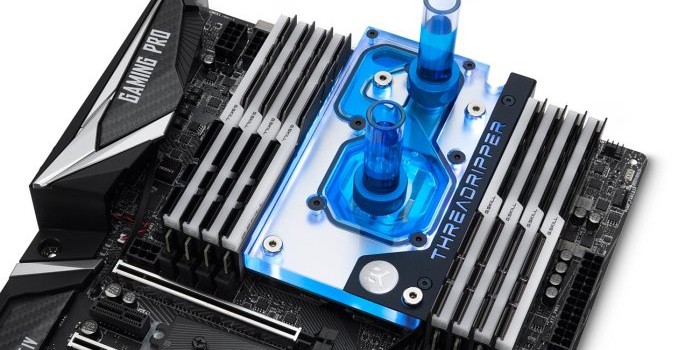
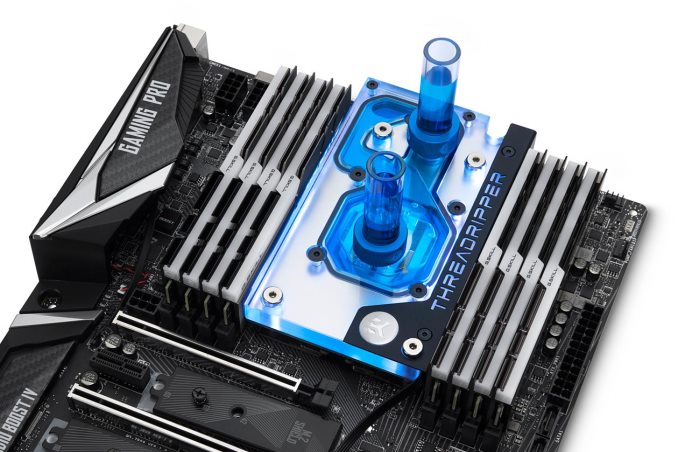
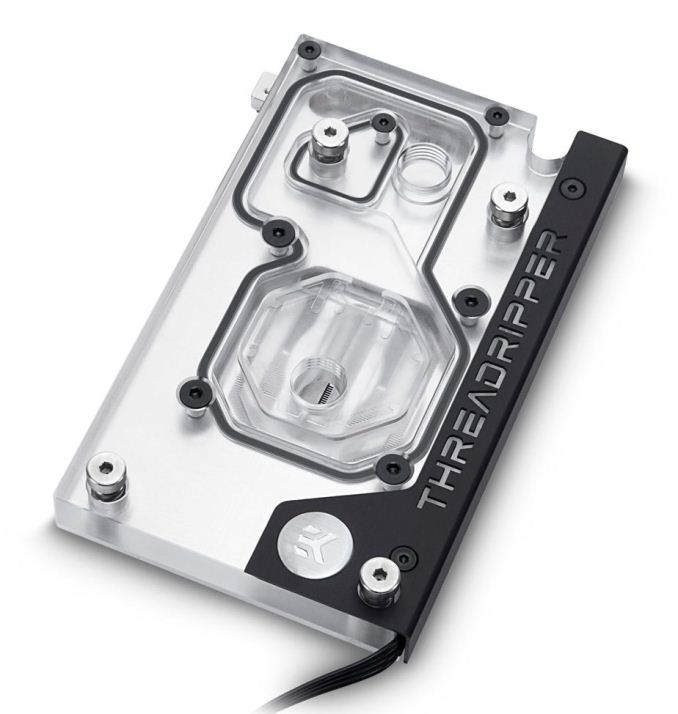
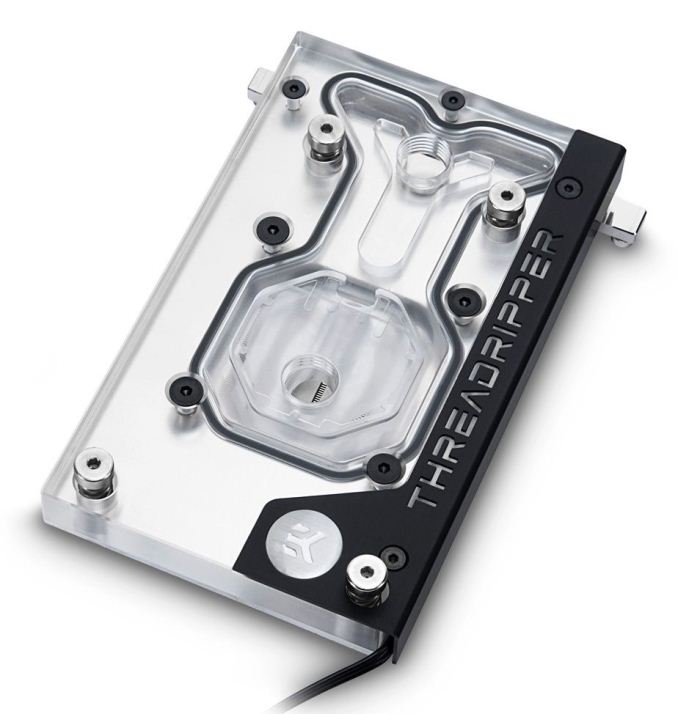
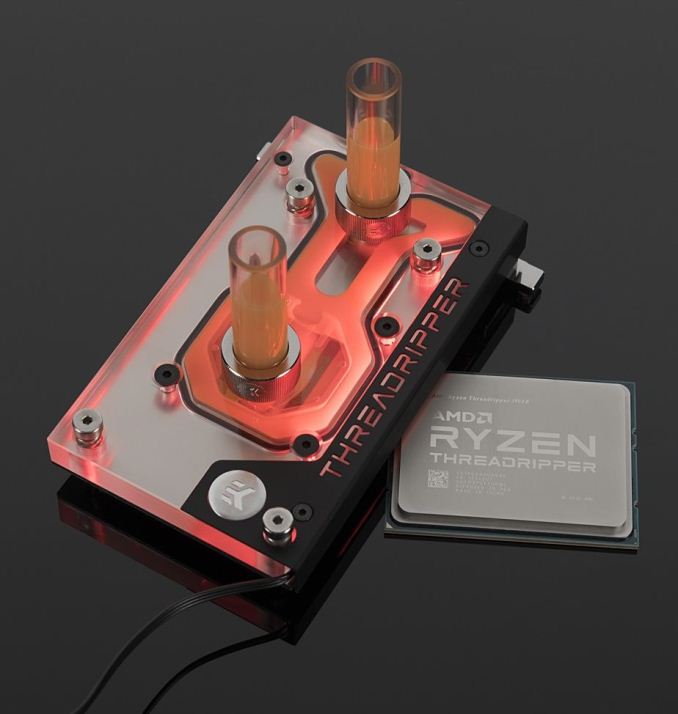
EKWB has announced the release of two new monoblocks made for GIGABYTE and MSI Threadripper X399  motherboards. Both blocks are an all-in-one (CPU and power delivery) cooling solution with a redesigned cold plate and fin area, claimed to cover most of the Ryzen Threadripper surface enabling better thermal transfer. In addition to the CPU itself, the block also cools the power delivery with liquid flowing directly over the necessary components. One could argue that with sufficient cooling, pushing Threadripper CPUs beyond their TDP through overclocking should be easier. 

The base of both monoblocks is made of nickel-plated electrolytic copper, while the top is made of acrylic glass. The block comes fully assembled with nickel-plated mounting screws and brass screw-in standoffs pre-installed. This is the only style available. EKWB includes Thermal Grizzly Hydronaut (1g) thermal paste, as well as thermal pads for contact with the power delivery modules, in each package. Both blocks use standard G1/4 threading, and barbs are sold separately. The GIGABYTE block (right, below) is compatible on two motherboards, the X399 Aorus Gaming 7 (rev. 1.0) and the X299 Designare EX (rev. 1.0). The MSI block (left, below) is compatible with the X399 Gaming Pro Carbon AC and the X399 SLI Plus. The different flow channels are due to each company layout being different.

  
Left: MSI; Right: GIGABYTE

Each monoblock contains RGB LEDs, but uses them in different ways due to each motherboard configuration. The GIGABYTE block is equipped with a Digital RGB LED strip and connects to a dedicated 3-pin digital LED header. With this strip and the GIGABYTE RGB Fusion App, users are able to individually control color to each LED on the digital LED strip. The block also includes a standard 4-pin 12V RGB LED strip able to connect to the motherboard’s 4-pin LED header. The LED shines through the base of the block and through a cover that has “Threadripper” cut out. The LED strip cover is removable for ease of adjusting cable orientation or replacing the LED strip. The MSI block, on the other hand, includes a 4-pin RGB LED strip controlled by its Mystic Light software and does not come with a digital or any additional strips.

Both monoblocks are available now through the EK Webshop and their Partner Reseller Network. MSRP for both blocks is $139.99 / €125.95 (inc. VAT). There are separate links to the GIGABYTE and MSI versions.

Related Reading: