News


The EVGA X299 FTW K Motherboard Review: Dual U.2 Ports

The EVGA X299 FTW K is our first X299 motherboard from EVGA. The FTW K aims to bring users a solid power delivery, three-way multi-GPU capabilities, two M.2 slots, and a unique feature so far on our X299 coverage: two U.2 ports. The X29…

Intel Announces Q4 2017 and FY 2017 Results

Intel Announces Q4 2017 and FY 2017 Results

Today Intel announced their quarterly earnings, and 2017 was another record year for the company. Q4 revenue was a record $17.1 billion, and the full year revenue was a record $62.8 billion. For this quarter, Intel’s GAAP earnings took a hit due to a $5.4 billion tax expense thanks to the new tax reforms that were enacted in December, but as a one-time hit, it shouldn’t be a concern going forward. In fact, Intel is forecasting only a 14% tax rate for FY 2018.

In GAAP terms, Intel’s gross margin was 63.1%, which is up 1.4% from a year ago, and their operating income was up 19% to $5.4 billion. However, thanks to a 111.4% effective tax rate due to the one time $5.4 billion tax fee, Intel is actually reporting a GAAP loss for the quarter of $0.7 billion. Earnings per share were therefore down 120% to a loss per share of $0.15.
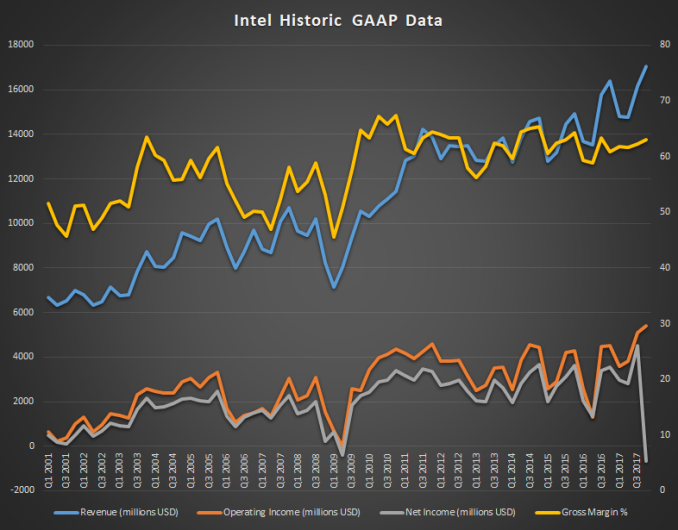
Due to the tax impact, it’s probably a good thing to look at Non-GAAP earnings as well which will exclude that one-time charge. In terms of Non-GAAP, Intel’s gross margin was 64.8%, which was up 1.7%. Operating income was up 21% to $5.9 billion. Intel’s Non-GAAP tax rate was 21.2%, which is actually higher than the 19.8% they paid last year, and net income was $5.2 billion, up 34% from a year ago. This led to earnings per share being up 37% to $1.08.

For the full year, Intel had $62.8 billion in revenue, with a gross margin of 62.3%. Operating income was up 39% year-over-year to $17.9 billion, although thanks to the tax hit their net income was down 7% to $9.6 billion. In Non-GAAP terms, net income was up 27% to $16.8 billion.

Intel Q3 2017 Financial Results (GAAP)
  Q4’2017 Q3’2017 Q4’2016
Revenue $17.1B $16.1B $16.4B
Operating Income $5.4B $5.1B $4.5B
Net Income -$0.7B $4.5B $3.6B
Gross Margin 63.1% 62.3% 61.7%
Client Computing Group Revenue $9.0B +1.6% -2.0%
Data Center Group Revenue $5.6B +14.7% +20.0%
Internet of Things Revenue $879M +3.5% +21.0%
Non-Volatile Memory Solutions Group $889M -0.2% +9.0%
Programmable Solutions Group $568M +21.1% +35.0%

Intel is still pivoting business away from the declining PC market, and they have done well to diversify, but still, their PC business is still the biggest piece of the pie. For the quarter, the Client Computing Group had revenues of $9.0 billion, which is down 2% year-over-year, but for the full year of 2017, their CCG was up 3% to $34 billion. It’s not quite dead yet. In an effort to show their diversification, Intel is now quoting their data in “PC-centric” and “Data-centric” and conveniently, Data-centric is all of their business outside of the CCG, but even so, the CCG still accounted for 53% of Intel’s revenue for the quarter.

But, the Data-centric group is certainly growing much quicker than the PC market which is still in a decline. The Data Center Group is by far the largest portion of Intel’s Data-centric efforts, and the DCG had revenues of $5.6 billion for the quarter, which are up 20% year-over-year. With the expansion of the cloud, this likely still has some ways to go before it hits a peak, so it’s likely just a matter of time before they finally surpass their Client Computing Group.

The rest of the Data-centric business was also up for the quarter, with IoT up 20% year-over-year, to $879 million. For the full year the IoT was up 20% and had revenues of $3.2 billion. Non-volatile memory was up 9% for the quarter to $889 million, and for the year it was up 37% to $3.5 billion. Programmable Solutions was up 35% for the quarter to $568 million, and for the full year, was up 14% to $1.9 billion.
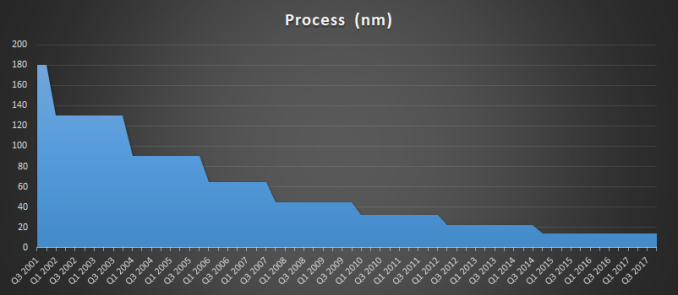
Intel still hasn’t shipped anything on 10nm to the point where someone could go buy a chip, although we’re finally getting close, with Intel shipping 10nm to some of their partners. 14nm was delayed, but the delay in getting to 10nm has been longer than likely anyone expected. Intel has still made some bold claims about density, so it should be a good node for them if and when it arrives.

Intel’s forecast for Q1 2018 is for $15.0 billion in revenue, plus or minus $500 million, and despite the rough start to 2018, they are still forecasting another record year, with $65 billion in revenue, plus or minus $1.0 billion.

Source: Intel Investor Relations

SK Hynix’s Product Catalog Lists 16 Gb DDR4 Chips, Opens Doors to 256 GB DIMMs

SK Hynix’s Product Catalog Lists 16 Gb DDR4 Chips, Opens Doors to 256 GB DIMMs

SK Hynix has recently added single-die DDR4 memory chips featuring 16 Gb capacity to its product catalog. The benefit of the increase in single-die capacity is two fold: not only will the new components enable the company to build high-capacity memory modules using fewer chips, but also it will enable SK Hynix and its partners to build 256 GB DDR4 memory modules for ultra-high-end servers.

16 Gb DRAM chips per se are not exactly a breakthrough. Memory makers, including SK Hynix, already build high-capacity DRAM components by stacking two or four 8 Gb memory dies vertically using TSVs to get 16 Gb and 32 Gb components, then use such chips to build memory modules featuring 64 GB and 128 GB density. Stacking makes organization of DIMMs very complex: in the case of a 64 GB module we are dealing with a quad-ranked DIMM (featuring two physical and two logical ranks), whereas a 128 GB module is octal ranked (featuring two physical ranks and four logical ranks). LRDIMMs have a relatively high latency in general (because they use additional buffers), meanwhile complexity of 64 GB/128 GB LRDIMM architecture forces module makers to increase them even further (to CL20/CL22 for DDR4-2400/DDR4-2666 speed bins).

By contrast, SK Hynix has managed to develop single-die 16 Gb DDR4 components. Such ICs enable producers to build client memory modules or subsystems with a fewer number of chips, lowering power consumption, and allows server-class DIMMs with densities of up to 256 GB. When it comes to servers, the 16 Gb DDR4 components will allow to build dual-ranked 64 GB modules, quad-ranked 128 GB LRDIMMs and octal-ranked 256 GB LRDIMMs.

Do not expect the 256 GB modules to show up tomorrow, but the importance of ultra-high-density LRDIMMs is hard to overestimate. For example, if the microcode is adjusted to allow it, a single socket Xeon Scalable platform featuring an -M suffixed processors with 12 total memory slots could potentially support 3 TB of six-channel memory. Meanwhile, an AMD EPYC-based system can currently support 2 TB of eight-channel memory per CPU socket, and these modules could help support double that. For in-memory applications like huge databases, the more DRAM they can get the better. Undoubtedly, 128 GB and 256 GB memory modules will come at a price. For example, Crucial sells its 128 GB DDR4-LRDIMM for $3999.99 in retail, so a 2X capacity module would cost considerably higher.

SK Hynix’s 16 Gb DDR4 chips are organized as 1Gx16 and 2Gx8 and supplied in FBGA96 and FBGA78 packages, respectively. At present, 16 Gb memory components are rated to operate in DDR4-2133 CL15 and DDR4-2400 CL17 modes at 1.2 Volts. Sometimes in the third quarter SK Hynix plans to add DDR4-2666 CL19 to the lineup. SK Hynix does not disclose which manufacturing technology it uses to make its 16 Gb chips, but it is logical to expect that the company uses a fabrication process with minimal feature sizes and high yields to make large dies.

General Specifications of SK Hynix’s 16 Gb Chips
Part Number Transfer Rate Latency Org. Pkg. VDD Availability
H5ANAG6NAMR-TFC 2133 MT/s 15-15-15 1Gx16 FBGA96 1.2 V Now
H5ANAG6NAMR-UHC 2400 MT/s 17-17-17
H5ANAG6NCMR-UHC 2400 MT/s 17-17-17 Q3 2018
H5ANAG6NCMR-VKC 2666 MT/s 19-19-19
H5ANAG8NAMR-TFC 2133 MT/s 15-15-15 2Gx8 FBGA78 Now
H5ANAG8NAMR-UHC 2400 MT/s 17-17-17
H5ANAG8NCMR-UHC 2400 MT/s 17-17-17 Q3 2018
H5ANAG8NCMR-VKC 2666 MT/s 19-19-19

Keep in mind that it will take quite a while for server makers to validate 16 Gb chips and 2Hi/4Hi stacks based on them, so do not expect 256 GB modules to hit today’s servers shortly from now. In the meantime, 16 Gb DDR4 chips will enable makers of SO-DIMMs to build single-sided 16 GB DDR4 SO-DIMM modules. This will also allow thin laptops (that do not use modules, but rely on commodity memory) to install 16 GB of DRAM using eight chips. For any user wondering why most 13-inch notebooks do not want to use 16 GB of DRAM in all but the high-end specification, these chips should enable a nicer ecosystem for higher memory capacity small notebooks.

Related Reading