News


Promise Launches TD-300 9-in-1 Thunderbolt 3 Dock: GbE, HDMI, USB 3.0, TB3 Charging & More
Promise Launches TD-300 9-in-1 Thunderbolt 3 Dock: GbE, HDMI, USB 3.0, TB3 Charging & More

Promise has introduced its first Thunderbolt 3 dock designed primarily for Apple’s latest MacBook Pro laptops, but also compatible with any systems featuring a TB3 header. The Promise TD-300 dock carries a variety of modern ports and targets media professionals (who also happen to use Promise’s external storage solutions), but can also satisfy needs of mainstream users as well.

Nowadays a lot of people replace desktops with laptops and use them accordingly: plug in external displays, keyboards, storage systems, various peripherals, even external graphics cards. Therefore, when Apple launched its latest generation MacBook Pro notebooks with only four Thunderbolt 3 ports, many of such people were upset with the absense of popular USB Type-A connectors. Apple promised them that upcoming docking solutions would solve their needs, but it has taken developers a little less than a year to design solutions that would offer something more than a couple of USB Type-A headers, a GbE and a DisplayPort. Recently OWC launched its 13-in-1 ‘one dock to rule them all’ solution and this week Promise releases its 9-in-1 dock.
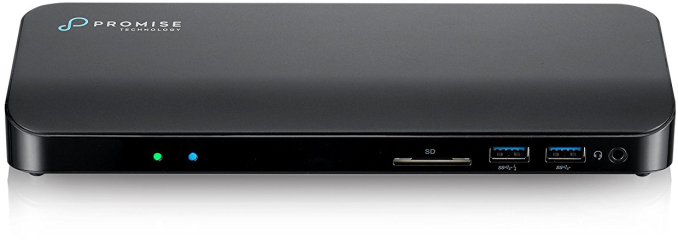
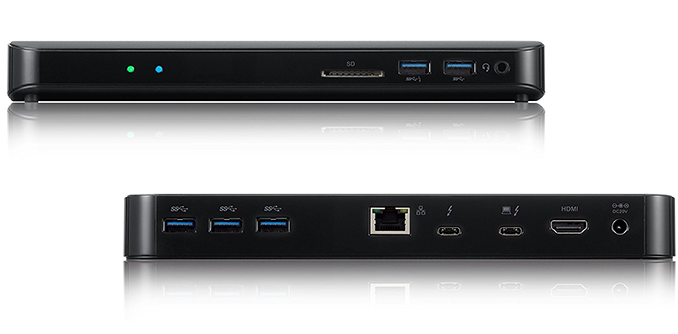
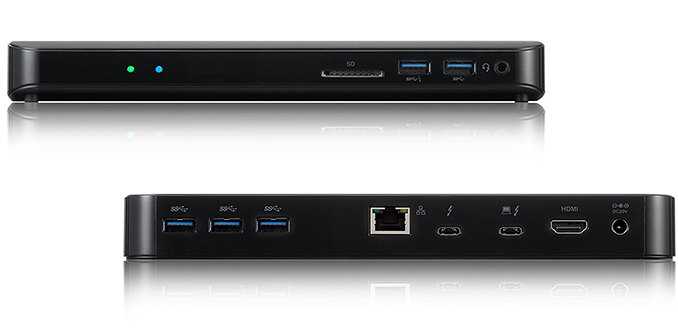
When it comes to general ports that are used by everyone, the Promise TD-300 (DOCK1TB3US) is equipped with five USB 3.0 connectors (one supporting 5V/1.5A charging) — two on the front and three on the back. Docks with five USB headers are rather rare, but since there are people with loads of external USB peripherals (a keyboard, a mouse, a printer, a scanner, and a spare one for a USB drive), demand for such adapters clearly exists. People who use laptops for stationary work obviously prefer the fastest and the most stable Internet connection possible, so the TD-300 has a GbE port, which will be handy in business/corporate environments as well.
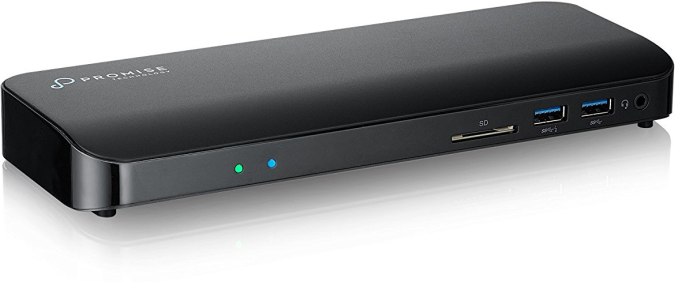
Moving on to more specific I/O connectors, we notice that the TD-300 comes with an SD 3.0 card reader, a feature that will be greatly appreciated by professional photographers, which happen to be among Promise’s regular clientele. To display photos or videos, the TD-300 has an HDMI 2.0 connector and another TB3 header that carries two DP 1.2 streams (the header can be used to daisy chain other TB3 devices too). HDMI ports are rare guests on TB3 docks because manufacturers need to install DP-to-HDMI bridges to enable them (adding to BOM), so Promise deserves a credit for installing one. Meanwhile, the TD-300 lacks basic DisplayPort connectors, possibly because of design complexity. Keeping in mind that most high-end displays usually feature both HDMI and DisplayPort inputs, the lack of DP is hardly a problem. Meanwhile, if someone needs to plug two monitors to the TD-300, they will have to use an HDMI output and a TB3-to-DP cable that costs from $10 to $20. Jumping from video to audio, the TD-300 also has 2.1-channel-supporting TRRS connector that can be used to plug in speakers, a headset and other audio equipment.
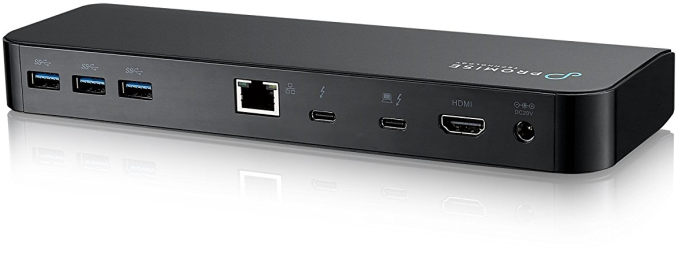
To add convenience, the Promise TD-300  can deliver up to 60 W of power using its Thunderbolt 3 input cable to the laptop, eliminating any need to use the notebook’s own charger. Larger and more powerful PCs (such as Apple’s MacBook Pro 15”) will charge slower because they are designed for more powerful chargers (85 W in case of the MBP).

One interesting thing to note about the Promise TD-300 is its design. Unlike most of Thunderbolt 3 docks out there, this one does not match design of the latest MacBook Pro computers. It is black, its front side is tapering, it even has two LEDs (one indicates power, another indicates TB3 connection). In fact, Promise aims its TD-300 primarily at its own customers, including those who use the Pegasus3 TB3 external storage solutions or other products, so it wanted to match its own devices on the first place. Furthermore, black just fits well in any home or office environment.

The Promise TD-300 will be available for $249 from November 22 directly from Promise, from Amazon as well as from other retailers. The TD-300 comes with a 0.5-meter Thunderbolt 3 cable and is covered by a two-year warranty.

Related Reading:

Toshiba Commercializes SDK’s 9th Gen PMR, Tech Enables 14 TB PMR HDDs in 2018

Toshiba Commercializes SDK’s 9th Gen PMR, Tech Enables 14 TB PMR HDDs in 2018

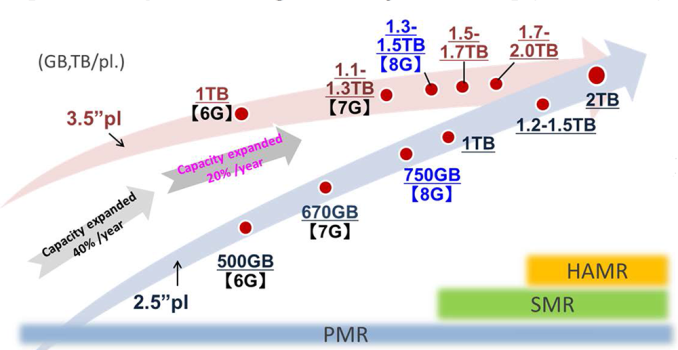
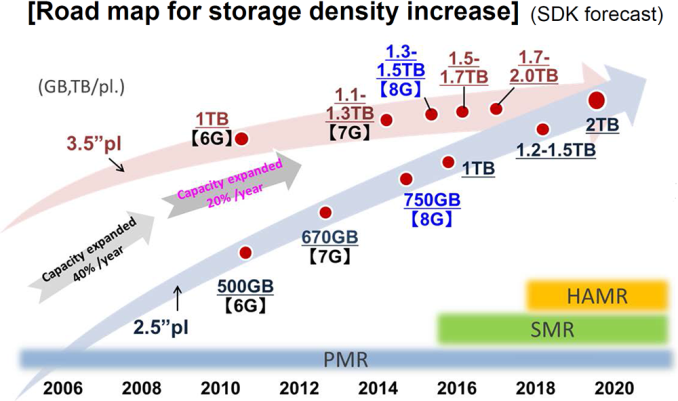
Toshiba recently started to ship its single-platter 1 TB 2.5”/7 mm hard drives in the HDD market for notebooks. The drive is based on Showa Denko K.K.’s (SDK) 9th generation perpendicular magnetic recording (PMR) platters that have never been used for any products before. The main feature of the new generation is increased areal density, which enables 1 TB 2.5” platters and up to 1.8 TB 3.5” platters. This opens the door for the next-gen nearline PMR HDDs with up to 14 TB capacity sometimes in 2018.

Small Drive Prognosticates Big Future for 9th Gen PMR

Toshiba is the first customer of SDK to use its latest 1 TB 2.5” PMR media inside the single-platter MQ04ABF100 hard drive. The drive has a 128MB cache buffer and features a 5400 RPM spindle speed. The 2.5”/7 mm drive is aimed at inexpensive laptops that require a lot of storage. Toshiba officially introduced the drive in late September. PC makers like Lenovo have started to add its support to BIOSes of some PCs, indicating that actual shipments of the HDD have either started, or, are about to. Previous 2.5”/7 mm drives such as those from Seagate (ST1000LM048) and Western Digital (WD10SPZX) used platters based on shingled magnetic recording (SMR) technology with all its associated performance peculiarities. While the launch of a PMR-based 1 TB 2.5”/7 mm HDD is important, the potential of the 9th generation PMR does not end here.

Since 2015, Showa Denko has found a way to increase areal density of its 9G PMR media, SDK’s 3.5″ 9G PMR platters now have capacity of up to 1.8 TB.

According to SDK, 9th generation PMR media for 3.5” hard drives will have capacity between 1.5 and 1.8 TB. Typically, platters of the same generation produced by SDK, Seagate, and Western Digital have similar areal density with some minor differences. Therefore, we can expect the 9th gen PMR technology from the aforementioned HDD makers to feature similar capacities. Showa Denko plans to start mass production of its 9th gen PMR 3.5” media in early 2018, but, neither Seagate nor Western Digital (who produce their leading-edge platters in-house) have announced their timeline for similar discs. Typically, production schedules for advanced media also tend to be very similar for various makers, but we do not have any official data in hand right now.

14 TB PMR HDDs May Be Just Around the Corner

Today’s top-of-the-range enterprise-class 3.5” HDDs from Seagate and Western Digital can store up to 12 TB of data. They are based on eight 8th generation PMR platters featuring ~1.5 TB capacities. Toshiba is a little bit behind its rivals with their 10 TB units featuring seven 8th gen platters with 1.43 TB capacity. With the arrival of the 9th gen PMR platters in 2018, hard drive makers will be able to increase the capacities of their eight-platter models to 14 TB, while designs with seven platters can go up to 12 TB.

It is interesting to note that Seagate has been talking about 14 TB models for a while, without any concrete public details. Meanwhile, the company’s 14 TB HDD will be more than just a capacity bump. With the 12 TB Enterprise Capacity (Exos) model, Seagate began to use TDMR (two-dimensional magnetic recording) technology to boost the read performance of the drives. The 14 TB HDD will take advantage of Seagate’s 2nd gen TDMR implementation. We can expect an increase in performance and/or other refinements.

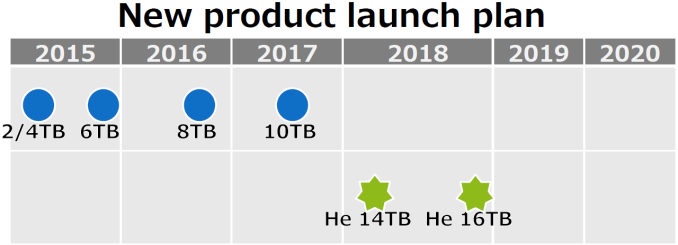
Toshiba has also been talking about its 14 TB HDDs since at least mid-2016 (investor presentation, page 22). As Toshiba does not produce advanced platters in-house, it will have to use SDK’s 9th gen PMR media for its upcoming 14 TB HDDs. It is noteworthy that the company’s next-gen nearline hard drives are projected to be helium-filled models. This will enable lower power consumption compared to their existing 10TB products.

Assuming that Toshiba’s HDD roadmap has not been altered since 2016, we can also expect a helium-filled 16 TB nearline drive in late-2018. However, no details about that model are available at this time.

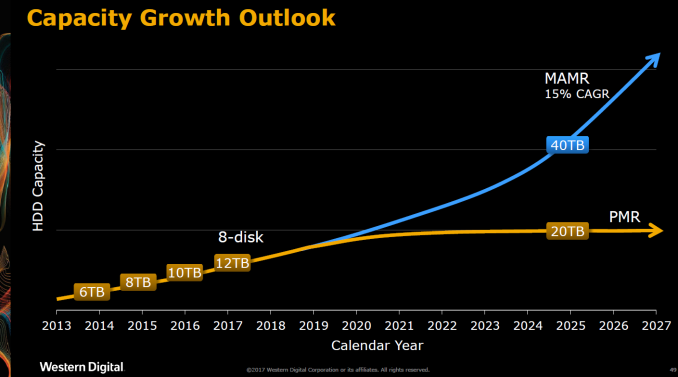
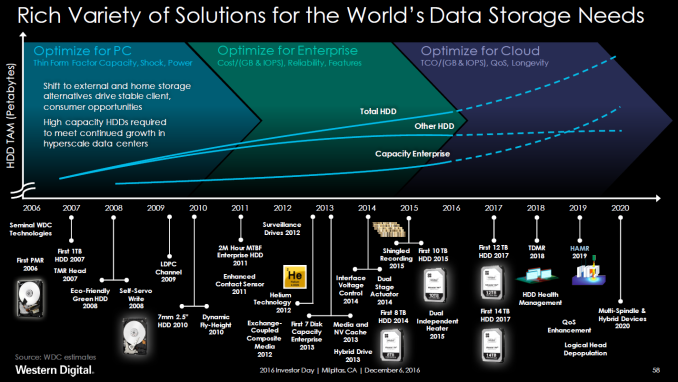
Western Digital has not announced any plans for 14 TB PMR HDDs so far, but the company is committed to PMR evolution (based on its most recent presentation, pages 21 and 49) and it will be a surprise if it does not use its upcoming PMR platters for higher-capacity nearline hard drives. Meanwhile, one of the older Western Digital’s roadmaps (page 58) points to usage of TDMR in 2018. Since the company has ceased development of 10K and 15K HDDs for enterprises, the only candidates for TDMR are nearline hard drives, assuming that the roadmap has not changed.

Related Reading:

Intel Announces XMM 8060 5G & XMM 7660 Category 19 LTE Modems, Both Due in 2019

Intel Announces XMM 8060 5G & XMM 7660 Category 19 LTE Modems, Both Due in 2019

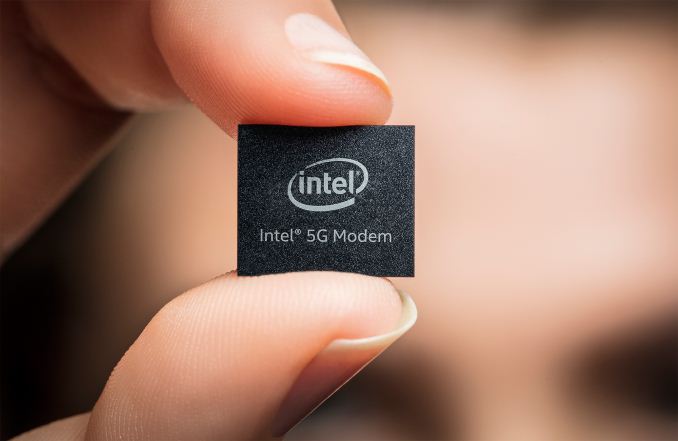
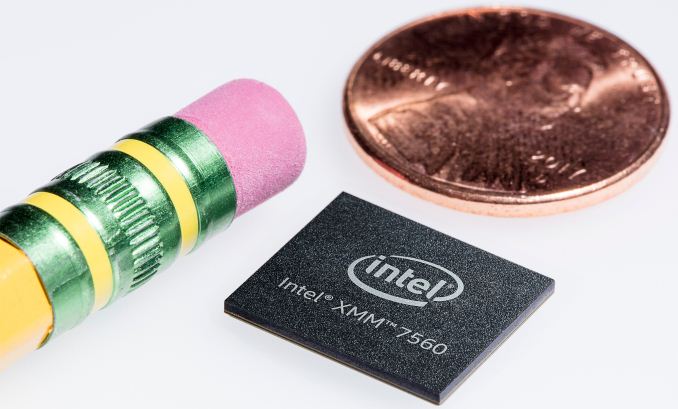
Intel last week announced that its first commercial 5G modem, the XMM 8060, is now under development and will ship in a couple of years. As part of the announcement, the company reiterated its plans to offer a top-to-bottom XMM 8000 family of 5G modems for various applications, including smartphones, PCs, buildings and vehicles. In addition, the company announced its XMM 7660 Cat-19 LTE modem that supports download speeds of up to 1.6 Gbps, which will be available in 2019.

At present, Intel’s 5G Mobile Trial Platform is used to test 5G technologies in different locations around the world. For example, one of such devices installed aboard the Tallink Silja Europa cruise ship is used to enable Internet connectivity to passengers while in port in Tallinn, Estonia, (where another 5G MTP is installed) and the nearby area. Meanwhile, Intel’s 5G Modem for client applications is evolving as well. Intel said that devices powered by the silicon can now make calls over the 28 GHz band. The 5G MTP will be used for its purposes for a while and will even gain new capabilities over time, but the company is working on a family of commercial modems that will be used for mass applications sometimes in 2019 and onwards. The Intel XMM 8000-series multi-mode modems will operate in both sub-6 GHz and millimeter wave global spectrum bands, combining support for existing and next-gen radios. Intel does detail the whole lineup two years before the launch but indicates that it will be able to address smartphones, PCs, vehicles, and fixed wireless consumer premise equipment (CPE).

One of the first members of the Intel XMM 8000 family will be the XMM 8060 modem. This unit will support full 5G non-standalone and standalone NR, as well as 2G, 3G/CDMA, and 4G modes, thus enabling devices to work in different locations, including large cities with 5G standalone NR (this may be a distant future) as well as rural areas that have 2G or 3G networks. Intel expects commercial devices based on the XMM 8060 to ship in mid-2019, a little bit ahead of 5G networks deployment in 2020.

Since 5G is not going to become widespread for a number of years to come, there will be demand for Gigabit speeds over LTE from various parties in 2018 – 2020. Intel announced its first-gen Cat 16 Gigabit LTE modem — the XMM 7560 — earlier this year and at present the chip is being tested by smartphone makers. A good news is that it now can officially achieve Gigabit-class speeds (presumably in an actual device), so expect commercial products on its base sometimes next year. In the meantime, Intel is prepping the XMM 7660, its second-generation Gigabit LTE modem capable of up to Cat 19 (1.6 Gbps) downlink connections. Intel hasn’t disclosed much in the way of details on this one, but expect a natural set of features here — advanced MIMO, carrier aggregation, 256QAM, loads of bands support, etc. Intel expects commercial devices to adopt the XMM 7660 in 2019. By that time, leading carriers will implement many of the features necessary for both 5G and Gigabit LTE, so the modem will be able to achieve its speeds in many locations.

Related Reading:

The MSI X299 Tomahawk Arctic Motherboard Review: White as Snow

Our first look at MSI X299 offerings arrived in the form of a mid-range board from the Arsenal Gaming series, the Tomahawk Arctic. The Tomahawk line of motherboards, MSI says, have heavy plated heatsinks and “combative looks ready for anything”. It uses MSI’s branded ‘Military Class VI’ components and claims to have features for gamers aimed to improve the gaming experience.

ASUS Launches ROG Swift PG27VQ: Curved 27-inch LCD with 165 Hz G-Sync & RGB Lighting

ASUS Launches ROG Swift PG27VQ: Curved 27-inch LCD with 165 Hz G-Sync & RGB Lighting

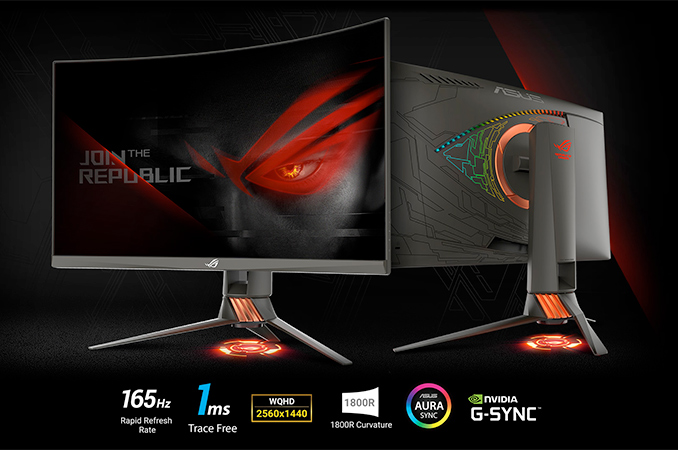
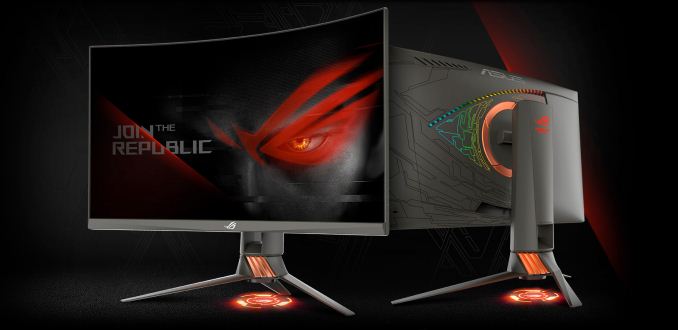
ASUS is about to start selling its new ROG Swift PG27VQ, the company’s latest 165Hz monitor. Aimed at gamers who are looking for a very high responsiveness in games along with ultimate style, the monitor features a curved panel and 1 ms response time. To make design of the ROG Swift PG27VQ unique, ASUS added its RGB Aura Sync lighting to the back of the display.

RGB LED lighting has (inexplicably) become a signature feature of gaming hardware in 2017. As we’ve already seen, there are motherboards, graphics cards, memory modules, chassis, PSUs, keyboards, mice, even SSDs with RGB LEDs, on the market these days. Earlier this year ASUS decided to complete the list of RGB lighting-enabled devices with its curved ROG monitors. So far, the company formally introduced three of such displays, but only the relatively inexpensive ROG Strix XG27VQ has been released commercially so far. ASUS is going to change this in the coming weeks as it is getting ready to start sales of the considerably more expensive ROG Swift PG27VQ.

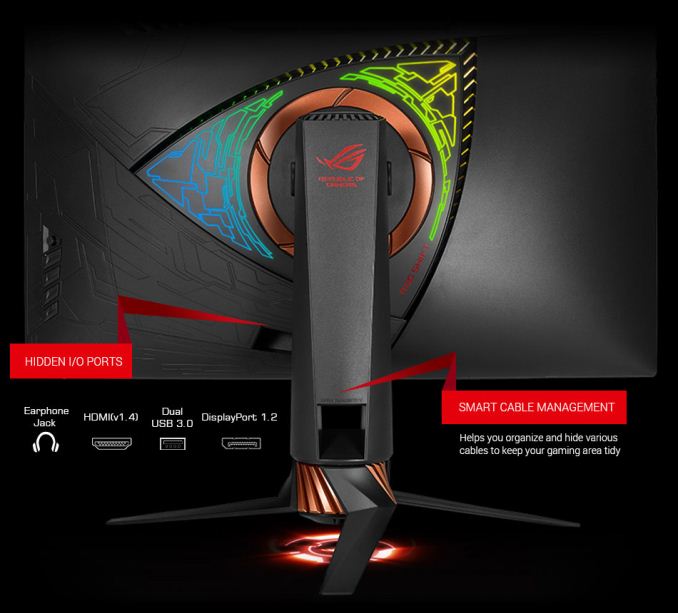
The ASUS PG27VQ uses a 27” TN panel with a 2560×1440 resolution, an “overclockable” 165 Hz refresh rate, a 1 ms response time as well as a 1800R curvature. Responsiveness is a major selling point of the monitor, which is a reason why the manufacturer went with a TN panel featuring 400 nits brightness, 1000:1 contrast ratio and 170°/160° viewing angles, nothing unexpected from TN here. As for ergonomics, the ROG Swift PG27VQ can adjust height, tilt, swivel or can be attached to a VESA wall mounting. Those interested in a multi-display configuration will be glad to know that the display has thin bezels. As for connectivity, the monitor comes with an HDMI 1.4, a DisplayPort 1.2, a dual-port USB 3.0 hub and an earphone jack.

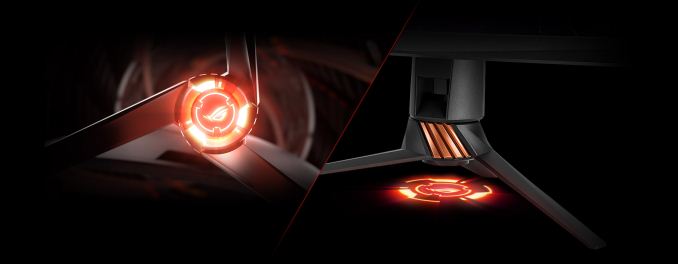
Just like any other ‘Republic of Gamers’ monitor from ASUS, the ROG Swift PG27VQ features a host of features aimed just at gamers. Firstly, it supports NVIDIA’s G-Sync dynamic refresh rate technology with ULMB, which is designed to make fast-paced actions look sharper. The combination of a 165 Hz maximum refresh rate, 1 ms response time as well as G-Sync with ULMB should deliver rather impressive experience. Secondly, the monitor comes with the ASUS Aura Sync RGB lighting on the back to customize the look of the display or even synchronize its lighting with other components featuring the technology. In addition, the LCD has ROG’s LED lighting projection signature on the bottom, which owners can customize as well. Thirdly, the monitor supports the ASUS GamePlus modes, which are present on other gaming monitors by the company, and ASUS GameVisual color profiles for different type of content. Finally, the monitor is compatible with NVIDIA’s 3D Vision technology for those who still have the shutter 3D glasses kit (or plan to get one now).

ASUS ‘Most Responsive’ 27″ Curved Gaming Monitor
  ROG Swift PG27VQ
Panel 27″ TN
Native Resolution 2560 × 1440
Refresh Rate Range 165 Hz overclockable
Dynamic Refresh Rate G-Sync with ULMB
G-Sync Range unknown
Response Time 1 ms (gray-to-gray)
Brightness 400 cd/m²
Contrast 1000:1
Viewing Angles 170°/160°
Curvature 1800R
Inputs HDMI 1.4
DisplayPort 1.2
Audio 3.5 mm audio jack
USB Hub Dual-port USB 3.0 hub
RGB Effects ASUS Aura Sync RGB lighting
Proprietary Enhancements Trace Free Technology
Color Temperature Selection: 4 Modes
GamePlus Modes:  Crosshair/Timer/Display Alignment
Low Blue Light: Yes
GameVisual Modes: Scenery/Racing/Cinema/RTS/RPG/FPS/sRGB
Power Consumption
 
Idle 0.5 W
Active 67.5 W
Detailed Information Link

The ASUS ROG Swift PG27VQ is expected to be available from leading retailers like Amazon and Newegg in several weeks. Being a unique offering, the new unit will cost $799.99, a price tag well above average for a 27” monitor.