News


Intel's Credit-Card Sized Compute Card Detailed, Shipping in August

Intel’s Credit-Card Sized Compute Card Detailed, Shipping in August
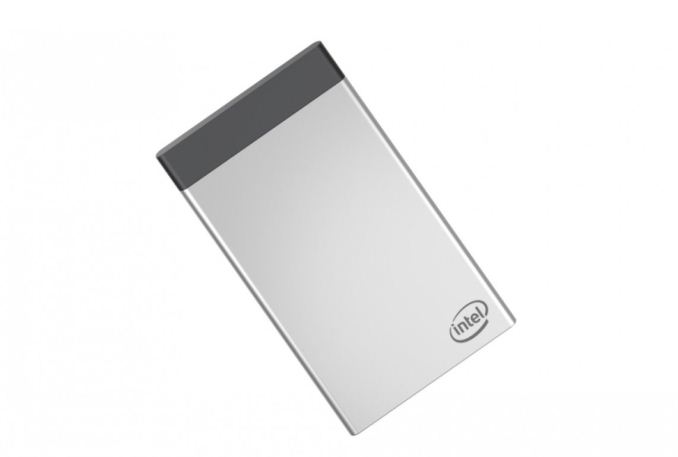
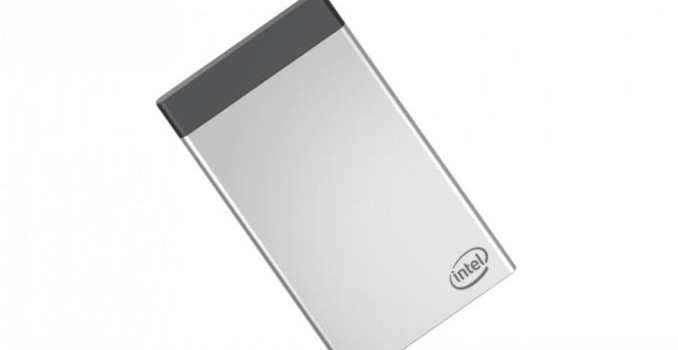
Intel unveiled its credit card-sized Compute Card at CES earlier this year, and now at Computex, the company has brought us up to speed on the available SKUs and the release date.

The Compute Card comes packed with the full functionality of a standard computer, including an SoC, connectivity, storage, and memory in one slim device. The device slots into a range of devices from laptops, tablets, and AIOs to interactive refrigerators and IoT gateways. The devices can be ejected and replaced, thus decoupling compute from the device and allowing for easy upgrades as the card evolves into more powerful variants. That could also make for interesting new laptop platforms with longer shelf lives.

Intel Compute Card SKUs
  CD1IV128MK CD1M3128MK CD1P64GK CD1C64GK
CPU Core i5-7Y57 Core m3-7Y30 Pentium N4200 Celeron N3450
Memory 4GB DDR3
Storage 128GB Intel SSD 64GB eMMC
Connectivity Intel Wireless-AC 8265
(2×2 .11ac & Bluetooth 4.2)
Intel Wireless-AC 7265
(2×2 .11ac & Bluetooth 4.2)

The Compute Card family offers processors that span from Core to Celeron and come in four SKUs. Each respective product has varying compute, storage, and connectivity options, though the processor serves as the only differentiation between the two high-end options. Aside from listing the processors, Intel hasn’t given us an indication of performance.

Intel has signed on a bevy of partners to develop new products that leverage the device, including Contec, ECS, Foxconn, LG Display, MoBits Electronics, NexDock, Sharp, Seneca, SMART Technologies, Suzhou Lehui Display, and TabletKiosk. Many of these partners will have products on display at Computex 2017. Dell, HP, and Lenovo are also working on new products, but have yet to reveal any of the end devices.

Intel also released its Compute Card Device Design Kit, which is a set of guides and reference designs that simplify and speed up the product development process.

In many ways Intel’s Compute Card signifies the company’s continued push for product diversification as it delves into IoT, automated driving, and other lucrative climes. In this case, its efforts also further its objectives in the mobility space, as we can expect new laptops and AIOs to come to market with the new cards installed. The Compute Card will begin shipping in August 2017, but Intel hasn’t revealed pricing info.

Paul Alcorn contributed to this report
Intel's Credit-Card Sized Compute Card Detailed, Shipping in August

Intel’s Credit-Card Sized Compute Card Detailed, Shipping in August

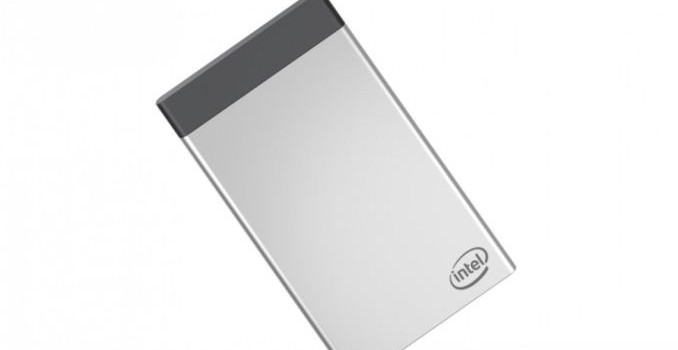
Intel unveiled its credit card-sized Compute Card at CES earlier this year, and now at Computex, the company has brought us up to speed on the available SKUs and the release date.

The Compute Card comes packed with the full functionality of a standard computer, including an SoC, connectivity, storage, and memory in one slim device. The device slots into a range of devices from laptops, tablets, and AIOs to interactive refrigerators and IoT gateways. The devices can be ejected and replaced, thus decoupling compute from the device and allowing for easy upgrades as the card evolves into more powerful variants. That could also make for interesting new laptop platforms with longer shelf lives.

Intel Compute Card SKUs
  CD1IV128MK CD1M3128MK CD1P64GK CD1C64GK
CPU Core i5-7Y57 Core m3-7Y30 Pentium N4200 Celeron N3450
Memory 4GB DDR3
Storage 128GB Intel SSD 64GB eMMC
Connectivity Intel Wireless-AC 8265
(2×2 .11ac & Bluetooth 4.2)
Intel Wireless-AC 7265
(2×2 .11ac & Bluetooth 4.2)

The Compute Card family offers processors that span from Core to Celeron and come in four SKUs. Each respective product has varying compute, storage, and connectivity options, though the processor serves as the only differentiation between the two high-end options. Aside from listing the processors, Intel hasn’t given us an indication of performance.

Intel has signed on a bevy of partners to develop new products that leverage the device, including Contec, ECS, Foxconn, LG Display, MoBits Electronics, NexDock, Sharp, Seneca, SMART Technologies, Suzhou Lehui Display, and TabletKiosk. Many of these partners will have products on display at Computex 2017. Dell, HP, and Lenovo are also working on new products, but have yet to reveal any of the end devices.

Intel also released its Compute Card Device Design Kit, which is a set of guides and reference designs that simplify and speed up the product development process.

In many ways Intel’s Compute Card signifies the company’s continued push for product diversification as it delves into IoT, automated driving, and other lucrative climes. In this case, its efforts also further its objectives in the mobility space, as we can expect new laptops and AIOs to come to market with the new cards installed. The Compute Card will begin shipping in August 2017, but Intel hasn’t revealed pricing info.

Paul Alcorn contributed to this report
Aorus Announces the GTX 1070 Gaming Box eGFX Adapter

Aorus Announces the GTX 1070 Gaming Box eGFX Adapter

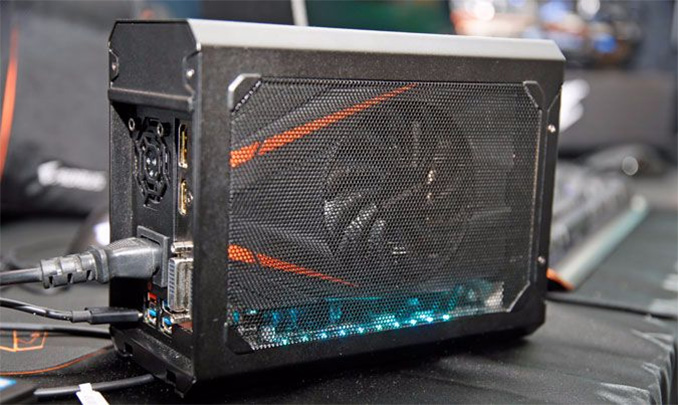
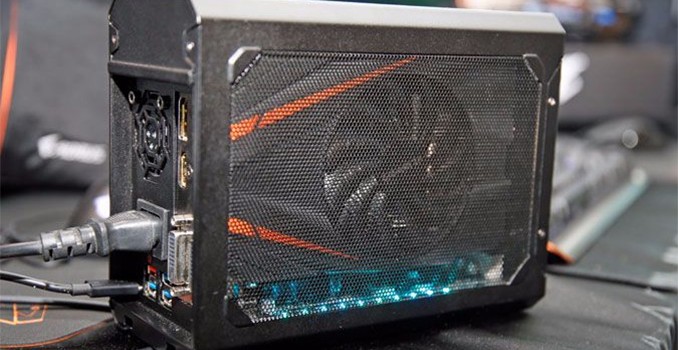
To date, the designs we’ve seen for Thunderbolt 3 eGFX chassis have all been just that – an empty chassis. This lets the user install any GPU they want, but it also means the chassis needs to be sized to accept particularly large video cards. So for Computex Gigabyte’s Aorus division is turning the tables a bit by offering the GTX 1070 Gaming Box: an eGFX adapter that contains a built-in/preinstalled GeForce GTX 1070 video card, allowing them to cut down on the size and complexity of the adapter significantly.

While exact dimensions were not available at press time, the GTX 1070 Gaming Box appears to be about half the length and height of the Razer Core and the Alienware Graphics Amp, the current market leaders in this nascent space. Undoubtedly, the Gaming Box benefits from having its card built-in and, because Aorus makes video cards, the company has an edge up on the competition.

The back of the Aorus GTX 1070 Gaming Box is filled with ports you can use to connect to monitors and other peripherals, including four USB 3.0 ports, two DVI-out connectors, one HDMI out and a single, full-size DisplayPort connection. There’s also a Thunderbolt 3 port that you use to connect to your laptop.

Notably, the smaller size of the Gaming Box means that unlike any other graphics amp we’ve seen, the Gaming Box is itself reasonably portable. In fact, it comes with an attractive padded case you can use to take it with you on trips.

The integrated nature of the Gaming Box also means that the eGFX adapter is also a bit more reasonably priced. Aorus will be selling the box for $599, a roughly $200 premium over a stand-alone GTX 1070 card. This works out to roughly $100 cheaper than even some of the cheapest eGFX chassis on the market, further bringing down the overall cost of going with an eGFX solution.

The Aorus GTX 1070 Gaming Box is due out this summer.

Avram Piltch contributed to this report

Aorus Announces the GTX 1070 Gaming Box eGFX Adapter

Aorus Announces the GTX 1070 Gaming Box eGFX Adapter

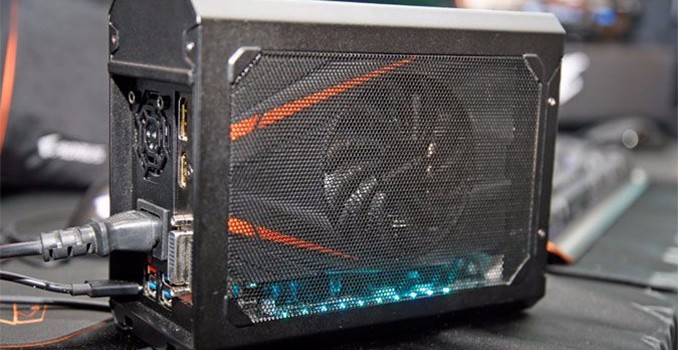
To date, the designs we’ve seen for Thunderbolt 3 eGFX chassis have all been just that – an empty chassis. This lets the user install any GPU they want, but it also means the chassis needs to be sized to accept particularly large video cards. So for Computex Gigabyte’s Aorus division is turning the tables a bit by offering the GTX 1070 Gaming Box: an eGFX adapter that contains a built-in/preinstalled GeForce GTX 1070 video card, allowing them to cut down on the size and complexity of the adapter significantly.

While exact dimensions were not available at press time, the GTX 1070 Gaming Box appears to be about half the length and height of the Razer Core and the Alienware Graphics Amp, the current market leaders in this nascent space. Undoubtedly, the Gaming Box benefits from having its card built-in and, because Aorus makes video cards, the company has an edge up on the competition.

The back of the Aorus GTX 1070 Gaming Box is filled with ports you can use to connect to monitors and other peripherals, including four USB 3.0 ports, two DVI-out connectors, one HDMI out and a single, full-size DisplayPort connection. There’s also a Thunderbolt 3 port that you use to connect to your laptop.

Notably, the smaller size of the Gaming Box means that unlike any other graphics amp we’ve seen, the Gaming Box is itself reasonably portable. In fact, it comes with an attractive padded case you can use to take it with you on trips.

The integrated nature of the Gaming Box also means that the eGFX adapter is also a bit more reasonably priced. Aorus will be selling the box for $599, a roughly $200 premium over a stand-alone GTX 1070 card. This works out to roughly $100 cheaper than even some of the cheapest eGFX chassis on the market, further bringing down the overall cost of going with an eGFX solution.

The Aorus GTX 1070 Gaming Box is due out this summer.

Avram Piltch contributed to this report