News


Dell Launches 'VR Ready' XPS 27 AIO: 4K, Core i7-7700, Radeon RX 570, 10 Speakers

Dell Launches ‘VR Ready’ XPS 27 AIO: 4K, Core i7-7700, Radeon RX 570, 10 Speakers

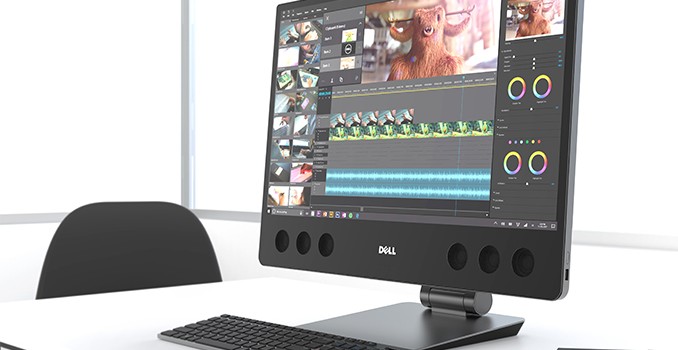
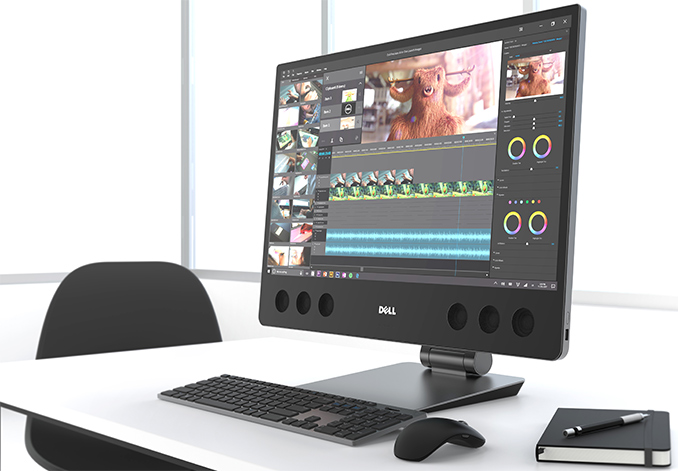
Dell has launched a new version of their XPS 27 all-in-one gaming PC. The VR Ready flavor of the XPS 27 has the same 4K display and the same 10-speaker audio sub-system as the latest iteration of the large XPS AIO, but is powered by a more powerful CPU from Intel along with AMD’s discrete Radeon RX 570 graphics board.

AIO PCs have existed for decades, with their continued popularity fueled by their compact, desk-sized footprint. In the recent years demand for higher performance and even gaming-grade all-in-ones increased noticeably, and manufacturers started to offer AIOs with rather powerful hardware. In fact, in early 2016 several PC makers even introduced Mini-ITX-based AIOs with top-of-the-range discrete graphics cards aiming at customers seeking for maximum performance.

Dell’s new XPS 27 with the VR Ready badge are designed for gamers with average requirements for performance. The systems are still considerably more powerful than their predecessors launched earlier this year are because they do not use integrated or mobile graphics, but rely on AMD’s Radeon RX 570 (2048 stream processors, 128 texture units, 32 ROPs, 256-bit memory bus, etc.) graphics adapter with 8 GB of memory. Meanwhile, the key feature of the latest XPS 27 remained intact: the audio sub-system with 10 speakers (six on the front, two down firing and two radiating) designed to enable surround sound without using bulky external audio equipment.
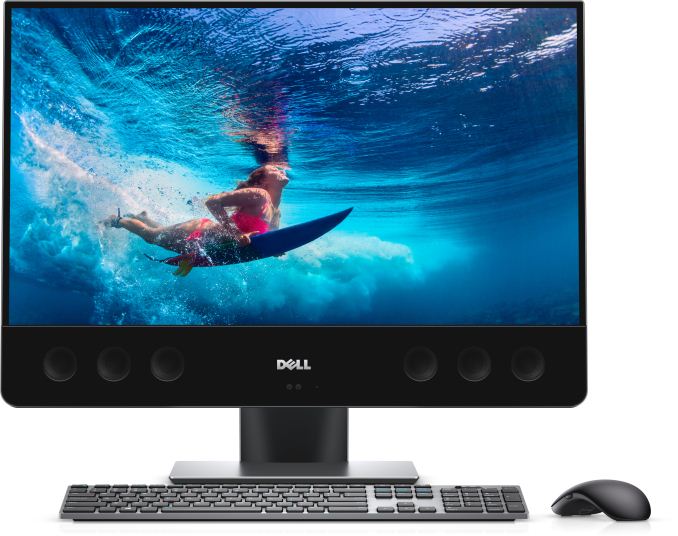
The VR Ready versions of the Dell XPS 27 are based on Intel’s Core i7-7700 CPU as well as the H170 PCH. By default, the systems are equipped with 16 GB of DDR4-2133 memory, but that is upgradeable to 64 GB. As for storage, the PCs have one M.2 slot (PCIe 3.0 x4) as well as two 2.5” bays for HDDs or SSDs, all accessible to the end user. When it comes to connectivity, the Dell XPS 27 feature 802.11ac Wi-Fi, Bluetooth 4.x, a GbE port, five USB 3.0 Type-A headers, one HDMI output, one DisplayPort 1.2, two Thunderbolt 3 ports (USB Type-C), an SD/MMC card reader, a 720p webcam with an IR sensor for facial recognition, a microphone and so on. Overall, there are plenty of ports to plug-in additional peripherals, including various VR gear.

Dell XPS 27 7760 ‘VR-Ready’ Specifications
  Non-Touch Touch-Enabled
Display 27″ IPS with 3840×2160 resolution
1.07 billion colors, 100% Adobe RGB, 350-nit brightness
CPU Intel Core i7-7700
4C/8T, 3.6/4.2 GHz
8 MB cache
65 W
PCH Intel H170
Graphics AMD Radeon RX 570 with 8 GB of GDDR5
2048 stream processors, 128 texture units, 32 ROPs, 256-bit memory bus
Memory  16 GB of DDR4-2133 (four slots in total, upgradeable to 64 GB)
Storage 2 TB HDD
32 GB caching SSD (M.2)
512 GB SSD (PCIe 3.0 x4)
Wi-Fi IEEE 802.11ac Wi-Fi + BT 4.x
Ethernet GbE
Display Outputs 1 × HDMI
1 × DP 1.2
Audio 10 speakers
1 × audio out
USB 5 × USB 3.0 Type-A (5 Gbps, one supports PowerShare)
2 × Thunderbolt 3 (USB Type-C)
Other I/O 720p webcam with RGB and IR sensors
SD/MMC card reader
Dimensions 625 mm / 24.6″ × 435 mm / 17.1″ × 80 mm / 3.16″
Stand regular articulating stand
OS Windows 10 Home Windows 10 Home or Pro

All Dell XPS 27 AIO PCs are constructed of CNC-machined aluminum and come with UltraSharp displays with a 4K (3840×2160) resolution. Meanwhile, computers with touch-enabled screens also feature articulating stands for added convenience. The stand comes at an extra cost, so some gamers may prefer to install a larger SSD and/or more memory and skip the touch option.
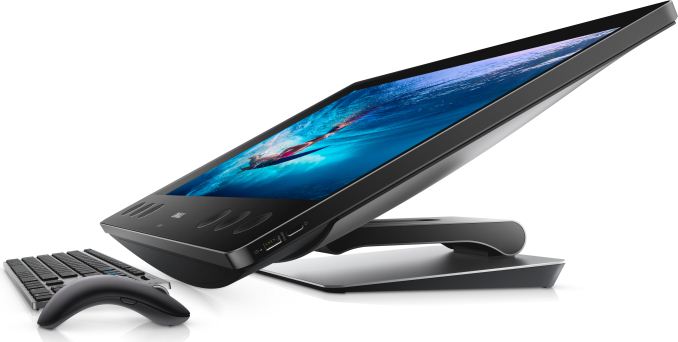
At present Dell offers two versions of the VR Ready XPS 27 featuring Intel’s Core i7-7700 CPU and AMD’s Radeon RX 570 GPU, but different storage configurations and touch support. The model with a 2 TB HDD and 32 GB caching SSD costs $1999.99, whereas the model with a 512 GB PCIe SSD, a touchscreen display with articulating stand and optional Windows 10 Pro comes at $2,649.99.

Related Reading:

Dell Launches 'VR Ready' XPS 27 AIO: 4K, Core i7-7700, Radeon RX 570, 10 Speakers

Dell Launches ‘VR Ready’ XPS 27 AIO: 4K, Core i7-7700, Radeon RX 570, 10 Speakers

Dell has launched a new version of their XPS 27 all-in-one gaming PC. The VR Ready flavor of the XPS 27 has the same 4K display and the same 10-speaker audio sub-system as the latest iteration of the large XPS AIO, but is powered by a more powerful CPU from Intel along with AMD’s discrete Radeon RX 570 graphics board.

AIO PCs have existed for decades, with their continued popularity fueled by their compact, desk-sized footprint. In the recent years demand for higher performance and even gaming-grade all-in-ones increased noticeably, and manufacturers started to offer AIOs with rather powerful hardware. In fact, in early 2016 several PC makers even introduced Mini-ITX-based AIOs with top-of-the-range discrete graphics cards aiming at customers seeking for maximum performance.

Dell’s new XPS 27 with the VR Ready badge are designed for gamers with average requirements for performance. The systems are still considerably more powerful than their predecessors launched earlier this year are because they do not use integrated or mobile graphics, but rely on AMD’s Radeon RX 570 (2048 stream processors, 128 texture units, 32 ROPs, 256-bit memory bus, etc.) graphics adapter with 8 GB of memory. Meanwhile, the key feature of the latest XPS 27 remained intact: the audio sub-system with 10 speakers (six on the front, two down firing and two radiating) designed to enable surround sound without using bulky external audio equipment.

The VR Ready versions of the Dell XPS 27 are based on Intel’s Core i7-7700 CPU as well as the H170 PCH. By default, the systems are equipped with 16 GB of DDR4-2133 memory, but that is upgradeable to 64 GB. As for storage, the PCs have one M.2 slot (PCIe 3.0 x4) as well as two 2.5” bays for HDDs or SSDs, all accessible to the end user. When it comes to connectivity, the Dell XPS 27 feature 802.11ac Wi-Fi, Bluetooth 4.x, a GbE port, five USB 3.0 Type-A headers, one HDMI output, one DisplayPort 1.2, two Thunderbolt 3 ports (USB Type-C), an SD/MMC card reader, a 720p webcam with an IR sensor for facial recognition, a microphone and so on. Overall, there are plenty of ports to plug-in additional peripherals, including various VR gear.

Dell XPS 27 7760 ‘VR-Ready’ Specifications
  Non-Touch Touch-Enabled
Display 27″ IPS with 3840×2160 resolution
1.07 billion colors, 100% Adobe RGB, 350-nit brightness
CPU Intel Core i7-7700
4C/8T, 3.6/4.2 GHz
8 MB cache
65 W
PCH Intel H170
Graphics AMD Radeon RX 570 with 8 GB of GDDR5
2048 stream processors, 128 texture units, 32 ROPs, 256-bit memory bus
Memory  16 GB of DDR4-2133 (four slots in total, upgradeable to 64 GB)
Storage 2 TB HDD
32 GB caching SSD (M.2)
512 GB SSD (PCIe 3.0 x4)
Wi-Fi IEEE 802.11ac Wi-Fi + BT 4.x
Ethernet GbE
Display Outputs 1 × HDMI
1 × DP 1.2
Audio 10 speakers
1 × audio out
USB 5 × USB 3.0 Type-A (5 Gbps, one supports PowerShare)
2 × Thunderbolt 3 (USB Type-C)
Other I/O 720p webcam with RGB and IR sensors
SD/MMC card reader
Dimensions 625 mm / 24.6″ × 435 mm / 17.1″ × 80 mm / 3.16″
Stand regular articulating stand
OS Windows 10 Home Windows 10 Home or Pro

All Dell XPS 27 AIO PCs are constructed of CNC-machined aluminum and come with UltraSharp displays with a 4K (3840×2160) resolution. Meanwhile, computers with touch-enabled screens also feature articulating stands for added convenience. The stand comes at an extra cost, so some gamers may prefer to install a larger SSD and/or more memory and skip the touch option.

At present Dell offers two versions of the VR Ready XPS 27 featuring Intel’s Core i7-7700 CPU and AMD’s Radeon RX 570 GPU, but different storage configurations and touch support. The model with a 2 TB HDD and 32 GB caching SSD costs $1999.99, whereas the model with a 512 GB PCIe SSD, a touchscreen display with articulating stand and optional Windows 10 Pro comes at $2,649.99.

Related Reading:
TechInsights Publishes Preliminary Analysis of 3D XPoint Memory

TechInsights Publishes Preliminary Analysis of 3D XPoint Memory

Now that the Intel Optane Memory M.2 SSDs are readily available on the open market, anyone with an electron microscope and the skills to use it can begin to probe the secrets of 3D XPoint memory that Intel and Micron have been keeping tightly under wraps since announcing the new technology in August 2015. The reverse engineering experts at TechInsights have been doing just that, and they recently published their initial findings.

Die Size

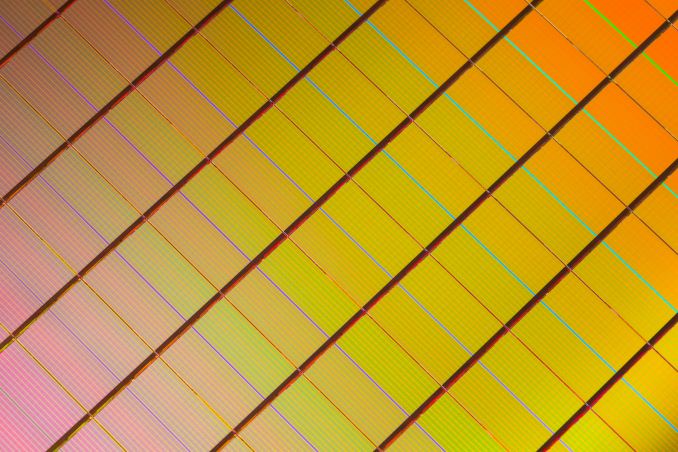
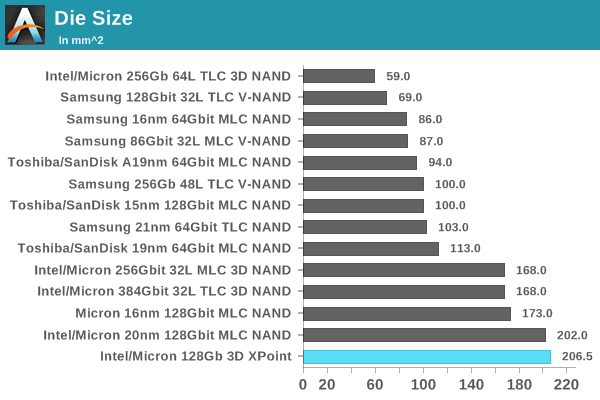
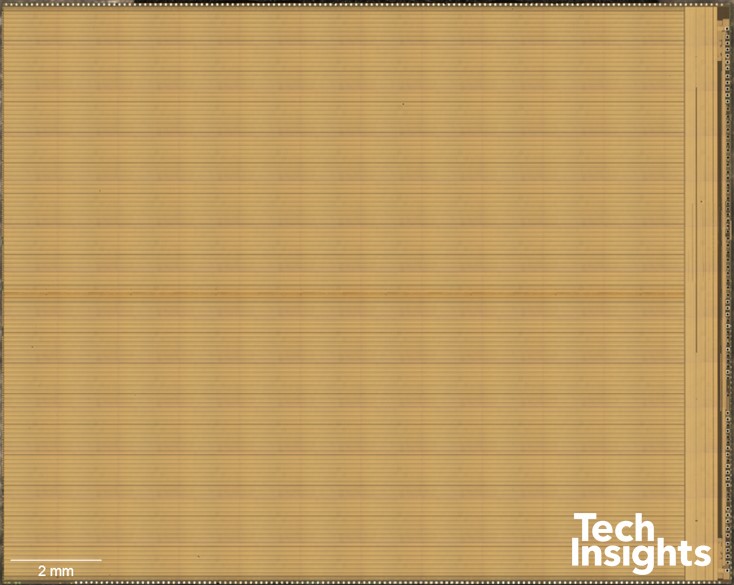
With some of the first high-resolution die photographs of 3D XPoint, TechInsights has provided precise measurements of the die size and memory density. The 128Gb 3D XPoint die is 206.5 mm2, much larger than is typical for modern NAND flash or DRAM but comparable to Intel’s 128Gb 20nm planar MLC NAND. A large total die size is typical for Intel and Micron, as they have historically not catered to the mobile market with their NAND flash while competitors like Samsung and Toshiba have strived to ensure their flash will physically fit in devices like smartphones. (That trend is changing with the introduction this year of 64-layer 3D NAND where Intel and Micron are producing both a larger 512Gb TLC part and a smaller 256Gb TLC part.)

Bit Density

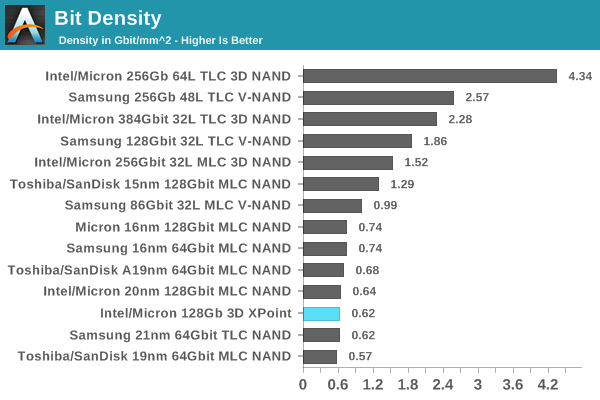
The Intel Optane SSD DC P4800X is using memory of similar density to the Intel SSD DC P3700 that it is displacing as the flagship of Intel’s SSD product line. When comparing similar chips, die size is a strong predictor of manufacturing cost, but 3D XPoint memory is quite different from NAND flash memory, both older planar NAND or newer 3D NAND. Still, there’s some value in noting that the P4800X is arriving with a price tag about 25% higher than the P3700 initially carried. This suggests that the manufacturing process for 3D XPoint is either more expensive than planar NAND or that 3D XPoint yields are not mature enough, but a lot of the markup can also be explained by the lack of high-performance competition for Optane SSDs.

TechInsights calculates that 91.4% of the 3D XPoint die area is occupied by the memory array itself. This is a much higher figure than for NAND flash, where the record is 84.9% for Intel/Micron 3D NAND with its “CMOS under the array” design that puts a large portion of the peripheral circuitry underneath the memory array instead of alongside. Samsung’s current 48-layer 3D V-NAND manages an array efficiency of just 70%, and 3D NAND from Toshiba and SK Hynix has been comparable. This means that once Intel gets around to increasing they layer count in future generations of 3D XPoint memory, they should be able to get much closer to the ideal capacity scaling than 3D NAND memory can currently achieve.

The analysis from TechInsights confirms that 3D XPoint memory is manufactured using a 20nm process, with the same pitch in both the bitline and wordline directions of the memory array. The DRAM market is only just moving beyond this milestone, so comparing the density of 3D XPoint to current DRAM highlights the fundamental capacity advantage 3D XPoint enjoys: around 4.5 times higher density compared to typical 20nm DRAM, and about 3.3 times higher than the most advanced 1Xnm DDR4 on the market. This gap is likely to widen with future generations of 3D XPoint.

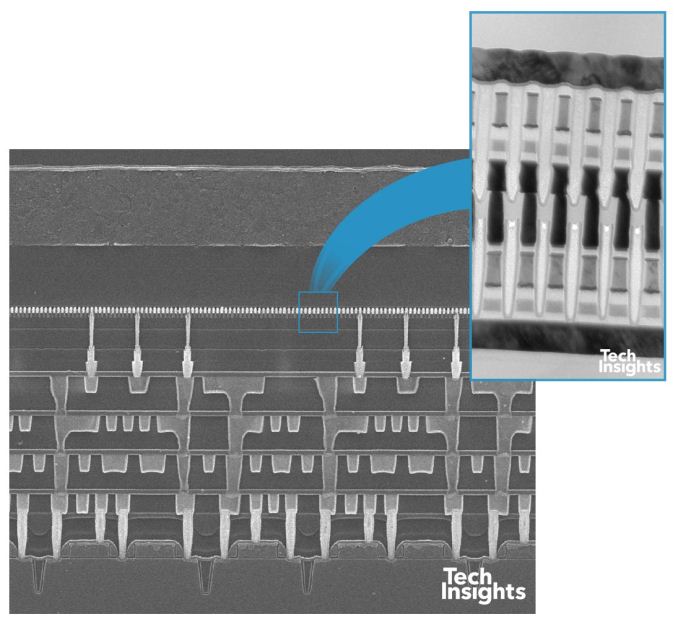
The materials and construction of an individual 3D XPoint memory cell have not been fully analyzed, but it appears to be a phase change memory element with a doped chalcogenide selector switch. The 3D XPoint memory array is constructed between the fourth and fifth metal interconnect layers above the silicon die.