News


Acer ProDesigner BM320 32-inch 4K Monitor Launched: dE < 1 Guaranteed

Acer ProDesigner BM320 32-inch 4K Monitor Launched: dE < 1 Guaranteed

While gaming monitors like the Predator X27 and Z271UV tend to get the most attention, there is still a significant market for work-oriented monitors that boast accurate color reproduction and a large work area. Those are two criteria that the new Acer ProDesigner BM320 has been designed to meet.

This 32-inch display has a native UHD resolution of 3840 x 2160 with a standard refresh rate of 60 Hz. It features an IPS panel with anti-glare coating, a peak brightness of 350 nits, wide viewing angles of 178°/178, and a 5ms response time. Contrast is listed as a comical marketing speak 100,000,000:1, which is the Acer Adaptive Contrast Management (ACM) figure.
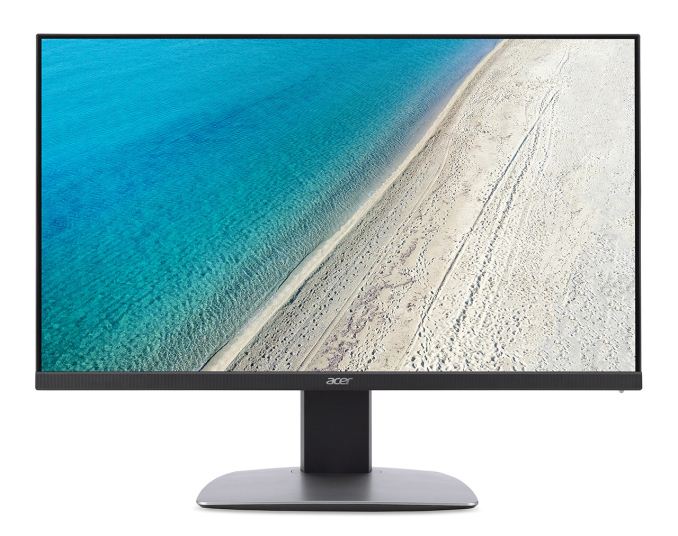
Color reproduction and wide color gamut support is a key feature of this model, and it expands its range to include 100% of Adobe RGB, 100% of sRGB (plus 100% of Rec. 709), and 90% of DCI-P3 coverage. There is no explicit mention of a 10-bit panel, but support for 10-bit color is touted as a feature. The ProDesigner BM320 also comes factory calibrated and tested to ensure a DeltaE of 1.0 or less, which is near perfect color accuracy and better than almost all other claims of per-unit factory calibration, which typically gives dE < 3. Professionals will also have access to 6-axis color adjustment settings to create custom color profiles or simply to update the calibration as the monitor ages.
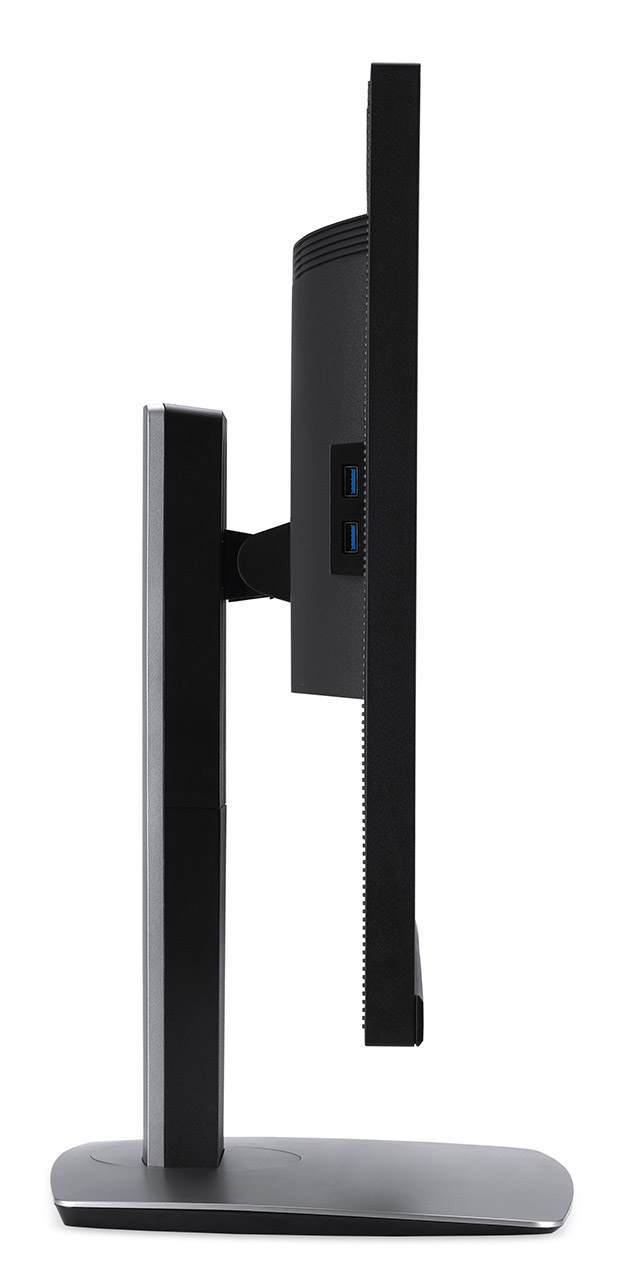
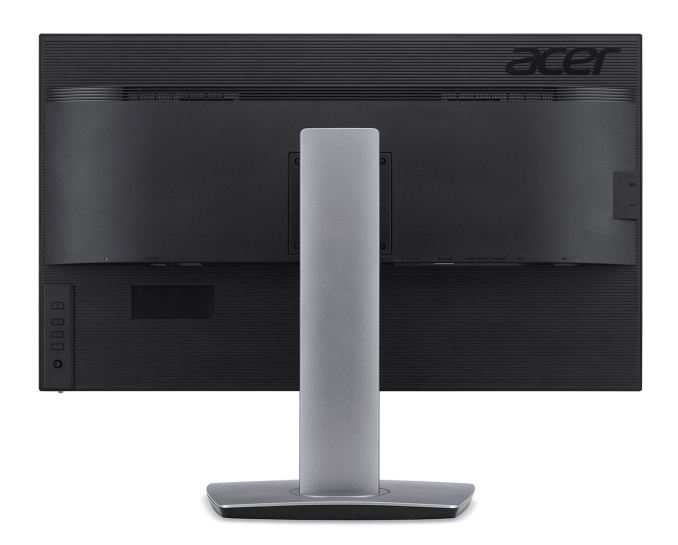
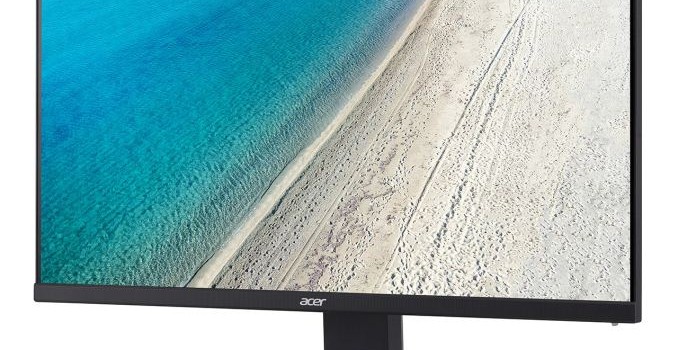
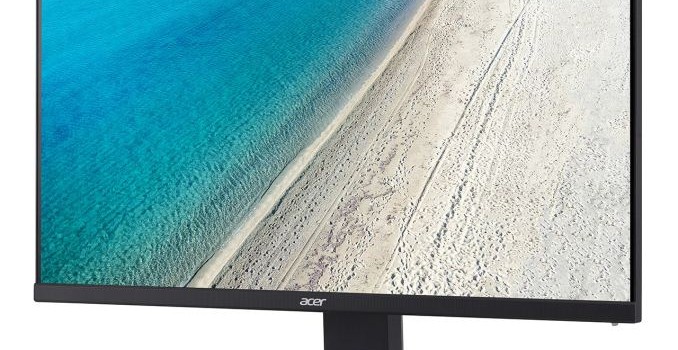
Given its professional positioning, the BM320 ships with Acer’s highly adjustable ErgoStand. The stand can tilt the display between -5 to 25 degrees, swivel +/- 45 degrees, pivot +/- 90 degrees, and provide height adjustments of up to 5.9 inches (150mm). The 90° of swivel rotation should not be overlooked since that means the display can be rotated into a vertical orientation. The ZeroFrame design results in this model having very thin screen bezels on three sides, which should help create near seamless multiple monitor setups.

Acer ProDesigner BM320
Product Page Link
Panel 32-inch IPS
Native Resolution 3840 x 2160 (16:9)
Maximum Refresh Rate 60 Hz
Response Time 5 ms (GTG)
Brightness 350 nit
Contrast ‘100,000,000:1’
Using ACM
Viewing Angles 178º/178º
Dynamic Refresh None
Pixel Density 138 PPI
Display Colors 1.07 billion
10-bit Support
10-bit Native?
Color Gamut Support Adobe RGB: 100%
sRGB: 100%
Rec. 709: 100%
DCI-P3: 90%
Stand Tilt (-5º to 25º)
Swivel (-45º to 45º)
Pivot (-90º to 90º)
Height (up to 5.9-inch / 150 mm)
Inputs 1 x DisplayPort 1.2a
1 x Mini DisplayPort
1 x DVI
1 x HDMI 2.0
USB Hub 4 x USB 3.0
(1 x USB 3.0 for hub)
Audio 2 x 2W
Price / MSRP $1299

Connectivity is listed as DVI, DisplayPort 1.2, Mini DisplayPort, and HDMI 2.0 video outputs. There is also a five port USB 3.0 hub (1 up, 4 down) and two integrated 2W stereo speakers.

The Acer ProDesigner BM320 is available now in the United States with an MSRP of $1299 and a three-year warranty. That is a high price tag for gaming enthusiasts, but not outside of the norm for a display aimed at creative professionals.

Related Reading

Acer ProDesigner BM320 32-inch 4K Monitor Launched: dE < 1 Guaranteed

Acer ProDesigner BM320 32-inch 4K Monitor Launched: dE < 1 Guaranteed

While gaming monitors like the Predator X27 and Z271UV tend to get the most attention, there is still a significant market for work-oriented monitors that boast accurate color reproduction and a large work area. Those are two criteria that the new Acer ProDesigner BM320 has been designed to meet.

This 32-inch display has a native UHD resolution of 3840 x 2160 with a standard refresh rate of 60 Hz. It features an IPS panel with anti-glare coating, a peak brightness of 350 nits, wide viewing angles of 178°/178, and a 5ms response time. Contrast is listed as a comical marketing speak 100,000,000:1, which is the Acer Adaptive Contrast Management (ACM) figure.

Color reproduction and wide color gamut support is a key feature of this model, and it expands its range to include 100% of Adobe RGB, 100% of sRGB (plus 100% of Rec. 709), and 90% of DCI-P3 coverage. There is no explicit mention of a 10-bit panel, but support for 10-bit color is touted as a feature. The ProDesigner BM320 also comes factory calibrated and tested to ensure a DeltaE of 1.0 or less, which is near perfect color accuracy and better than almost all other claims of per-unit factory calibration, which typically gives dE < 3. Professionals will also have access to 6-axis color adjustment settings to create custom color profiles or simply to update the calibration as the monitor ages.

Given its professional positioning, the BM320 ships with Acer’s highly adjustable ErgoStand. The stand can tilt the display between -5 to 25 degrees, swivel +/- 45 degrees, pivot +/- 90 degrees, and provide height adjustments of up to 5.9 inches (150mm). The 90° of swivel rotation should not be overlooked since that means the display can be rotated into a vertical orientation. The ZeroFrame design results in this model having very thin screen bezels on three sides, which should help create near seamless multiple monitor setups.

Acer ProDesigner BM320
Product Page Link
Panel 32-inch IPS
Native Resolution 3840 x 2160 (16:9)
Maximum Refresh Rate 60 Hz
Response Time 5 ms (GTG)
Brightness 350 nit
Contrast ‘100,000,000:1’
Using ACM
Viewing Angles 178º/178º
Dynamic Refresh None
Pixel Density 138 PPI
Display Colors 1.07 billion
10-bit Support
10-bit Native?
Color Gamut Support Adobe RGB: 100%
sRGB: 100%
Rec. 709: 100%
DCI-P3: 90%
Stand Tilt (-5º to 25º)
Swivel (-45º to 45º)
Pivot (-90º to 90º)
Height (up to 5.9-inch / 150 mm)
Inputs 1 x DisplayPort 1.2a
1 x Mini DisplayPort
1 x DVI
1 x HDMI 2.0
USB Hub 4 x USB 3.0
(1 x USB 3.0 for hub)
Audio 2 x 2W
Price / MSRP $1299

Connectivity is listed as DVI, DisplayPort 1.2, Mini DisplayPort, and HDMI 2.0 video outputs. There is also a five port USB 3.0 hub (1 up, 4 down) and two integrated 2W stereo speakers.

The Acer ProDesigner BM320 is available now in the United States with an MSRP of $1299 and a three-year warranty. That is a high price tag for gaming enthusiasts, but not outside of the norm for a display aimed at creative professionals.

Related Reading

Toshiba Demonstrates NVMe SSD With 64-Layer BiCS3 3D NAND

Toshiba Demonstrates NVMe SSD With 64-Layer BiCS3 3D NAND

Toshiba’s transition from planar NAND flash to 3D NAND flash memory has been a long, drawn-out process. Their BiCS 3D NAND architecture is on its third generation but has yet to have any significant impact on the SSD market. The first generation of BiCS 3D NAND was never mass produced. The second generation 256Gb 48-layer BiCS2 3D NAND has seen some use in memory cards and smartphones, but its only presence in the SSD market has been the BG series—a relatively low-volume OEM-only line of BGA SSDs. It’s enough to prove that their 3D NAND isn’t vaporware, but hasn’t done anything to alleviate the ongoing global NAND shortage or push prices down. Toshiba’s third generation 3D NAND is planned to be the one that finally displaces planar NAND, with a 512Gb 64-layer TLC part that should be able to beat the price/GB of Toshiba’s 15nm planar TLC, and a smaller 256Gb part for lower-capacity applications like memory cards.

This week Toshiba is publicly demonstrating for the first time a SSD using their 64-layer BiCS3 3D NAND. At the Dell EMC World conference, Toshiba has a live demo of a laptop containing a prototype XG-series NVMe PCIe SSD with a total of 1TB of BiCS3 3D TLC NAND. Toshiba’s XG3 series is the OEM counterpart to the OCZ RD400 consumer NVMe drives. Toshiba won’t comment on how the XG prototype differs from the RD400 or XG3 aside from using 3D NAND, but the prototype probably offers an early look at what the next XG will feature when it is ready to be officially announced. The prototype is a model that is currently sampling to large OEMs and could be formally announced in just a few months.

Toshiba has announced that they intend to migrate all of their SSD product lines to their 3D TLC NAND, starting with OEM and enterprise products before rolling out to the retail market. They are not willing to commit to a particular timeline for completing the transition, but we should see multiple models announced and shipping by the end of 2017. Supply will continue to be a concern as new 3D NAND fab capacity comes online in 2018, and that’s when we might see the current flash memory shortage wrap up and SSD prices resume a healthy decline.