News


SK Hynix to Ship GDDR6 Memory for Graphics Cards by Early 2018

SK Hynix to Ship GDDR6 Memory for Graphics Cards by Early 2018

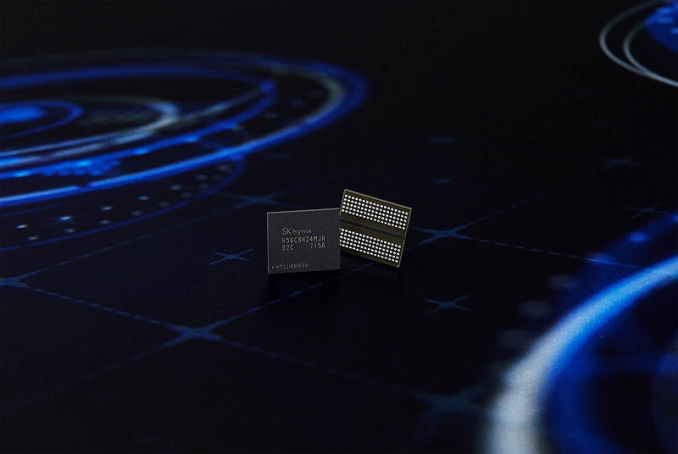
In a surprising move, SK Hynix has announced its first memory chips based on the yet-unpublished GDDR6 standard. The new DRAM devices for video cards have capacity of 8 Gb and run at 16 Gbps per pin data rate, which is significantly higher than both standard GDDR5 and Micron’s unique GDDR5X format. SK Hynix plans to produce its GDDR6 ICs in volume by early 2018.

GDDR5 memory has been used for top-of-the-range video cards for over seven years, since summer 2008 to present. Throughout its active lifespan, GDDR5 increased its data rate by over two times, from 3.6 Gbps to 9 Gbps, whereas its per chip capacities increased by 16 times from 512 Mb to 8 Gb. In fact, numerous high-end graphics cards, such as NVIDIA’s GeForce GTX 1060 and 1070, still rely on the GDDR5 technology, which is not going anywhere even after the launch of Micron’s GDDR5X with up to 12 Gbps data rate per pin in 2016. As it appears, GDDR6 will be used for high-end graphics cards starting in 2018, just two years after the introduction of GDDR5X.

SK Hynix is not disclosing too many details about its GDDR6 chips, but they have revealed that the chips are 8 Gb devices with 16 Gbps data transfer rate, which in turn are being manufactured on SK Hynix’s 21 nm process technology. The company is also stating that GDDR6 will have a 10% lower operating voltage than GDDR5, though they don’t specify if that’s relative to the low voltage (1.35 V), standard (1.5 V) or high frequency (1.55 V) version of GDDR5.

What is noteworthy is that SK Hynix does disclose some details about the first graphics cards to use its GDDR6 memory. As it appears, that adapter will have a 384-bit memory bus and will thus support memory bandwidth upwards of 768 GB/s. Given the number of chips required for a 384-bit memory sub-system, it is logical to assume that the card will carry 12 GB of memory. SK Hynix is not disclosing the name of its partner among GPU developers, but it is logical to assume that we are talking a high-end product that will replace an existing graphics card.

Unlike GDDR5X, GDDR6 is expected to be manufactured by all three major DRAM makers, and consequently should be available more widely. SK Hynix believes that GDDR6 will supplant both GDDR5 and GDDR5X relatively quickly. Nonetheless, keep in mind that while it took GDDR5 a relatively short amount of time to replace GDDR4 on high-end graphics cards in 2008 – 2009, it then took the memory standard years to replace GDDR3 on mainstream adapters.

SK Hynix to Ship GDDR6 Memory for Graphics Cards by Early 2018

SK Hynix to Ship GDDR6 Memory for Graphics Cards by Early 2018

In a surprising move, SK Hynix has announced its first memory chips based on the yet-unpublished GDDR6 standard. The new DRAM devices for video cards have capacity of 8 Gb and run at 16 Gbps per pin data rate, which is significantly higher than both standard GDDR5 and Micron’s unique GDDR5X format. SK Hynix plans to produce its GDDR6 ICs in volume by early 2018.

GDDR5 memory has been used for top-of-the-range video cards for over seven years, since summer 2008 to present. Throughout its active lifespan, GDDR5 increased its data rate by over two times, from 3.6 Gbps to 9 Gbps, whereas its per chip capacities increased by 16 times from 512 Mb to 8 Gb. In fact, numerous high-end graphics cards, such as NVIDIA’s GeForce GTX 1060 and 1070, still rely on the GDDR5 technology, which is not going anywhere even after the launch of Micron’s GDDR5X with up to 12 Gbps data rate per pin in 2016. As it appears, GDDR6 will be used for high-end graphics cards starting in 2018, just two years after the introduction of GDDR5X.

SK Hynix is not disclosing too many details about its GDDR6 chips, but they have revealed that the chips are 8 Gb devices with 16 Gbps data transfer rate, which in turn are being manufactured on SK Hynix’s 21 nm process technology. The company is also stating that GDDR6 will have a 10% lower operating voltage than GDDR5, though they don’t specify if that’s relative to the low voltage (1.35 V), standard (1.5 V) or high frequency (1.55 V) version of GDDR5.

What is noteworthy is that SK Hynix does disclose some details about the first graphics cards to use its GDDR6 memory. As it appears, that adapter will have a 384-bit memory bus and will thus support memory bandwidth upwards of 768 GB/s. Given the number of chips required for a 384-bit memory sub-system, it is logical to assume that the card will carry 12 GB of memory. SK Hynix is not disclosing the name of its partner among GPU developers, but it is logical to assume that we are talking a high-end product that will replace an existing graphics card.

Unlike GDDR5X, GDDR6 is expected to be manufactured by all three major DRAM makers, and consequently should be available more widely. SK Hynix believes that GDDR6 will supplant both GDDR5 and GDDR5X relatively quickly. Nonetheless, keep in mind that while it took GDDR5 a relatively short amount of time to replace GDDR4 on high-end graphics cards in 2008 – 2009, it then took the memory standard years to replace GDDR3 on mainstream adapters.

Acer Announces Predator Triton 700 Gaming Laptop: Core i7, GeForce GTX 10 Series, & 1 TB SSD

Acer Announces Predator Triton 700 Gaming Laptop: Core i7, GeForce GTX 10 Series, & 1 TB SSD

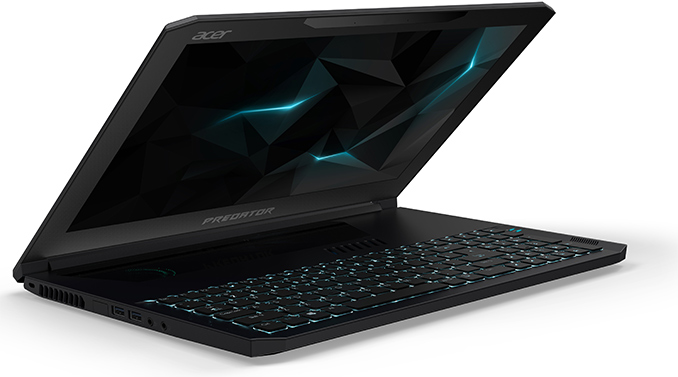
Acer this week announced its new high-end gaming laptop, the Predator Triton 700. Designed to strike a balance between features and weight, the laptop features a quad-core Intel CPU, a yet unspecified NVIDIA GPU, 16 GB of memory, as well as a mechanical keyboard. Meanwhile the laptop measures in at just 18.9 mm thick and weighs around 2.6 kilograms, or roughly about the size of a mainstream notebook from a decade ago.

The Acer Predator Triton 700 comes with a 15.6” FHD display and is based on Intel’s Core i5-7300HQ or Core i7-7700HQ processor, depending on exact model. The laptop is equipped with 16 GB of DDR4-2400, up to two 512 GB SSDs, Rivet Networks Killer DoubleShot Pro network solution (featuring a 2×2 802.11ac Wi-Fi and a GbE controller), Thunderbolt 3 connectivity, and other features one would expect from a high-end laptop.

Acer Predator Triton 700
  i7-7700HQ i5-7300HQ
Display 15.6″ IPS panel with 1920×1080 resolution
CPU Core i7-7700HQ (4C/8T, 6 MB, 2.8/3.8GHz) Core i5-7300HQ (4C/4T, 6 MB, 2.5/3.5GHz)
Graphics NVIDIA GeForce GTX 10-series with G-Sync support for external displays
RAM 16 GB DDR4-2400 (upgradeable to 32 GB)
Storage Up to two 512 GB SSDs with PCIe 3.0 x4 or SATA interface
Wi-Fi Rivet Killer Wireless-AC 2×2 802.11ac Wi-Fi
Bluetooth Bluetooth 4.1
Ethernet Rivet Killer E2x00 GbE controller
USB 2 × USB 3.0 Type-A
1 × USB 2.0 Type-A
Thunderbolt × USB Type-C Thunderbolt 3 connector
Display Outputs 1 × DisplayPort
1 × HDMI 2.0
Keyboard Mechanical backlit keyboard with programmable keys
Other I/O Microphone, stereo speakers, audio jacks, webcam (with HDR imaging)
Dimensions Width: 393 mm/15.47″
Depth: 263 mm/10.35″
Thickness: 18.9 mm/0.744″
Weight 2.6 kilograms
Price Starts at $2999 or €3399, depending on configuration and market

In terms of overall design, the Predator Triton 700 is one of a number of recent thinner-and-lighter high-end gaming laptops to hit the market in recent years. As the popularity of gaming notebooks has continued to rise, various makers of such PCs started to diversify their lineups with thinner machines aimed at gamers, essentially splitting these niche products to classes that differ by performance and weight/dimensions. With the Predator Triton 700, Acer is looking to bring the performance of a gaming desktop to the “thin-class” gaming laptops, and gives us an idea what to expect from next-gen gaming notebooks in general.

A feature of the Predator Triton 700 that Acer is especially proud of – and is a major component of allowing the laptop to be as small as it is – is its cooling system, which has five heatpipes and two thin AeroBlade 3D fans with curved metal blades that create increased airflow. A large Corning Gorilla Glass plate that acts like a touchpad covers the cooling system and the innards of the laptop, whereas the backlit mechanical keyboard resides towards the user, giving the system a very distinctive look.

Meanwhile, one of the things that Acer is not disclosing are the graphics processors options available: the only thing we know is that the system runs an undisclosed GeForce GTX 10-series processor, and that the high-end configuration scores ~17,000 points in 3DMark11 (based on Acer’s presentation). Such a performance level is common for the NVIDIA GeForce GTX 1070 GPU (when working with the i7-7700HQ), but this GPU consumes 110 W of power, so it’s not clear whether a 15.6”/18.9mm chassis with two blowers offers enough cooling capacity to prevent significant throttling. Typically, relatively thin gaming notebooks use GeForce GTX 1060 graphics chips with around 80 W TDP, but such GPUs hit around 12,000 – 13,000 in 3DMark11 (with the same CPU). It’s highly probable that Acer will be offering a GTX 1060 version as a mid-range configuration anyhow, so the real question is what exact GPU will go into the high-end configuration. NotebookCheck.net speculates that the Predator Triton 700 is equipped with a yet unannounced version of NVIDIA’s GP104 GPU with a considerably reduced TDP.

Wrapping things up, the Acer Predator Triton 700 gaming laptop will be available in Europe and North America this August. MSRPs will start from €3399 and $2999, depending on configuration, with exact specs and prices varying from market to market.

Related Reading:

Acer Adds 12-Inch Switch 3 & Switch 5 2-in-1s to Kaby Lake Laptop Lineup

Acer Adds 12-Inch Switch 3 & Switch 5 2-in-1s to Kaby Lake Laptop Lineup

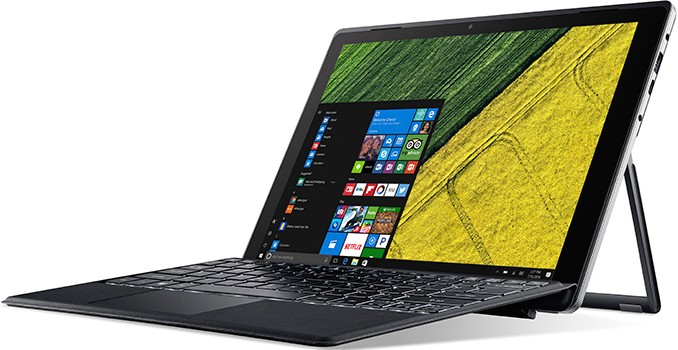
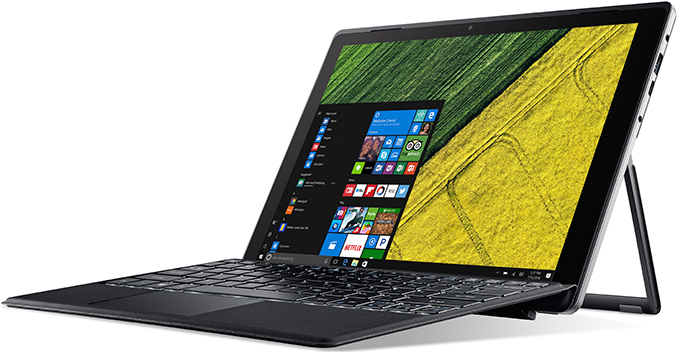
Acer this week introduced its new high-end 2-in-1 hybrid PCs that will be available later this year. The Acer Switch 5 will be aimed at users who require both portability and performance, and is based on Intel’s Core i5/i7 CPU while being paired with up to 8 GB of DRAM as well as up to 512 GB of solid-state storage. To integrate a relatively powerful CPU while retaining moderate price, power consumption and long battery life, Acer had to give up a 4K display panel and a Thunderbolt 3 controller, which were key features of the Switch 5’s predecessor. In addition, Acer announced its new inexpensive Switch 3 convertible notebook that in many ways resembles its more advanced brother.

Sales of PCs continued to decline in Q1 2017 and totaled 62.2 million units, according to Gartner. Market researchers believe that many consumers delay purchases of new PCs because their old machines are good enough and because they tend to spend more on smartphones. Meanwhile, there are multiple indications that computers in hybrid form-factors continue to gain popularity because many people want to have convenience of a tablet (e.g., compact sizes, touchscreen, etc.) and versatility of a laptop (physical keyboard, performance, features). After large PC makers introduced loads of various convertible PCs last year, competition in the segment intensified. Since 2-in-1s still represent a new category, PC vendors continue to learn what the end-user wants from such systems and continue to evolve their designs in response. To a large degree, this is exactly what Acer did with its entry-level Switch 3 and higher-end Switch 5: it upped the bar for its inexpensive machine and eliminated “overkill” features on the advanced model.

Comparison of Acer Switch 3 and 5
  Switch 5 Switch 3
Screen Resolution 12″ 2160×1440 12.2″ 1920×1200
CPU Core i5-7200U (2C/4T, 3 MB, 2.5/3.1 GHz)
Core i5-7300U (2C/4T, 3 MB, 2.6/3.5 GHz)
Core i7-7500U (2C/4T, 4 MB, 2.7/3.5 GHz)
Core i7-7600U (2C/4T, 4 MB,  2.8/3.9 GHz)
Celeron 3865U (2C/2T, 2 MB, 1.8 GHz)
Celeron 3965U (2C/2T, 2 MB, 2.2 GHz)
Pentium 4415U (2C/4T, 2 MB, 2.3 GHz)
Graphics HD Graphics 620 (24 EUs) HD Graphics 610 (12 EU)
RAM 8 GB LPDDR3 4 GB LPDDR3
Storage 256 or 512 GB PCIe 3.0 x2 32, 64 or 128 GB eMMC
Wi-Fi 2×2 802.11ac Wi-Fi
Bluetooth Bluetooth 4.0
USB 3.0 × Type-A
× Type-C (also used for charging, external display, etc.)
Card Reader MicroSD
Fingerprint Sensor Yes No
Other I/O Microphone, stereo speakers, audio jack
Battery Life 10.5 hours 8 hours
Thickness Pad: 9.6 mm
Pad + keyboard: ~15.4 mm
Pad: 9.95 mm
Pad + keyboard: 16.3 mm
Weight Pad: 920 grams
Pad + keyboard: 1270 grams
Pad: 900 grams
Pad + keyboard: unknown
Price $799 and €1099 $399 and €499

Acer Switch 5: Fanless PC with Intel Core i5/i7

The Acer Switch 5 hybrid laptop is powered by on Intel’s 7th generation dual-core Core i5/i7 CPUs with a 15W TDP. Previously the company used various Core M (Skylake-Y) CPUs for such computers, but since Core i5/i7 offer considerably higher performance due to higher frequencies, Acer decided to switch to them. The manufacturer uses its fanless “Liquid Loop” cooling solution (based on either heatpipe or vapor chamber tech) to cool down the CPU. Consequently the new PC is utterly quiet, just like its predecessors, the Acer Switch 12 S as well as the Switch Alpha.

The new 2-in-1 can be equipped with up to 8GB of LPDDR3 memory, a 256 GB or a 512 GB PCIe 3.0 x2 SSD, a 802.11 ac Wi-Fi controller with 2×2 MU-MIMO technology, front- and back-facing cameras, a fingerprint reader, one USB 3.0 Type-A, and one USB 3.0 Type-C (5 Gbps) port, as well as a MicroSD card reader.

However unlike its predecessor the Switch 12 S, the Acer Switch 5 comes with only one display option: a 12” IPS panel with a 2160×1440 resolution, covered with an unspecified protective glass. The multi-touch display supports the Acer Active Pen for note-taking and sketching, solidifying its tablet credentials. Previous-gen high-end convertibles from Acer offered an optional 4K display panel, but this time the manufacturer decided not to give such an option. Thunderbolt 3 has also been excised, presumably due to power consumption and/or cost concerns.

The Acer Switch 5 is made of anodized aluminum, and because it also now uses a higher-performance CPU and a more powerful cooling system, the unit got a little thicker and heavier than the Aspire Switch 12 S. The tablet itself is about 9.6 mm (0.38 inches) thick and weighs around 920 grams (2.03 pounds). Meanwhile, the new keyboard seems to be more compact than the predecessor, which is why the whole system became thinner and lighter: with the keyboard connected, the 2-in-1 laptop is 15.24 mm thick (0.6 inches) and weighs around 1270 grams (2.8 pounds).

The Acer Switch 5 will hit the market in North America and EMEA in June starting at $799 and €1099, respectively (exact specs vary by the region). The system will be available in China starting from July at a price from ¥7,499.

Gallery: Acer Switch 5

Acer Switch 3: Entry-Level 2-in-1 with FHD Display

The Acer Switch 3 is an entry-level 2-in-1, which is positioned above the inexpensive Switch V10 and the Switch One 10 launched a year ago. With the Switch 3, Acer is no longer pursuing the low end of the market, which is why the system inherits a lot from its more expensive brother, the Switch 5 (e.g., design, configuration of ports, etc.).

The Switch 3 is based on Intel’s Kaby Lake Celeron and Pentium processors, with cooling provided by Acer’s fanless cooling solution. The device comes with up to 4 GB of LPDDR3, up to 128 GB of eMMC solid-state storage, front- and back-facing cameras, as well as dual-band MIMO 802.11ac Wi-Fi. The 2-in-1 also features a USB Type-C port, which is used for data transfer, video output and charging. The Switch 3 has a 12.2” IPS touchscreen with 1920×1200 resolution. As for dimensions and weight, the system is a bit thicker (9.95 mm), but a bit lighter (900 grams) than the Switch 5.

Since the Switch 3 does not have to address the low end of the market, it is not going to come at a bargain price. The convertible will be available in Europe and the U.S. in June for €499 and $399, respectively. It will hit the Chinese market in July starting at ¥4,999. And keep in mind that exact specs will vary depending on the region.

Gallery: Acer Switch 3

Related Reading: