News


Acer Announces Predator X27 Monitor: 4K@144 Hz with DCI-P3, HDR10, & G-Sync
Acer Announces Predator X27 Monitor: 4K@144 Hz with DCI-P3, HDR10, & G-Sync

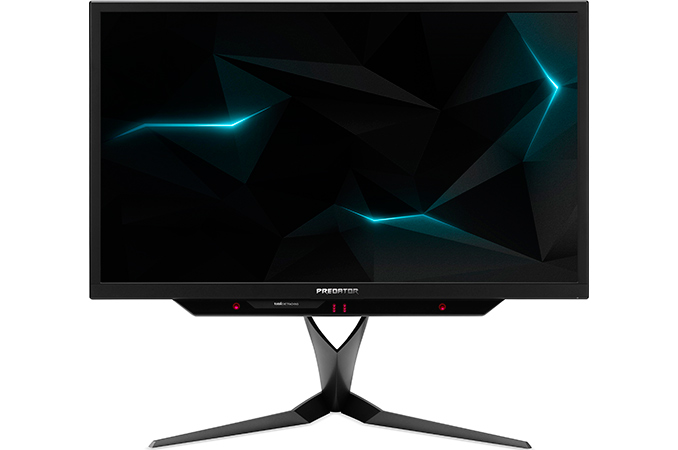
At its annual Next@Acer event, Acer formally introduced the Predator X27, its new flagship gaming display. The company’s first HDR monitor, the Predator X27 is Acer’s implementation of NVIDIA’s prototype HDR monitor design, which we first saw back at CES 2017. So like NVIDIA’s prototype, Acer is aiming for the top with this monitor, offering 4K, HDR, a wide color gamut, and a high refresh rate all in a single display. Unfortunately for those of you eager to shell out for the Rolls-Royce of gaming monitors, you’ll have to wait a bit longer; Acer is not announcing a release date or a price at this time.

By the numbers, the Predator X27 offers a 4K resolution, a 144 Hz refresh rate, a 1000-nits brightness, and uses a quantum dot film to enable HDR10 and the DCI-P3 color gamut. To further appeal to gamers, the Predator X27 also supports NVIDIA’s G-Sync HDR technology as well as Tobii eye-tracking. The new unit is one of a few announced 4K displays to support such a high refresh rate along with HDR10 and NVIDIA’s G-Sync HDR technology.

The Acer Predator X27 is based on AU Optronics’ M270QAN02.2 AHVA panel with a 3840×2160 resolution, 178°/178° horizontal/vertical viewing angles, up to 1,000 nits brightness, a 4 ms response time and a 144 Hz refresh rate. The monitor comes with a direct LED backlighting system with 384 zones, which ensures both high brightness as well as better contrast ratios through localized dimming. The backlighting system is further enhanced with a quantum dot film in order to give the monitor wide color gamut capabilities, allowing it to display 96% of the DCI-P3 color gamut, which pairs up nicely with its HDR support via the HDR10 format. Finally, the Predator X27 features NVIDIA’s G-Sync HDR variable refresh rate technology.

To take full advantage of the Predator X27 monitor, gamers are going to need an NVIDIA GeForce GTX 10-series graphics card with a DisplayPort 1.4 connector. NVIDIA & Acer are using every bit of bandwidth offered by DisplayPort 1.4 here, and even that’s not enough; the X27’s bandwidth requirements actually exceed what DisplayPort can provide. As a result the monitor (like all monitors based on the NVIDIA design) will use 4:2:2 chroma subsampling when gaming to stay within the bandwidth confines of DisplayPort 1.4. Meanwhile as you might expect, the display’s lone HDMI 2.0 port is limited to 60Hz operation. In addition, expect the display to require a USB cable to control the Tobii eye-tracking hardware.
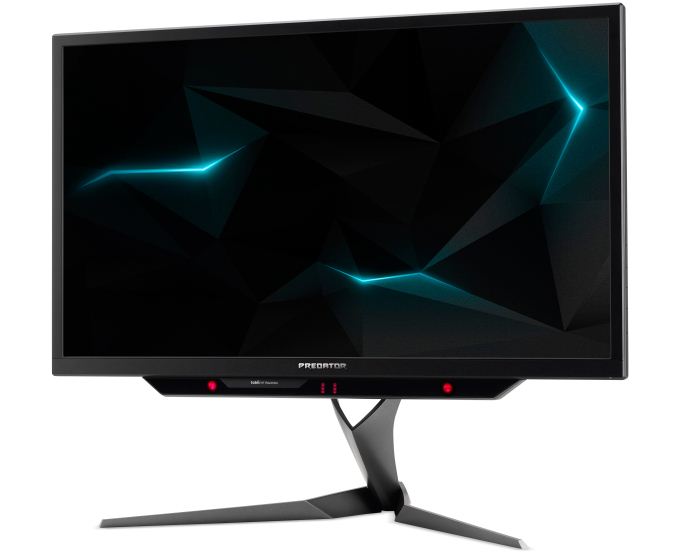
To date, only Acer and ASUS have announced gaming displays powered by the M270QAN02.2 AHVA panel from AUO and supporting 4Kp144 with a 1,000 nits brightness, quantum dots, and HDR10. Such monitors in many ways represent a new generation of gaming displays that support not only a high resolution and refresh rate, but also the DCI-P3 color saturation, advanced backlighting with local dimming, and so on.

Specifications of Acer 4K/144Hz G-SYNC Gaming Monitor
  Predator X27
Panel 27″ IPS (AHVA)
Resolution 3840 × 2160
Refresh Rate 144 Hz (w/4:2:2 Choma Subsampling)
Variable Refresh Rate NVIDIA G-Sync HDR
Response Time 4 ms
Brightness 1000 cd/m²
Contrast Unknown
Backlighting Direct LED, 384 zones
Quantum Dot Yes
HDR HDR10 Support
Viewing Angles 178°/178° horizontal/vertical
PPI 163 pixels per inch
Colors 1.07 billion
Color Saturation sRGB: 100%
Adobe RGB: 99%
 DCI-P3: 96%
Rec. 2020: 82%
Inputs 2 × DisplayPort 1.4
1 × HDMI 2.0

Acer remained tight-lipped about pricing and availability timeframe of its Predator X27 display, but since AU Optronics is reportedly kicking off mass production of its M270QAN02.2 in July, it is likely that Acer, ASUS and other companies that use the panel may start selling their products on its base in late Q3, or early Q4 2017. As for pricing, we may well be talking about devices with MSRPs north from $1500 (some whispers say so), but Acer and its rivals yet have to announce their MSRPs.

Related Reading:
Micron Hires New CEO: Sanjay Mehrotra, SanDisk Co-Founder And Former CEO

Micron Hires New CEO: Sanjay Mehrotra, SanDisk Co-Founder And Former CEO

In February, Micron CEO Mark Durcan announced his retirement after three decades with the company. Durcan had previously announced plans to retire in 2012 while serving as the company’s president, but the death of then-CEO Steve Appleton prompted Durcan to postpone his retirement indefinitely to serve as Micron’s CEO. Micron’s board of directors has now selected Sanjay Mehrotra to be the new president and CEO of Micron. Durcan will step down and be replaced by Mehrotra effective May 8, 2017.

Mehrotra’s background includes co-founding SanDisk in 1988 and serving as its president and CEO from 2011 until its acquisition in 2016 by Western Digital. Prior to serving as CEO of SanDisk, Mehrotra had been the chief operating officer, head of engineering and chief of product development. Under Mehrotra’s leadership SanDisk’s annual revenue peaked at $6.6 billion and the company sold for $16 billion in 2016 to Western Digital. With long experience leading a major memory manufacturer, Mehrotra is one of the most highly-qualified candidates possible to take over at Micron.

Outgoing CEO Mark Durcan will be stepping down as CEO and from the board of directors effective May 8 but plans to stay on as an advisor until early August. Mehrotra plans to divide his time between Micron headquarters in Boise, Idaho and Micron’s Silicon Valley offices in Milpitas, California, a few blocks from SanDisk headquarters.

LaCie Announces 2big Dock: 2-Bay TB3 DAS with Card Reader, USB-A and DisplayPort

LaCie Announces 2big Dock: 2-Bay TB3 DAS with Card Reader, USB-A and DisplayPort

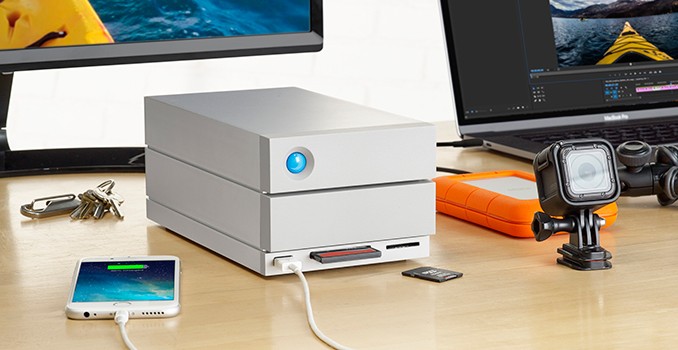
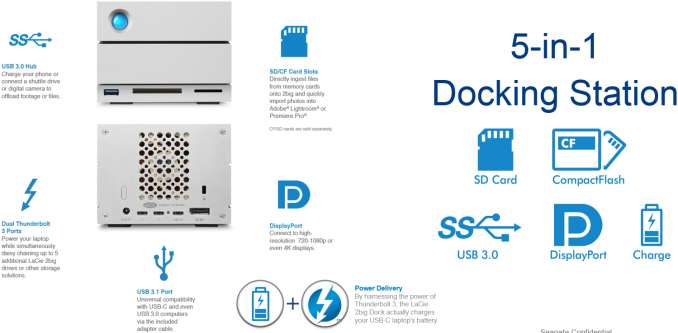
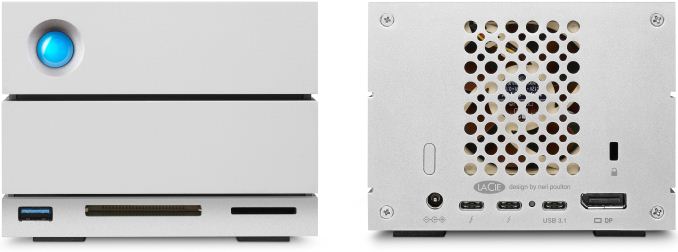
LaCie this week has taken the wraps off of the latest member of their family of DAS devices, the 2big Dock. The newly revealed dock is their first Thunderbolt 3/USB-C-enabled dock, offering the latest in connectivity for laptops and PCs. Operating as both a DAS and a TB3/USB-C hub, the 2big Dock integrates two high-performance hard drives while offering a card reader, a USB 3.0 Type-A port, and a DisplayPort (1.2). The 2big Dock offers up to 20 TB capacity with a sequential read/write speed of up to 440 MB/s.

Like their prior Thunderbolt 2 docks, LaCie is aiming to fully leverage the capabilities and intended use cases for Thunderbolt-equipped laptops. As discussed multiple times, modern high-end laptops are so thin that it in many cases it is physically impossible (or very complicated) to install full-sized USB Type-A or DisplayPort headers on them and sometimes there is no space for memory card readers in the chassis (this is the case with Apple’s MacBook and MacBook Pro, HP’s Spectre and some other), which means that many people need docking stations to fulfill their connectivity needs.

LaCie is a well-known name in the DAS business, however prior to now they’ve never done anything approaching a dock. So as you’d expect for a company whose core strength is in the storage business, the company has opted to build an entry-level DAS that also doubles as a Thunderbolt 3 dock. All-told, the 2big Dock offers card reader supporting SD and CompactFlash cards, a DisplayPort, a USB 3.0 Type-A port, and a USB 3.0 Type-C port with power delivery, while allowing the Dock to be used with both Thunderbolt 3 and pure USB-C host devices.

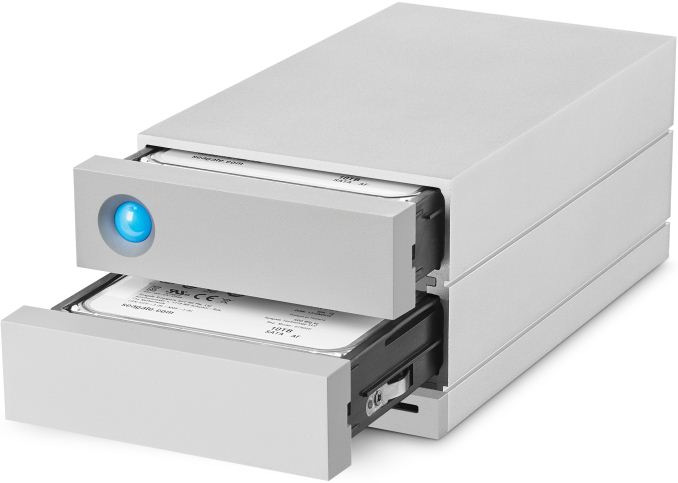
LaCie is going to offer three versions of the 2big Dock DAS: with 12 TB, 16 TB and 20 TB capacities, all based on the Seagate IronWolf Pro enterprise-class drives for NAS. The DAS fully supports RAID 1 and RAID 0 capabilities for two HDDs — so owners can ensure either maximum reliability for their data (by mirroring them), or double their sequential read/write speeds up to ~440 MB/s (by striping them). LaCie does not disclose the exact controller it uses to enable hardware RAID functionality, but it is logical to assume that it is the ASMedia ASM1092R chip, which has two device ports and one host SATA port (and which was used in the previous-gen 2big DAS). As for controllers for the docking station, the manufacturer also remains tight-lipped and we do not know what kind of bridges are used for PCIe and SATA bridging, PCIe and USB bridging, or the card reader.

The LaCie 2big Dock with Thunderbolt 3 and USB-C
  12 TB
STGB12000400
16 TB
STGB16000400
20 TB
STGB20000400
Number of Bays 2 hot-swappable bays for 3.5″ HDDs
HDD Interface SATA 6 Gbps
HDDs Used Seagate IronWolf Pro
Capacity RAID 0: 12 TB
RAID 1: 6 TB
RAID 0: 16 TB
RAID 1: 8 TB
RAID 0: 20 TB
RAID 1: 10 TB
RAID 0/1/JBOD
RAID0 ~440 MB/s
RAID1 214 MB/s
RAID Controller ASMedia ASM1092R (?)
Ports 2 × Thunderbolt 3
 1 × USB 3.0 Type-A
1 × USB 3.0 Type-C
1 × DisplayPort (version unknown)
1 × SD card reader
1 × CF card reader
PSU external
Cables Included Thunderbolt 3 40Gb/s USB-C to USB-C cable
USB-A to USB-C (5 Gbps) cable
Software LaCie RAID Manager
Price (MSRP) unknown unknown unknown

Just like many other Thunderbolt 3 devices, the 2big Dock has two TB3 headers in a bid to daisy chain other TB3 devices, such as displays or special-purpose hardware. The 2big Dock DAS is also compatible with the previous-gen computers featuring Thunderbolt 2 ports (e.g., Apple’s Mac Pro and MacBook Pro) via a special adapter from Apple.

The LaCie 2big Dock will be available this summer and will be covered by the company’s five-year warranty. Pricing is not announced, but since we are talking about a dual-bay DAS, it is not going to be astronomical. At least, expect the 20 TB version to be considerably more affordable than the 6big 24 TB ($3000).

Gallery: LaCie 2big Dock

Related Reading:
Razer Announces The Lancehead Gaming Mice

Razer Announces The Lancehead Gaming Mice

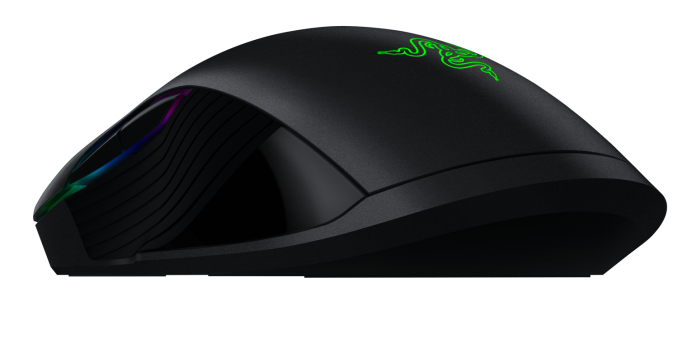
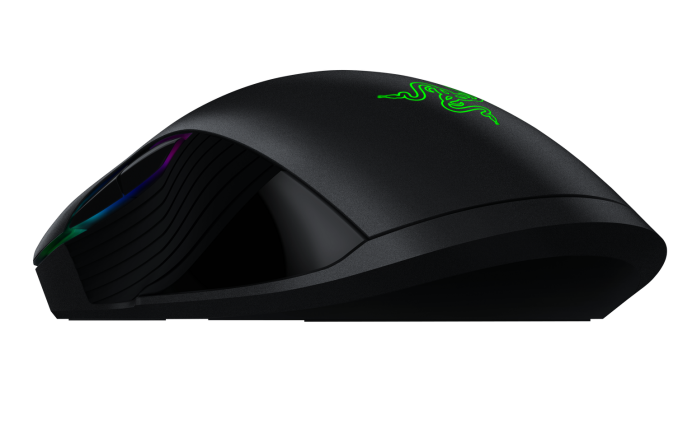
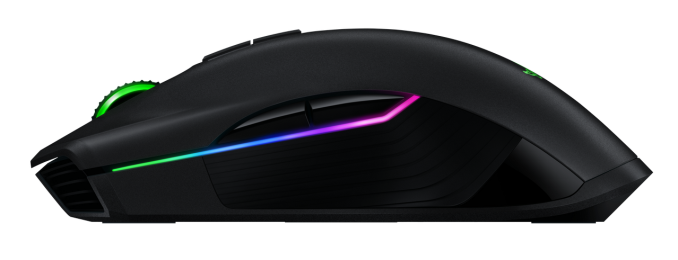
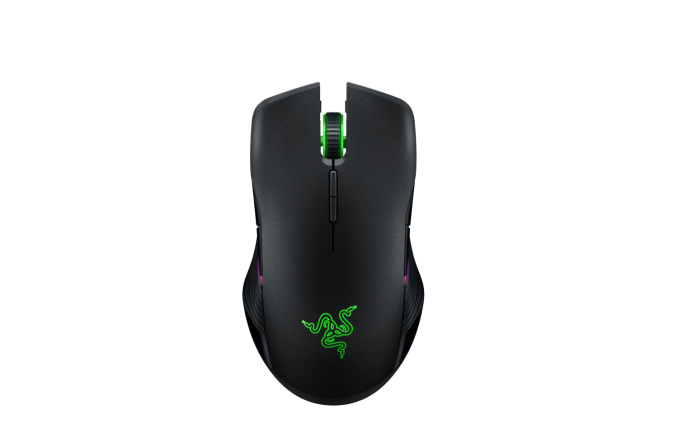
Today Razer is launching a pair of gaming mice into their lineup. The Razer Lancehead Wireless Gaming Mouse, and the Razer Lancehead Tournament Edition are the two new models, and perhaps just as interesting is that they are also announcing a new version of their configuration software, dubbed Razer Synapse Pro, which is currently in beta. Both of the new mice feature an ambidextrous body, which should please those who prefer using the mouse with their left hand, and of course both mice support Razer’s Chroma lighting.

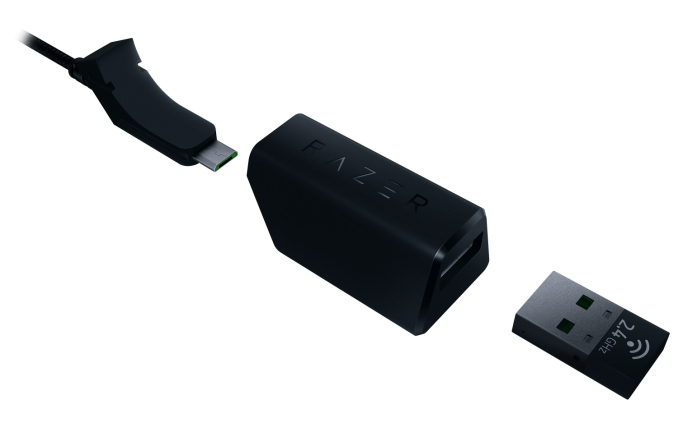
First up is the Lancehead Wireless Gaming Mouse. Wireless mice have come a long way, but they can still have issues in a group environment due to interference on the frequencies the radios operate at. This has been an ongoing issue since the dawn of time, and there are various methods to combat this. Razer is announcing a new technology in their repertoire to try to assist with these issues, and they are calling it Adaptive Frequency Technology (AFT). None of this is new science of course, since frequency hopping is par for the course, but Razer is advertising their AFT should help with latency by choosing the strongest interference-free channel when it starts, and only hopping when necessary. There’s nothing really unique about doing this, but with good error correction it should help. Razer is claiming that it outperforms every other wireless gaming mouse. Frankly it would be nice to see some of these devices move off of the extremely crowded 2.4 GHz frequency altogether, and with the relatively short distance from a mouse to a PC, it’s strange that they stick with the 2.4 GHz band.

In addition to the wireless component, the Lancehead comes with a 16,000 DPI sensor with 210 inches-per-second tracking and it can handle up to 50 G of acceleration. It also features mechanical mouse switches that Razer co-developed with Omron, and Razer is claiming lower latency on the clicks, as well as up to 50 million clicks of durability.

The second mouse is similar to the first, but ditches the wireless connection for a USB cable. The Razer Lancehead Tournament Edition also supports up to 450 inches-per-second of speed, and the same 16,000 DPI and 50 G acceleration as the wireless model.

Razer is also announcing the new Razer Synapse Pro software, which will be released soon. The Lancehead owners will be the first to get a chance to use the new software. Synapse Pro supports both cloud and on-device storage for mouse settings, which is a welcome change from the existing software, which requires an online account to sync the mouse settings, and do most of the other configuration. The new Synapse Pro will allow a user to access their device profile on any computer without requiring an internet connection. Finally.

Razer will be offering the new mice for pre-order now, with shipments of the Tournament Edition starting in May, and the Lancehead Wireless Gaming Mouse will be available in the May/June timeframe. Pricing starts at $79.99 USD for the wired version, and $139.99 for the wireless model.

Source: Razer

Skylake-SP Xeon List Published: Moving from E7/E5 Naming to Xeon Gold and Xeon Platinum

Skylake-SP Xeon List Published: Moving from E7/E5 Naming to Xeon Gold and Xeon Platinum

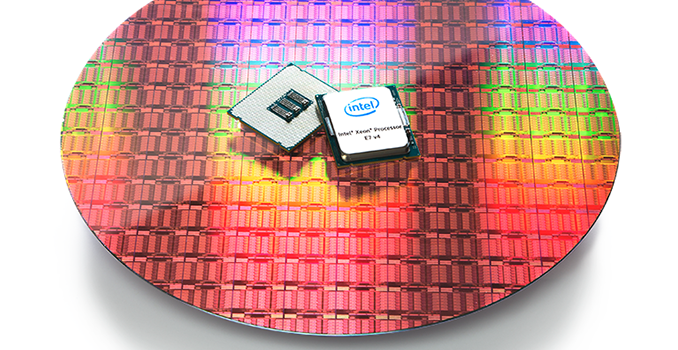
Presumably by accident, Intel this week has published a list of its upcoming processors that belong to the soon-to-launch Skylake Xeon families. The names were published by Intel in a PCN, or Product Change Notification, which makes it likely that this was an accidental disclosure.

In the PCN, it details that LGA3647 CPUs (which covers Xeon Phi processors and the upcoming Skylake Xeons) will have an arrow indicating which way processors should be oriented in the socket. It seems like an arbitrary PCN, just printing an arrow on a heat spreader, which makes this published list somewhat unexpected. But these names show the key parts of the Purley platforms for servers.

One of the poorly kept secrets in the industry over the last few weeks is that Intel is changing the nomenclature of its Xeon CPUs going forward. This will be a difficult change to explain, given that users are so familiar with the previous naming system, and the translation between old and new is not a simple one-to-one mapping. Skylake-SP thus introduces the new Xeon Gold and Xeon Platinum lineups for different markets of servers. We expect all these CPUs to be on LGA3647, given that the PCN seems to suggest that this singular print marking on the heatspreader was not on this socket design before.

Unfortunately, the published list does not have full CPU information, but we do get names and frequencies of 34 Skylake-SP processors (see details below) that will belong to the Xeon Gold and Xeon Platinum lineups, as well as the fact that these processors are designated with the H0 stepping. We might not see all these processors at launch (which at this time has still not officially been announced), and we expect Intel to expand the Xeon Gold/Platinum family with new models over the several quarters following the launch.

Based on the document, the initial Xeon Gold family will consist of 20 processors featuring 5000- and 6000-series model numbers. The Xeon Platinum lineup will feature 14 chips belonging to the 8000-series.

Basic Specifications of Intel Xeon Gold and Platinum CPUs
Model Freq.
(Base)
Product
Code
S-Spec
Xeon Platinum 8180M 2.5 GHz CD8067303192101 SR37T
Xeon Platinum 8180 CD8067303314400 SR377
Xeon Platinum 8176M 2.1 GHz CD8067303133605 SR37U
Xeon Platinum 8176 CD8067303314700 SR37A
Xeon Platinum 8170M CD8067303319201 SR3BD
Xeon Platinum 8170 CD8067303327601 SR37H
Xeon Platinum 8168 2.7 GHz CD8067303327701 SR37J
Xeon Platinum 8164 2.0 GHz CD8067303408800 SR3BB
Xeon Platinum 8160T 2.1 GHz CD8067303592800 SR3J6
Xeon Platinum 8160M CD8067303406600 SR3B8
Xeon Platinum 8160 CD8067303405600 SR3B0
Xeon Platinum 8158 3.0 GHz CD8067303406500 SR3B7
Xeon Platinum 8156 3.6 GHz CD8067303368800 SR3AV
Xeon Platinum 8153 2.0 GHz CD8067303408900 SR3BA
 
Xeon Gold 6154 3.0 GHz CD8067303592700 SR3J5
Xeon Gold 6152 2.1 GHz CD8067303406000 SR3B4
Xeon Gold 6150 2.7 GHz CD8067303328000 SR37K
Xeon Gold 6148 2.4 GHz CD8067303406200 SR3B6
Xeon Gold 6142M 2.6 GHz CD8067303405700 SR3B1
Xeon Gold 6142 2.6 GHz CD8067303405400 SR3AY
Xeon Gold 6140M 2.3 GHz CD8067303405500 SR3AZ
Xeon Gold 6140 2.3 GHz CD8067303405200 SR3AX
Xeon Gold 6138T 2.0 GHz CD8067303592900 SR3J7
Xeon Gold 6138 2.0 GHz CD8067303406100 SR3B5
Xeon Gold 6136 3.0 GHz CD8067303405800 SR3B2
Xeon Gold 6134M 3.2 GHz CD8067303330402 SR3AS
Xeon Gold 6134 3.2 GHz CD8067303330302 SR3AR
Xeon Gold 6132 2.6 GHz CD8067303592500 SR3J3
Xeon Gold 6130T 2.1 GHz CD8067303593000 SR3J8
Xeon Gold 6130 2.1 GHz CD8067303409000 SR3B9
Xeon Gold 6128 3.4 GHz CD8067303592600 SR3J4
Xeon Gold 6126T 2.6 GHz CD8067303593100 SR3J9
Xeon Gold 6126 2.6 GHz CD8067303405900 SR3B3
Xeon Gold 5122 3.6 GHz CD8067303330702 SR3AT

Most importantly, the PCN confirms that Intel is about to scrap its Xeon E5/E7 naming nomenclature for something different with the introduction of the Skylake-SP/EP processors. Instead of E5 and E7, Intel will call its CPUs for 2P and 4P/MP servers Xeon Gold and Xeon Platinum. Moreover, the feature-sets of chips aimed at different kinds of servers will also be different, just like today. The upcoming Xeon Gold CPUs will work in 2P configurations and will thus replace the existing Xeon E5-series. Meanwhile, it is logical to assume then the replacement for the Xeon E7 will be called the Xeon Platinum, and apart from higher maximum core count will also support various additional capabilities, including RAS features. We suspect that there will be more names than Gold and Platinum coming to market to cover other aspects of Intel’s product stack.

In the processor stack above, we also get T and M processors in the mix. T processors have historically been lower power processors, and this is likely still the case given that the T processors have lower frequencies than most of the rest of the CPUs. Some CPUs, like the Xeon Gold 6130 and 6130T, are at 2.0 GHz for both: this is likely relating to different turbo frequencies, but also the T product is binned for lower power. The M processors are somewhat of a mystery, as we’ve never had M on a processor before, except in mobile. Speculating a bit on our part, this could be a reference to MCDRAM, which is a feature we see on Xeon Phi processors. Although to be clear, we have nothing to suggest that Intel will be including MCDRAM on these parts, as the Xeon CPU die itself may be big and the MCDRAM silicon is also relatively sizeable. We suspect that the M processors will have a given feature or features in common, which might come at an extra expense in the final price tag.

In previous generations, Intel typically creates three different core designs for it’s latest Xeons: a low core count (LCC), medium/high core count (MCC/HCC, depending on the document), and an extreme core count (XCC) version. The XCC version has the highest amount of cores, the most cache, and costs the most, but typically the per-core frequency is low. Intel sometimes offers the XCC in a small core count configuration, but with a large cache, and something like the Xeon Platinum 8156 at 3.6 GHz most likely fits that description. One of the things that should seem obvious is that the naming of each processor is not linear with clock frequency. For example, the Gold 6150 runs at 2.7 GHz base, but the Gold 6152 runs at 2.1 GHz base. Using that fourth digit extensively means that we hope Intel has a strong and obvious way to describe which part of the CPU names mean specific things. At this point it is hard to see a specific pattern, given we do not know core counts.

Disclaimer: There’s a significant amount of information in the ecosystem about the upcoming Skylake-SP platform, mostly from leaks that we can’t personally confirm. So while we appreciate there is information out there, we’ve kept this analysis specifically to what is confirmed or could be inferred, as per AnandTech policy.