News


Samsung Acquires Quantum Dot Tech Company QD Vision

Samsung Acquires Quantum Dot Tech Company QD Vision

Earlier this week Samsung confirmed that they have acquired QD Vision, the US-based provider of quantum dot technology for consumer displays. According to sources cited by SamMobile, the deal was confirmed ahead of its official announcement next week by Jung Chil-hee, the head of Samsung’s Advanced Institute of Technology.

No details about the price of the acquisition are available yet, but from an observer’s point of view it makes sense that Samsung would want to acquire companies working in the field of quantum dots. Samsung has been heavily pushing quantum dots in their newest televisions in order to increase their color gamut without having to make use of backlights with multi-color LEDs. With Ultra HD content being mastered in the DCI-P3 or Rec. 2020 color spaces, this has become a necessary feature in high end televisions and monitors for content creation.

QD Vision’s technology works in a different manner from the technology Samsung currently uses in their televisions. In order to support HDR, televisions need to use full array backlighting so regions can be dimmed locally, and employing quantum dots in this situation requires a film layer between the backlight and the LCD array, which can be quite costly for larger displays. QD Vision’s technology works with edge-lit displays and places tubes of quantum dots between the LEDs and the guide plate that distributes light across the display. I took a look at a monitor that uses QD Vision’s technology earlier this year. It’s not clear where Samsung plans to utilize QD Vision’s technology, but the technology could play a big role in bringing wide color gamuts to lower cost displays, and QD Vision’s technology and patents related to quantum dots would also have value to Samsung for further development of the technology in general.

Samsung Acquires Quantum Dot Tech Company QD Vision

Samsung Acquires Quantum Dot Tech Company QD Vision

Earlier this week Samsung confirmed that they have acquired QD Vision, the US-based provider of quantum dot technology for consumer displays. According to sources cited by SamMobile, the deal was confirmed ahead of its official announcement next week by Jung Chil-hee, the head of Samsung’s Advanced Institute of Technology.

No details about the price of the acquisition are available yet, but from an observer’s point of view it makes sense that Samsung would want to acquire companies working in the field of quantum dots. Samsung has been heavily pushing quantum dots in their newest televisions in order to increase their color gamut without having to make use of backlights with multi-color LEDs. With Ultra HD content being mastered in the DCI-P3 or Rec. 2020 color spaces, this has become a necessary feature in high end televisions and monitors for content creation.

QD Vision’s technology works in a different manner from the technology Samsung currently uses in their televisions. In order to support HDR, televisions need to use full array backlighting so regions can be dimmed locally, and employing quantum dots in this situation requires a film layer between the backlight and the LCD array, which can be quite costly for larger displays. QD Vision’s technology works with edge-lit displays and places tubes of quantum dots between the LEDs and the guide plate that distributes light across the display. I took a look at a monitor that uses QD Vision’s technology earlier this year. It’s not clear where Samsung plans to utilize QD Vision’s technology, but the technology could play a big role in bringing wide color gamuts to lower cost displays, and QD Vision’s technology and patents related to quantum dots would also have value to Samsung for further development of the technology in general.

MSI Adds Low-Profile GeForce GTX 1050 Ti to Lineup

MSI Adds Low-Profile GeForce GTX 1050 Ti to Lineup

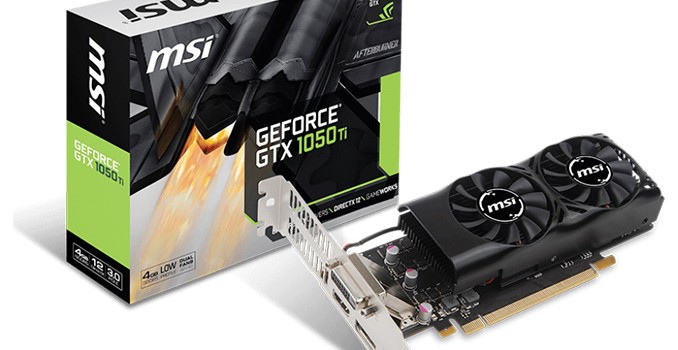
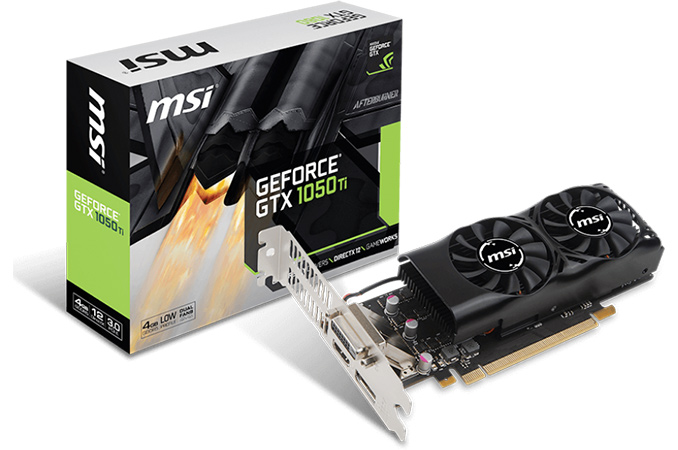
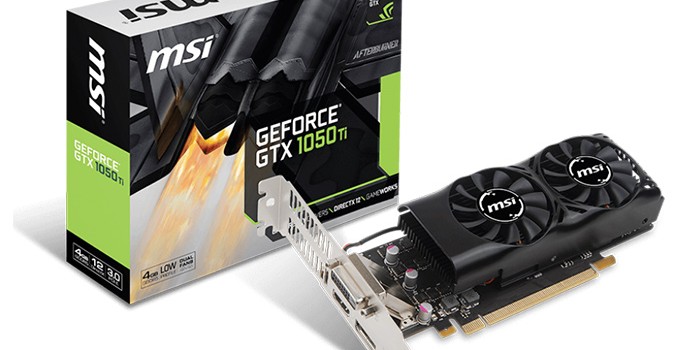
MSI has quietly added a new low-profile graphics card into their lineup. The adapter is based on NVIDIA’s GeForce GTX 1050 Ti GPU featuring the latest Pascal architecture and carries 4 GB of GDDR5 memory. The card will replace those powered by NVIDIA’s first-generation Maxwell graphics processors in MSI’s lineup and will be among the most affordable gaming-grade graphics boards on the market. The card does not require auxiliary power and is compatible with a wide range of PCs. The drive is still dual slot width, however.

The MSI GeForce GTX 1050 Ti 4GT LP is based on the GP107 GPU (768 stream processors, 48 texture units, 32 raster operations pipelines, 128-bit memory bus) clocked at 1.29/1.39 GHz (base/boost) and carries 4 GB of GDDR5 memory at 7 Gbps. The board has DL-DVI, HDMI 2.0 and DisplayPort 1.4 outputs with HDCP 2.2 support, which is required for Ultra HD Blu-ray playback. Tthe card comes with a dual-slot cooling system featuring two fans.

The low-profile GeForce GTX 1050 Ti consumes up to 75 W of power, and as a result it does not require any auxiliary power connectors –  something important when upgrading low-end PCs from large OEM brands that sometimes do not have any spare connectors left. The lack of power connectors will allow the video card to replace the GeForce GTX 750-series and the GeForce GTX 950 75W series adapters with similar power consumption.

Nowadays it is not easy to find a low-profile graphics card with reasonable performance and a good feature-set. NVIDIA’s GP107 GPU is based on the company’s latest Pascal architecture and thus supports DirectX 12 and Vulkan APIs as well as has an advanced media playback engine that supports hardware-accelerated decoding and encoding of H.265 (HEVC) video. Therefore, MSI’s GeForce GTX 1050 Ti 4GT LP graphics card is an interesting product compatible with slim and outdated desktops and HTPCs. As an added bonus, MSI claims that it uses MIL-STD-810G certified components to ensure a long lifespan for the board.

MSI did not announce the price of the GeForce GTX 1050 Ti 4GT LP, but it is unlikely that it is going to cost significantly higher than $139 recommended by NVIDIA.

Related Reading:

MSI Adds Low-Profile GeForce GTX 1050 Ti to Lineup

MSI Adds Low-Profile GeForce GTX 1050 Ti to Lineup

MSI has quietly added a new low-profile graphics card into their lineup. The adapter is based on NVIDIA’s GeForce GTX 1050 Ti GPU featuring the latest Pascal architecture and carries 4 GB of GDDR5 memory. The card will replace those powered by NVIDIA’s first-generation Maxwell graphics processors in MSI’s lineup and will be among the most affordable gaming-grade graphics boards on the market. The card does not require auxiliary power and is compatible with a wide range of PCs. The drive is still dual slot width, however.

The MSI GeForce GTX 1050 Ti 4GT LP is based on the GP107 GPU (768 stream processors, 48 texture units, 32 raster operations pipelines, 128-bit memory bus) clocked at 1.29/1.39 GHz (base/boost) and carries 4 GB of GDDR5 memory at 7 Gbps. The board has DL-DVI, HDMI 2.0 and DisplayPort 1.4 outputs with HDCP 2.2 support, which is required for Ultra HD Blu-ray playback. Tthe card comes with a dual-slot cooling system featuring two fans.

The low-profile GeForce GTX 1050 Ti consumes up to 75 W of power, and as a result it does not require any auxiliary power connectors –  something important when upgrading low-end PCs from large OEM brands that sometimes do not have any spare connectors left. The lack of power connectors will allow the video card to replace the GeForce GTX 750-series and the GeForce GTX 950 75W series adapters with similar power consumption.

Nowadays it is not easy to find a low-profile graphics card with reasonable performance and a good feature-set. NVIDIA’s GP107 GPU is based on the company’s latest Pascal architecture and thus supports DirectX 12 and Vulkan APIs as well as has an advanced media playback engine that supports hardware-accelerated decoding and encoding of H.265 (HEVC) video. Therefore, MSI’s GeForce GTX 1050 Ti 4GT LP graphics card is an interesting product compatible with slim and outdated desktops and HTPCs. As an added bonus, MSI claims that it uses MIL-STD-810G certified components to ensure a long lifespan for the board.

MSI did not announce the price of the GeForce GTX 1050 Ti 4GT LP, but it is unlikely that it is going to cost significantly higher than $139 recommended by NVIDIA.

Related Reading:

Game Bundles: Get Civilization VI, Doom, Watch_Dogs 2 for Free with AMD, NVIDIA and Samsung Hardware

Game Bundles: Get Civilization VI, Doom, Watch_Dogs 2 for Free with AMD, NVIDIA and Samsung Hardware

From time to time companies bundle the latest games with their hardware in a bid to attract attention of gamers and to make their products more competitive. Such promotions are mutually beneficial: for gamers, it is a good way to upgrade and save some money on titles, while for companies it is an efficient way to increase sales. Recently AMD and Samsung have launched campaigns that add a free digital copy of various digital games with their products, including Civilization VI, Doom and Watch_Dogs 2.

Update 11/22: NVIDIA has launched its own promotion, which will add Watch_Dogs 2 to select GeForce GTX 1070/1080 graphics cards and notebooks featuring these GPUs.

AMD: Get Civilization VI and Doom for Free

Running from October 27 to January 27 (or when AMD runs out of Doom codes), the chipmaker working with the usual etailers (Amazon, Newegg, etc) to include a voucher for Doom as a motherboard bundle. This bundle covers most AM3+ motherboards, but it also covers top-to-bottom AMD systems that use an AM3+ motherboard, AMD FX CPU, and an AMD Radeon graphics card. AMD has not published the exact list of AM3+ motherboards that come with a free digital copy of Doom, but more information can be obtained from AMD’s Rewards web-site.

Meanwhile it is noteworthy that this week AMD also initiated its new Civilization VI promotion for Radeon graphics cards. To get a free copy of the latest in the just-one-more-turn-before-bed gaming series, you will need to buy an AMD Radeon RX 480 (or a PC with such a board inside) from an eligible retailer. Right now, the campaign is already live in some countries, and will eventually spread to other regions as well.

AMD’s Civilization IV and Doom Campaigns
Hardware Game Campaign End Date
AM3+ Motherboard Doom January 27, 2017
AMD Radeon RX 480 Civilization VI January 15, 2017


Samsung: Watch_Dogs 2 for Free

In the recent years Samsung has made inroads into gaming PCs with its high-performance SSDs based on its 3D V-NAND memory. At times, Samsung bundled popular titles with its drives, and its new Watch_Dogs 2 campaign expands to curved displays as well.
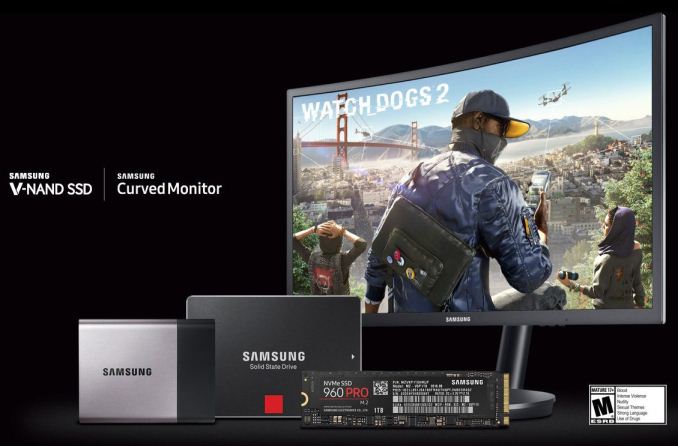
On the SSD side of matters, Samsung latest bundle covers most of their V-NAND SSDs, including the recently launched 960 PRO & EVO, and their 850 SATA counterparts. Also covered in this bundle is the company’s Portable SSD, the T3. Meanwhile on the monitor side of matters, the bundle covers Samsung’s CFG70 or CF791 curved monitors. The bundle will be available in North America at select retailers only until December 31, 2016, or while coupons last.

Samsung’s Watch_Dogs 2 Promo Campaign
SSDs
Model Form-Factor Capacity Notes
960 PRO M.2 512 GB, 1 TB, 2 TB 48-layer MLC V-NAND
960 EVO M.2 500 GB, 1 TB 48-layer TLC V-NAND
850 PRO 2.5″ 512 GB, 1 TB 32-layer MLC V-NAND
850 EVO M.2, mSATA 500 GB, 1 TB TLC V-NAND
Portable SSD T3 USB 3.1 Type-C 500 GB, 1 TB, 2 TB 32-layer TLC V-NAND
Curved Displays
Model Diagonal Resolution Notes
CFG70 24″ 1920×1080 Features quantum dot technology, 1800R Curvature
CFG70 27″ unknown
CF791 34″ 3440×1440 1500R curvature

It is noteworthy that Samsung is promoting its curved displays with and without quantum dot technology among gamers using a free game bundle campaign. While curved monitors are available from all major display suppliers, they are not very popular. Meanwhile, Samsung seems to see potential of such monitors for this market segment, which is why it will add a free copy of Watch_Dogs 2 to its CFG70 and CF791 displays until the end of this year.

NVIDIA: Hackers Wanted

NVIDIA on Tuesday (11/22) launched its new free game campaign, which will last for a month. This time the GPU designer will bundle Watch_Dogs 2 with select GeForce GTX 1070/1080 video cards and laptops carrying mobile versions of the graphics processors.

The game uses a number of NVIDIA’s technologies supported by its GameWorks package, including HBAO+ global lighting, TXAA antialiasing as well as HFTS and PCSS techniques for improved shadows.

NVIDIA’s Hackers Wanted Campaign
Hardware Game Campaign End Date
NVIDIA GeForce GTX 1070/1080 Watch_Dogs 2 December 19, 2016
Laptop Featuring GeForce GTX 1070/1080

The campaign will last till December 19 and if you have no plans to upgrade your display or SSD, but intend to get a new GPU, this will be your chance to get a free copy of Watch_Dogs 2 as well.

Related Reading:

Sources: AMD, Samsung.