News


More Greenlow Motherboards Announced: ASRock Rack’s C230 Series

More Greenlow Motherboards Announced: ASRock Rack’s C230 Series

On the back of Intel’s muted launch for the Xeon E3-1200 v5 platform, the server based business units from normal motherboards consumer facing companies are announcing their C230 series. We covered GIGABYTE Server’s offering in a previous pipeline post, and next up comes ASRock Rack with ATX, microATX and mini-ITX offerings for workstations set up for server-based airflow.

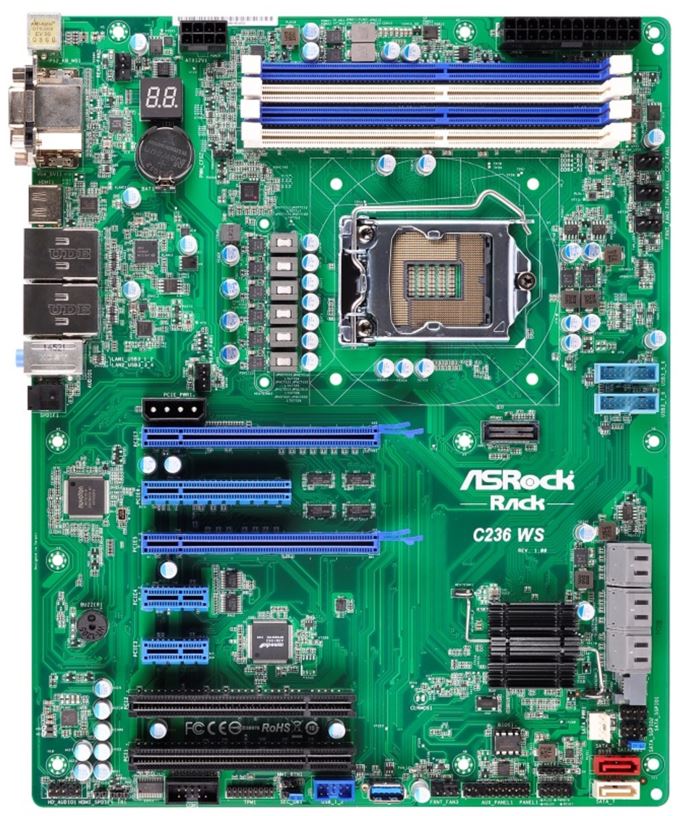
C236 WS

First up is the full ATX model, giving support for dual PCIe co-processors at PCIe 3.0 x8/x8, dual Intel networking (I210 and I219), another PCIe 3.0 x4 slot from the chipset, a total of eight SATA ports with SATA Express in there as well, an onboard USB 3.0 Type-A port and eight other USB 3.0 ports through two headers and a four ports on the rear panel.

Compared to the consumer ASRock motherboards, this is eminently more clinical and aimed at its specific market – there is low end onboard audio (ALC662 or lower), COM and TPM support, display outputs and PCIe to PCI bridges for legacy connections.

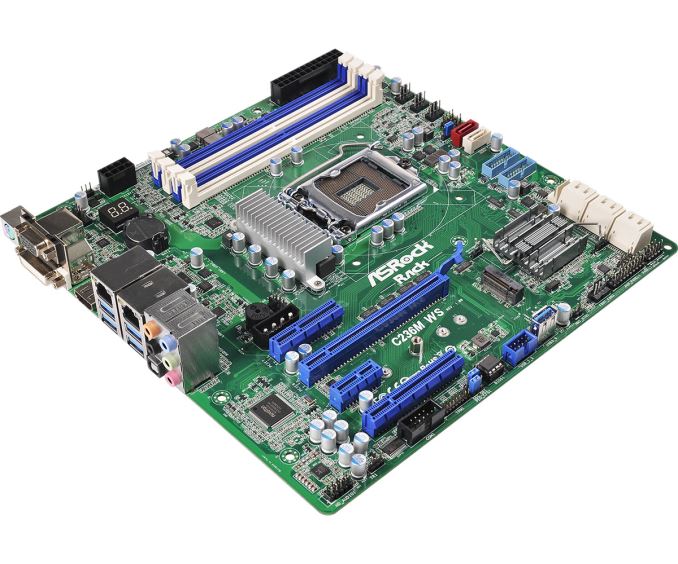
C236M WS (link)

The micro-ATX member of this family carries over a number of features, such as the dual networking (this time I219-LM and I210) and eight SATA ports, but also implements an M.2 connector and a SATA DOM. Audio is boosted up to at least the ALC892 with 5.1 support, and the power delivery on the processor gets a heatsink for good measure. Perhaps surprisingly we see a total of six fan headers as well.

Despite the layout of the PCIe slots, the bottom open-ended x8 is part of the CPU lanes, offering x8/x8 configuration with a PCIe 3.0 x4 at the top from the chipset. Unfortunately, despite the free PCIe lanes in the system, that M.2 slot is only geared for PCIe 3.0 x1 bandwidth.

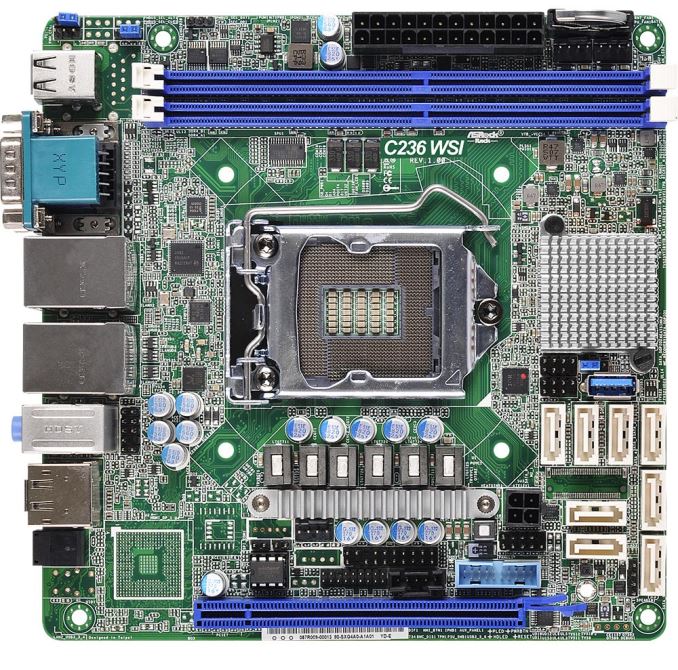
C236 WSI (link)

Similar to the boards from GIGABYTE Server, the smaller mini-ITX one is the more interesting out of the set. Here’s a small board with support for up to 32GB of ECC DDR4 memory, a total of eight SATA ports, dual network controllers (again I219 and I210), a full PCIe 3.0 x16 and a rear-IO COM header.

There’s an interesting large gap in the bottom left however, showing solder pads but no integrated chip. The size of the pad suggests that there is room here for an Alpine Ridge controller, suggesting that in the future there might be a version with either USB 3.1 or Thunderbolt 3.

Availability of these motherboards will be dependent on B2B distribution channels, although we might see one or two filter into commercial channels as well.

Source: ASRock Rack

More Greenlow Motherboards Announced: ASRock Rack’s C230 Series

More Greenlow Motherboards Announced: ASRock Rack’s C230 Series

On the back of Intel’s muted launch for the Xeon E3-1200 v5 platform, the server based business units from normal motherboards consumer facing companies are announcing their C230 series. We covered GIGABYTE Server’s offering in a previous pipeline post, and next up comes ASRock Rack with ATX, microATX and mini-ITX offerings for workstations set up for server-based airflow.

C236 WS

First up is the full ATX model, giving support for dual PCIe co-processors at PCIe 3.0 x8/x8, dual Intel networking (I210 and I219), another PCIe 3.0 x4 slot from the chipset, a total of eight SATA ports with SATA Express in there as well, an onboard USB 3.0 Type-A port and eight other USB 3.0 ports through two headers and a four ports on the rear panel.

Compared to the consumer ASRock motherboards, this is eminently more clinical and aimed at its specific market – there is low end onboard audio (ALC662 or lower), COM and TPM support, display outputs and PCIe to PCI bridges for legacy connections.

C236M WS (link)

The micro-ATX member of this family carries over a number of features, such as the dual networking (this time I219-LM and I210) and eight SATA ports, but also implements an M.2 connector and a SATA DOM. Audio is boosted up to at least the ALC892 with 5.1 support, and the power delivery on the processor gets a heatsink for good measure. Perhaps surprisingly we see a total of six fan headers as well.

Despite the layout of the PCIe slots, the bottom open-ended x8 is part of the CPU lanes, offering x8/x8 configuration with a PCIe 3.0 x4 at the top from the chipset. Unfortunately, despite the free PCIe lanes in the system, that M.2 slot is only geared for PCIe 3.0 x1 bandwidth.

C236 WSI (link)

Similar to the boards from GIGABYTE Server, the smaller mini-ITX one is the more interesting out of the set. Here’s a small board with support for up to 32GB of ECC DDR4 memory, a total of eight SATA ports, dual network controllers (again I219 and I210), a full PCIe 3.0 x16 and a rear-IO COM header.

There’s an interesting large gap in the bottom left however, showing solder pads but no integrated chip. The size of the pad suggests that there is room here for an Alpine Ridge controller, suggesting that in the future there might be a version with either USB 3.1 or Thunderbolt 3.

Availability of these motherboards will be dependent on B2B distribution channels, although we might see one or two filter into commercial channels as well.

Source: ASRock Rack

Skylake Xeon Motherboards: GIGABYTE’s C230 Series Announced

Skylake Xeon Motherboards: GIGABYTE’s C230 Series Announced

With the new E3-1200 v5 processors announced today we also get a new series of workstation/server motherboards under the C230 series. Aside from standard workstation and Xeon markets that these platforms typically target, due to a set of increased limitations these new processors will not work in consumer grade motherboards, meaning that even for home use the C230 series will be at the front and center for enthusiasts who are interested in going down the Xeon route. Today GIGABYTE Server announced a quartet of motherboards for end-users and business customers alike, including ATX and mini-ITX configurations with IPMI management and NVMe support.

MW31-SP0 (link)

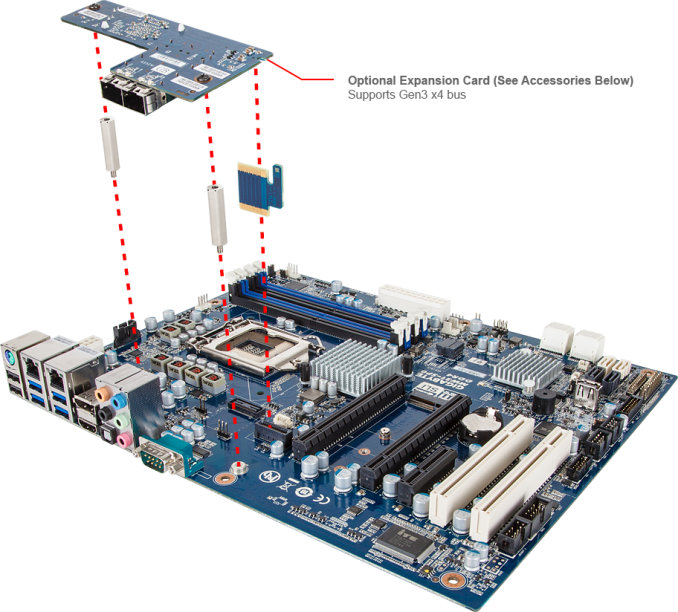
First up is a dual graphics workstation board for SLI or Crossfire with dual Intel network ports (I210+I219-LM), a COM port, TPM support, M.2 support and an interesting proprietary connector between the CPU socket and the PCIe slots for expansion cards:

GIGABYTE Server sells cards for 10 gigabit Ethernet, Thunderbolt 3 via Intel’s Alpine Ridge controller, or additional M.2 slots as required. This proprietary connector has bandwidth for up to four PCIe lanes, and the range of cards that will be offered will most likely depend on the take-up of this connector and how many customers are interested in customizing parts of their motherboard like this.

Other features include an on-board USB Type-A port for software license dongles and the use of a low-end Realtek ALC887 audio codec that we normally find on low end motherboards. Interestingly rather than take the full eight SATA ports from the chipset, here there are four as expected but another four from a Marvell 9230 controller, which does not support RST but its own control storage system for RAID. The PCIe x4 slot in the middle of the motherboard is only a PCIe x2 by design, and we also get USB 3.0 support via a VLI controller rather than the chipset. There is no IMPI control on this motherboard either.

MW21-SE0 (link)

Moving to micro-ATX, this model is somewhat stripped out providing a base entry into a Skylake Xeon workstation. There is no onboard audio for example, only a single PCIe 3.0 x16, only one Intel I219-LM network controller, a TPM, some SATA ports and USB headers, plus four DDR4 slots for up to 64GB of memory. Add in a COM port, VGA for the AST1400 control and that’s about it.

The design is offers a four-phase processor arrangement, with the final PCIe slot at x4 from the chipset. Despite the image above looking as if the DDR4 memory is inserted sequentially, it seems that this ‘stock’ photograph is from a mockup where the slots were placed in the wrong colors.

MX11-PC0 (link)

On the server side, the MX11-PC0 actually looks like an interesting mini-ITX motherboard for the rest of the ecosystem to consider. It somewhat attempts to adhere to the thin mini-ITX standard with a half-height rear IO, but there are a number of interesting elements to this worth noting. The DRAM slots are positioned for server use, but the power ports are still on the outside of the motherboard in such a way that a couple of features stick out.

First up is the U.2 port, where the battery is stuck to. This uses the SFF-8639 connector which we’ve seen on Intel’s SSD 750, and runs at PCIe 3.0 x4 speeds with NVMe support. We’ve seen this connector on a couple of ASUS ROG boards so far (the Impact and Extreme), but the more the merrier. Aside from the PCIe 3.0 x16 slot and SATA ports we also get an AST2400 controller IC with an associated memory chip, and a pair of Intel I210 network ports.

The rear of the board also gets co-locator LED buttons and power/reset/NMI buttons.

MX31-BS0 (link)

In a similar server style, the MX31-BS0 also puts the socket/DRAM orientation more suited for server airflow but also attempts to aim for that low to mid-range implementation with IPMI control via an AST2400, dual I210 network ports, an M.2 slot supporting SATA and PCIe 3.0 x1, onboard USB 2.0 Type-A and what amusingly looks like a Realtek audio codec onboard but the system comes without rear-panel audio jacks, leaving the audio solely for SPDIF output.

Typically motherboards from GIGABYTE’s Server business unit start as B2B sales only and the more consumer focused models should end up on select retailers over the next few months.

Source: GIGABYTE Server

Skylake Xeon Motherboards: GIGABYTE’s C230 Series Announced

Skylake Xeon Motherboards: GIGABYTE’s C230 Series Announced

With the new E3-1200 v5 processors announced today we also get a new series of workstation/server motherboards under the C230 series. Aside from standard workstation and Xeon markets that these platforms typically target, due to a set of increased limitations these new processors will not work in consumer grade motherboards, meaning that even for home use the C230 series will be at the front and center for enthusiasts who are interested in going down the Xeon route. Today GIGABYTE Server announced a quartet of motherboards for end-users and business customers alike, including ATX and mini-ITX configurations with IPMI management and NVMe support.

MW31-SP0 (link)

First up is a dual graphics workstation board for SLI or Crossfire with dual Intel network ports (I210+I219-LM), a COM port, TPM support, M.2 support and an interesting proprietary connector between the CPU socket and the PCIe slots for expansion cards:

GIGABYTE Server sells cards for 10 gigabit Ethernet, Thunderbolt 3 via Intel’s Alpine Ridge controller, or additional M.2 slots as required. This proprietary connector has bandwidth for up to four PCIe lanes, and the range of cards that will be offered will most likely depend on the take-up of this connector and how many customers are interested in customizing parts of their motherboard like this.

Other features include an on-board USB Type-A port for software license dongles and the use of a low-end Realtek ALC887 audio codec that we normally find on low end motherboards. Interestingly rather than take the full eight SATA ports from the chipset, here there are four as expected but another four from a Marvell 9230 controller, which does not support RST but its own control storage system for RAID. The PCIe x4 slot in the middle of the motherboard is only a PCIe x2 by design, and we also get USB 3.0 support via a VLI controller rather than the chipset. There is no IMPI control on this motherboard either.

MW21-SE0 (link)

Moving to micro-ATX, this model is somewhat stripped out providing a base entry into a Skylake Xeon workstation. There is no onboard audio for example, only a single PCIe 3.0 x16, only one Intel I219-LM network controller, a TPM, some SATA ports and USB headers, plus four DDR4 slots for up to 64GB of memory. Add in a COM port, VGA for the AST1400 control and that’s about it.

The design is offers a four-phase processor arrangement, with the final PCIe slot at x4 from the chipset. Despite the image above looking as if the DDR4 memory is inserted sequentially, it seems that this ‘stock’ photograph is from a mockup where the slots were placed in the wrong colors.

MX11-PC0 (link)

On the server side, the MX11-PC0 actually looks like an interesting mini-ITX motherboard for the rest of the ecosystem to consider. It somewhat attempts to adhere to the thin mini-ITX standard with a half-height rear IO, but there are a number of interesting elements to this worth noting. The DRAM slots are positioned for server use, but the power ports are still on the outside of the motherboard in such a way that a couple of features stick out.

First up is the U.2 port, where the battery is stuck to. This uses the SFF-8639 connector which we’ve seen on Intel’s SSD 750, and runs at PCIe 3.0 x4 speeds with NVMe support. We’ve seen this connector on a couple of ASUS ROG boards so far (the Impact and Extreme), but the more the merrier. Aside from the PCIe 3.0 x16 slot and SATA ports we also get an AST2400 controller IC with an associated memory chip, and a pair of Intel I210 network ports.

The rear of the board also gets co-locator LED buttons and power/reset/NMI buttons.

MX31-BS0 (link)

In a similar server style, the MX31-BS0 also puts the socket/DRAM orientation more suited for server airflow but also attempts to aim for that low to mid-range implementation with IPMI control via an AST2400, dual I210 network ports, an M.2 slot supporting SATA and PCIe 3.0 x1, onboard USB 2.0 Type-A and what amusingly looks like a Realtek audio codec onboard but the system comes without rear-panel audio jacks, leaving the audio solely for SPDIF output.

Typically motherboards from GIGABYTE’s Server business unit start as B2B sales only and the more consumer focused models should end up on select retailers over the next few months.

Source: GIGABYTE Server

Intel Launches ‘Greenlow’: C236 Chipset and Skylake E3-1200 v5 Xeons

Intel Launches ‘Greenlow’: C236 Chipset and Skylake E3-1200 v5 Xeons

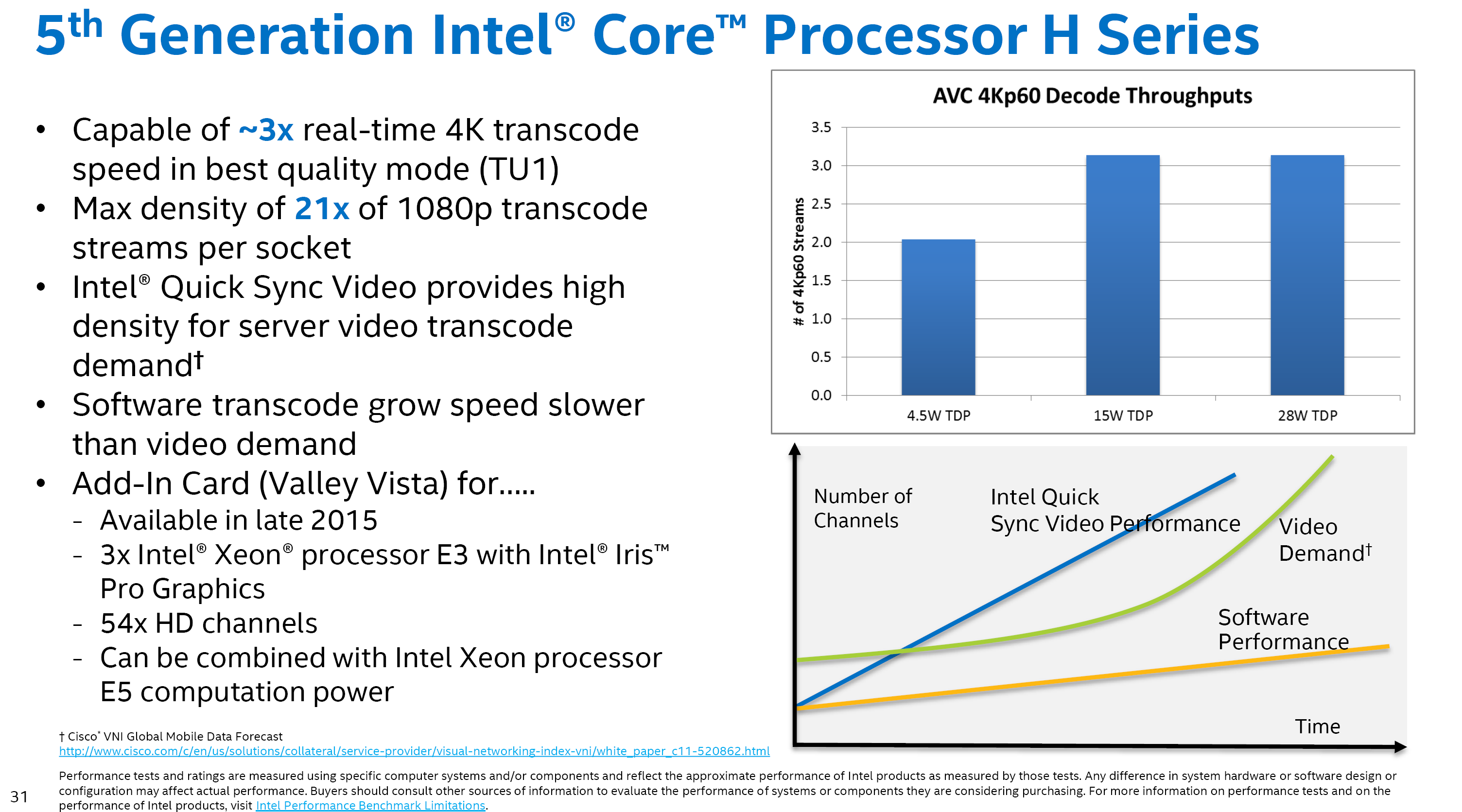
One of the recent notable aspects about the Xeon E3 family was the lack of a significant presence with Intel’s Broadwell architecture. A handful of them were released under the E3 v4 nomenclature, with half of them only for embedded solutions – we reviewed the socketed models at the time, but noted through IDF that the main direction these models were going seemed to be towards Intel’s Valley Vista PCIe co-processors, where three of them would be fixed to a PCIe card. For most single socket workstation users, this means a jump from Haswell-based E3 v3 to Skylake-based E3 v5. 

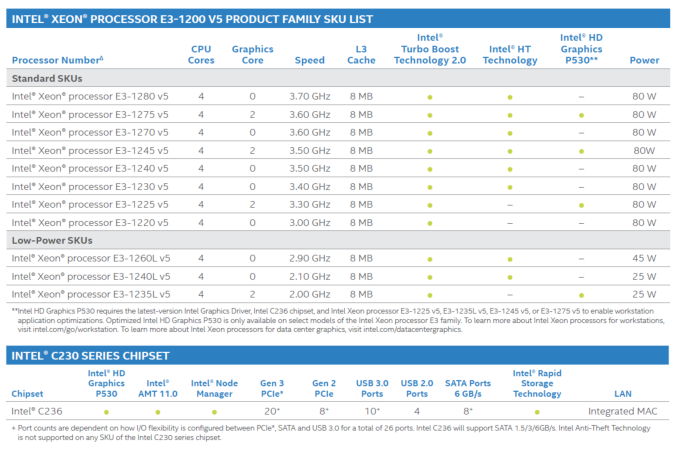
In a somewhat muted launch today, without any PR announcement or anything in the way of details direct, Intel quietly launched details regarding their new workstation single-processor platform based on Skylake. Through Intel’s processor information repository, Intel ARK, eleven socketed models were released in the E3-1200 v5 Xeon family. As with previous Xeons, the goal here is to supply server level features that wouldn’t normally be on consumer grade hardware. All these parts support DDR4 un-buffered modules in both non-ECC and ECC configurations up to 16 GB per module, giving 64 GB maximum. Xeon platforms historically run at base JEDEC memory configurations, so expect to see DDR4-2133 at 15-15-15 subtimings being the norm. Similar to the Skylake consumer parts, DDR3L up to 1600 MT/s is also supported.

These are all quad core parts, ranging from 25W low power models at 2.1 GHz base clock (with hyperthreading) up to up to 80W for the fastest 3.7 GHz model. Prices will range from $193 for the E3-1220 v5 up to $612 for the E3-1280 v5. As shown in the table, only a select few will have integrated graphics, and those that do will be under the HD P530 designation, which if we refer to the standard Skylake launch corresponds to a GT2 configuration with 24 execution units. At this point in time, there are no dual core parts.
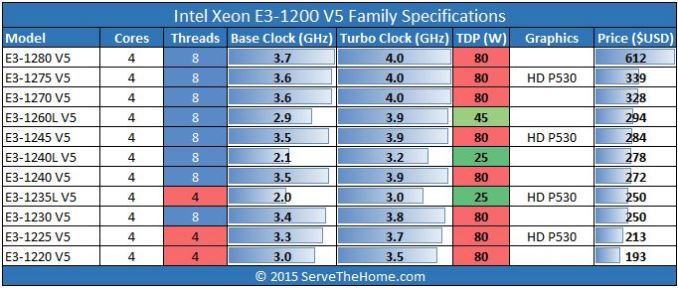

ServeTheHome’s Table of Xeon Processors is a great representation of the offerings

Several parts clearly fly out as interesting – the E3-1275 v5 comes in at just over half the price of the E3-1280 v5 for only a 100 MHz deficit on the base clock. For $9 less, the E3-1270 v5 does the same as the E3-1275 v5 but without the integrated graphics. The one below that, the E3-1260L v5, is one of the low power parts at 45W but still comes close in single threaded frequency to those above it. One of Intel’s big comparison points to these parts will be with Xeon D-1540, also known as Broadwell-DE. This is a 45W part that offers eight cores at 2.0 GHz base/2.6 GHz turbo, with similar DDR4 support but 12MB of L3 cache ‘at $581’.

Users interested in the perennial alternative to the Core processors, the E3-123x range, might come up empty handed this generation. Not necessarily due to the processor itself, but multiple sources in discussion or published at ComputerBase are concluding that Intel is further locking the Xeon processors down for Skylake. This means that in order to use a Xeon processor, you need a server based chipset, such as the C230 series, rather than the 100-series found in consumer platforms. Several companies have confirmed that a ‘workaround’ in this case is most likely not possible.

This new segregation tactic shows that Intel is perhaps trying to adjust any overlap these two markets may have had for non-business users, putting more power into the hands of the OEMs that develop pre-build systems. While E3-1200 based server motherboards have not been difficult to source in the past, they tend to be workstation/server focused and not have bells and whistles that accompany consumer boards. This also removes any thought of potential overclocking that may/may not be overlooked in some Xeon parts in the past. That being said, we have seen ASUS/ASRock release workstation type motherboards in the past that still have consumer trimmings.

Greenlow PCH Validation Matrix
Xeon SKL-S H110 H170 Z170 B150 Q150 Q170 C236
No No No No No No Yes

Addition 10/21: The quote direct from Intel is that ‘we do not validate or support Xeon E3 SKUs with client chipsets’. This has always been the case in the past so nothing on the official line has changed, and at this time Intel is not making any additional comment to the adjustment in compatibility.

The new Greenlow platform (E3-1200 v5 Xeon plus C236 motherboards) will look like the consumer counterparts with sixteen PCIe lanes for co-processors, dual DDR4/DDR3L memory support, DMI Gen 3.0 to the PCH, a mix of PCIe 3.0 lanes from the chipset, support for up to eight SATA 3.0 ports, and a myriad of possibilities through 26 lanes of HSIO.
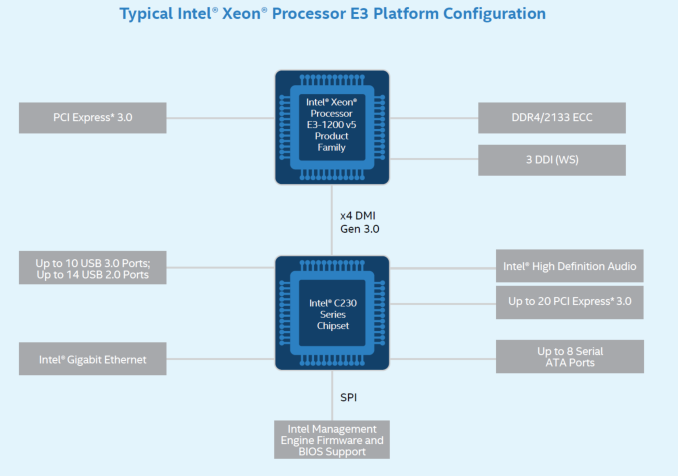
At this point in time the launch seems to be biased towards workstations rather than anything 1P server related, but information is currently patchy. At this point in time we are looking to get sampled with some of these processors, along with appropriate motherboards as well. Some motherboard announcements have been made from GIGABYTE Server and ASRock Rack, and I suspect workstation OEMs will come forth in due course.

Source: ComputerBase, ServeTheHome, Intel ARK