News


OCZ Announces First SATA Host Managed SSD: Saber 1000 HMS
OCZ Announces First SATA Host Managed SSD: Saber 1000 HMS

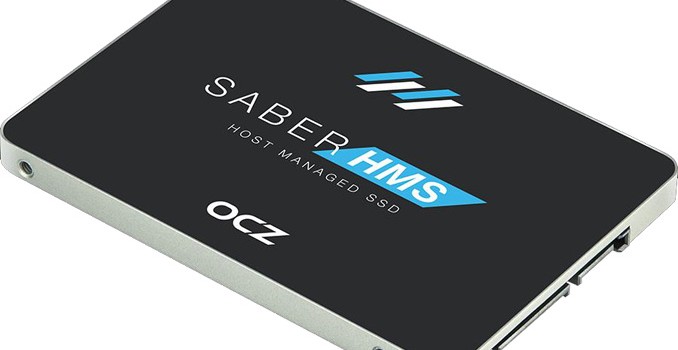
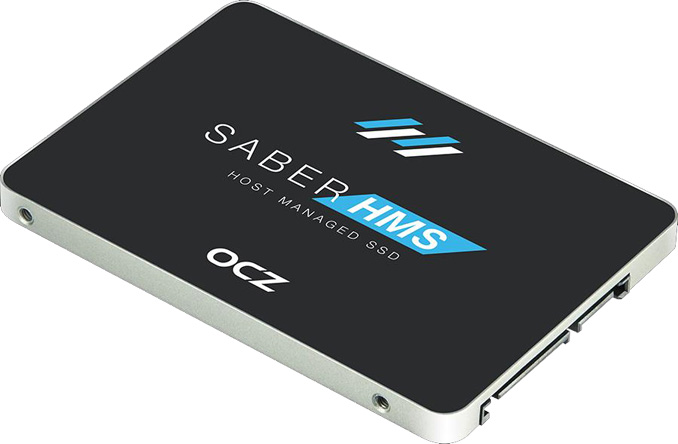
Today OCZ is introducing the first SATA drive featuring a technology that may be the next big thing for enterprise SSDs. Referred to by OCZ as “Host Managed SSD” technology (HMS) and known elsewhere in the industry by the buzzword “Storage Intelligence”, the general idea is to let the host computer know more about what’s going on inside the SSD and to have more influence over how the SSD controller goes about its business.

Standardization efforts have been underway for more than a year in the committees for SAS, SATA, and NVMe, but OCZ’s implementation is a pre-standard design that may not be compatible with what is eventually ratified. To provide some degree of forwards compatibility, OCZ is releasing an open-source abstraction library to provide what they hope will be a hardware-agnostic interface that can be used with future HMS devices.

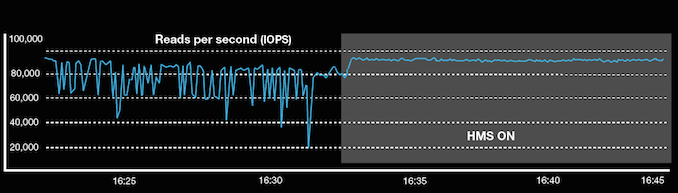
OCZ’s HMS implementation provides a vendor-specific extension of the ATA command set. A mode switch is required to access HMS features; when HMS mode is off the drive behaves like a normal non-HMS SATA drive and all background processing like garbage collection are managed autonomously by the SSD. When the HMS features are enabled, the host computer can request that the drive override normal operating procedure and disable all background processes, or to perform them as a high-priority task. If background processing is left disabled for too long, the drive will re-enable the background processing when needed and suffer the immediate performance penalty of the emergency garbage collection.

The intention is to allow better aggregate performance from an array of drives. An example OCZ gives is of an array divided into three pools of drives. At any given time, two pools are actively receiving writes, while the drives in the third pool are focusing solely on the “background” housekeeping operations. The two pools that are in active use defer all the background processing and operate with peak performance and consistency. By cycling the drive pools through the two modes, the intention is that none of the active drives will ever reach the steady-state of having constant background processing to free up space for the incoming writes. This provides a big improvement to performance consistency, and can also provide a minor improvement to overall throughput of the array.
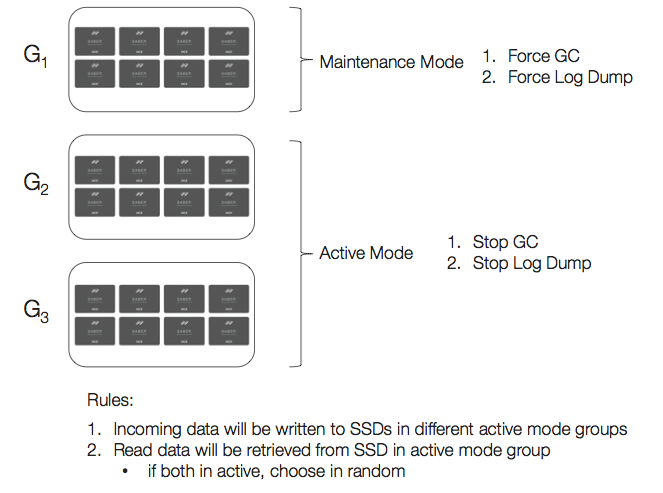
Obviously, the load balancing and coordination required by such a scheme is not part of any traditional RAID setup. OCZ expects early adopters of HMS technology to make use of it from application layer code. HMS does not require any new operating system drivers, and OCZ will be providing tools and reference code to facilitate using HMS. They plan to eventually expand this to a comprehensive SDK, but for now everybody is in the position of having to explore how to best make use of HMS for their specific use case. For some customers, that may mean load balancing several pools of SSDs attached to a single server, while others may find it easier to temporarily offline an entire server for housekeeping.

OCZ has also envisioned that future HMS products may expand the controls from managing background processing to also changing overprovisioning or power limits on the fly, but they have no specific timeline for those features.
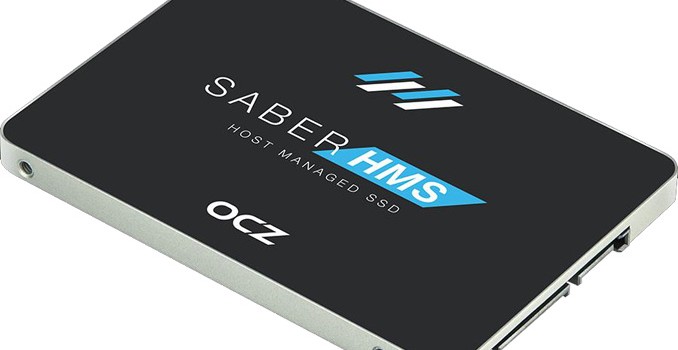
The drive OCZ is introducing with HMS technology is a variant of their existing Saber 1000 enterprise SATA SSD. The Saber 1000 HMS differs only in the SSD controller firmware; otherwise it is still a low-cost drive using the Barefoot 3 controller and is intended primarily for read-oriented workloads. Pricing is the same with or without HMS capability, though the Saber 1000 HMS is only offered in the 480GB and 960GB capacities. The warranty in either case is limited to 5 years, but because the HMS controls can affect write amplification, the Saber HMS write endurance rating is based on the actual Program/Erase cycle count of the drive rather than the total amount of data written to the drive.

OCZ Saber 1000 HMS
Capacity 480GB 960GB
4kB Random Read IOPS 90k 91k
4kB Random Write IOPS 22k 16k
Random Read Latency 135µs 135µs
Random Write Latency 55µs 55µs
Sequential Read 550 MB/s 550 MB/s
Sequential Write 475 MB/s 445 MB.s
MSRP $370 $713

As a read-oriented drive with relatively little overprovisioning, the Saber 1000 has a lot to gain from HMS in terms of write performance and consistency, and it may allow the Saber 1000 HMS to compete in areas the Saber 1000 isn’t fast enough for.

In addition to control over the garbage collection process, the Saber 1000 HMS provides a similar set of controls for managing when the controller saves metadata from its RAM to the flash. This is the information the controller uses to keep track of where each piece of data is physically stored and which blocks are free to accept new writes. Every write to the disk adds to the metadata log, so the changes need to be periodically evicted from RAM to flash. This is one of the key data structures that the drive’s power loss protection needs to preserve, so the size of the in-RAM metadata log may also be limited by the drive’s capacitor budget.

To enable software to make effective use of these controls, the Saber 1000 HMS provides an unprecedented view in to the inner workings of the drive. Software can query the drive for the NAND page size, erase block size, number of blocks per bank and number of banks in the drive. The total program and erase counts are reported separately, and information about free blocks is reported as the total across the drive as well as the average, maximum, and minimum per bank. The drive also provides a status summary of whether garbage collection or metadata log dumping are active, and whether they are needed. OCZ’s reference guide provides recommendations for interpreting all of these indicators.

The Saber 1000 HMS will be available in early November for bulk purchases. The technical documentation and reference code should be available online today.
OCZ Announces First SATA Host Managed SSD: Saber 1000 HMS

OCZ Announces First SATA Host Managed SSD: Saber 1000 HMS

Today OCZ is introducing the first SATA drive featuring a technology that may be the next big thing for enterprise SSDs. Referred to by OCZ as “Host Managed SSD” technology (HMS) and known elsewhere in the industry by the buzzword “Storage Intelligence”, the general idea is to let the host computer know more about what’s going on inside the SSD and to have more influence over how the SSD controller goes about its business.

Standardization efforts have been underway for more than a year in the committees for SAS, SATA, and NVMe, but OCZ’s implementation is a pre-standard design that may not be compatible with what is eventually ratified. To provide some degree of forwards compatibility, OCZ is releasing an open-source abstraction library to provide what they hope will be a hardware-agnostic interface that can be used with future HMS devices.

OCZ’s HMS implementation provides a vendor-specific extension of the ATA command set. A mode switch is required to access HMS features; when HMS mode is off the drive behaves like a normal non-HMS SATA drive and all background processing like garbage collection are managed autonomously by the SSD. When the HMS features are enabled, the host computer can request that the drive override normal operating procedure and disable all background processes, or to perform them as a high-priority task. If background processing is left disabled for too long, the drive will re-enable the background processing when needed and suffer the immediate performance penalty of the emergency garbage collection.

The intention is to allow better aggregate performance from an array of drives. An example OCZ gives is of an array divided into three pools of drives. At any given time, two pools are actively receiving writes, while the drives in the third pool are focusing solely on the “background” housekeeping operations. The two pools that are in active use defer all the background processing and operate with peak performance and consistency. By cycling the drive pools through the two modes, the intention is that none of the active drives will ever reach the steady-state of having constant background processing to free up space for the incoming writes. This provides a big improvement to performance consistency, and can also provide a minor improvement to overall throughput of the array.

Obviously, the load balancing and coordination required by such a scheme is not part of any traditional RAID setup. OCZ expects early adopters of HMS technology to make use of it from application layer code. HMS does not require any new operating system drivers, and OCZ will be providing tools and reference code to facilitate using HMS. They plan to eventually expand this to a comprehensive SDK, but for now everybody is in the position of having to explore how to best make use of HMS for their specific use case. For some customers, that may mean load balancing several pools of SSDs attached to a single server, while others may find it easier to temporarily offline an entire server for housekeeping.

OCZ has also envisioned that future HMS products may expand the controls from managing background processing to also changing overprovisioning or power limits on the fly, but they have no specific timeline for those features.

The drive OCZ is introducing with HMS technology is a variant of their existing Saber 1000 enterprise SATA SSD. The Saber 1000 HMS differs only in the SSD controller firmware; otherwise it is still a low-cost drive using the Barefoot 3 controller and is intended primarily for read-oriented workloads. Pricing is the same with or without HMS capability, though the Saber 1000 HMS is only offered in the 480GB and 960GB capacities. The warranty in either case is limited to 5 years, but because the HMS controls can affect write amplification, the Saber HMS write endurance rating is based on the actual Program/Erase cycle count of the drive rather than the total amount of data written to the drive.

OCZ Saber 1000 HMS
Capacity 480GB 960GB
4kB Random Read IOPS 90k 91k
4kB Random Write IOPS 22k 16k
Random Read Latency 135µs 135µs
Random Write Latency 55µs 55µs
Sequential Read 550 MB/s 550 MB/s
Sequential Write 475 MB/s 445 MB.s
MSRP $370 $713

As a read-oriented drive with relatively little overprovisioning, the Saber 1000 has a lot to gain from HMS in terms of write performance and consistency, and it may allow the Saber 1000 HMS to compete in areas the Saber 1000 isn’t fast enough for.

In addition to control over the garbage collection process, the Saber 1000 HMS provides a similar set of controls for managing when the controller saves metadata from its RAM to the flash. This is the information the controller uses to keep track of where each piece of data is physically stored and which blocks are free to accept new writes. Every write to the disk adds to the metadata log, so the changes need to be periodically evicted from RAM to flash. This is one of the key data structures that the drive’s power loss protection needs to preserve, so the size of the in-RAM metadata log may also be limited by the drive’s capacitor budget.

To enable software to make effective use of these controls, the Saber 1000 HMS provides an unprecedented view in to the inner workings of the drive. Software can query the drive for the NAND page size, erase block size, number of blocks per bank and number of banks in the drive. The total program and erase counts are reported separately, and information about free blocks is reported as the total across the drive as well as the average, maximum, and minimum per bank. The drive also provides a status summary of whether garbage collection or metadata log dumping are active, and whether they are needed. OCZ’s reference guide provides recommendations for interpreting all of these indicators.

The Saber 1000 HMS will be available in early November for bulk purchases. The technical documentation and reference code should be available online today.
The Samsung Galaxy Tab S2 Review

The first Android tablet I ever used was the original Galaxy Tab. It was a 7″ Android tablet running Android Froyo, and it seemed a lot like a large version of my Galaxy S. In hindsight, it wasn’t a very good tablet, but Samsung was one of the first Android vendors to enter the market and they were working with a version of Android that had never been designed with tablets in mind. As Android moved to Gingerbread and then to the tablet exclusive release of Android Honeycomb, Samsung was always among the group of manufacturers producing Android tablets. While some vendors like LG and HTC have left and returned to the tablet market, Samsung has continually producing new Galaxy Tab tablets, and those tablets constitute a very large portion of the Android tablets that are sold each year. Read on for the AnandTech review of Samsung’s newest tablet, the Galaxy Tab S2.

AMD Releases Catalyst 15.10 Beta Drivers

AMD Releases Catalyst 15.10 Beta Drivers

In a manner that appears it may be building momentum, AMD has released another new driver update. As this is a point driver release the changes aren’t immense, but AMD has pushed through some stability fixes along with some other improvements to prep their drivers for some forthcoming game releases. As always these are all welcome news items.

First off there are a few notes on Ashes of the Singularity. Along with providing performance and quality optimizations there is also a fixed issue with a ‘Driver has stopped responding’ error showing up while playing in DirectX 12 mode.  AMD does note however that there still remains issues with the game crashing on some AMD 300 series GPUs and Ashes of the Singularity may fail to launch on some 2GB cards.

For Star Wars: Battlefront high performance graphics can now be used on devices running switchable graphics. AMD is also aware of a small number of users who are experiencing crashes with GTA V on some AMD Radeon R9 390X GPUs. Some changes have been made that should resolve the issue and they will continue to monitor user feedback on the problem.

On the stability front AMD has brought fixes for a couple of TDR errors which caused a crash when toggling between minimized and maximized mode while viewing 4K YouTube content or running the Unreal Engine 4 DirectX benchmark. Additionally playback issues with both MPEG2 and intermittent playback issues in Cyberlink PowerDVD when connected to  a 3D display through HDMI have both been resolved. Lastly there was a problem with driver installation halting on some configurations that is now fixed.

Those interested in reading more or installing the drivers for AMD’s desktop, mobile, and integrated GPUs can find them on AMD’s Catalyst beta download page.

AMD Releases Catalyst 15.10 Beta Drivers

AMD Releases Catalyst 15.10 Beta Drivers

In a manner that appears it may be building momentum, AMD has released another new driver update. As this is a point driver release the changes aren’t immense, but AMD has pushed through some stability fixes along with some other improvements to prep their drivers for some forthcoming game releases. As always these are all welcome news items.

First off there are a few notes on Ashes of the Singularity. Along with providing performance and quality optimizations there is also a fixed issue with a ‘Driver has stopped responding’ error showing up while playing in DirectX 12 mode.  AMD does note however that there still remains issues with the game crashing on some AMD 300 series GPUs and Ashes of the Singularity may fail to launch on some 2GB cards.

For Star Wars: Battlefront high performance graphics can now be used on devices running switchable graphics. AMD is also aware of a small number of users who are experiencing crashes with GTA V on some AMD Radeon R9 390X GPUs. Some changes have been made that should resolve the issue and they will continue to monitor user feedback on the problem.

On the stability front AMD has brought fixes for a couple of TDR errors which caused a crash when toggling between minimized and maximized mode while viewing 4K YouTube content or running the Unreal Engine 4 DirectX benchmark. Additionally playback issues with both MPEG2 and intermittent playback issues in Cyberlink PowerDVD when connected to  a 3D display through HDMI have both been resolved. Lastly there was a problem with driver installation halting on some configurations that is now fixed.

Those interested in reading more or installing the drivers for AMD’s desktop, mobile, and integrated GPUs can find them on AMD’s Catalyst beta download page.