News


Intel Announces FY 2015 Q3 Results: Strong Earnings Despite Client Computing Drop
Intel Announces FY 2015 Q3 Results: Strong Earnings Despite Client Computing Drop

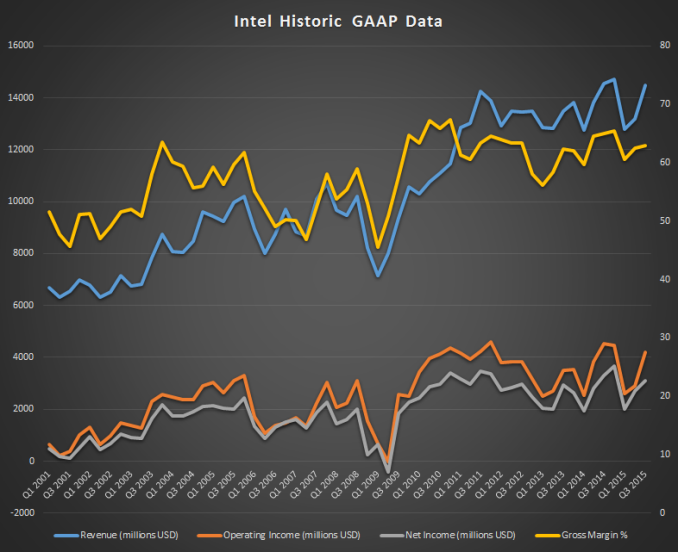
Intel released their third quarter earnings for fiscal year 2015 today, and it was certainly a rocky quarter. Their revenue for the quarter was $14.5 billion, which was in-line with their expectations, and revenues were flat as compared to Q3 of 2014. They actually did very well to remain flat though since the Client Computing Group struggled due to the combination of PC and tablet sales. Gross margin was down slightly to 63%, and operating income and net income were also down 8% to $4.2 billion and $3.1 billion respectively. Earnings per share fell 3% to $0.66.

Intel Q3 2015 Financial Results (GAAP)
  Q3’2015 Q2’2015 Q3’2014
Revenue $14.5B $13.2B $14.5B
Operating Income $4.2B $2.9B $4.5B
Net Income $3.1B $2.7B $3.3B
Gross Margin 63.0% 62.5% 65.0%
Client Computing Group Revenue $8.5B +13% -7%
Data Center Group Revenue $4.1B +8% +12%
Internet of Things Revenue $581M +4% +10%
Software and Services Revenue $556M flat +4%
All Other Revenue $682M -5% +19%

In Q3, Intel launched Skylake which is their 6th generation Core processor, and the also announced their 3D X-Point memory technology. Sales of Skylake have just begun, and I would expect to see a broader rollout in Q4. The memory tech is still going to be a while before we see it in a purchasable product.
The biggest underperformer from Intel was the Client Computing Group. Revenue for this group was down 7% to $8.5 billion with platform volumes down 19%. This was somewhat helped by an increase in Average Selling Price (ASP) of 15%. Notebooks and desktops were down 14% and 15% respectively, and ASP for these units were up 4% and 8%. The PC market is certainly struggling despite the rollout of Windows 10 and Skylake. The free upgrade for Windows 10 certainly won’t be helping matters. But the biggest drop from Intel was in the tablet sector, where Intel powered tablet sales were down 39%. The tablet market is almost like a compressed version of the PC market when looked at over time.

Intel’s Data Center Group had a much stronger quarter. Revenue was $4.1 billion, up 12%, which was driven by platform volume up 6% and ASP also up 6%. Much of this was driven by growth in cloud computing which is growing even faster than Intel had predicted.

The remainder of their revenue came from Internet of Things which had growth of 10% to $581 million, Software and services had a flat revenue of $556 million, and the “all other” segment had 19% growth to $682 million.

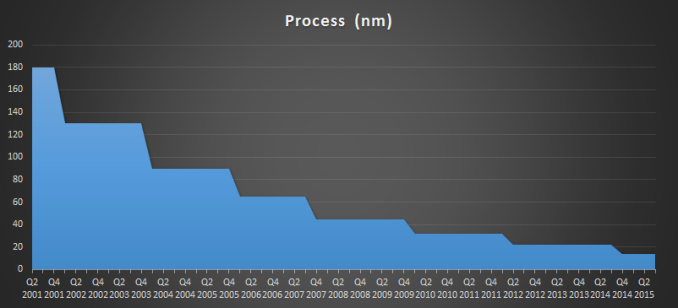
Looking forward for Q4, Intel is looking for revenues of $14.8 billion plus or minus $500 million, which would be up 2% from Q3, and gross margin is expected to drop 1.0% to 62%. The drop in margin is attributed to a ramp up of their Ireland fab ahead of schedule which is outputting wafers at a higher cost than the more established fabs for the time being. In addition, the costs for 14 nm is still higher per chip than 22 nm, but the percentage of 14 nm to 22 nm is certainly shifting towards the newer process which drives down margins.
I think the overall quarter is actually fairly good for Intel. Despite a definite drop in the PC market, they managed to make up most of that with a strong showing in cloud computing. The ramp up to Skylake and Windows 10 should start in full in Q4. Intel seems cautiously optimistic that the rollout of Windows 10, especially in enterprise, should be much quicker than the last upgrade which should help sales.

Source: Intel Investor Relations
Intel Announces FY 2015 Q3 Results: Strong Earnings Despite Client Computing Drop

Intel Announces FY 2015 Q3 Results: Strong Earnings Despite Client Computing Drop

Intel released their third quarter earnings for fiscal year 2015 today, and it was certainly a rocky quarter. Their revenue for the quarter was $14.5 billion, which was in-line with their expectations, and revenues were flat as compared to Q3 of 2014. They actually did very well to remain flat though since the Client Computing Group struggled due to the combination of PC and tablet sales. Gross margin was down slightly to 63%, and operating income and net income were also down 8% to $4.2 billion and $3.1 billion respectively. Earnings per share fell 3% to $0.66.

Intel Q3 2015 Financial Results (GAAP)
  Q3’2015 Q2’2015 Q3’2014
Revenue $14.5B $13.2B $14.5B
Operating Income $4.2B $2.9B $4.5B
Net Income $3.1B $2.7B $3.3B
Gross Margin 63.0% 62.5% 65.0%
Client Computing Group Revenue $8.5B +13% -7%
Data Center Group Revenue $4.1B +8% +12%
Internet of Things Revenue $581M +4% +10%
Software and Services Revenue $556M flat +4%
All Other Revenue $682M -5% +19%

In Q3, Intel launched Skylake which is their 6th generation Core processor, and the also announced their 3D X-Point memory technology. Sales of Skylake have just begun, and I would expect to see a broader rollout in Q4. The memory tech is still going to be a while before we see it in a purchasable product.

The biggest underperformer from Intel was the Client Computing Group. Revenue for this group was down 7% to $8.5 billion with platform volumes down 19%. This was somewhat helped by an increase in Average Selling Price (ASP) of 15%. Notebooks and desktops were down 14% and 15% respectively, and ASP for these units were up 4% and 8%. The PC market is certainly struggling despite the rollout of Windows 10 and Skylake. The free upgrade for Windows 10 certainly won’t be helping matters. But the biggest drop from Intel was in the tablet sector, where Intel powered tablet sales were down 39%. The tablet market is almost like a compressed version of the PC market when looked at over time.

Intel’s Data Center Group had a much stronger quarter. Revenue was $4.1 billion, up 12%, which was driven by platform volume up 6% and ASP also up 6%. Much of this was driven by growth in cloud computing which is growing even faster than Intel had predicted.

The remainder of their revenue came from Internet of Things which had growth of 10% to $581 million, Software and services had a flat revenue of $556 million, and the “all other” segment had 19% growth to $682 million.

Looking forward for Q4, Intel is looking for revenues of $14.8 billion plus or minus $500 million, which would be up 2% from Q3, and gross margin is expected to drop 1.0% to 62%. The drop in margin is attributed to a ramp up of their Ireland fab ahead of schedule which is outputting wafers at a higher cost than the more established fabs for the time being. In addition, the costs for 14 nm is still higher per chip than 22 nm, but the percentage of 14 nm to 22 nm is certainly shifting towards the newer process which drives down margins.

I think the overall quarter is actually fairly good for Intel. Despite a definite drop in the PC market, they managed to make up most of that with a strong showing in cloud computing. The ramp up to Skylake and Windows 10 should start in full in Q4. Intel seems cautiously optimistic that the rollout of Windows 10, especially in enterprise, should be much quicker than the last upgrade which should help sales.

Source: Intel Investor Relations

AMD Corporate Fellow Phil Rogers Leaves Company, Joins NVIDIA

AMD Corporate Fellow Phil Rogers Leaves Company, Joins NVIDIA

With respect to both structure and personnel, the last few months have been busy – if not tumultuous – for AMD. The company recently reorganized itself so that their graphics division and its employees are once again a whole entity under R…

AMD Corporate Fellow Phil Rogers Leaves Company, Joins NVIDIA

AMD Corporate Fellow Phil Rogers Leaves Company, Joins NVIDIA

With respect to both structure and personnel, the last few months have been busy – if not tumultuous – for AMD. The company recently reorganized itself so that their graphics division and its employees are once again a whole entity under R…

Apple Updates Their iMac Peripherals

Apple Updates Their iMac Peripherals

In addition to introducing a new 21.5″ iMac with 4K Retina display and an upgraded 27″ iMac with 5K Retina display, Apple also announced some interesting improvements to their computer peripherals that will begin shipping with the new iMac models.

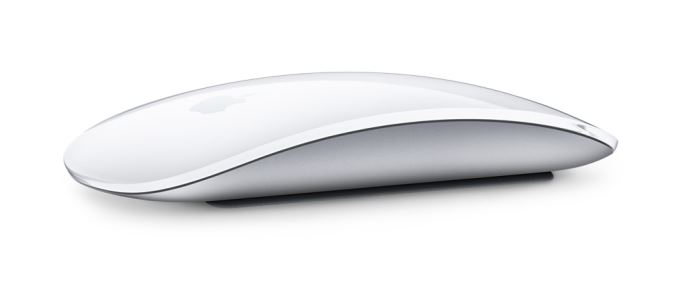
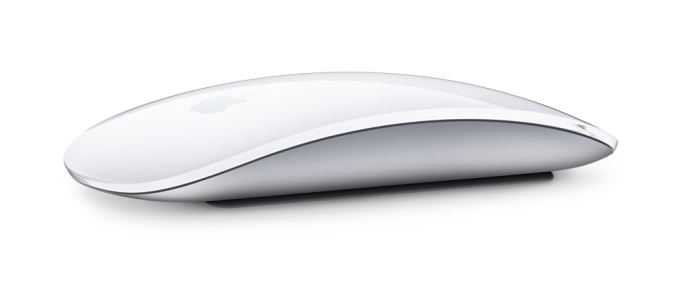
First up is the Magic Mouse 2. There’s not a ton of changes here, and as you can see from the image above the form factor of the mouse is relatively unchanged from the last model. It now comes with a built in battery which should last a month between charges, and can be recharged using the built in lightning port. Apple claims they have also improved the design of the feet so tracking with be smoother. The use of AA batteries in the old magic mouse was definitely the biggest annoyance, and although I’m not a fan of it for ergonomic reasons, the Magic Mouse 2 seems like a worthwhile upgrade to anyone who uses one often and has to keep replacing or recharging their batteries.

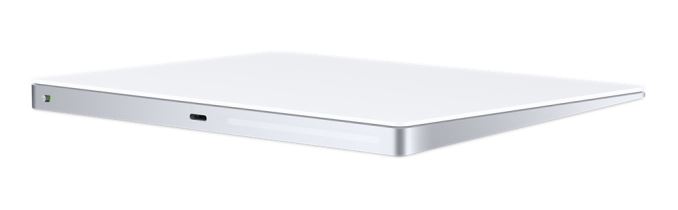
Next is the new Magic Trackpad 2. This is arguably the biggest improvement of the three updates, although one could argue that the Magic Keyboard 2 takes that title. I personally think the new trackpad is the biggest improvement because it includes the Force Touch technology from Apple’s MacBook trackpads. Like the MacBook, the Magic Trackpad 2 uses force sensors and an electromagnet to simulate the feeling of a traditional trackpad. This allows you to click anywhere, which was a problem with the diving board design of the previous version. The new Magic Trackpad 2 also has a 30% larger touch surface than the last model, and like the Magic Mouse 2 it has a rechargeable internal battery which can be recharged via a lightning cable.

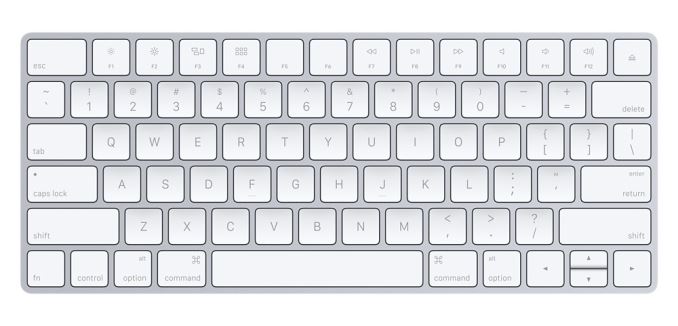
Last, but not least, is the the Magic Keyboard. For me the biggest upgrade here is actually an aesthetic one, as the previous keyboard was a strange marriage of aluminum and plastic along with a barrel running along one side to elevate it and fit in batteries. The new design with its internal rechargeable battery pack looks much nicer and fits well with the upgraded Magic Trackpad. Apple claims they’ve improved key stability by 33% via the use of a new scissor switch.

If you’re not a Mac user you probably won’t be any more interested in these new accessories than the last generation, but they all represent notable upgrades for users who do use any of the existing Magic accessories. The new Magic Keyboard will cost $99, while the Magic Trackpad 2 is $129 and the Magic Mouse 2 is $79. What’s interesting is that the higher price of the Magic Trackpad 2 also means that swapping it in for the Magic Mouse 2 with the new iMacs requires a $50 fee, which used to be a free swap with the previous models.

Like the iMacs announced today, Apple’s new peripherals are already available for sale on the Apple Online Store and will begin shipping this week.