News


NVIDIA Announces Maxwell-Based Quadro M Mobile Series
NVIDIA Announces Maxwell-Based Quadro M Mobile Series

By and large we erroneously tend to think of NVIDIA’s Quadro family of video cards as desktop video cards. While NVIDA has offered mobile Quadro cards for nearly a decade now, it’s largely the desktop versions that get all of the attention in the press, and this outcome is not unexpected. Professional CAD, CAM, and content creation have long been the domain of high-powered workstations, and while notebooks have since taken over the majority of the PC market, the transition in the professional space has been slower. Consequently the mobile Quadro family has not attracted nearly as much attention given the importance of desktop workstations.

As the last quarter of 2015 kicks off though, this is a situation that is changing for NVIDIA and workstations vendors as a whole. Intel announced their first mobile Xeon, the Xeon E3-1500M v5, marking Intel’s formalization of the mobile workstation market. And with Intel now more on-board than ever before, for vendors like NVIDIA this means that mobile workstations – though less powerful than their desktop counterparts – may not be playing second-fiddle to desktops much longer.

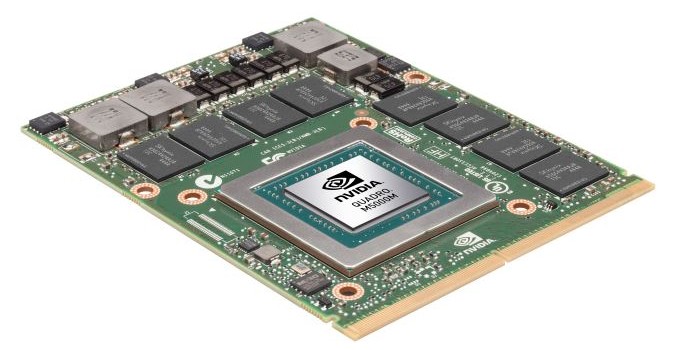
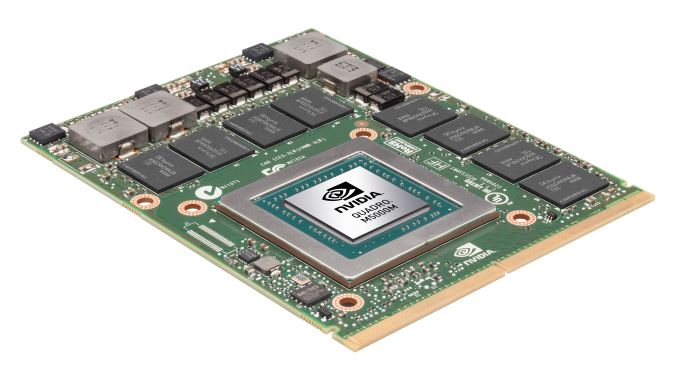
This brings us to today’s announcement from NVIDIA, the Quadro M Mobile series. After having updated the desktop Quadro lineup with new products based on Maxwell GPUs back in August, NVIIDA is starting off October by giving the mobile Quadro lineup the same Maxwell treatment. Altogether NVIDIA is launching six new Quadro M Mobile video cards, refreshing the entire lineup from top-to-bottom in a single go.

Overall this is a low-key launch for NVIDIA – there weren’t any full press briefings – but I suspect that for NVIDIA the launch of the latest generation of Quadro Mobile parts will be a big deal. The Maxwell architecture’s major gains in efficiency have helped all platforms, but no platform has been helped more than the power and heat dissipation limited mobile market, making mobile the form factor where Maxwell truly shines. As we’ve already seen in the consumer space over the past year, NVIDIA has been able to significantly increase their performance over the Kepler generation while staying within their regular TDPs, and this bodes well for NVIDIA’s Quadro Mobile lineup. NVIDIA is touting an up to 2x increase in performance, and as we’ve seen Maxwell should be able to come very close to that in many mobile workloads.

NVIDIA Quadro Mobile Specification Comparison (High-End)
  Quadro M5000M Quadro M4000M Quadro M3000M
CUDA Cores 1536 1280 1024
Memory Clock 5GHz GDDR5 5GHz GDDR5 5GHz GDDR5
Memory Bus Width 256-bit 256-bit 256-bit
VRAM 8GB 4GB 4GB
FP64 1/32 1/32 1/32
TDP 100W 100W 75W
GPU GM204 GM204 GM204
Architecture Maxwell 2 Maxwell 2 Maxwell 2

Taking a look at the individual cards, NVIDIA has opted to retain their traditional family-number-mobile naming scheme. This results in these new parts being the Quadro MxxxxM series, a bit of a mouthful of a product name.

Digging deeper, the new Quadro parts can essentially be divided up into two groups of cards. The Quadro M3000M, M4000M, and M5000 are all based on NVIDIA’s GM204 GPU. The most powerful of these is roughly comparable to the GeForce GTX 980M, with 1536 CUDA cores enabled. It’s also the only SKU to get 8GB of VRAM, made possible through the use of the recent introduction of 8Gb GDDR5 memory chips. Meanwhile the 1280 and 1024 CUDA cores respectively is the M4000M and M3000M, which use further cut down GPUs and pair it up with 4GB of VRAM. Both the M5000M and M4000M are top-wattage 100W parts, while the M3000M brings that down to 75W.

NVIDIA Quadro Mobile Specification Comparison (Low-End)
  Quadro M2000M Quadro M1000M Quadro M600M
CUDA Cores 640 512 384
Memory Clock 5GHz GDDR5 5GHz GDDR5 5GHz GDDR5
Memory Bus Width 128-bit 128-bit 128-bit
VRAM 4GB 2GB 2GB
FP64 1/32 1/32 1/32
TDP 55W 45W 30W
GPU GM107 GM107 GM107
Architecture Maxwell 1 Maxwell 1 Maxwell 1

At the other end of the spectrum we have the M600M, M1000M, and M2000M. Post press time we received confirmation from NVIDIA that these parts are based on the company’s GM107 GPU, so the Quadro M Mobile family is going to be split between the Maxwell 2 and Maxwell 1 architectures.

In any case, these parts are the lower power, lower performance, and lower price members of the Quadro M Mobile family. The M2000M features 640 CUDA cores and 4GB of VRAM, while the M1000M drops to 512 CUDA cores and 2GB of VRAM, with the M600M bringing up the rear with just 384 CUDA cores and 2GB of VRAM. TDPs for these parts are 55W, 40W, and 30W respectively, which means these parts are going to be more practical for thin and light mobile workstations than the 100W heavy-hitters at the high-end of the family.

In regards of features, these parts will inherit the standard Maxwell family features, including Maxwell’s energy efficiency improvements and greater media encode/decode support. For the Maxwell 2 based parts (M3000M and up), this includes full hardware support for HEVC encoding and limited “hybrid” HEVC decode support. As for the Maxwell 1 based parts (M2000M and below) this includes a faster-than-Kepler H.264 video encoder and “hybrid” HEVC decode support, but no HEVC encode support. NVIDIA has also confirmed that Optimus will be supported on all of these parts; otherwise in a direct-wired situation, each part can drive up to 4 displays, as opposed to 2 for the previous Kepler generation parts.

Finally, as the launch of the Quadro M Mobile series is timed to roughly coincide with the release of Intel’s Skylake processors, NVIDIA tells us that OEM availability will be similar. The parts will be rolling out over the rest of the quarter, with NVIDIA already securing design wins in Dell’s Precision 15 5000 series, Precision 15 and 17 7000 series, HP’s ZBook series, and the previously announced Lenovo ThinkPad P50 and P70.
NVIDIA Announces Maxwell-Based Quadro M Mobile Series

NVIDIA Announces Maxwell-Based Quadro M Mobile Series

By and large we erroneously tend to think of NVIDIA’s Quadro family of video cards as desktop video cards. While NVIDA has offered mobile Quadro cards for nearly a decade now, it’s largely the desktop versions that get all of the attention in the press, and this outcome is not unexpected. Professional CAD, CAM, and content creation have long been the domain of high-powered workstations, and while notebooks have since taken over the majority of the PC market, the transition in the professional space has been slower. Consequently the mobile Quadro family has not attracted nearly as much attention given the importance of desktop workstations.

As the last quarter of 2015 kicks off though, this is a situation that is changing for NVIDIA and workstations vendors as a whole. Intel announced their first mobile Xeon, the Xeon E3-1500M v5, marking Intel’s formalization of the mobile workstation market. And with Intel now more on-board than ever before, for vendors like NVIDIA this means that mobile workstations – though less powerful than their desktop counterparts – may not be playing second-fiddle to desktops much longer.

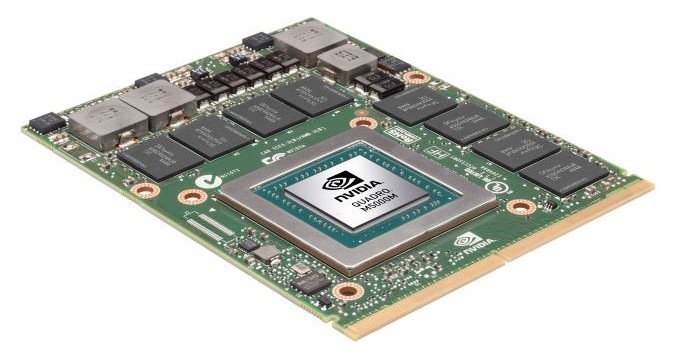
This brings us to today’s announcement from NVIDIA, the Quadro M Mobile series. After having updated the desktop Quadro lineup with new products based on Maxwell GPUs back in August, NVIIDA is starting off October by giving the mobile Quadro lineup the same Maxwell treatment. Altogether NVIDIA is launching six new Quadro M Mobile video cards, refreshing the entire lineup from top-to-bottom in a single go.

Overall this is a low-key launch for NVIDIA – there weren’t any full press briefings – but I suspect that for NVIDIA the launch of the latest generation of Quadro Mobile parts will be a big deal. The Maxwell architecture’s major gains in efficiency have helped all platforms, but no platform has been helped more than the power and heat dissipation limited mobile market, making mobile the form factor where Maxwell truly shines. As we’ve already seen in the consumer space over the past year, NVIDIA has been able to significantly increase their performance over the Kepler generation while staying within their regular TDPs, and this bodes well for NVIDIA’s Quadro Mobile lineup. NVIDIA is touting an up to 2x increase in performance, and as we’ve seen Maxwell should be able to come very close to that in many mobile workloads.

NVIDIA Quadro Mobile Specification Comparison (High-End)
  Quadro M5000M Quadro M4000M Quadro M3000M
CUDA Cores 1536 1280 1024
Memory Clock 5GHz GDDR5 5GHz GDDR5 5GHz GDDR5
Memory Bus Width 256-bit 256-bit 256-bit
VRAM 8GB 4GB 4GB
FP64 1/32 1/32 1/32
TDP 100W 100W 75W
GPU GM204 GM204 GM204
Architecture Maxwell 2 Maxwell 2 Maxwell 2

Taking a look at the individual cards, NVIDIA has opted to retain their traditional family-number-mobile naming scheme. This results in these new parts being the Quadro MxxxxM series, a bit of a mouthful of a product name.

Digging deeper, the new Quadro parts can essentially be divided up into two groups of cards. The Quadro M3000M, M4000M, and M5000 are all based on NVIDIA’s GM204 GPU. The most powerful of these is roughly comparable to the GeForce GTX 980M, with 1536 CUDA cores enabled. It’s also the only SKU to get 8GB of VRAM, made possible through the use of the recent introduction of 8Gb GDDR5 memory chips. Meanwhile the 1280 and 1024 CUDA cores respectively is the M4000M and M3000M, which use further cut down GPUs and pair it up with 4GB of VRAM. Both the M5000M and M4000M are top-wattage 100W parts, while the M3000M brings that down to 75W.

NVIDIA Quadro Mobile Specification Comparison (Low-End)
  Quadro M2000M Quadro M1000M Quadro M600M
CUDA Cores 640 512 384
Memory Clock 5GHz GDDR5 5GHz GDDR5 5GHz GDDR5
Memory Bus Width 128-bit 128-bit 128-bit
VRAM 4GB 2GB 2GB
FP64 1/32 1/32 1/32
TDP 55W 45W 30W
GPU GM107 GM107 GM107
Architecture Maxwell 1 Maxwell 1 Maxwell 1

At the other end of the spectrum we have the M600M, M1000M, and M2000M. Post press time we received confirmation from NVIDIA that these parts are based on the company’s GM107 GPU, so the Quadro M Mobile family is going to be split between the Maxwell 2 and Maxwell 1 architectures.

In any case, these parts are the lower power, lower performance, and lower price members of the Quadro M Mobile family. The M2000M features 640 CUDA cores and 4GB of VRAM, while the M1000M drops to 512 CUDA cores and 2GB of VRAM, with the M600M bringing up the rear with just 384 CUDA cores and 2GB of VRAM. TDPs for these parts are 55W, 40W, and 30W respectively, which means these parts are going to be more practical for thin and light mobile workstations than the 100W heavy-hitters at the high-end of the family.

In regards of features, these parts will inherit the standard Maxwell family features, including Maxwell’s energy efficiency improvements and greater media encode/decode support. For the Maxwell 2 based parts (M3000M and up), this includes full hardware support for HEVC encoding and limited “hybrid” HEVC decode support. As for the Maxwell 1 based parts (M2000M and below) this includes a faster-than-Kepler H.264 video encoder and “hybrid” HEVC decode support, but no HEVC encode support. NVIDIA has also confirmed that Optimus will be supported on all of these parts; otherwise in a direct-wired situation, each part can drive up to 4 displays, as opposed to 2 for the previous Kepler generation parts.

Finally, as the launch of the Quadro M Mobile series is timed to roughly coincide with the release of Intel’s Skylake processors, NVIDIA tells us that OEM availability will be similar. The parts will be rolling out over the rest of the quarter, with NVIDIA already securing design wins in Dell’s Precision 15 5000 series, Precision 15 and 17 7000 series, HP’s ZBook series, and the previously announced Lenovo ThinkPad P50 and P70.
NVIDIA's GeForce NOW - GRID Cloud Gaming Service Goes the Subscription Way

NVIDIA’s GeForce NOW – GRID Cloud Gaming Service Goes the Subscription Way

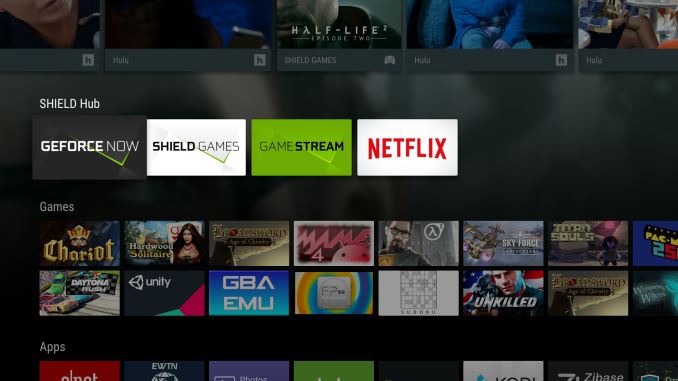
NVIDIA’s GRID game streaming service was launched back in 2013 as a beta project. Over the last couple of years, they have added a number of features that bring together the capabilities of their data center GPUs and their Tegra SoCs. At GDC 2015, NVIDIA indicated that they would be promoting the GRID program from beta to a commercial service. The commercial service was originally slated to launch along with the SHIELD Android TV in May, but the launch kept getting pushed back.

Today, NVIDIA is announcing that the service is getting out of beta with a new tag – GeForce NOW. With widespread and reliable Internet connectivity, content consumption is going the streaming way – services such as Netflix, Spotify and Hulu boast a huge subscriber base. NVIDIA is hoping that GeForce NOW will become the de-facto service for consumers looking to stream games.

Game streaming is quite challenging compared to traditional media streaming – in addition to low latency real-time encoding on the server side, we also need the client user input to have minimal lag while getting reflected on the server side. Companies such as OnLive and Gaikai have tried to address this market with mixed success (getting bought out by Sony in 2015 and 2012 respectively).

However, from our limited time over the past two years with the GRID beta service, we have to say that the experience can be quite compelling – the gaming experience is instant without having to wait for multi-gigabyte downloads, and one has a huge library of games to choose from (similar to Netflix’s library of movies). NVIDIA has been pushing hard to keep latency within reason – generally aiming for the equivalent of a console game at 30fps – and while network quality and location are paramount here, reasonably low latency is attainable if you live close enough to one of NVIDIA’s hosting facilities.

Moving on, NVIDIA believes that the other major advantage for their streaming service is that the rendering GPUs are in the data center and can be regularly upgraded. The end-user side just needs a dumb decoder and gaming controller – the SHIELD Android TV is quite future proof here, as it can easily decode 4Kp60 streams and has a GbE LAN connector – so only the hosting side would need to catch up. Currently, the GeForce NOW experience provides for game streaming at up to 1080p60 at 25 Mbps, while a 720p30 stream at less than 10 Mbps is also available for users with limited bandwidth. Similar to Netflix, NVIDIA uses adaptive bit-rate streaming that can scale the quality appropriately within the available bandwidth.

The initial focus of GeForce NOW is on the SHIELD Tablet and SHIELD Android TV. NVIDIA also has long-term plans to enable PCs as clients for the service.

As for the structure of the service, back in March NVIDIA announced that this would be a multi-tier basic/premium service. However as things have been finalized, NVIDIA has reduced that to a single tier of paid service, and there has been no talk of a basic or free service ala the current free beta. As such the GeForce NOW service will be priced at $8/month, with a 3-month free trial period starting after sign-up.

In terms of games, the catalog has been fairly consistent in the type of games NVIDIA is offering over the lifetime of the GRID beta, and it appears that this will continue to be the case for the paid service. This would mean that the games on the subscription service will largely be second-run games that have already been on the market for 6 months or more; the previous Batman game, the next-to-latest GRID game, etc, with 50 or so games to kick things off. In this sense GeForce NOW is very similar to the early days of Netflix, with the service acting as a way of accessing second-run content for cheap.


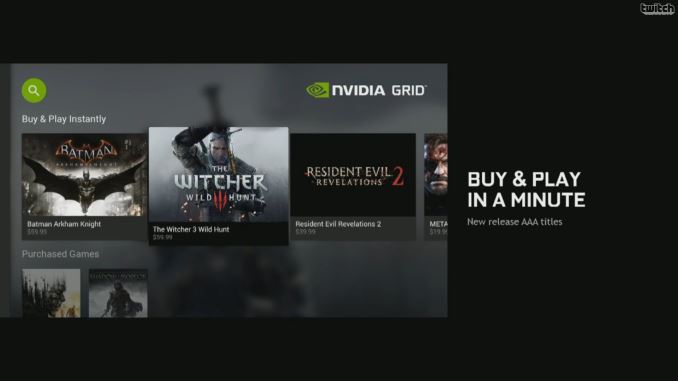
GeForce NOW Buy & Play (From NVIDIA’s March Service Announcement)

However NVIDIA is still bringing brand-new games to the service as well, and as previously announced back in March this will be through their Buy & Play program. Under Buy & Play, newer games that aren’t available from the publisher for full subscription licensing can instead be purchased by individual customers for use with the streaming service, allowing customers to buy and immediately play these games on GeForce NOW. NVIDIA tells us that they will be rolling out new games under this program on a weekly basis, with the service launching with heavy hitters such as The Witcher III and Resident Evil: Revelations 2 available via Buy & Play on day one. However we should also note that based on NVIDIA’s comments, it sounds like you must remain a subscriber in order to access the GeForce NOW service at all, so individual games picked up via Buy & Play would not be available if you discontinued your subscription.

Wrapping things up, NVIDIA has told us that GeForce NOW will be available in the US, Canada, Europe (incl. western Russia), Japan and South Korea starting today. The launch regions have been mainly dictated by the availability of data centers to serve the regions with minimal latency.

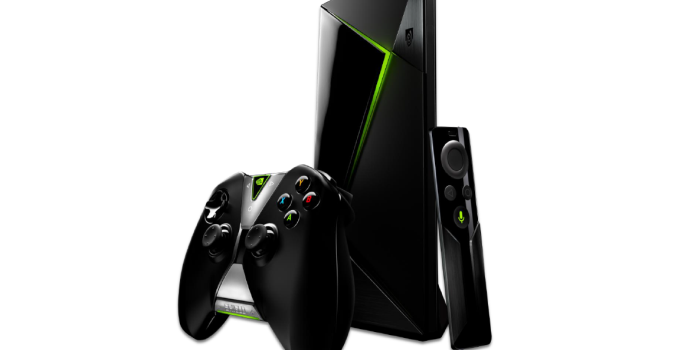
Finally, as part of the updates today, NVIDIA will also be more widely selling the SHIELD Android TV. In particular, Europe (UK, Germany, France and the Nordics) will finally be receiving the console, bringing the console beyond the American shores. Meanwhile in the US, we will start to see the STB available in brick and mortar stores such as Best Buy, Frys and Micro Center. And last but not least in a marketing promotion, Google Fiber outlets will also be promoting the SHIELD Android TV.

NVIDIA's GeForce NOW - GRID Cloud Gaming Service Goes the Subscription Way

NVIDIA’s GeForce NOW – GRID Cloud Gaming Service Goes the Subscription Way

NVIDIA’s GRID game streaming service was launched back in 2013 as a beta project. Over the last couple of years, they have added a number of features that bring together the capabilities of their data center GPUs and their Tegra SoCs. At GDC 2015, NVIDIA indicated that they would be promoting the GRID program from beta to a commercial service. The commercial service was originally slated to launch along with the SHIELD Android TV in May, but the launch kept getting pushed back.

Today, NVIDIA is announcing that the service is getting out of beta with a new tag – GeForce NOW. With widespread and reliable Internet connectivity, content consumption is going the streaming way – services such as Netflix, Spotify and Hulu boast a huge subscriber base. NVIDIA is hoping that GeForce NOW will become the de-facto service for consumers looking to stream games.

Game streaming is quite challenging compared to traditional media streaming – in addition to low latency real-time encoding on the server side, we also need the client user input to have minimal lag while getting reflected on the server side. Companies such as OnLive and Gaikai have tried to address this market with mixed success (getting bought out by Sony in 2015 and 2012 respectively).

However, from our limited time over the past two years with the GRID beta service, we have to say that the experience can be quite compelling – the gaming experience is instant without having to wait for multi-gigabyte downloads, and one has a huge library of games to choose from (similar to Netflix’s library of movies). NVIDIA has been pushing hard to keep latency within reason – generally aiming for the equivalent of a console game at 30fps – and while network quality and location are paramount here, reasonably low latency is attainable if you live close enough to one of NVIDIA’s hosting facilities.

Moving on, NVIDIA believes that the other major advantage for their streaming service is that the rendering GPUs are in the data center and can be regularly upgraded. The end-user side just needs a dumb decoder and gaming controller – the SHIELD Android TV is quite future proof here, as it can easily decode 4Kp60 streams and has a GbE LAN connector – so only the hosting side would need to catch up. Currently, the GeForce NOW experience provides for game streaming at up to 1080p60 at 25 Mbps, while a 720p30 stream at less than 10 Mbps is also available for users with limited bandwidth. Similar to Netflix, NVIDIA uses adaptive bit-rate streaming that can scale the quality appropriately within the available bandwidth.

The initial focus of GeForce NOW is on the SHIELD Tablet and SHIELD Android TV. NVIDIA also has long-term plans to enable PCs as clients for the service.

As for the structure of the service, back in March NVIDIA announced that this would be a multi-tier basic/premium service. However as things have been finalized, NVIDIA has reduced that to a single tier of paid service, and there has been no talk of a basic or free service ala the current free beta. As such the GeForce NOW service will be priced at $8/month, with a 3-month free trial period starting after sign-up.

In terms of games, the catalog has been fairly consistent in the type of games NVIDIA is offering over the lifetime of the GRID beta, and it appears that this will continue to be the case for the paid service. This would mean that the games on the subscription service will largely be second-run games that have already been on the market for 6 months or more; the previous Batman game, the next-to-latest GRID game, etc, with 50 or so games to kick things off. In this sense GeForce NOW is very similar to the early days of Netflix, with the service acting as a way of accessing second-run content for cheap.


GeForce NOW Buy & Play (From NVIDIA’s March Service Announcement)

However NVIDIA is still bringing brand-new games to the service as well, and as previously announced back in March this will be through their Buy & Play program. Under Buy & Play, newer games that aren’t available from the publisher for full subscription licensing can instead be purchased by individual customers for use with the streaming service, allowing customers to buy and immediately play these games on GeForce NOW. NVIDIA tells us that they will be rolling out new games under this program on a weekly basis, with the service launching with heavy hitters such as The Witcher III and Resident Evil: Revelations 2 available via Buy & Play on day one. However we should also note that based on NVIDIA’s comments, it sounds like you must remain a subscriber in order to access the GeForce NOW service at all, so individual games picked up via Buy & Play would not be available if you discontinued your subscription.

Wrapping things up, NVIDIA has told us that GeForce NOW will be available in the US, Canada, Europe (incl. western Russia), Japan and South Korea starting today. The launch regions have been mainly dictated by the availability of data centers to serve the regions with minimal latency.

Finally, as part of the updates today, NVIDIA will also be more widely selling the SHIELD Android TV. In particular, Europe (UK, Germany, France and the Nordics) will finally be receiving the console, bringing the console beyond the American shores. Meanwhile in the US, we will start to see the STB available in brick and mortar stores such as Best Buy, Frys and Micro Center. And last but not least in a marketing promotion, Google Fiber outlets will also be promoting the SHIELD Android TV.

NVIDIA SHIELD Android TV OTA Update Improves HTPC Credentials

NVIDIA SHIELD Android TV OTA Update Improves HTPC Credentials

The NVIDIA SHIELD Android TV was launched back in May with the intent to dominate the over-the-top set-top-box (OTT STB) landscape. Premium features such as full HDMI 2.0a support and HEVC Main10 decoding enabled the coveted Netflix 4K certification. No other set top box (including the recently announced 2015 Apple TV and the Amazon 4K Fire TV) has anything close to the SHIELD Android TV in terms of advertised hardware and software capabilities. Our review, however, pointed out a few missed opportunities. Aside from the experience with Android TV as a software platform (something for which NVIDIA is not directly responsible), we had indicated that NVIDIA could have done a better job of codec licensing and configurability to cater to HTPC enthusiasts. Today, NVIDIA is announcing an OTA update to address some of those issues.

Today’s OTA update (v2.0) brings a notable set of features for local media streaming

  • Expanded codec and container support:
    • Adds pass-through support for Dolby TrueHD and DTS-HD Master Audio lossless audio*
    • Adds MPEG2, VC-1, and WMV9 hardware-acceleration
    • Adds M2TS, ASF, and WMV container support for VC-1
    • Adds WMA audio support (including WMA Pro, and WMA Lossless)

Currently, the above set of features are available for use in the native Android Video and Photo apps. NVIDIA is working closely with third-party app developers (including Kodi and MX Player) to ensure that these media players will also be able to take advantage of the newly added features.

The other important feature that is being made available is the ability to set the display refresh rate to 23.976 Hz. Currently, it is a static setting available under Settings > Device > HDMI > Resolution. Only 60 Hz (US) / 50 Hz (Europe) and 23.976 Hz are currently available, and the UI is also set to the selected refresh rate. However, NVIDIA expects third-party app developers to be able to dynamically alter the display refresh rate based on the content frame rate using the new APIs. This will be important since consumers should not be playing games or actually be navigating the user interface at 23.976 Hz. Syncing up the display refresh rate to the content frame rate should hopefully turn out to be a transparent exercise with the third-party apps.

The new firmware also brings support for overscan adjustment (particularly useful for display sinks that tend to overscan, resulting in a cropped view of the interface). Most TVs don’t need this.

Other enhancements include native 4K rendering for select Android games (Beach Buggy Racing, Bombsquad, Hardwood Solitaire IV, Riptide GP 2, Kosmik Revenge, Video Poker Duel, Leo’s Fortune, Machinarium, Meltdown, Never Alone, Samurai II, and Sky Gamblers: Storm Raiders), ability to transfer data between USB storage and a microSD card, ability to manually turn off the SHIELD controller and lowering the audio latency by as much as 40ms compared to standard Android. The last aspect is especially important for gaming, and it will be one of the prime reasons to pick up the update before checking out the GeForce NOW cloud game streaming service that is getting launched today.

NVIDIA has also updated the table comparing the SHIELD Android TV to the competition. The latest version is reproduced below. As usual, these are NVIDIA’s claims and need to be taken with a pinch of salt.

We did go through the various aspects with concrete ‘yes’ or ‘no’ answers and the table seems to line up well with the actual specifications of the competitors’ products. The SHIELD Android TV continues to justify the premium flagship tag despite recent entrants such as the 2015 Apple TV and the Amazon 4K Fire TV. NVIDIA’s willingness to also focus on local media playback is good news for the general consumers as well as HTPC enthusiasts. For this reason alone, we can and do recommend the SHIELD Android TV over competing OTT STBs.