News


be quiet! Showcases New Silent Base 600 Case & SilentWings 3 Fans

be quiet! Showcases New Silent Base 600 Case & SilentWings 3 Fans

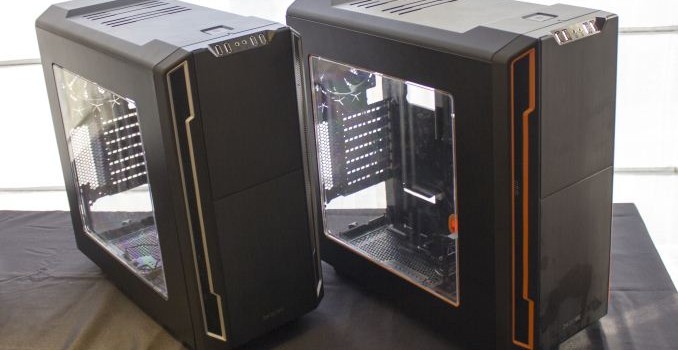
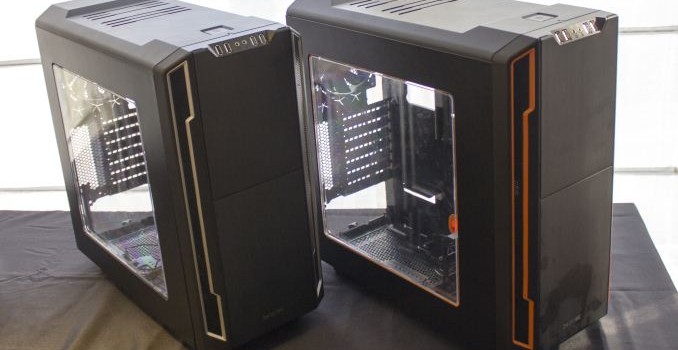
be quiet! had two new products to show in its suite at Computex. The first one is Silent Base 600, which is a smaller and more affordable version of the Silent Base 800 that was first showed at last year’s Computex. Typical to be quiet! brand, the company focused on building a quiet case, yet still offering excellent cooling performance. be quiet! will be offering models with and without the side window, and the case comes with two pre-installed Pure Wings 2 fans (140mm in the front and 120mm in the back) with support for up to seven fans (six in the windowed model). GPUs and CPU coolers of up to 400mm and 170mm are supported respectively and the Silent Base 600 will be available in September in three colors (orange, black & silver) with MSRPs of $100 (no window) and $115 (with side window).

The other new product be quiet! showcased is the third generation SilentWings fan. be quiet! modified the shape of the blades to produce higher airflow without increasing the noise level and SilentWings 3 is also the only consumer-oriented fan with a 6-pole motor. Both PWM and non-PWM models will be available in October with the Euro MSRPs being about 20€. 

be quiet! Showcases New Silent Base 600 Case & SilentWings 3 Fans

be quiet! Showcases New Silent Base 600 Case & SilentWings 3 Fans

be quiet! had two new products to show in its suite at Computex. The first one is Silent Base 600, which is a smaller and more affordable version of the Silent Base 800 that was first showed at last year’s Computex. Typical to be quiet! brand, the company focused on building a quiet case, yet still offering excellent cooling performance. be quiet! will be offering models with and without the side window, and the case comes with two pre-installed Pure Wings 2 fans (140mm in the front and 120mm in the back) with support for up to seven fans (six in the windowed model). GPUs and CPU coolers of up to 400mm and 170mm are supported respectively and the Silent Base 600 will be available in September in three colors (orange, black & silver) with MSRPs of $100 (no window) and $115 (with side window).

The other new product be quiet! showcased is the third generation SilentWings fan. be quiet! modified the shape of the blades to produce higher airflow without increasing the noise level and SilentWings 3 is also the only consumer-oriented fan with a 6-pole motor. Both PWM and non-PWM models will be available in October with the Euro MSRPs being about 20€. 

IBM Pairs Xilinx FPGAs to POWER8 to Create an Education Cloud Service

IBM Pairs Xilinx FPGAs to POWER8 to Create an Education Cloud Service

Today IBM has announced “SuperVessel”, an OpenStack based cloud service that enables students and developers to develop applications on a POWER 8 based infrastructure. What makes this cloud service interesting is the announcement that Hemant Dhulla, Vice President of Data Center and Wired Communications for Xilinx made:

Xilinx is delighted to have been chosen as the provider of FPGA accelerators for the IBM SuperVessel cloud. FPGA-based compute acceleration is a critical part of the OpenPOWER Foundation vision to handle demanding workloads in the most cost and power-efficient way. For this reason, a CAPI-enabled Xilinx FPGA is attached to every IBM POWER8 node in the SuperVessel cloud. The research and development being done in the SuperVessel is helping to define the future of heterogeneous computing.”

FPGAs, or field-programmable gate arrays are traditionally used to perform a specific algorithm in hardware. The result is a bulky and expensive chip (produced in low quantities) that runs a certain algorithms at very high speed and low latency. 

Offloading some processing tasks to a specialized chip is certainly nothing new. APUs are CPUs that offload some of their tasks to integrated GPUs. But quite a few parallel algorithms run fast but pretty inefficiently on GPUs. In many cases, an FPGA uses a lot less power. 

Intel has been delivering “customized” Xeons to large customers such as Amazon en Facebook, and has been promising that it will integrate Altera FPGAs inside certain Xeons.  Intel recently bought Altera for $16.7 Billion. 

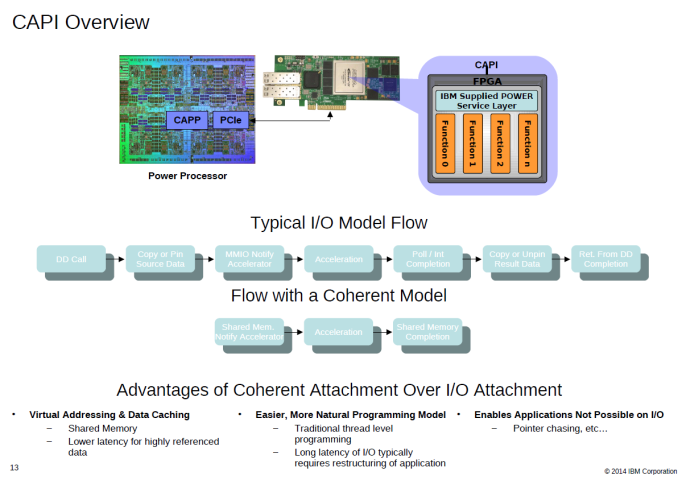
But IBM seems to have beaten Intel to the FPGA punch with CAPI, the POWER8’s Coherent Accelerator Processor Interface. IBM does not integrate FPGA inside the POWER8 package (yet), but communicates coherently over the PCI express interface. 

The most interesting fact about “Supervessel” that is IBM has managed to make a cloud service that makes ample us of – traditionally expensive – FPGAs, and that the necessary software is in place to make it relatively easy to make use of those FPGAs.  What software did IBM implement to make offload some of the processing work to the Xilinx FPGAs? Unfortunately, so far we only saw the press release and it is very light on technical details. Nevertheless, it is interesting to note that the OpenPOWER Foundation is making a lot of progress in very little time – it was founded only at the end of 2013.

IBM Pairs Xilinx FPGAs to POWER8 to Create an Education Cloud Service

IBM Pairs Xilinx FPGAs to POWER8 to Create an Education Cloud Service

Today IBM has announced “SuperVessel”, an OpenStack based cloud service that enables students and developers to develop applications on a POWER 8 based infrastructure. What makes this cloud service interesting is the announcement that Hemant Dhulla, Vice President of Data Center and Wired Communications for Xilinx made:

Xilinx is delighted to have been chosen as the provider of FPGA accelerators for the IBM SuperVessel cloud. FPGA-based compute acceleration is a critical part of the OpenPOWER Foundation vision to handle demanding workloads in the most cost and power-efficient way. For this reason, a CAPI-enabled Xilinx FPGA is attached to every IBM POWER8 node in the SuperVessel cloud. The research and development being done in the SuperVessel is helping to define the future of heterogeneous computing.”

FPGAs, or field-programmable gate arrays are traditionally used to perform a specific algorithm in hardware. The result is a bulky and expensive chip (produced in low quantities) that runs a certain algorithms at very high speed and low latency. 

Offloading some processing tasks to a specialized chip is certainly nothing new. APUs are CPUs that offload some of their tasks to integrated GPUs. But quite a few parallel algorithms run fast but pretty inefficiently on GPUs. In many cases, an FPGA uses a lot less power. 

Intel has been delivering “customized” Xeons to large customers such as Amazon en Facebook, and has been promising that it will integrate Altera FPGAs inside certain Xeons.  Intel recently bought Altera for $16.7 Billion. 

But IBM seems to have beaten Intel to the FPGA punch with CAPI, the POWER8’s Coherent Accelerator Processor Interface. IBM does not integrate FPGA inside the POWER8 package (yet), but communicates coherently over the PCI express interface. 

The most interesting fact about “Supervessel” that is IBM has managed to make a cloud service that makes ample us of – traditionally expensive – FPGAs, and that the necessary software is in place to make it relatively easy to make use of those FPGAs.  What software did IBM implement to make offload some of the processing work to the Xilinx FPGAs? Unfortunately, so far we only saw the press release and it is very light on technical details. Nevertheless, it is interesting to note that the OpenPOWER Foundation is making a lot of progress in very little time – it was founded only at the end of 2013.

SFF-8639 Connector Renamed as U.2

SFF-8639 Connector Renamed as U.2

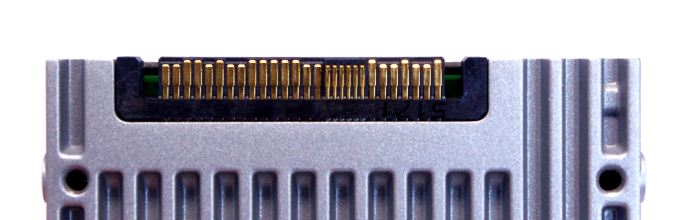
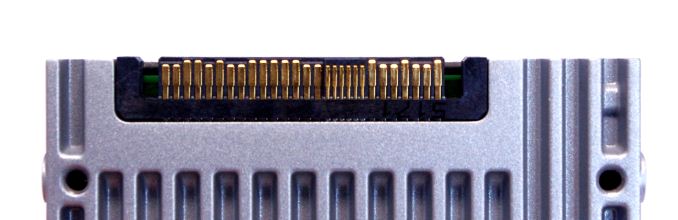
As SATA Express never took off because of the two-lane limitation, the SSD and motherboard industries have been looking for an alternative connector for connecting 2.5″ SSDs over PCIe. SFF-8639, which is essentially SATA Express on steroids with support for four PCIe lanes, has been viewed as the most potent connector because it already has industry support in the enterprise space and with the SSD 750 Intel brought the SFF-8639 connector to the client side. Given that SFF-8639 isn’t a very consumer facing name (even I’ve had trouble remembering the numbers), the SSD Form Factor Working Group has decided to rename the connector as U.2 to make it more marketable. That coincides well with M.2 that has already been used in the industry for a couple of years and more importantly both connectors now carry alike naming.

Whether U.2 and 2.5″ PCIe SSDs take off in the client space remains to be seen, though. The biggest hurdle is the expensive cabling because unlike normal SATA and SATA Express cables, the U.2 cable consists of several small, shielded cables that increase the cost. From what I have heard that is the reason why the industry came up with SATA Express in the first place because the OEMs wanted to keep the cabling cost equivalent to existing SATA cables.

I believe M.2 will be the main connector / form factor in the client space, but there is still a market for high performance and capacity 2.5″ PCIe SSDs as M.2 has more physical limitations that restrict the capacities and thermals. I can see U.2 in high-end motherboards where the connector and cable costs aren’t that big of an issue, but we’ll see what happens over the next year or two.

Source: Hardwarezone via PC Perspective