News


NVIDIA Releases 372.54 WHQL Game Ready Driver

NVIDIA Releases 372.54 WHQL Game Ready Driver

Yesterday NVIDIA unveiled the GeForce GTX 10 Series for notebooks. Following through they have sent out the new 372.54 driver update with support for the new notebooks and in the process moved us to a new driver branch with Release 370. This new branch gives us a host of other fixes, feature additions, and some game ready support for a few new game releases this month.

We start off with some small SLI fixes. First off there was an issue with shadow darkness randomly changing during gameplay in The Witcher 3. It also appears that if one wanted to run an auxiliary third GTX 1080 that SLI could not be turned on for the first two cards, which would be helpful if one wanted a hefty gaming rig and a card to run compute jobs on the side. Last on the SLI front, there is a new SLI profile for space engineers. Moving on there is also a corrected high DPC latency issue for GP104 cards, which includes the GTX 1080 and GTX 1070. In software stability issues we see fixes for stuttering in the Netflix windows Store app and crashing in Call of Duty: Black Ops III, and in the hardware compatibility department NVIDIA has resolved an issue with high idle clock speeds while using two DisplayPort displays.

For the list of game ready support that typically comes with these driver updates we have last weeks No Man’s Sky, Next week’s releases of Deus Ex: Mankind Divided and Obduction, with Codemasters F1 2016 and Epic Game’s Paragon open beta capping off the list with their release this week. Out of the games receiving support, No Man’s Sky is receiving a beta SLI profile and Deus Ex: Mankind Divided will have a DX11 SLI profile.

Finishing off with this week’s driver update, we have a list of new features. On the list is support for an updated version of NVIDIA’s BatteryBoost technology, lower power consumption for multi-monitor 144Hz G-Sync display setups, and some developer related updates. These last updates include support for OpenGL VR SDK 1.4 in Windows, and also a Windows cross-API interop between Vulkan and DX11, meaning Vulkan app compatibility with existing DX11 HMD runtimes. NVIDIA additionally lists driver support for DXGI 2 VR, and of course, this driver update provides support for the new GeForce GTX 10-series GPU powered notebooks.

Anyone interested can download the updated drivers through GeForce Experience or on the NVIDIA driver download page. More information on this update and further issues can be found in the 372.54 release notes.

NVIDIA Releases 372.54 WHQL Game Ready Driver

NVIDIA Releases 372.54 WHQL Game Ready Driver

Yesterday NVIDIA unveiled the GeForce GTX 10 Series for notebooks. Following through they have sent out the new 372.54 driver update with support for the new notebooks and in the process moved us to a new driver branch with Release 370. This new branch gives us a host of other fixes, feature additions, and some game ready support for a few new game releases this month.

We start off with some small SLI fixes. First off there was an issue with shadow darkness randomly changing during gameplay in The Witcher 3. It also appears that if one wanted to run an auxiliary third GTX 1080 that SLI could not be turned on for the first two cards, which would be helpful if one wanted a hefty gaming rig and a card to run compute jobs on the side. Last on the SLI front, there is a new SLI profile for space engineers. Moving on there is also a corrected high DPC latency issue for GP104 cards, which includes the GTX 1080 and GTX 1070. In software stability issues we see fixes for stuttering in the Netflix windows Store app and crashing in Call of Duty: Black Ops III, and in the hardware compatibility department NVIDIA has resolved an issue with high idle clock speeds while using two DisplayPort displays.

For the list of game ready support that typically comes with these driver updates we have last weeks No Man’s Sky, Next week’s releases of Deus Ex: Mankind Divided and Obduction, with Codemasters F1 2016 and Epic Game’s Paragon open beta capping off the list with their release this week. Out of the games receiving support, No Man’s Sky is receiving a beta SLI profile and Deus Ex: Mankind Divided will have a DX11 SLI profile.

Finishing off with this week’s driver update, we have a list of new features. On the list is support for an updated version of NVIDIA’s BatteryBoost technology, lower power consumption for multi-monitor 144Hz G-Sync display setups, and some developer related updates. These last updates include support for OpenGL VR SDK 1.4 in Windows, and also a Windows cross-API interop between Vulkan and DX11, meaning Vulkan app compatibility with existing DX11 HMD runtimes. NVIDIA additionally lists driver support for DXGI 2 VR, and of course, this driver update provides support for the new GeForce GTX 10-series GPU powered notebooks.

Anyone interested can download the updated drivers through GeForce Experience or on the NVIDIA driver download page. More information on this update and further issues can be found in the 372.54 release notes.
ASRock Rack Launches the 2U4N-F/X200: Four 72-core Knights Landing Xeon Phi CPUs in 2U

ASRock Rack Launches the 2U4N-F/X200: Four 72-core Knights Landing Xeon Phi CPUs in 2U

This week is Intel’s Developer Forum in San Francisco, the annual event where Intel and Intel’s partners show their latest products and discuss a number of core topics to Intel’s business. Last year the focus was on the new Skylake microarchitecture, and this year we have down on our list a number of 3D XPoint and Xeon Phi discussions and announcements. One of the first to contact us with their IDF news was ASRock Rack, the server arm of ASRock, about their high-density Xeon Phi solution.


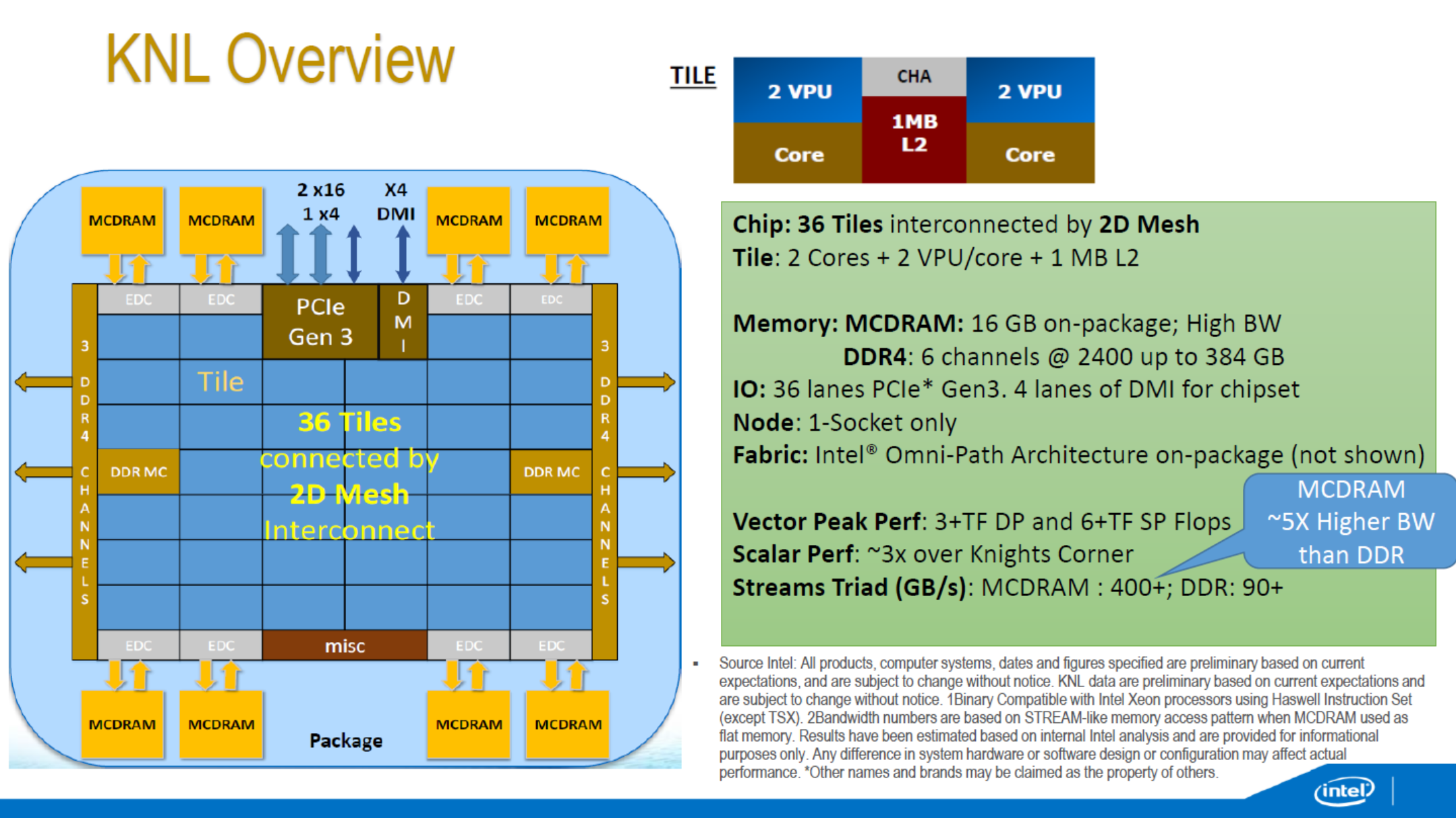
Overview of Xeon Phi X200, Knights Landing

The Xeon Phi many-core platform is transitioning from an add-in card to stand-alone processor, with the latest Knights Landing generation offering up to 72 high performance cores (now a couple of generations away from a pure Atom core) with combined high-bandwidth MCDRAM and the potential for Intel Omnipath support directly on the package. We covered the discussion and launch of Knights Landing last year at Supercomputing15, and saw some preview customer systems at Computex a couple of months ago, however the mix of ISC16 and IDF16 has most of the enterprise consumer-focused system releases surrounding Knights Landing.

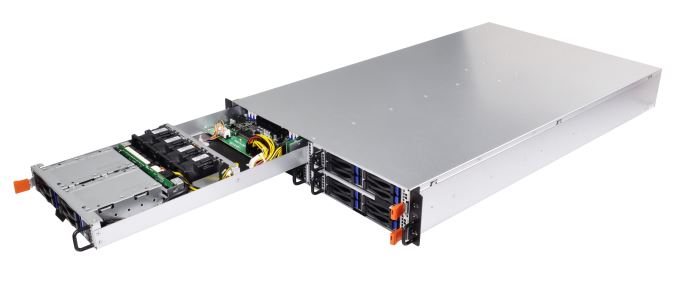
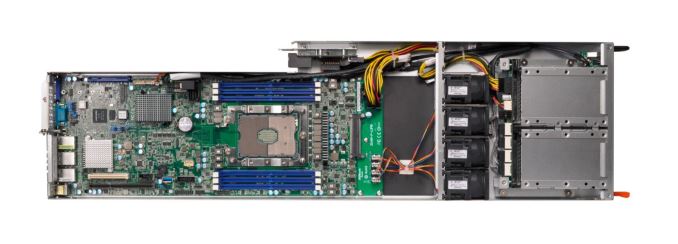
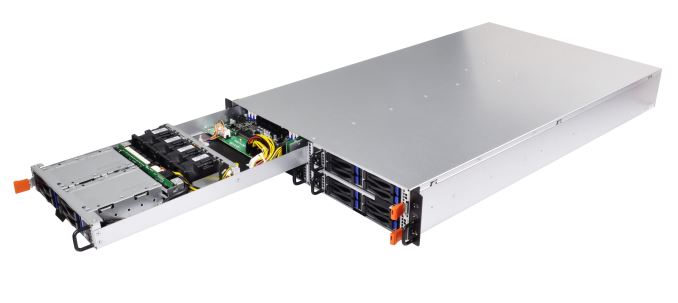
For a segment of Xeon Phi customers, density is important. Pack ‘em, rack ‘em and stack ‘em is the end goal, and the 2U4N-F/X200 aims to do just that. The 2U server uses half-width modules to fit in four separate systems in the chassis, each with an X200 Xeon Phi CPU, six DIMM slots with support for DDR4 2400/2133 RDIMM/LRDIMM, four 2.5-inch storage slots (either 4xSATA/SAS or 2xNVMe+2xSATA/SAS), two PCIe 3. X2 slots, one M.2 slot, a combination 1600W 80 PLUS Platinum redundant (1+1) power supply for the four nodes, two GbE Intel i350 network ports and integrated IPMI 2.0 (via AST2400) with KVM and a dedicated LAN port.


P1 Socket for Xeon Phi, seen at Supercomputing15

Xeon Phi uses Intel’s P1 socket, which we saw back at Supercomputing15 and has been characterised in recent media as the LGA-3647 socket. At this point in time, Intel has only confirmed this socket for Xeon Phi use, and other use cases are not yet verified. ASRock Rack states that their platform on show at IDF16 this week will support all the main Xeon Phi X200 CPUs, and they have support in the works for Omni-path associated SKUs. Professional users interested in ASRock’s high-density platform will have to get in contact with their regional branch for more information and pricing.

Source: ASRock

Related Reading: