News


SAPPHIRE Announces NITRO+ Radeon RX 480

SAPPHIRE Announces NITRO+ Radeon RX 480

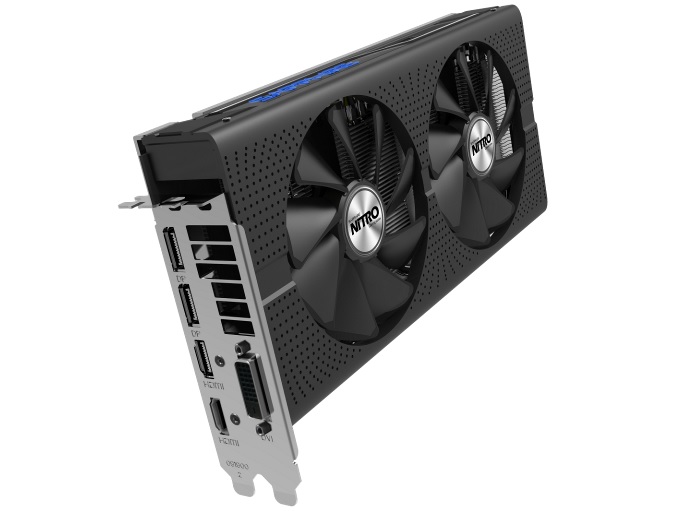
This morning SAPPHIRE is announcing their latest card in the NITRO+ family, the NITRO+ Radeon RX 480. Some key features of SAPPHIRE’s new NITRO+ RX 480 cards include higher clock speeds, an improved cooler with a back plate included, and software fan health monitoring. Along with this we’ll also get RGB lighting and power delivery that is improved over what we saw on the reference RX 480.

The cooler is improved from SAPPHIREs last generation with two 95mm dual-ball bearing fans. Meaning longer fan life and potentially quieter operation. In fact, SAPPHIRE isn’t content simply improving the quality of their fans. They also are including a feature called “Fan Check” in their upcoming SAPPHIRE TriXX 3.0. Fan Check allows users to check the health of their fans and if an issue is detected they can contact customer support for a replacement fan. Thanks to quick swap fans the user can replace just the fan with a single screw, no more need to return a whole card for a dead fan, and no more need to disassemble a card to remove the fan. I think this sounds like a neat feature, but considering the use of dual ball bearing fans and that the fans shut off when temperatures are under 52 degrees Celsius, I won’t be surprised if the number of users needing replacements is rather low.

It has occured to me that you can’t throw a dart without hitting an RGB LED card anymore. Regardless it does come in handy when color coordinating a build. Along with having the usual option to control the RGB lighting through SAPPHIRE’s utility, there is also a hardware controlled red button on the back of the card which will let one work through the various included modes such as fan speed or GPU temperature modes.

Radeon RX 480 Specification Comparison
  SAPPHIRE NITRO+ Radeon RX 480 8GB SAPPHIRE NITRO+ Radeon RX 480 4GB AMD Radeon RX 480 8GB AMD Radeon RX 480 4GB
Boost Clock 1342MHz 1306MHz 1266MHz
Memory Clock 8Gbps GDDR5 7Gbps GDDR5 8Gbps GDDR5 7Gbps GDDR5
VRAM 8GB 4GB 8GB 4GB
Launch Date Next Week 6/29/2016
Launch Price $269 $219 $239 $199

We will be seeing factory overclocks from both the 8GB and 4GB versions of this card. While base clocks are presumably higher they were not shared, though the boost clocks come out to 6% and about 3% over AMD’s reference cards respectively. The memory clocks are right in line with the reference Radeon RX 480 8GB and 4GB cards.

For those that enjoy running on overclocked hardware the NITRO+ Radeon RX 480 includes a NITRO Boost dual bios switch that further increases the boost clock and power limit for some extra performance. To help feed overclocking endeavors the card also comes with an 8-pin power connector and a new model of their own Black Diamond Chokes which they profess drop coil temperatures by another 15%.

Amusingly, with the increasing growth in VR this generation having multiple HDMI outputs is becoming a highlighted feature all around. Following suit, we can find dual HDMI on the business end of the NITRO+ Radeon RX 480 sharing space with two DisplayPort connectors and a DVI-D port.

Finally, for pricing the SAPPHIRE NITRO+ Radeon RX 480 will be listed at $269 for the 8GB card and $219 for the 4GB model, a $30 and $20 premium over the reference models, respectively. So far the NITRO+ RX 480 appears to be a robustly built card with all the bells and whistles we’re seeing this generation including RGB lighting, fan shutoff, and warranty fan replacement while they were at it. Exact release dates have not yet been revealed, but those interested in these cards will find them available from etailers next week.

SAPPHIRE Announces NITRO+ Radeon RX 480

SAPPHIRE Announces NITRO+ Radeon RX 480

This morning SAPPHIRE is announcing their latest card in the NITRO+ family, the NITRO+ Radeon RX 480. Some key features of SAPPHIRE’s new NITRO+ RX 480 cards include higher clock speeds, an improved cooler with a back plate included, and software fan health monitoring. Along with this we’ll also get RGB lighting and power delivery that is improved over what we saw on the reference RX 480.

The cooler is improved from SAPPHIREs last generation with two 95mm dual-ball bearing fans. Meaning longer fan life and potentially quieter operation. In fact, SAPPHIRE isn’t content simply improving the quality of their fans. They also are including a feature called “Fan Check” in their upcoming SAPPHIRE TriXX 3.0. Fan Check allows users to check the health of their fans and if an issue is detected they can contact customer support for a replacement fan. Thanks to quick swap fans the user can replace just the fan with a single screw, no more need to return a whole card for a dead fan, and no more need to disassemble a card to remove the fan. I think this sounds like a neat feature, but considering the use of dual ball bearing fans and that the fans shut off when temperatures are under 52 degrees Celsius, I won’t be surprised if the number of users needing replacements is rather low.

It has occured to me that you can’t throw a dart without hitting an RGB LED card anymore. Regardless it does come in handy when color coordinating a build. Along with having the usual option to control the RGB lighting through SAPPHIRE’s utility, there is also a hardware controlled red button on the back of the card which will let one work through the various included modes such as fan speed or GPU temperature modes.

Radeon RX 480 Specification Comparison
  SAPPHIRE NITRO+ Radeon RX 480 8GB SAPPHIRE NITRO+ Radeon RX 480 4GB AMD Radeon RX 480 8GB AMD Radeon RX 480 4GB
Boost Clock 1342MHz 1306MHz 1266MHz
Memory Clock 8Gbps GDDR5 7Gbps GDDR5 8Gbps GDDR5 7Gbps GDDR5
VRAM 8GB 4GB 8GB 4GB
Launch Date Next Week 6/29/2016
Launch Price $269 $219 $239 $199

We will be seeing factory overclocks from both the 8GB and 4GB versions of this card. While base clocks are presumably higher they were not shared, though the boost clocks come out to 6% and about 3% over AMD’s reference cards respectively. The memory clocks are right in line with the reference Radeon RX 480 8GB and 4GB cards.

For those that enjoy running on overclocked hardware the NITRO+ Radeon RX 480 includes a NITRO Boost dual bios switch that further increases the boost clock and power limit for some extra performance. To help feed overclocking endeavors the card also comes with an 8-pin power connector and a new model of their own Black Diamond Chokes which they profess drop coil temperatures by another 15%.

Amusingly, with the increasing growth in VR this generation having multiple HDMI outputs is becoming a highlighted feature all around. Following suit, we can find dual HDMI on the business end of the NITRO+ Radeon RX 480 sharing space with two DisplayPort connectors and a DVI-D port.

Finally, for pricing the SAPPHIRE NITRO+ Radeon RX 480 will be listed at $269 for the 8GB card and $219 for the 4GB model, a $30 and $20 premium over the reference models, respectively. So far the NITRO+ RX 480 appears to be a robustly built card with all the bells and whistles we’re seeing this generation including RGB lighting, fan shutoff, and warranty fan replacement while they were at it. Exact release dates have not yet been revealed, but those interested in these cards will find them available from etailers next week.

AMD Releases Q2 FY 2016 Financial Results

AMD Releases Q2 FY 2016 Financial Results

This afternoon, AMD announced their second quarter earnings for the 2016 fiscal year. It’s been a while, but AMD finds itself in the black for this quarter, with higher revenues, and thanks to $150 million from a joint venture with Nantong Fujitsu Microelectronics, AMD’s net income found its way into the positive column. AMD had revenues of $1.027 billion for the quarter, which is up 23% from last quarter, and more importantly up 9% from a year ago. Gross margin for the quarter was 31%, which is still not what AMD wants or needs to maintain profitability, but it is up 6% from their Q2 2015 results which is good news for the company. AMD did record an operating loss for the quarter of $8 million, but that’s a big improvement compared to the $68 million loss last quarter and $137 million loss in Q2 2015. Net income for this quarter was $68 million, or $0.08 per share, compared to a net loss of $109 million last quarter and a $181 million loss a year ago.

AMD Q2 2016 Financial Results (GAAP)
  Q2’2016 Q1’2016 Q2’2015
Revenue $1027M $832M $942M
Gross Margin 31% 32% 25%
Operating Income -$8M -$68M -$137M
Net Income $69M -$109M -$181M
Earnings Per Share $0.08 -$0.14 -$0.23

AMD also released Non-GAAP results which exclude restructuring charges and some other results. On a Non-GAAP basis, AMD had the same $1.027 billion in revenue, but showed a slight operating income of $3 million, compared to a $55 million operating loss last quarter and a $87 million loss last year. Looking at net results, AMD had a net loss of $40 million, or $0.05 per share, compared to a $96 million net loss last quarter and a $131 million net loss a year ago.

AMD Q2 2016 Financial Results (Non-GAAP)
  Q2’2016 Q1’2016 Q2’2015
Revenue $1027M $832M $942M
Gross Margin 31% 32% 28%
Operating Income $3M -$55M -$87M
Net Income -$40M -$96M -$131M
Earnings Per Share -$0.05 -$0.12 -$0.17

AMD attributes their revenue increase primarily to higher sales of its semi-custom SoCs, and with the announcement of the Xbox One Scorpio AMD has secured another design win there. Overall the Enterprise, Embedded, and Semi-Custom segment had revenues of $592 million for the quarter, which is up 5% from a year ago, once again attributed to the increased sales of semi-custom SoCs. The segment had an operating income of $84 million for the quarter, up from $27 million in Q2 2015.

AMD Q2 2016 Enterprise, Embedded, and Semi-Custom
  Q2’2016 Q1’2016 Q2’2015
Revenue $592M $372M $563M
Operating Income $84M $16M $27M

AMD’s Computing and Graphics segment just had an important quarter with the launch of their first FinFet GPU design in the AMD Radeon RX 480. They’ve also been releasing several Carrizo based APUs and CPUs, as well as announcing Bristol Ridge, and all the while working on Zen. The Computing and Graphics segment had revenues of $435 million for the quarter, which is up 15% from Q2 2015. Notebook processor and GPU sales have been tagged as the reason for the revenue increase. The segment had an operating loss of $81 million, which is better than the $147 million operating loss a year ago, but still a bit way from profitability. Lowered expenses have helped them here quite a bit, but they still have some work to do. AMD’s average selling price of their notebook APUs decreased compared to Q2 2015, and GPU average selling price also declined.

AMD Q2 2016 Computing and Graphics
  Q2’2016 Q1’2016 Q2’2015
Revenue $435M $460M $379M
Operating Income -$81M -$70M -$147M

Looking ahead to next quarter, AMD is expecting revenues to increase 18% from this quarter, plus or minus 3%.

Source: AMD Investor Relations