News


AMD Releases Q2 FY 2016 Financial Results
AMD Releases Q2 FY 2016 Financial Results

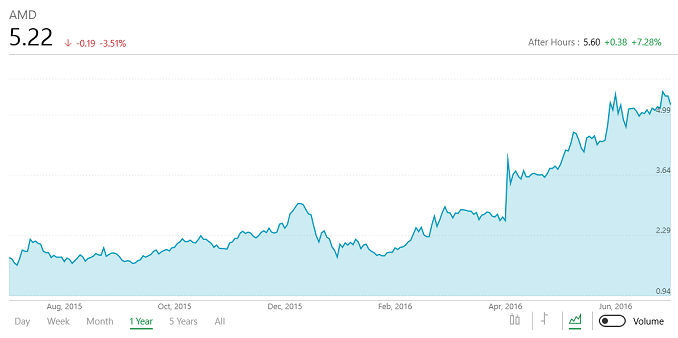
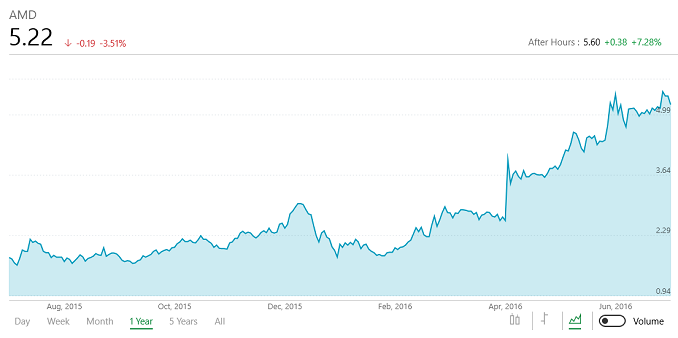
This afternoon, AMD announced their second quarter earnings for the 2016 fiscal year. It’s been a while, but AMD finds itself in the black for this quarter, with higher revenues, and thanks to $150 million from a joint venture with Nantong Fujitsu Microelectronics, AMD’s net income found its way into the positive column. AMD had revenues of $1.027 billion for the quarter, which is up 23% from last quarter, and more importantly up 9% from a year ago. Gross margin for the quarter was 31%, which is still not what AMD wants or needs to maintain profitability, but it is up 6% from their Q2 2015 results which is good news for the company. AMD did record an operating loss for the quarter of $8 million, but that’s a big improvement compared to the $68 million loss last quarter and $137 million loss in Q2 2015. Net income for this quarter was $68 million, or $0.08 per share, compared to a net loss of $109 million last quarter and a $181 million loss a year ago.

AMD Q2 2016 Financial Results (GAAP)
  Q2’2016 Q1’2016 Q2’2015
Revenue $1027M $832M $942M
Gross Margin 31% 32% 25%
Operating Income -$8M -$68M -$137M
Net Income $69M -$109M -$181M
Earnings Per Share $0.08 -$0.14 -$0.23

AMD also released Non-GAAP results which exclude restructuring charges and some other results. On a Non-GAAP basis, AMD had the same $1.027 billion in revenue, but showed a slight operating income of $3 million, compared to a $55 million operating loss last quarter and a $87 million loss last year. Looking at net results, AMD had a net loss of $40 million, or $0.05 per share, compared to a $96 million net loss last quarter and a $131 million net loss a year ago.

AMD Q2 2016 Financial Results (Non-GAAP)
  Q2’2016 Q1’2016 Q2’2015
Revenue $1027M $832M $942M
Gross Margin 31% 32% 28%
Operating Income $3M -$55M -$87M
Net Income -$40M -$96M -$131M
Earnings Per Share -$0.05 -$0.12 -$0.17

AMD attributes their revenue increase primarily to higher sales of its semi-custom SoCs, and with the announcement of the Xbox One Scorpio AMD has secured another design win there. Overall the Enterprise, Embedded, and Semi-Custom segment had revenues of $592 million for the quarter, which is up 5% from a year ago, once again attributed to the increased sales of semi-custom SoCs. The segment had an operating income of $84 million for the quarter, up from $27 million in Q2 2015.

AMD Q2 2016 Enterprise, Embedded, and Semi-Custom
  Q2’2016 Q1’2016 Q2’2015
Revenue $592M $372M $563M
Operating Income $84M $16M $27M

AMD’s Computing and Graphics segment just had an important quarter with the launch of their first FinFet GPU design in the AMD Radeon RX 480. They’ve also been releasing several Carrizo based APUs and CPUs, as well as announcing Bristol Ridge, and all the while working on Zen. The Computing and Graphics segment had revenues of $435 million for the quarter, which is up 15% from Q2 2015. Notebook processor and GPU sales have been tagged as the reason for the revenue increase. The segment had an operating loss of $81 million, which is better than the $147 million operating loss a year ago, but still a bit way from profitability. Lowered expenses have helped them here quite a bit, but they still have some work to do. AMD’s average selling price of their notebook APUs decreased compared to Q2 2015, and GPU average selling price also declined.

AMD Q2 2016 Computing and Graphics
  Q2’2016 Q1’2016 Q2’2015
Revenue $435M $460M $379M
Operating Income -$81M -$70M -$147M

Looking ahead to next quarter, AMD is expecting revenues to increase 18% from this quarter, plus or minus 3%.

Source: AMD Investor Relations
Super Talent Launches their PCIe Nova U.2 SSDs, up to 2 TB and 3 GB/s

Super Talent Launches their PCIe Nova U.2 SSDs, up to 2 TB and 3 GB/s

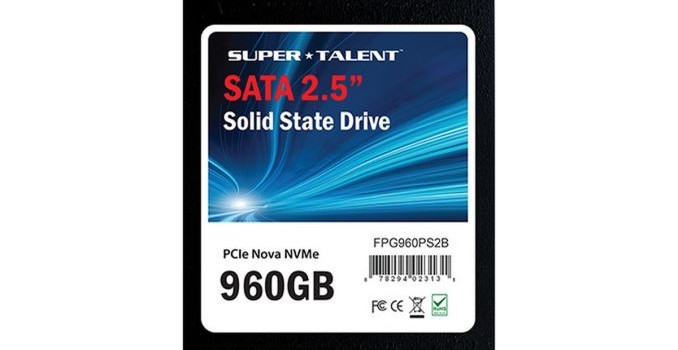
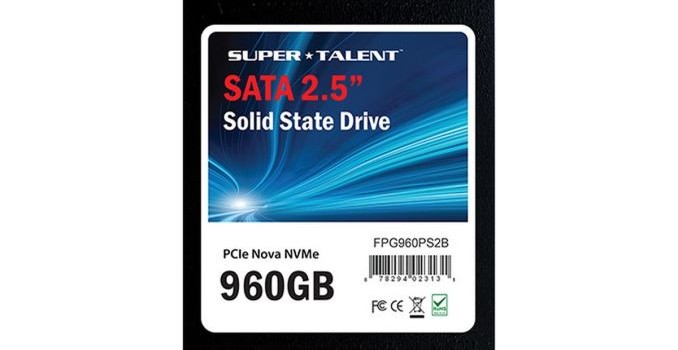
The march to U.2 adoption is slow but coming – it is already more successful than SATA Express ever was. Consumer motherboards are now coming equipped with slots, and we’ve seen a single vendor supply drives to the consumer space – a number of players behind the scenes are shipping to enterprise users, and are expected to launch consumer grade products at some point in the next twelve months. While not specifically aimed at consumers, we got word that this week Super Talent has added a family of SSDs with U.2 connector into its lineup of products. Their new PCIe Nova drives will be aimed at servers and workstations first, and will offer capacities up to 2TB as well as high quoted performance. In fact, the new SSDs will be the fastest drives in Super Talent’s lineup and will compete against high-end drives from companies like Intel and HGST.

The Super Talent PCIe Nova SSDs with a U.2 (SFF-8639) connector and PCIe 3.0 x4 interface will be based on MLC NAND memory and will be offered in various configurations, initially starting with 120 GB, up to 1920 GB. The manufacturer does not disclose the exact model of the controller or the exact type of flash it uses to build the devices, but it claims that the drives have maximum sequential read speed of 3 GB/s and maximum sequential write speed of 2.2 GB/s. Super Talent also does not specify endurance of the SSDs, but declares a mean time between failures (MTBF) at 1 million hours, which is in line with consumer storage devices.

Super Talent PCIe Nova SSD General Specifications
Capacity 120 GB 240 GB 480 GB 960 GB 1920 GB
Model Number FPG120PS2B FPG240PS2B FPG480PS2B FPG960PS2B FPG1T9PS2B
Controller unknown
NAND Flash MLC NAND, unknown manufacturer
Sequential Read Up to 3 GB/s
Sequential Write Up to 2.2 GB/s
Form-Factor 2.5″/9.5mm
Interface U.2 with PCIe 3.0 x4
MTBF 1 million hours

As for dimensions, all drives come in 2.5”/9.5 mm form-factor, rather than 7mm. They are still compatible with almost all desktops, servers, workstations as well as other applications with large storage bays and U.2, however some mobile devices might have limitations. Keep in mind that Super Talent officially positions its PCIe Nova drives for servers and workstations, despite the consumer based MTBF and no listed enterprise features.

The U.2 connector has still got some traction to gain in the desktop space, with about a dozen motherboards currently supporting the native connector and over 100 others suitable via M.2 to U.2 converter cards. On the enterprise side, companies like Intel and HGST have released a number of SSDs for servers and workstations featuring this interface and server/storage systems makers like Supermicro support U.2 with their latest SuperServer and SuperStorage solutions, including features such as the NVMe 1.2 protocol as well as hot-swapping.

The main driving force for U.2, at least publicly, has so far been Intel and its DC P3xxx-series SSDs. For workstations, Intel also released its SSD 750-series drives with the SFF-8639 connector in 2015. As a result, Super Talent’s PCIe Nova SSDs will not have a lot of competitors. At this time, Super Talent has not disclosed prices for the PCIe Nova line, but enterprise customers can contact their local ST reps for more info.

Super Talent Launches their PCIe Nova U.2 SSDs, up to 2 TB and 3 GB/s

Super Talent Launches their PCIe Nova U.2 SSDs, up to 2 TB and 3 GB/s

The march to U.2 adoption is slow but coming – it is already more successful than SATA Express ever was. Consumer motherboards are now coming equipped with slots, and we’ve seen a single vendor supply drives to the consumer space – a number of players behind the scenes are shipping to enterprise users, and are expected to launch consumer grade products at some point in the next twelve months. While not specifically aimed at consumers, we got word that this week Super Talent has added a family of SSDs with U.2 connector into its lineup of products. Their new PCIe Nova drives will be aimed at servers and workstations first, and will offer capacities up to 2TB as well as high quoted performance. In fact, the new SSDs will be the fastest drives in Super Talent’s lineup and will compete against high-end drives from companies like Intel and HGST.

The Super Talent PCIe Nova SSDs with a U.2 (SFF-8639) connector and PCIe 3.0 x4 interface will be based on MLC NAND memory and will be offered in various configurations, initially starting with 120 GB, up to 1920 GB. The manufacturer does not disclose the exact model of the controller or the exact type of flash it uses to build the devices, but it claims that the drives have maximum sequential read speed of 3 GB/s and maximum sequential write speed of 2.2 GB/s. Super Talent also does not specify endurance of the SSDs, but declares a mean time between failures (MTBF) at 1 million hours, which is in line with consumer storage devices.

Super Talent PCIe Nova SSD General Specifications
Capacity 120 GB 240 GB 480 GB 960 GB 1920 GB
Model Number FPG120PS2B FPG240PS2B FPG480PS2B FPG960PS2B FPG1T9PS2B
Controller unknown
NAND Flash MLC NAND, unknown manufacturer
Sequential Read Up to 3 GB/s
Sequential Write Up to 2.2 GB/s
Form-Factor 2.5″/9.5mm
Interface U.2 with PCIe 3.0 x4
MTBF 1 million hours

As for dimensions, all drives come in 2.5”/9.5 mm form-factor, rather than 7mm. They are still compatible with almost all desktops, servers, workstations as well as other applications with large storage bays and U.2, however some mobile devices might have limitations. Keep in mind that Super Talent officially positions its PCIe Nova drives for servers and workstations, despite the consumer based MTBF and no listed enterprise features.

The U.2 connector has still got some traction to gain in the desktop space, with about a dozen motherboards currently supporting the native connector and over 100 others suitable via M.2 to U.2 converter cards. On the enterprise side, companies like Intel and HGST have released a number of SSDs for servers and workstations featuring this interface and server/storage systems makers like Supermicro support U.2 with their latest SuperServer and SuperStorage solutions, including features such as the NVMe 1.2 protocol as well as hot-swapping.

The main driving force for U.2, at least publicly, has so far been Intel and its DC P3xxx-series SSDs. For workstations, Intel also released its SSD 750-series drives with the SFF-8639 connector in 2015. As a result, Super Talent’s PCIe Nova SSDs will not have a lot of competitors. At this time, Super Talent has not disclosed prices for the PCIe Nova line, but enterprise customers can contact their local ST reps for more info.

HP’s Elite x3 Windows 10 Smartphone to Cost $699, Set to Be Available Worldwide

HP’s Elite x3 Windows 10 Smartphone to Cost $699, Set to Be Available Worldwide

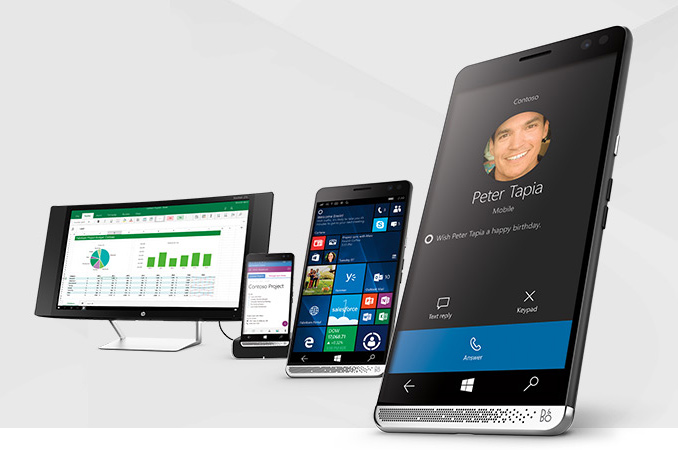
When HP introduced its flagship Elite x3 phablet earlier this year at MWC, the smartphone made a very positive impression mostly because HP decided to make a bold move and create a Windows Continuum device aimed purely at the business professional on a company contract. It drew a little ire from some industry analysts, thinking that HP building a Windows phone would never see the light of day. To them it was a paper announcement, but this week shows that the Elite x3 is still alive and well, and coming to consumers and business users. What the company did not announce in February was its recommended price as well as countries, where it planned to make the product available. This weeks details show that the Elite x3 will hit the market in August and will be sold in 46 countries worldwide.

The HP Elite x3 smartphone is based on Qualcomm’s Snapdragon 820 SoC, as well as Microsoft’s Windows 10 Mobile OS. The device is equipped a 5.96” AMOLED display and comes with 64 MB of eMMC 5.1 NAND flash storage, 4 GB of LPDDR4 RAM as well as all the necessary connectivity features, including 4G/LTE, 802.11ac Wi-Fi, Bluetooth 4.0 and a USB Type-C connector. Developed specifically for enterprise and business users, who value security, the device is FIPS 140-2 certified and features Secure Boot (with iris and fingerprint scanners), full disk encryption with a 256-bit key, fTPM 2.0, and so on.

  HP Elite x3
SoC Qualcomm Snapdragon 820
2x Kryo @ 2.15 GHz
2x Kryo @ 1.59 GHz
Adreno 530
RAM/NAND 4 GB LPDDR4 RAM,
64 GB eMMC 5.1 NAND
microSD ‘up to 2 TB’
Display 5.96-inch, 2560×1440 AMOLED (494 PPI)
Corning Gorilla Glass 4
Network X12 Cat 12/13 LTE-A
Single Nano-SIM or Dual Nano-SIM Models
Micro-SD Shared with Nano-SIM
Dimensions 161.8 x 83.5 x 7.8 (mm)
6.36 x 3.29 x 0.31 (in)
Weight 195 grams
0.43 lb / 6.88 oz
Rear Camera 16 MP, LED Flash
Front Camera 8 MP wide angle, Iris Camera
Battery 4150 mAh, 3.85 V, 15.98 Wh,
PMA and Qi charging
OS Windows 10 Mobile
Connectivity Intel AC-7260AN WiFi (2×2 802.11ac + BT 4.0 LE)
NFC, GPS
USB 3.0 Type-C
Additional Windows Hello (Iris and Fingerprint),
FIPS 140-2, fTPM 2.0
128-bit Unified encryption, 256-bit full disk
Disaster recovery Protection
Win10 includes 128-bit BitLocker and Enterprise Grade VPN
Bang&Olufsen Sound
3x Noise-Cancelling Microphones
Water/Dust Proof Certification IP 67
MIL-STD 810G (salt/fog/humidity/shock/thermal)

While the internal specifications of the HP Elite x3 are impressive, the company does not position the device as just its flagship smartphone. HP believes that there are enterprise customers interested in using one device for multiple workloads and in various situations by taking advantage of Microsoft’s Continuum technology, which allows you to run your phone as a desktop PC. To support such clients, HP intends to offer a special dock (with an Ethernet adapter, DisplayPort USB connectors, etc.) that can work with desktop displays as well as keyboards. When purchased from the HP online store, the dock should come as standard. In addition, the company plans to sell the Mobile Extender laptop, which does not have its own processor or storage, but relies on the Elite x3. The Mobile Extender has a 12.5” display (with 1920×1080 resolution), USB-C ports, speakers as well as a spill-resistant keyboard with a drain and backlighting.

Current competition, at least in the Continuum space, comes from Acer’s Liquid Jade Primo which was demoed at MWC and quietly shipped several days ago, and the Lumia 950.

According to Engadget, which cites a representative of HP, the phablet itself will cost $699 in the U.S. and $799 when acquired with a dock, starting from August 29. Slashgear claims that the Elite x3 will cost €863 in the Netherlands and 8,624 SEK in Sweden. Unfortunately, the price of the Mobile Extender is still unknown. 

Sources: Engadget, Slashgear, HP Netherlands, HP Sweden.

HP’s Elite x3 Windows 10 Smartphone to Cost $699, Set to Be Available Worldwide

HP’s Elite x3 Windows 10 Smartphone to Cost $699, Set to Be Available Worldwide

When HP introduced its flagship Elite x3 phablet earlier this year at MWC, the smartphone made a very positive impression mostly because HP decided to make a bold move and create a Windows Continuum device aimed purely at the business professional on a company contract. It drew a little ire from some industry analysts, thinking that HP building a Windows phone would never see the light of day. To them it was a paper announcement, but this week shows that the Elite x3 is still alive and well, and coming to consumers and business users. What the company did not announce in February was its recommended price as well as countries, where it planned to make the product available. This weeks details show that the Elite x3 will hit the market in August and will be sold in 46 countries worldwide.

The HP Elite x3 smartphone is based on Qualcomm’s Snapdragon 820 SoC, as well as Microsoft’s Windows 10 Mobile OS. The device is equipped a 5.96” AMOLED display and comes with 64 MB of eMMC 5.1 NAND flash storage, 4 GB of LPDDR4 RAM as well as all the necessary connectivity features, including 4G/LTE, 802.11ac Wi-Fi, Bluetooth 4.0 and a USB Type-C connector. Developed specifically for enterprise and business users, who value security, the device is FIPS 140-2 certified and features Secure Boot (with iris and fingerprint scanners), full disk encryption with a 256-bit key, fTPM 2.0, and so on.

  HP Elite x3
SoC Qualcomm Snapdragon 820
2x Kryo @ 2.15 GHz
2x Kryo @ 1.59 GHz
Adreno 530
RAM/NAND 4 GB LPDDR4 RAM,
64 GB eMMC 5.1 NAND
microSD ‘up to 2 TB’
Display 5.96-inch, 2560×1440 AMOLED (494 PPI)
Corning Gorilla Glass 4
Network X12 Cat 12/13 LTE-A
Single Nano-SIM or Dual Nano-SIM Models
Micro-SD Shared with Nano-SIM
Dimensions 161.8 x 83.5 x 7.8 (mm)
6.36 x 3.29 x 0.31 (in)
Weight 195 grams
0.43 lb / 6.88 oz
Rear Camera 16 MP, LED Flash
Front Camera 8 MP wide angle, Iris Camera
Battery 4150 mAh, 3.85 V, 15.98 Wh,
PMA and Qi charging
OS Windows 10 Mobile
Connectivity Intel AC-7260AN WiFi (2×2 802.11ac + BT 4.0 LE)
NFC, GPS
USB 3.0 Type-C
Additional Windows Hello (Iris and Fingerprint),
FIPS 140-2, fTPM 2.0
128-bit Unified encryption, 256-bit full disk
Disaster recovery Protection
Win10 includes 128-bit BitLocker and Enterprise Grade VPN
Bang&Olufsen Sound
3x Noise-Cancelling Microphones
Water/Dust Proof Certification IP 67
MIL-STD 810G (salt/fog/humidity/shock/thermal)

While the internal specifications of the HP Elite x3 are impressive, the company does not position the device as just its flagship smartphone. HP believes that there are enterprise customers interested in using one device for multiple workloads and in various situations by taking advantage of Microsoft’s Continuum technology, which allows you to run your phone as a desktop PC. To support such clients, HP intends to offer a special dock (with an Ethernet adapter, DisplayPort USB connectors, etc.) that can work with desktop displays as well as keyboards. When purchased from the HP online store, the dock should come as standard. In addition, the company plans to sell the Mobile Extender laptop, which does not have its own processor or storage, but relies on the Elite x3. The Mobile Extender has a 12.5” display (with 1920×1080 resolution), USB-C ports, speakers as well as a spill-resistant keyboard with a drain and backlighting.

Current competition, at least in the Continuum space, comes from Acer’s Liquid Jade Primo which was demoed at MWC and quietly shipped several days ago, and the Lumia 950.

According to Engadget, which cites a representative of HP, the phablet itself will cost $699 in the U.S. and $799 when acquired with a dock, starting from August 29. Slashgear claims that the Elite x3 will cost €863 in the Netherlands and 8,624 SEK in Sweden. Unfortunately, the price of the Mobile Extender is still unknown. 

Sources: Engadget, Slashgear, HP Netherlands, HP Sweden.