News


Seagate BarraCuda Pro 10TB Helium HDD Capsule Review
Seagate BarraCuda Pro 10TB Helium HDD Capsule Review

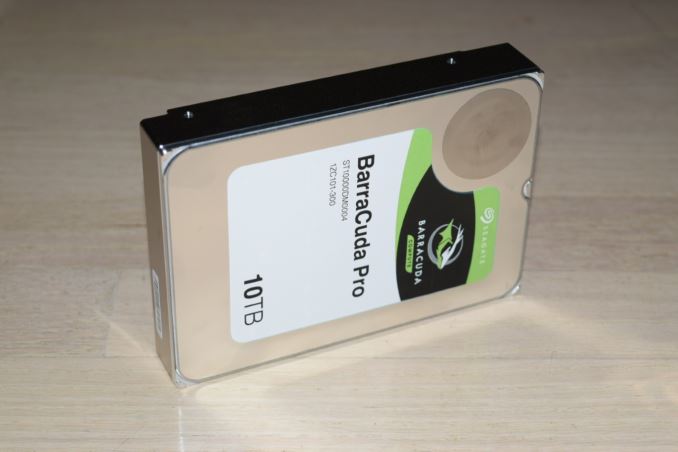
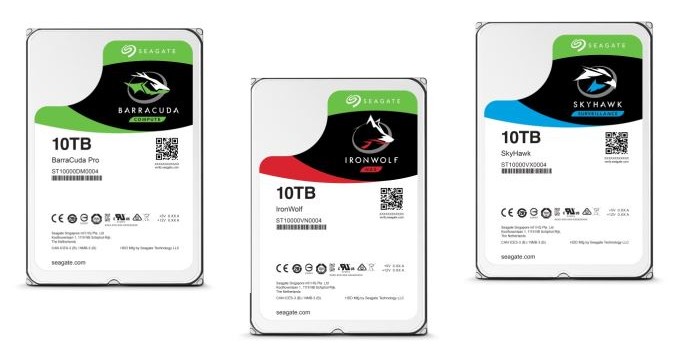
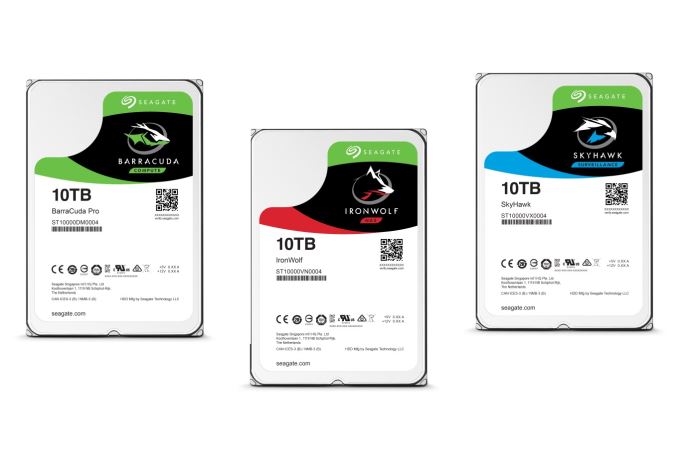
Seagate has introduced a trio of 10TB hard drive models today, as part of the launch of their new Guardian series. There are three main parts to the series: BarraCuda Pro, IronWolf and SkyHawk, all focusing on slightly different markets and available in capacities up to 10TB. The top 10TB models from each segment are based on helium technology, which we have covered in detail in multiple articles. We will be taking a look at the NAS-focused IronWolf series next month, but, a quick look at the performance and features of the BarraCuda Pro is the focus of this capsule review.

Introduction and Testing Methodology

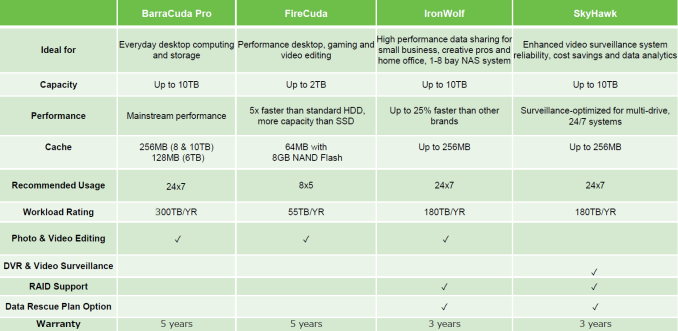
The Seagate BarraCuda Pro 10TB is a 7200RPM SATAIII (6 Gbps) hard drive based on helium technology with a 256MB DRAM cache. According to Seagate, it typically draws around 6.8W, making it one of the most power efficient 3.5″ hard drives in the market. It targets creative professionals with high-performance desktops, home servers and/or direct-attached storage units. It is meant for 24×7 usage (unlike traditional desktop-class hard drives) and carries a workload rating of 300TB/year, backed by a 5-year warranty. The various aspects of the drive are summarized in the table below.

Seagate BarraCuda 10TB Specifications
Model Number ST10000DM0004
Interface SATA 6 Gbps
Sector Size / AF 4096
Rotational Speed 7200 RPM
Cache 256 MB (Multi-segmented)
Rated Load / Unload Cycles 300 K
Non-Recoverable Read Errors / Bits Read < 1 in 1014
MTBF 1 M
Rated Workload ~ 300 TB/yr
Operating Temperature Range 0 to 60 C
Physical Parameters 14.7 x 10.19 x 2.61 cm; 650 g
Warranty 5 years
Price (in USD, as-on-date) $535

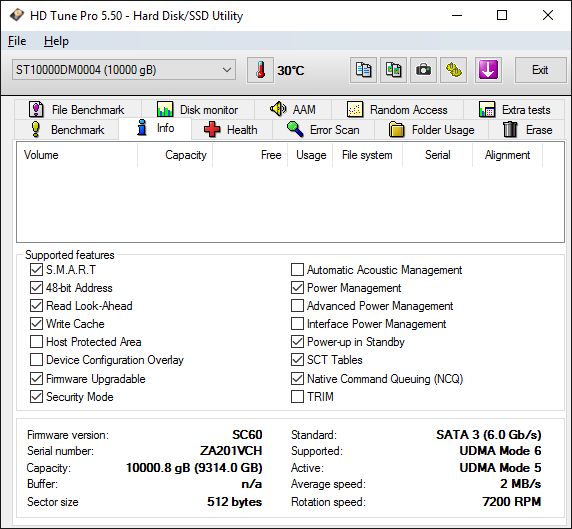
A high-level overview of the various supported SATA features is provided by HD Tune Pro, and shows support for common mechanical features such as NCQ.
The main focus of our evaluation is the performance of the HDD as an internal disk drive in a PC. Towards this, we used one of the SATA 6 Gbps ports off the PCH in the testbed outlined below.

AnandTech DAS Testbed Configuration
Motherboard Asus Z97-PRO Wi-Fi ac ATX
CPU Intel Core i7-4790
Memory Corsair Vengeance Pro CMY32GX3M4A2133C11
32 GB (4x 8GB)
DDR3-2133 @ 11-11-11-27
OS Drive Seagate 600 Pro 400 GB
Optical Drive Asus BW-16D1HT 16x Blu-ray Write (w/ M-Disc Support)
Add-on Card Asus Thunderbolt EX II
Chassis Corsair Air 540
PSU Corsair AX760i 760 W
OS Windows 8.1 Pro
Thanks to Asus and Corsair for the build components

Performance – Raw Drives

HD Tune Pro 5.50 was used to run a number of tests on the unformatted drive. The gallery below presents some interesting numbers for various access types, and how the location of the data in the platter can affect the performance.

Sustained sequential reads can reach a maximum of 258 MBps, but it can also drop down to as low as 110 MBps. Sequential writes exhibit similar numbers. Random reads get around 65 IOPS, while writes come between 56 IOPS and 264 IOPS, depending on the transfer size.

DAS Benchmarks

The BarraCuda Pro was connected to a 6 Gbps SATA port off the PCH in our DAS testbed. After formatting in NTFS, it was subject to our DAS test suite.

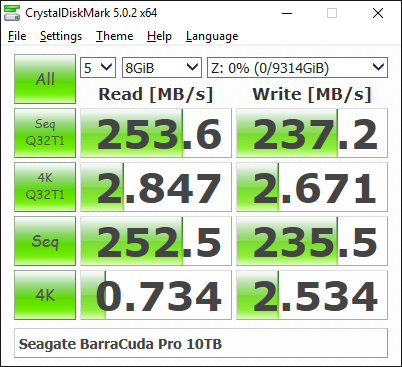
Consumers opting for drives such as the 10TB Seagate BarraCuda Pro typically need high-capacity local storage for holding and editing / processing large-sized multimedia files. Prior to taking a look at the real-life benchmarks, we first check what CrystalDiskMark has to report for the drive.
In order to tackle the real-life use-case of transferring large amounts of data back and forth from the drive, we created three test folders with the following characteristics:

  • Photos: 15.6 GB collection of 4320 photos (RAW as well as JPEGs) in 61 sub-folders
  • Videos: 16.1 GB collection of 244 videos (MP4 as well as MOVs) in 6 sub-folders
  • BR: 10.7 GB Blu-ray folder structure of the IDT Benchmark Blu-ray (the same that we use in our robocopy tests for NAS systems)
Seagate BarraCuda Pro 10TB robocopy Benchmarks (MBps)
  Write Bandwidth Read Bandwidth
Photos 201.32 181.05
Videos 205.84 192.58
Blu-ray Folder 203.87 199.62

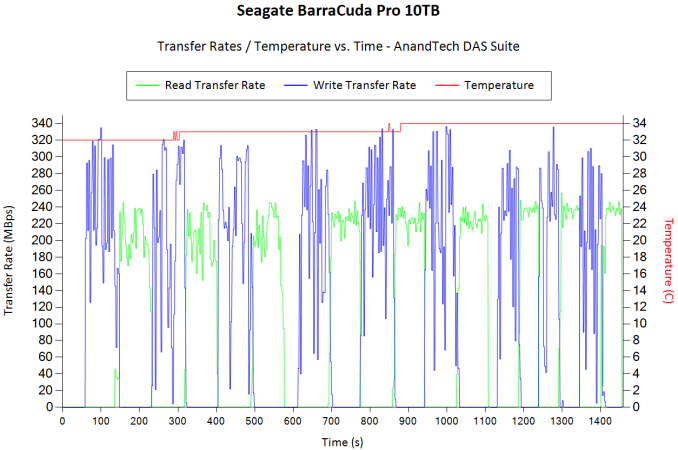
While processing our DAS suite, we also recorded the instantaneous transfer rates and temperature of the drive. Compared to typical disk drives, the write transfers show higher instantaneous speeds due to a combination of the firmware and the 256 MB cache inside the drive. However, sustained write rates are comparable to other high-capacity drives when the cache is excausted. The temperature of the unit at the end of the transfers (more than 250GB of traffic) was less than 35C, pointing to the power-efficiency of the platform.
For the use-case involving editing of multimedia files directly off the disk, we take advantage of PCMark 8’s storage benchmark. The storage workload is a good example of a user workload, involving games as well as multimedia editing applications. The command line version allows us to cherry-pick storage traces to run on a target drive. We chose the following traces.

  • Adobe Photoshop (Light)
  • Adobe Photoshop (Heavy)
  • Adobe After Effects
  • Adobe Illustrator

Usually, PCMark 8 reports time to complete the trace, but the detailed log report has the read and write bandwidth figures which we present in our performance graphs. Note that the bandwidth number reported in the results don’t involve idle time compression. Results might appear low, but that is part of the workload characteristic.

Seagate BarraCuda Pro 10TB PCMark8 Storage Benchmarks (MBps)
  Write Bandwidth Read Bandwidth
Adobe Photoshop (Light) 245.54 10.76
Adobe Photoshop (Heavy) 234.15 12.87
Adobe After Effects 76.35 10.18
Adobe Illustrator 174.86 9.67

Performance with a USB 3.0 Bridge

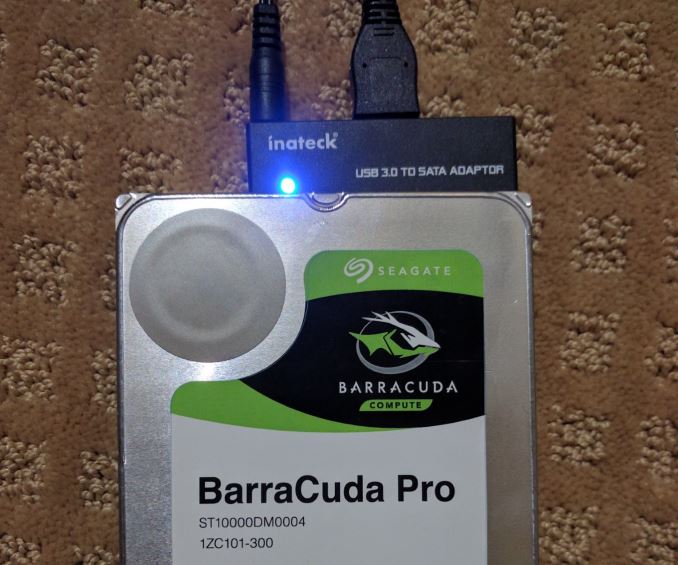
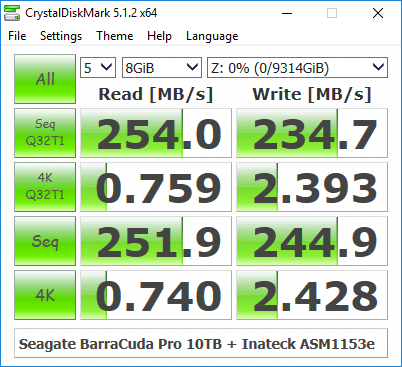
Seagate suggests that the BarraCuda Pro 10TB is suitable for use in direct-attached storage systems. We put the drive behind an Inatek USB 3.0 to SATA adaptor (using the ASMedia ASM1153E chipset) and processed the CrystalDiskMark benchmark.
]

During the benchmark process, we also noted the power consumed by the adaptor at the wall. We found that the combination could draw up to 12W during the spin-up of the hard drive. With no disk traffic, the power consumption dropped down to 3.4W. During the benchmarking process itself, the power consumption at the wall ranged between 6W and 8W.

Concluding Remarks

Coming to the business end of the review, it can be clearly seen that the BarraCuda Pro 10TB is a unique product in the market. It is not often that we see a leading capacity ‘desktop-class’ hard drive rated for 24×7 operation or workload ratings of 300TB/year. To top it all, Seagate is even throwing in a 5-year warranty. The only disappointing aspects are the load/unload cycle rating and the MTBF – given the positioning of the product, it could have been closer to that of the enterprise drives.

In our evaluation, the drive successfully met all of Seagate’s claims. It is pleasing to see helium make its appearance in mass-market consumer devices. Hopefully, economies of scale should help the current MSRPs to go further down in the future.

There is a price to pay for all of the above aspects, though. The MSRP of the BarraCuda Pro 10TB is $535, and it is quite a bit more than that of the other 10TB drives being launched by Seagate today – the SkyHawk surveillance drive ($460) and the IronWolf NAS drive ($470). Seagate’s Enterprise 10TB Helium drive, by comparison, is currently on Amazon for $600. We will address these drives in due course in order to accurately map Seagate’s performance roadmap.
Seagate's New 'Guardian Series' Portfolio Brings 10TB Helium HDDs to Consumers

Seagate’s New ‘Guardian Series’ Portfolio Brings 10TB Helium HDDs to Consumers

Our recent interview with Seagate’s CTO, Mark Re, gave us an idea about of the future of the hard drive market. As late as Q1 2016, Seagate had considered helium-based drives suitable for high-end applications only. However, the fast-changing competitive landscape, as well as changes in consumer requirements, have made it necessary for Seagate to re-evaluate the options. Today, the Guardian Series, consisting of a portfolio of 10TB helium-based drives, is being launched for various segments in the mainstream consumer market.

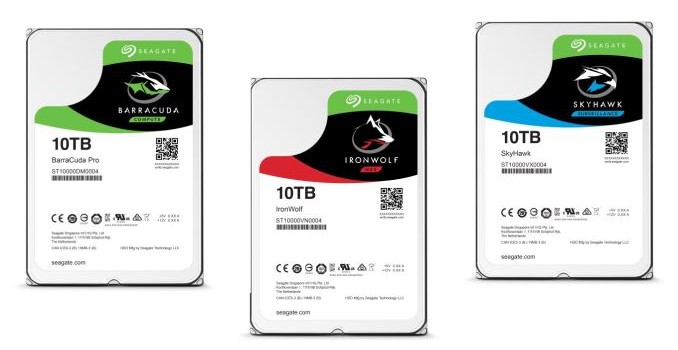
Seagate launched a 10TB helium drive for enterprise applications back in April. The technology is now making its way into 10TB drives for three different market segments:

  • Desktop computing, with the BarraCuda Pro
  • NAS units (1 to 8-bay) with the IronWolf series
  • Surveillance (NVRs and DVRs) with the SkyHawk series

One of the important aspects to note here is that only the 10TB drives are helium-based. All the drives being launched today are 7200 RPM drives and use traditional perpendicular magnetic recording (PMR) technology.

BarraCuda Pro and FireCuda

The BarraCuda series also integrates a multi-tier cache, which involves drive-based management of various storage media on the disk (DRAM, flash and magnetic platters). The intent is obviously to improve responsiveness and, to an extent, also lower power consumption.

In the Compute market, Seagate is also bringing out a new SSHD (SSD + HDD hybrid) under the FireCuda SSHD branding (now, in both 2.5″ and 3.5″ form factors).

IronWolf

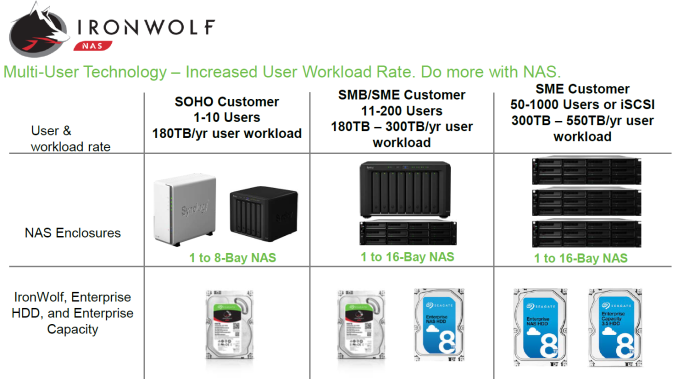
The IronWolf series is focused on hard drives for the NAS segment, currently served by vendors such as Synology and QNAP. One of the most interesting aspects of the IronWolf series is the integration of a rotational vibration sensor in the high-capacity models. This has traditionally been restricted to enterprise NAS drives, and it is a welcome feature. Seagate markets their NAS-optimized firmware under the AgileArray moniker. It includes drive balancing features (vibration dampening hardware control and RV sensor handling) as well as RAID-related features such as TLER (time-limited error recovery) configurations to avoid drives erroneously dropping out of arrays etc. It also includes specific power management features such as optimized spin-down / standby / sleep entry.

IronWolf is rated for workloads of up to 180TB/yr. Higher workload options include the Enterprise NAS HDD (300TB/yr) and the Enterprise Capacity HDD (550TB/yr)

IronWolf drives also come with the optional Seagate Rescue data recovery service (this is retained from the previous NAS HDD / Enterprise NAS HDD marketing feature set).

SkyHawk

The final market segment that Seagate is addressing today is storage for surveillance / IP camera / NVR (networked video recorder) applications. This segment is forecast for huge growth, bringing high-capacity drives into the forefront.

The SkyHawk series will be addressing this market with firmware optimized for video stream recording (ATA streaming extensions support for up to 64HD cameras) and 24×7 operation. The workload rating is similar to the IronWolf series at 180TB/yr. The firmware also enables quick time-to-record when coming out of idle – something essential for scenarios where recording is triggered only when motion is detected. Helium-based drives also enable low power consumption and lowered heat dissipation requirements.

The SkyHawk drives also come with RV sensors and the series is supported by Seagate Rescue for data recovery. For large-scale surveillance storage requirements (say, 100+ cameras), Seagate suggests the Enterprise Capacity HDDs with a 550TB/yr workload rating instead.

Prices and Availability

The BarraCuda Pro carries a 5-year warranty, with the 10TB drive having an MSRP of $535. The IronWolf and SkyHawk drives carry 3-year warranties, with the 10TB drives carrying MSRPs of $470 and $460 respectively.

Seagate seemed to be late to the helium game, with both HGST and Western Digital coming out with a number of helium-based drives for different applications over the last couple of years. However, with the introduction of the Guardian series, Seagate has wrested the initiative by targeting multiple market segments. In particular, targeting the surveillance market that is forecast for huge growth will help Seagate in achieving economies of scale. That will, in turn, should make the price of drives such as the BarraCuda Pro 10TB more palatable to the average consumer.


Seagate's New 'Guardian Series' Portfolio Brings 10TB Helium HDDs to Consumers

Seagate’s New ‘Guardian Series’ Portfolio Brings 10TB Helium HDDs to Consumers

Our recent interview with Seagate’s CTO, Mark Re, gave us an idea about of the future of the hard drive market. As late as Q1 2016, Seagate had considered helium-based drives suitable for high-end applications only. However, the fast-changing competitive landscape, as well as changes in consumer requirements, have made it necessary for Seagate to re-evaluate the options. Today, the Guardian Series, consisting of a portfolio of 10TB helium-based drives, is being launched for various segments in the mainstream consumer market.

Seagate launched a 10TB helium drive for enterprise applications back in April. The technology is now making its way into 10TB drives for three different market segments:

  • Desktop computing, with the BarraCuda Pro
  • NAS units (1 to 8-bay) with the IronWolf series
  • Surveillance (NVRs and DVRs) with the SkyHawk series

One of the important aspects to note here is that only the 10TB drives are helium-based. All the drives being launched today are 7200 RPM drives and use traditional perpendicular magnetic recording (PMR) technology.

BarraCuda Pro and FireCuda

The BarraCuda series also integrates a multi-tier cache, which involves drive-based management of various storage media on the disk (DRAM, flash and magnetic platters). The intent is obviously to improve responsiveness and, to an extent, also lower power consumption.

In the Compute market, Seagate is also bringing out a new SSHD (SSD + HDD hybrid) under the FireCuda SSHD branding (now, in both 2.5″ and 3.5″ form factors).

IronWolf

The IronWolf series is focused on hard drives for the NAS segment, currently served by vendors such as Synology and QNAP. One of the most interesting aspects of the IronWolf series is the integration of a rotational vibration sensor in the high-capacity models. This has traditionally been restricted to enterprise NAS drives, and it is a welcome feature. Seagate markets their NAS-optimized firmware under the AgileArray moniker. It includes drive balancing features (vibration dampening hardware control and RV sensor handling) as well as RAID-related features such as TLER (time-limited error recovery) configurations to avoid drives erroneously dropping out of arrays etc. It also includes specific power management features such as optimized spin-down / standby / sleep entry.

IronWolf is rated for workloads of up to 180TB/yr. Higher workload options include the Enterprise NAS HDD (300TB/yr) and the Enterprise Capacity HDD (550TB/yr)

IronWolf drives also come with the optional Seagate Rescue data recovery service (this is retained from the previous NAS HDD / Enterprise NAS HDD marketing feature set).

SkyHawk

The final market segment that Seagate is addressing today is storage for surveillance / IP camera / NVR (networked video recorder) applications. This segment is forecast for huge growth, bringing high-capacity drives into the forefront.

The SkyHawk series will be addressing this market with firmware optimized for video stream recording (ATA streaming extensions support for up to 64HD cameras) and 24×7 operation. The workload rating is similar to the IronWolf series at 180TB/yr. The firmware also enables quick time-to-record when coming out of idle – something essential for scenarios where recording is triggered only when motion is detected. Helium-based drives also enable low power consumption and lowered heat dissipation requirements.

The SkyHawk drives also come with RV sensors and the series is supported by Seagate Rescue for data recovery. For large-scale surveillance storage requirements (say, 100+ cameras), Seagate suggests the Enterprise Capacity HDDs with a 550TB/yr workload rating instead.

Prices and Availability

The BarraCuda Pro carries a 5-year warranty, with the 10TB drive having an MSRP of $535. The IronWolf and SkyHawk drives carry 3-year warranties, with the 10TB drives carrying MSRPs of $470 and $460 respectively.

Seagate seemed to be late to the helium game, with both HGST and Western Digital coming out with a number of helium-based drives for different applications over the last couple of years. However, with the introduction of the Guardian series, Seagate has wrested the initiative by targeting multiple market segments. In particular, targeting the surveillance market that is forecast for huge growth will help Seagate in achieving economies of scale. That will, in turn, should make the price of drives such as the BarraCuda Pro 10TB more palatable to the average consumer.


SiFive Unveils Freedom Platforms for RISC-V-Based Semi-Custom Chips

SiFive Unveils Freedom Platforms for RISC-V-Based Semi-Custom Chips

SiFive, a company established by researchers who invented the RISC-V instruction set architecture in the University of California Berkeley several years ago, has this week announced two platforms which could be used to design semi-custom SoCs based on RISC-V cores. SiFive is the world’s first and yet the only company developing chips featuring the RISC-V ISA and it already has initial customers interested in designing SoCs for machine learning, storage, embedded, IoT and wearable applications.

SiFive: World’s First Developer of Commercial RISC-V Chips

RISC-V is an open-source microprocessor architecture developed by researchers in the Computer Science Division at UC Berkeley and officially introduced in 2010. It has since been evolved by various both academic researchers and volunteers. The CPU ISA was designed for various applications including mobile and embedded devices, and is available free under a BSD license. Those who adopt RISC-V can develop either open and free cores, or closed and proprietary cores, which is good for developing commercial projects that do not want to share secrets with rivals.

A number of companies (including huge ones like Google, Hewlett Packard Enterprise and Oracle) recently joined the RISC-V Foundation, but barely any organization has unveiled an actual RISC-V-based commercial chip (what they have internally is anyone’s guess). Basically, as far as we know, the technology has never left various research labs. As a result the original team that worked on the technology at UC Berkeley founded SiFive, which is going to develop commercial semi-custom SoCs for various applications featuring RISC-V cores as well as third-party IP.

New Semi-Custom Chip Business Model

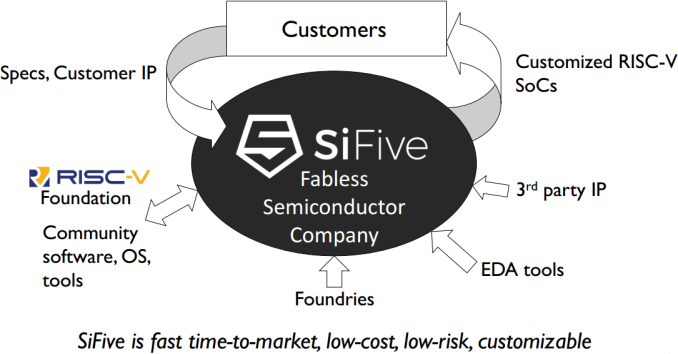
Chips are used for a lot of applications and in the coming years the need for custom SoCs will only grow as customers demand specialized hardware for their problem sets. However, development of modern SoCs is not a very affordable task from a financial standpoint. To build a simple chip, one needs to license the general-purpose compute cores (or ISA itself) from companies like ARM or Imagination Technologies, but to also get a variety of supporting IP (e.g., memory controllers, I/O interfaces, etc.) either from developers like Rambus, or build everything from scratch. Licensing typically requires companies to pay an upfront fee for a set of rights, and an SDK, and then royalties for every ASIC (application specific integrated circuit) containing the IP that they sell. In other words, a company building a chip needs to make a hefty investment to begin, and then the licensing fees will affect the pricing of every unit sold. Moreover, to create a chip, one needs a semiconductor development team to specify requirements, design the IC (integrated circuit), tape it out, analyze defects and implement fixes (if needed). Hiring a dedicated development team for just one chip is expensive and complicated. As a result, many newcomers need either to join bigger players (who have appropriate teams inhouse), or concentrate on software and utilize off-the-shelf silicon to build modern devices. SiFive plans to design semi-custom chips for the latter companies using RISC-V cores as well as its common Freedom platforms and technologies. Use of RISC-V cores (as well as common components designed by SiFive) is being touted to help to significantly lower development costs.

The company promises that its approach will enable players without significant financial and technological backing to get their own custom SoCs with their own special-purpose IP. SiFive claims that it will be able not only to integrate third-party IP into chips, but also add custom features, such as RISC-V extensions, accelerators, or co-processors. Moreover, the chip designer can also help its partners to integrate their unique intellectual property. In fact, SiFive can manage the entire process of chip development and manufacturing and then supply its clients the final manufactured chip for commercial applications.

From many points of view, SiFive’s business model resembles that of AMD’s EESC (enterprise, embedded and semi-custom) division, which develops SoCs for companies like Microsoft and Sony. The important difference between SiFive and other developers of semi-custom chips is that SiFive publishes all the low-level specs of its Freedom Unleashed and Freedom Everywhere platforms necessary for software development (e.g., memory maps, debug interfaces, interrupt control, etc.), whereas RISC-V Foundation provides basic development tools to make it considerably easier for programmers to design software for chips based on the microarchitecture. In fact, the software side of the story here is no less important than the hardware part. The use of the BSD license for a lot of this further lowers the investments required to deliver a solution involving a custom silicon and supporting software. For example, SiFive tells us that there is a lot of standard software (e.g., FreeBSE, FreeRTOS, etc) that already works on the Freedom platforms (on RISC-V-based platforms, to be more precise), so its customers only need to focus on their particular area of chip and software differentiation. However, it has been noted that customer specific extensions to the RISC-V ISA could certainly break some level of software compatibility, depending what is used and how.

“This expands on the tremendous amount of momentum in the RISC-V ecosystem,” said Jack Kang, VP of product and business development at SiFive. “Besides the ports and software targeted for the RISC-V ISA, these platforms will enable OS and other low-level software to be targeted to a standard platform specification.”

Two Platforms

Initially, SiFive will offer its clients two base platforms for different applications: the Freedom Unleashed (U500) for performance-demanding applications as well as the Freedom Everywhere (E300) for low-power devices. Both platforms have been verified with TSMC and can allow SiFive to quickly add customizations, which is what their customers require and which greatly speeds up time-to-market, simply because the bigger parts of Freedom-based ASICs have already been developed.

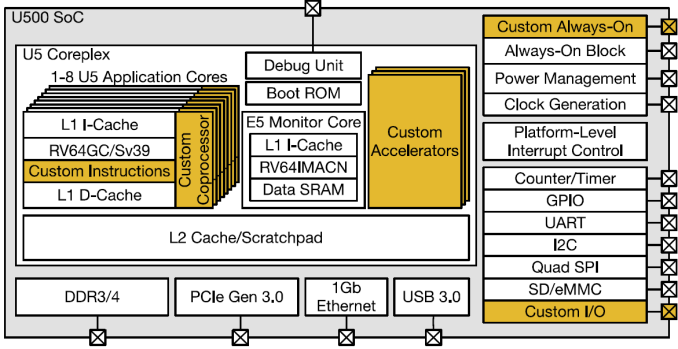
The SiFive Freedom U500 platform will feature up to eight 64-bit cache-coherent Unix-capable RISC-V cores. Each SoC based on the U500 features four DDR3/DDR4 DRAM channels with ECC support, PCIe 3.0, USB 3.0 (with OTG support), Gigabit Ethernet, power management, a variety of peripheral interfaces (e.g., SD/eMMC, GPIO, UART, I2C, etc.) and so on. SiFive can add various extensions to the general-purpose cores to meet demands of clients, add custom input/output interfaces, custom co-processors/accelerators and other IP. The chip designer verified its Freedom U500 platform with TSMC’s 28nm process technology and thus can quickly incorporate additional blocks, tape out the product and manufacture it using a proven process technology. SiFive tells us that several companies designing solutions for machine learning, storage, and networking have already expressed interest in using the U500 platform directly with SiFive.

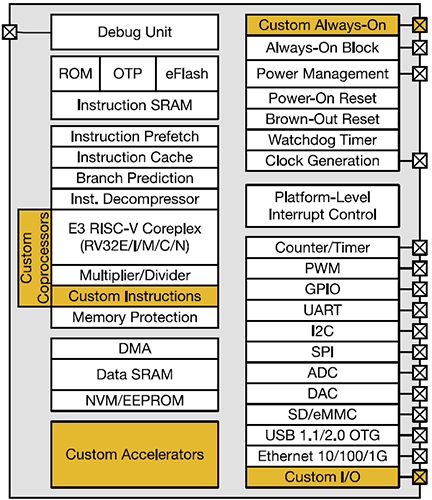
The SiFive Freedom E300 platform is intended for less demanding applications, which is why it is powered by a 32-bit single-issue in-order general purpose RISC-V core, which can be customized or enhanced to meet specific needs. The design supports on-chip memory and can support various interface technologies, including SD/eMMC, USB 1.1, GPIO, UART, I2C and so on. The Freedom E300 is optimized for TSMC’s 180 nm fabrication process, which is 15 years old and which is still used for many chips that are not complex and do not run at high frequencies. According to the chip developer, customers working on embedded microcontrollers, IoT, and wearables have demonstrated some interest in the E300 platform.

Default die sizes and cost have not been explicitly mentioned by SiFive at this time – it will be up to the customer IP and financial arrangements on a per-customer basis.

New Horizons

The management of SiFive stresses that the two platforms, which the company announced this month, are only the beginning for SiFive and more will be incoming. At a high level, this should broaden the number of markets that SiFive can address. Those future platforms will use different process technologies depending on requirements of appropriate applications. Keeping in mind the key promise of SiFive: low-cost development of custom SoCs. 

SiFive does not elaborate how much money its customers will be able to save due to the free RISC-V microarchitecture, any pre-developed platforms (with re-used components), proven silicon, open-source software or other advantages that the company has to offer. This is understandable because every customer product could be unique in complexity and customization. However, SiFive says that in certain cases it will be able to deliver products to startups that do not have any silicon teams at all, which essentially means that the developer plans to address needs of very small players. Typically, such companies cannot get access to custom silicon because of high costs and other difficulties, but SiFive implies that with their pre-developed Freedom platforms the startups may get their chance to build semi-custom chips and take advantage of things like higher performance and/or lower power consumption compared to off-the-shelf not-customized silicon or FPGAs. The VP of SiFive told us that he could see a future where a couple of engineers in a garage can get access to a custom SoC “with a moderate Kickstarter campaign.”

SiFive claims that it is a fabless semiconductor company which specializes in the development of various chips based on RISC-V-compatible cores. While semi-custom RISC-V SoCs may not be the most lucrative market segment, SiFive is the only player here and the company will clearly try to capitalize on its unique position. SiFive’s decision to use the RISC-V ISA is natural given the background of its founders, as well as the company’s business model (RISC-V is free). However, background and costs are not the only reason here. The interest towards the microarchitecture is growing – in recent months, companies like AMD, Google, IBM, NVIDIA, Microsoft, Qualcomm and Western Digital joined RISC-V Foundation, which manages the development of the technology.

Given the nature of semi-custom chip business, SiFive cannot disclose the names of companies interested in its platforms and since this is a private company, it does not need to confirm whether it is developing any commercial chips at all. However, given the interest for RISC-V from the aforementioned industry heavyweights, it looks like SiFive is a company to watch, not only because it could build interesting semi-custom SoCs, but because it could actually develop the industry’s first commercial chips based on open-source RISC-V microarchitecture.

SiFive Unveils Freedom Platforms for RISC-V-Based Semi-Custom Chips

SiFive Unveils Freedom Platforms for RISC-V-Based Semi-Custom Chips

SiFive, a company established by researchers who invented the RISC-V instruction set architecture in the University of California Berkeley several years ago, has this week announced two platforms which could be used to design semi-custom SoCs based on RISC-V cores. SiFive is the world’s first and yet the only company developing chips featuring the RISC-V ISA and it already has initial customers interested in designing SoCs for machine learning, storage, embedded, IoT and wearable applications.

SiFive: World’s First Developer of Commercial RISC-V Chips

RISC-V is an open-source microprocessor architecture developed by researchers in the Computer Science Division at UC Berkeley and officially introduced in 2010. It has since been evolved by various both academic researchers and volunteers. The CPU ISA was designed for various applications including mobile and embedded devices, and is available free under a BSD license. Those who adopt RISC-V can develop either open and free cores, or closed and proprietary cores, which is good for developing commercial projects that do not want to share secrets with rivals.

A number of companies (including huge ones like Google, Hewlett Packard Enterprise and Oracle) recently joined the RISC-V Foundation, but barely any organization has unveiled an actual RISC-V-based commercial chip (what they have internally is anyone’s guess). Basically, as far as we know, the technology has never left various research labs. As a result the original team that worked on the technology at UC Berkeley founded SiFive, which is going to develop commercial semi-custom SoCs for various applications featuring RISC-V cores as well as third-party IP.

New Semi-Custom Chip Business Model

Chips are used for a lot of applications and in the coming years the need for custom SoCs will only grow as customers demand specialized hardware for their problem sets. However, development of modern SoCs is not a very affordable task from a financial standpoint. To build a simple chip, one needs to license the general-purpose compute cores (or ISA itself) from companies like ARM or Imagination Technologies, but to also get a variety of supporting IP (e.g., memory controllers, I/O interfaces, etc.) either from developers like Rambus, or build everything from scratch. Licensing typically requires companies to pay an upfront fee for a set of rights, and an SDK, and then royalties for every ASIC (application specific integrated circuit) containing the IP that they sell. In other words, a company building a chip needs to make a hefty investment to begin, and then the licensing fees will affect the pricing of every unit sold. Moreover, to create a chip, one needs a semiconductor development team to specify requirements, design the IC (integrated circuit), tape it out, analyze defects and implement fixes (if needed). Hiring a dedicated development team for just one chip is expensive and complicated. As a result, many newcomers need either to join bigger players (who have appropriate teams inhouse), or concentrate on software and utilize off-the-shelf silicon to build modern devices. SiFive plans to design semi-custom chips for the latter companies using RISC-V cores as well as its common Freedom platforms and technologies. Use of RISC-V cores (as well as common components designed by SiFive) is being touted to help to significantly lower development costs.

The company promises that its approach will enable players without significant financial and technological backing to get their own custom SoCs with their own special-purpose IP. SiFive claims that it will be able not only to integrate third-party IP into chips, but also add custom features, such as RISC-V extensions, accelerators, or co-processors. Moreover, the chip designer can also help its partners to integrate their unique intellectual property. In fact, SiFive can manage the entire process of chip development and manufacturing and then supply its clients the final manufactured chip for commercial applications.

From many points of view, SiFive’s business model resembles that of AMD’s EESC (enterprise, embedded and semi-custom) division, which develops SoCs for companies like Microsoft and Sony. The important difference between SiFive and other developers of semi-custom chips is that SiFive publishes all the low-level specs of its Freedom Unleashed and Freedom Everywhere platforms necessary for software development (e.g., memory maps, debug interfaces, interrupt control, etc.), whereas RISC-V Foundation provides basic development tools to make it considerably easier for programmers to design software for chips based on the microarchitecture. In fact, the software side of the story here is no less important than the hardware part. The use of the BSD license for a lot of this further lowers the investments required to deliver a solution involving a custom silicon and supporting software. For example, SiFive tells us that there is a lot of standard software (e.g., FreeBSE, FreeRTOS, etc) that already works on the Freedom platforms (on RISC-V-based platforms, to be more precise), so its customers only need to focus on their particular area of chip and software differentiation. However, it has been noted that customer specific extensions to the RISC-V ISA could certainly break some level of software compatibility, depending what is used and how.

“This expands on the tremendous amount of momentum in the RISC-V ecosystem,” said Jack Kang, VP of product and business development at SiFive. “Besides the ports and software targeted for the RISC-V ISA, these platforms will enable OS and other low-level software to be targeted to a standard platform specification.”

Two Platforms

Initially, SiFive will offer its clients two base platforms for different applications: the Freedom Unleashed (U500) for performance-demanding applications as well as the Freedom Everywhere (E300) for low-power devices. Both platforms have been verified with TSMC and can allow SiFive to quickly add customizations, which is what their customers require and which greatly speeds up time-to-market, simply because the bigger parts of Freedom-based ASICs have already been developed.

The SiFive Freedom U500 platform will feature up to eight 64-bit cache-coherent Unix-capable RISC-V cores. Each SoC based on the U500 features four DDR3/DDR4 DRAM channels with ECC support, PCIe 3.0, USB 3.0 (with OTG support), Gigabit Ethernet, power management, a variety of peripheral interfaces (e.g., SD/eMMC, GPIO, UART, I2C, etc.) and so on. SiFive can add various extensions to the general-purpose cores to meet demands of clients, add custom input/output interfaces, custom co-processors/accelerators and other IP. The chip designer verified its Freedom U500 platform with TSMC’s 28nm process technology and thus can quickly incorporate additional blocks, tape out the product and manufacture it using a proven process technology. SiFive tells us that several companies designing solutions for machine learning, storage, and networking have already expressed interest in using the U500 platform directly with SiFive.

The SiFive Freedom E300 platform is intended for less demanding applications, which is why it is powered by a 32-bit single-issue in-order general purpose RISC-V core, which can be customized or enhanced to meet specific needs. The design supports on-chip memory and can support various interface technologies, including SD/eMMC, USB 1.1, GPIO, UART, I2C and so on. The Freedom E300 is optimized for TSMC’s 180 nm fabrication process, which is 15 years old and which is still used for many chips that are not complex and do not run at high frequencies. According to the chip developer, customers working on embedded microcontrollers, IoT, and wearables have demonstrated some interest in the E300 platform.

Default die sizes and cost have not been explicitly mentioned by SiFive at this time – it will be up to the customer IP and financial arrangements on a per-customer basis.

New Horizons

The management of SiFive stresses that the two platforms, which the company announced this month, are only the beginning for SiFive and more will be incoming. At a high level, this should broaden the number of markets that SiFive can address. Those future platforms will use different process technologies depending on requirements of appropriate applications. Keeping in mind the key promise of SiFive: low-cost development of custom SoCs. 

SiFive does not elaborate how much money its customers will be able to save due to the free RISC-V microarchitecture, any pre-developed platforms (with re-used components), proven silicon, open-source software or other advantages that the company has to offer. This is understandable because every customer product could be unique in complexity and customization. However, SiFive says that in certain cases it will be able to deliver products to startups that do not have any silicon teams at all, which essentially means that the developer plans to address needs of very small players. Typically, such companies cannot get access to custom silicon because of high costs and other difficulties, but SiFive implies that with their pre-developed Freedom platforms the startups may get their chance to build semi-custom chips and take advantage of things like higher performance and/or lower power consumption compared to off-the-shelf not-customized silicon or FPGAs. The VP of SiFive told us that he could see a future where a couple of engineers in a garage can get access to a custom SoC “with a moderate Kickstarter campaign.”

SiFive claims that it is a fabless semiconductor company which specializes in the development of various chips based on RISC-V-compatible cores. While semi-custom RISC-V SoCs may not be the most lucrative market segment, SiFive is the only player here and the company will clearly try to capitalize on its unique position. SiFive’s decision to use the RISC-V ISA is natural given the background of its founders, as well as the company’s business model (RISC-V is free). However, background and costs are not the only reason here. The interest towards the microarchitecture is growing – in recent months, companies like AMD, Google, IBM, NVIDIA, Microsoft, Qualcomm and Western Digital joined RISC-V Foundation, which manages the development of the technology.

Given the nature of semi-custom chip business, SiFive cannot disclose the names of companies interested in its platforms and since this is a private company, it does not need to confirm whether it is developing any commercial chips at all. However, given the interest for RISC-V from the aforementioned industry heavyweights, it looks like SiFive is a company to watch, not only because it could build interesting semi-custom SoCs, but because it could actually develop the industry’s first commercial chips based on open-source RISC-V microarchitecture.