News


Intel’s ‘Tick-Tock’ Seemingly Dead, Becomes ‘Process-Architecture-Optimization’
Intel’s ‘Tick-Tock’ Seemingly Dead, Becomes ‘Process-Architecture-Optimization’

As reported at The Motley Fool, Intel’s latest 10-K / annual report filing would seem to suggest that the ‘Tick-Tock’ strategy of introducing a new lithographic process note in one product cycle (a ‘tick’) and then an upgraded microarchitecture the next product cycle (a ‘tock’) is going to fall by the wayside for the next two lithographic nodes at a minimum, to be replaced with a three element cycle known as ‘Process-Architecture-Optimization’.

Intel’s Tick-Tock strategy has been the bedrock of their microprocessor dominance of the last decade. Throughout the tenure, every other year Intel would upgrade their fabrication plants to be able to produce processors with a smaller feature set, improving die area, power consumption, and slight optimizations of the microarchitecture, and in the years between the upgrades would launch a new set of processors based on a wholly new (sometimes paradigm shifting) microarchitecture for large performance upgrades. However, due to the difficulty of implementing a ‘tick’, the ever decreasing process node size and complexity therein, as reported previously with 14nm and the introduction of Kaby Lake, Intel’s latest filing would suggest that 10nm will follow a similar pattern as 14nm by introducing a third stage to the cadence.
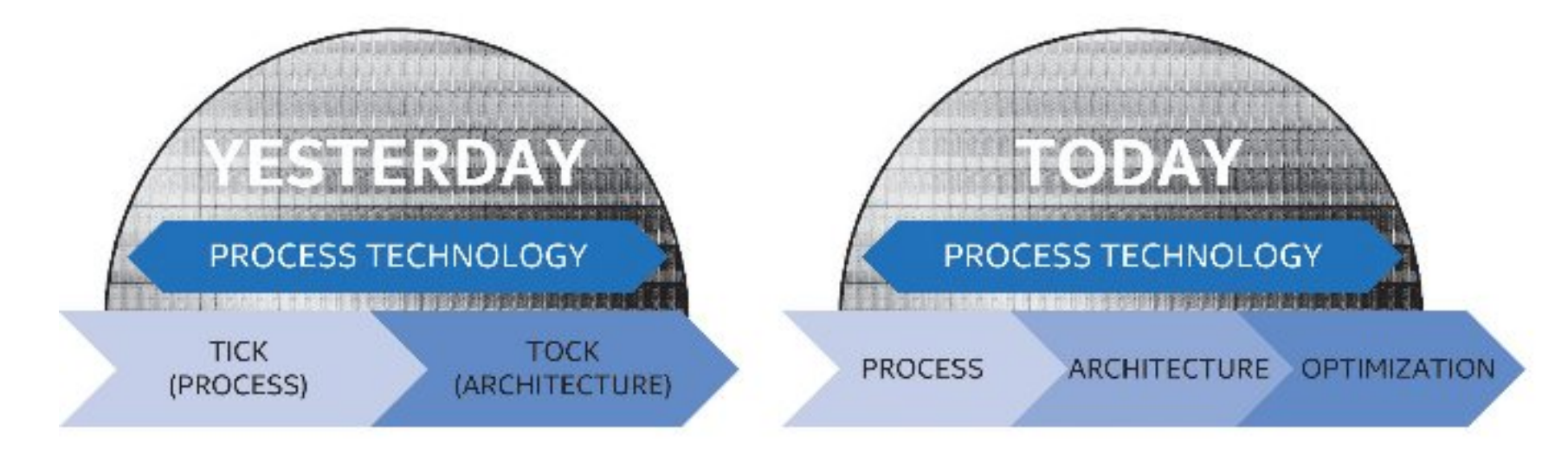
From Intel’s report: As part of our R&D efforts, we plan to introduce a new Intel Core microarchitecture for desktops, notebooks (including Ultrabook devices and 2 in 1 systems), and Intel Xeon processors on a regular cadence. We expect to lengthen the amount of time we will utilize our 14nm and our next generation 10nm process technologies, further optimizing our products and process technologies while meeting the yearly market cadence for product introductions.

While the new PAO or ‘Performance-Architecture-Optimization’ model is a direct result of the complexity of developing and implementing new lithographic nodes (Intel has even entered into a new five-year agreement with ASML to develop new extreme-ultra-violet lithographic techniques), but also with new process nodes typically comes a time where yields have to become high enough to remain financially viable in the long term. It has been well documented that the complexity of Intel’s 14nm node using the latest generation FinFET technology took longer than expected to reach maturation point compared to 22nm. As a result, product launches were stretched out and within a three-year cycle Intel was starting to produce only two new generations of products.
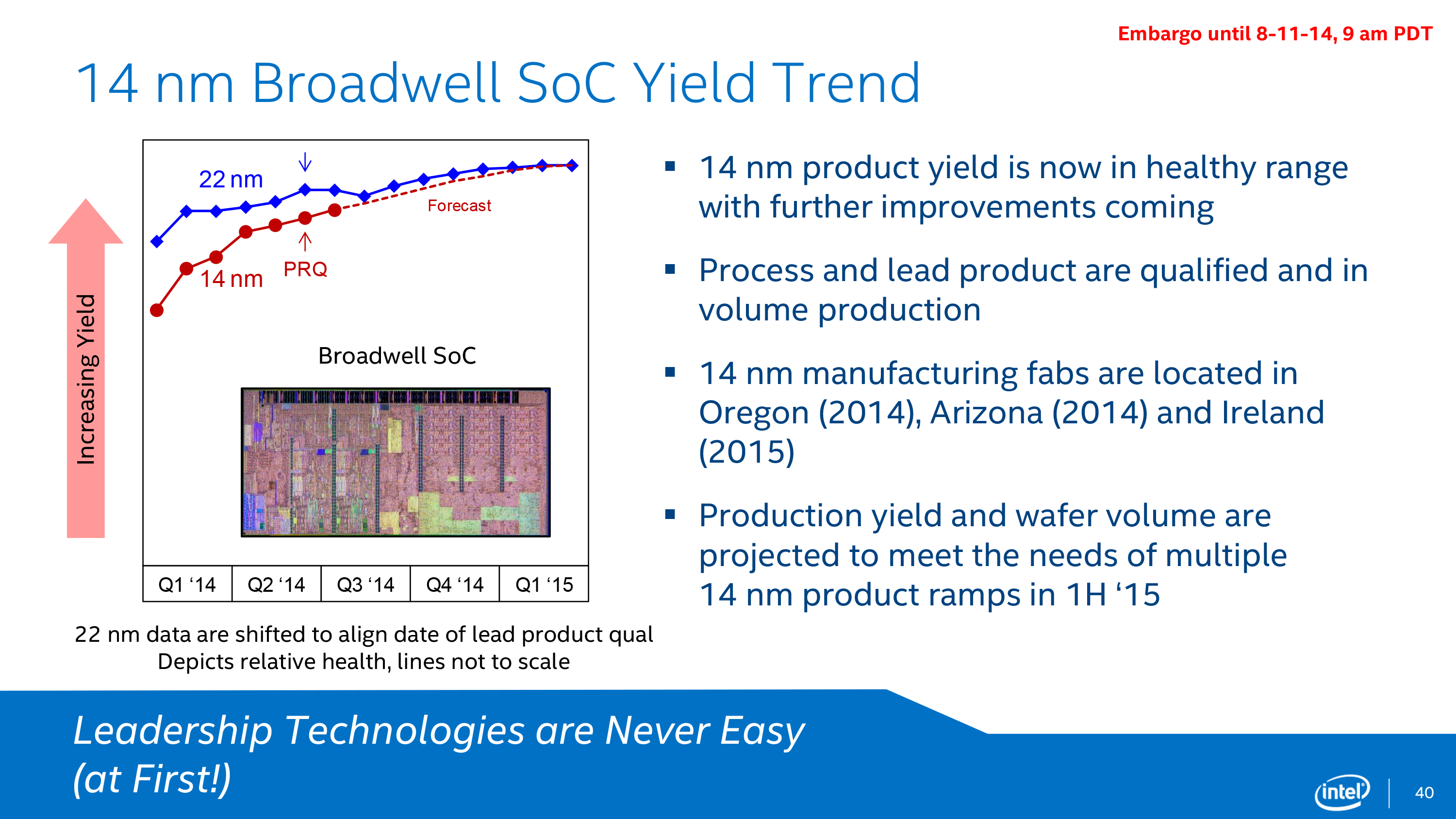
Intel’s current fabs in Ireland, Arizona, and Oregon are currently producing wafers on the 14nm node, with Israel joining Arizona and Oregon on the 22nm node. Intel also has agreements in place for third-party companies (such as Rockchip) to manufacture Intel’s parts for certain regional activity. As well as looking forward to 10nm, Intel’s filing also states projects in the work to move from 300mm wafers to 450mm wafers, reducing cost, although does not put a time frame on it.

The manufacturing lead Intel has had over the past few years over rivals such as Samsung, TSMC and Global Foundries, has put them in a commanding position in both home computing and enterprise. One could argue that by elongating the next two process nodes, Intel might lose ground on their advantage, especially as other companies start hitting their stride. However, the research gap is still there – Intel introduced 14nm back in August 2014, and has since released parts upwards of 400mm2, whereas Samsung 14nm / TSMC 16nm had to wait until the launch of the iPhone to see 100mm2 parts on the shelves, with Global Foundries still to launch their 14nm parts into products. While this relates to density, both power and performance are still considered to be on Intel’s side, especially for larger dies.
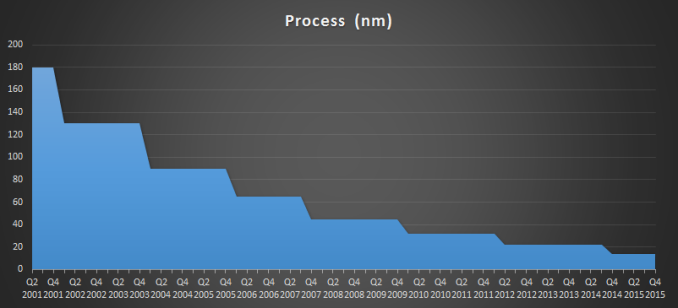
Intel’s Current Process Over Time

On the product side of things, Intel’s strategy of keeping the same microarchitecture for two generations allows its business customers to guarantee the lifetime of the halo platform, and maintain consistency with CPU sockets in both consumer and enterprise. Moving to a three stage cycle has thrown some uncertainty on this, depending on how much ‘optimization’ will go into the PAO stage: whether it will be microarchitectural, better voltage and thermal qualities, or if it will be graphics focused, or even if it will keep the same socket/chipset. This has a knock on effect with Intel’s motherboard partners, who have used the updated socket and chipset strategy every two generations as a spike in revenue.

Suggested Reading:

EUV Lithography Makes Good Progress, Still Not Ready for Prime Time
Tick Tock on the Rocks: Intel Delays 10nm, adds 3rd Gen 14nm
The Intel Skylake Mobile and Desktop Launch with Microarchitecture Analysis

Intel’s ‘Tick-Tock’ Seemingly Dead, Becomes ‘Process-Architecture-Optimization’

Intel’s ‘Tick-Tock’ Seemingly Dead, Becomes ‘Process-Architecture-Optimization’

As reported at The Motley Fool, Intel’s latest 10-K / annual report filing would seem to suggest that the ‘Tick-Tock’ strategy of introducing a new lithographic process note in one product cycle (a ‘tick’) and then an upgraded microarchitecture the next product cycle (a ‘tock’) is going to fall by the wayside for the next two lithographic nodes at a minimum, to be replaced with a three element cycle known as ‘Process-Architecture-Optimization’.

Intel’s Tick-Tock strategy has been the bedrock of their microprocessor dominance of the last decade. Throughout the tenure, every other year Intel would upgrade their fabrication plants to be able to produce processors with a smaller feature set, improving die area, power consumption, and slight optimizations of the microarchitecture, and in the years between the upgrades would launch a new set of processors based on a wholly new (sometimes paradigm shifting) microarchitecture for large performance upgrades. However, due to the difficulty of implementing a ‘tick’, the ever decreasing process node size and complexity therein, as reported previously with 14nm and the introduction of Kaby Lake, Intel’s latest filing would suggest that 10nm will follow a similar pattern as 14nm by introducing a third stage to the cadence.

From Intel’s report: As part of our R&D efforts, we plan to introduce a new Intel Core microarchitecture for desktops, notebooks (including Ultrabook devices and 2 in 1 systems), and Intel Xeon processors on a regular cadence. We expect to lengthen the amount of time we will utilize our 14nm and our next generation 10nm process technologies, further optimizing our products and process technologies while meeting the yearly market cadence for product introductions.

While the new PAO or ‘Process-Architecture-Optimization’ model is a direct result of the complexity of developing and implementing new lithographic nodes (Intel has even entered into a new five-year agreement with ASML to develop new extreme-ultra-violet lithographic techniques), but also with new process nodes typically comes a time where yields have to become high enough to remain financially viable in the long term. It has been well documented that the complexity of Intel’s 14nm node using the latest generation FinFET technology took longer than expected to reach maturation point compared to 22nm. As a result, product launches were stretched out and within a three-year cycle Intel was starting to produce only two new generations of products.

Intel’s current fabs in Ireland, Arizona, and Oregon are currently producing wafers on the 14nm node, with Israel joining Arizona and Oregon on the 22nm node. Intel also has agreements in place for third-party companies (such as Rockchip) to manufacture Intel’s parts for certain regional activity. As well as looking forward to 10nm, Intel’s filing also states projects in the work to move from 300mm wafers to 450mm wafers, reducing cost, although does not put a time frame on it.

The manufacturing lead Intel has had over the past few years over rivals such as Samsung, TSMC and Global Foundries, has put them in a commanding position in both home computing and enterprise. One could argue that by elongating the next two process nodes, Intel might lose ground on their advantage, especially as other companies start hitting their stride. However, the research gap is still there – Intel introduced 14nm back in August 2014, and has since released parts upwards of 400mm2, whereas Samsung 14nm / TSMC 16nm had to wait until the launch of the iPhone to see 100mm2 parts on the shelves, with Global Foundries still to launch their 14nm parts into products. While this relates to density, both power and performance are still considered to be on Intel’s side, especially for larger dies.

Intel’s Current Process Over Time

On the product side of things, Intel’s strategy of keeping the same microarchitecture for two generations allows its business customers to guarantee the lifetime of the halo platform, and maintain consistency with CPU sockets in both consumer and enterprise. Moving to a three stage cycle has thrown some uncertainty on this, depending on how much ‘optimization’ will go into the PAO stage: whether it will be microarchitectural, better voltage and thermal qualities, or if it will be graphics focused, or even if it will keep the same socket/chipset. This has a knock on effect with Intel’s motherboard partners, who have used the updated socket and chipset strategy every two generations as a spike in revenue.

Suggested Reading:

EUV Lithography Makes Good Progress, Still Not Ready for Prime Time
Tick Tock on the Rocks: Intel Delays 10nm, adds 3rd Gen 14nm
The Intel Skylake Mobile and Desktop Launch with Microarchitecture Analysis

Google Updates Youtube For iOS To Support Slide Over And Split Screen

Google Updates Youtube For iOS To Support Slide Over And Split Screen

Today Google shipped an update for the Youtube application on iOS. The update brings the app to version 11.10, and it’s one of the more significant updates the app has seen since Google brought the interface over from the Android version after the last major redesign. With this update the app now supports iOS 9’s split screen and slide over multitasking on iPads.

Both features work in the same way as other applications. While slide over is just a by-product of supporting split screen, it’s probably not too useful due to the fact that you can’t continue playback in the background when you slide the app away again. On the other hand, split screen is very handy for watching a video while doing something in another application. It is a bit awkward in a sense because if you try to make the video full screen it has really large black bars on the top and bottom, but that’s just due to the app aspect ratio when multitasking.

All that’s left now is for Google to include support for Picture in Picture windows. This would be the pinnacle of convenience, as it would let you watch the video even when the Youtube app isn’t actually on screen at all, and it would just sit in a perfectly sized floating window. There are probably a few of reasons why PiP still isn’t supported, including API limitations and difficulty with displaying advertisements and targeting using cookies, but it’s hopefully something Google is working on. For now, iPads users can grab the updated Youtube for iOS from the App Store and try out the new multitasking capabilities.

Google Updates Youtube For iOS To Support Slide Over And Split Screen

Google Updates Youtube For iOS To Support Slide Over And Split Screen

Today Google shipped an update for the Youtube application on iOS. The update brings the app to version 11.10, and it’s one of the more significant updates the app has seen since Google brought the interface over from the Android version after the last major redesign. With this update the app now supports iOS 9’s split screen and slide over multitasking on iPads.

Both features work in the same way as other applications. While slide over is just a by-product of supporting split screen, it’s probably not too useful due to the fact that you can’t continue playback in the background when you slide the app away again. On the other hand, split screen is very handy for watching a video while doing something in another application. It is a bit awkward in a sense because if you try to make the video full screen it has really large black bars on the top and bottom, but that’s just due to the app aspect ratio when multitasking.

All that’s left now is for Google to include support for Picture in Picture windows. This would be the pinnacle of convenience, as it would let you watch the video even when the Youtube app isn’t actually on screen at all, and it would just sit in a perfectly sized floating window. There are probably a few of reasons why PiP still isn’t supported, including API limitations and difficulty with displaying advertisements and targeting using cookies, but it’s hopefully something Google is working on. For now, iPads users can grab the updated Youtube for iOS from the App Store and try out the new multitasking capabilities.

Andrew S. Grove, Former CEO and Chairman of Intel, Passes Away Aged 79

Andrew S. Grove, Former CEO and Chairman of Intel, Passes Away Aged 79

It is our sad news today to extend a report that Andy Grove, a Silicon Valley pioneer and the former CEO and chairman of Intel, passed away aged 79. Mr. Grove joined Intel the day it was incorporated in 1968 and left active roles at the company in late 2004. Andy Grove played a critical role in Intel’s decision to refocus from computer memory to microprocessors in the eighties. He was also behind Intel’s transformation into a widely recognized consumer brand.

Born to a middle-class Jewish family in Budapest, Hungary, his family immigrated to the U.S. when he was 21, having survived Nazi occupation and escaping Soviet repressions. In the U.S. he studied chemical engineering at the City College of New York and then completed his Ph.D. at the University of California at Berkeley in 1963. Andy started his industry career at Fairchild Semiconductor, a pioneer in the manufacturing of integrated circuits, where Gordon Moore hired him as a researcher. By 1967, he became assistant head of R&D. At Fairchild, Mr. Grove developed a variety of integrated circuits and worked with such legendary engineers as Robert Noyce, Jerry Sanders and many others.

When Intel was founded in 1968, Andy was Intel’s third employee and started as the director of engineering, getting Intel’s manufacturing operations off the ground. Over the course of his career at Intel, Andy wrote several textbooks on the topics of semiconductors and management, some being used at a university level, as well as over forty technical papers and holds several patents. In 1979 Andy was Intel’s President, being made CEO in 1987, overseeing a growth in revenue to $20.8 billion at the time. In 1997 he became Intel’s Chairman, relinquishing his role as CEO in 1998 and continuing on the board until 2004 while working as a senior advisor to Intel and a lecturer at Stanford. He was Time magazine’s Man of the Year in 1997.

During his tenure as the chief executive, he made two important business decisions for the history of Intel. Firstly, he started to withdraw from the market of DRAM in the eighties because of heavy competition from Japanese makers. While Intel was larger than its rivals, it could not compete against all of them and instead of trying to pick an important market segment, it was decided that this was a moment for the company to refocus its business in general. Eventually, he described the process and decisions behind it in his book “Only the Paranoid Survive.” Secondly, he initiated massive CPU-related ad campaigns for consumers, which led to the Intel Inside brand to make the importance of microprocessor technology evident to the mainstream public. The decision to advertise CPUs beyond the pre-installed systems led to transformations of the semiconductor industry and to a degree helped expand the DIY PC market we know today. This led to Intel responsible for everything related to its CPUs. Thus when in 1994 it was discovered that the original Pentium processor had a fundamental bug in its FPU, the company replaced processors and organized the whole replacement scheme itself, which cost millions of dollars. Nonetheless, the company solved all the issues with the original Pentium chip under Mr. Grove’s tenure.

During Andy’s time at Intel, being a staunch advocate of open and honest debate and direct lines of communication to senior management, he oversaw a large portion of the super-fast growth in personal computing through the 1980s, 1990s and into the new century. It’s clear how much his work has had an effect on the computing industry and here at AnandTech. Anand started the website as a hobby back in 1997, the same year Andy became Chairman, and since then we’ve always been enthusiastic about the progression of personal computing as well as the enterprise segment, areas which Andy and Intel have steered into something completely unimaginable over 40 years ago.

We stand on the shoulders of giants in our work–none bigger than Andy Grove (1936-2016). You’ll be greatly missed. https://t.co/5cxDY92Ah5

— Brian Krzanich (@bkrunner) March 22, 2016

RIP Andy Grove. The best company builder Silicon Valley has ever seen, and likely will ever see.

— Marc Andreessen (@pmarca) March 22, 2016

Andy Grove was one of the giants of the technology world. He loved our country and epitomized America at its best. Rest in peace.

— Tim Cook (@tim_cook) March 22, 2016

The legacy of Mr. Grove will carry on, both as a brilliant pioneer of the semiconductor age but also in the components and devices we use. While not a household name like Moore, Jobs or Gates, Grove stands among them (with Dennis Richie) in the annals of computing.