News


Hands-On With the Xiaomi Mi5 – High-End at a Mid-Range Price

It’s been over 18 months since Xiaomi announced the Mi 4 back in June 2014, and today the company is finally ready to release the predecessor in the form of the Mi 5. The western launch here in Barcelona was presented by VP of Global, Hugo Barra and we were lucky enough to have the opportunity to live-blog the event and get a more in-depth hands-on later in the day. The Mi 5 is Xiaomi’s 5”-range form-factor flagship device and will be one of the main devices competing for buyer’s attention this generation.

In a fashion that is very popular with Chinese vendors, Xiaomi was eager to talk about the detailed specifications of the Mi 5 during its presentation, so without much ado, let’s go hands-on with Xiaomi’s latest phone.:


AMD Releases Radeon Software Crimson 16.2 Drivers

AMD Releases Radeon Software Crimson 16.2 Drivers

It didn’t take long at all, but AMD has come in with another driver update full of performance enhancements, compatibility fixes, and bug fixes. With continued efforts on their latest commitment to improve their drivers let’s look at what Crimson 16.2 bring to the table.

This release continues what has become a steady flow of bugfixes. From AMD solving general stability issues such as TDR errors found when running a system with Intel and AMD Graphics to an HDMI monitor, to multiple fixes from Fallout 4 relating to graphics glitches and edge cases found with AMD Crossfire and AMD Freesync. The recently released Rise of the Tomb Raider has also received some attention to fix both visual glitches and a crash that occurs when running very high settings and SMAA at 4K.

This latest driver also brings performance and quality improvements for Rise of the Tomb Raider and a report of the Radeon R9 390, Nano, and Fury series cards receiving VR Recommended status in Valves new SteamVR Performance Test. But what AMD draws the most attention to is Radeon Software Crimson Edition 16.2 being optimized for Yesterdays release of Stardock’s Ashes of the Singularity – Benchmark 2, of which we gave a thorough running as well.

As always, those interested in reading more or installing the updated hotfix drivers for AMD’s desktop, mobile, and integrated GPUs can find them either under the driver update section in Radeon Settings or on AMDs Radeon Software Crimson Edition download page.

Intel Announces XMM7480 LTE Modem: 4x DL CA, 256QAM

Intel Announces XMM7480 LTE Modem: 4x DL CA, 256QAM

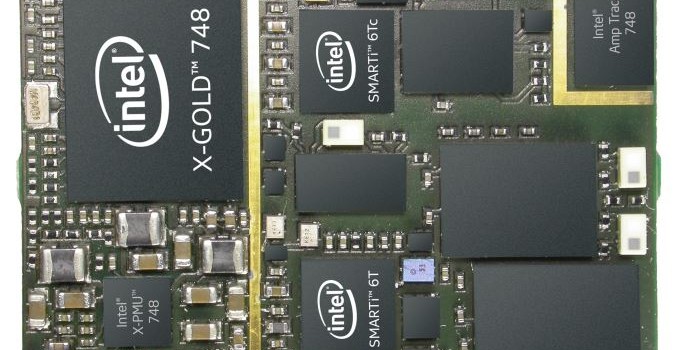
At MWC 2016, Intel announced their latest modem, the XMM7480. While to some extent Intel’s cadence isn’t quite as aggressive as others in the modem space, Intel’s modems are still a relevant part of the modem ecosystem.

At a high …

Samsung Announces 256GB UFS Embedded Storage Solution

Samsung Announces 256GB UFS Embedded Storage Solution

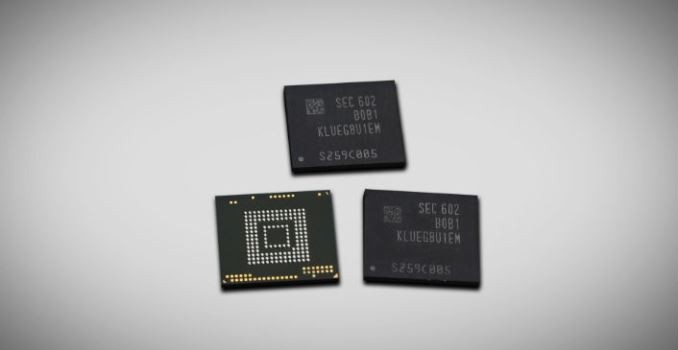
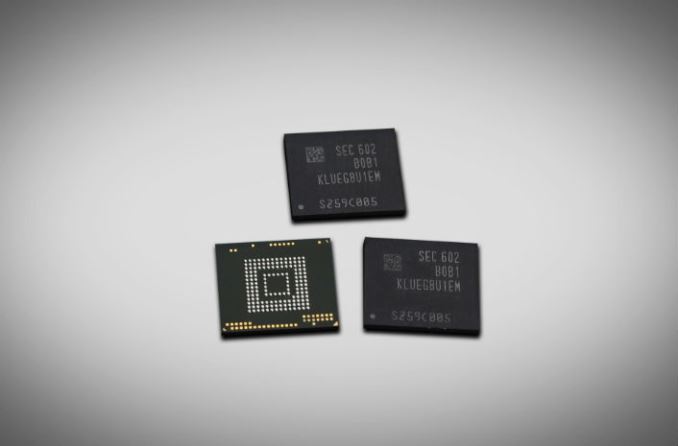
Interestingly enough, we’re seeing something of a division in the mobile storage space, as it seems that some OEMs are focusing their efforts on UFS for internal storage, while others are moving towards NVMe over mobile PCI-E. Samsung Electronics seems to be staying with UFS for now, and recently announced their next generation of UFS 2.0 embedded storage solutions, which use 3D V-NAND to enable better NAND storage characteristics and to bump up the capacity from 128GB to 256GB.

By moving to V-NAND, random reads and writes are now at 45k and 40k IOPS, or 176 and 156 MB/s with 4KB blocks, which is well over double what shipped in the Galaxy S6. For sequential reads, speeds top out as high as 850 MB/s which is even faster than the 520 MB/s maximum of some SATA SSDs. Given that this is likely to be Samsung’s 30nm V-NAND process, I suspect that the storage density needed to achieve this kind of performance involves some sort of SLC/TLC hybrid, but in the absence of more information it’s hard to say.

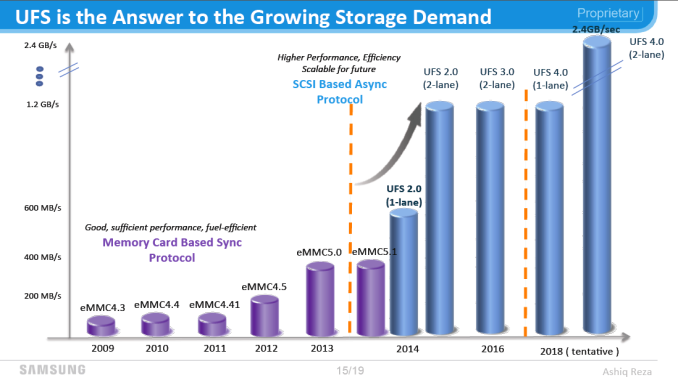
While the new NAND definitely is part of the speed improvement, it couldn’t have been achieved without an increase of the interface bandwidth. The new memory today is the first announced UFS 2.0 solution based on a 2-lane interface. The UFS 2.0 standard defines a lane running at up to HS Gear 3 at up to 600MB/s, so doubling up of the lanes gives a theoretical maximum of 1.2GB/s. It’ll definitely be interesting to see what devices adopt this storage solution in the near future.