News


ARM Announces New Cortex-R8 Real-Time Processor
ARM Announces New Cortex-R8 Real-Time Processor

ARM’s Cortex-R range of processor IP is something we haven’t talked about too much in the past, yet it’s a crucial part of ARM’s business and is integrated in a lot of devices. ARM divides its CPU offerings into three categories – At the high-end performance end we find the Cortex-A profile of application processors which most of us should be familiar with as cores such as the Cortex A53 and Cortex A72 are ubiquitous in today’s smartphone media coverage and get the most attention. The low-end should also be pretty familiar as the Cortex-M microcontrollers are found in virtually any conceivable gadget out there and also has seen increased exposure in the mobile segment due to their usage as the brain inside of both discrete as well as SoC-integrated sensor-hubs. 
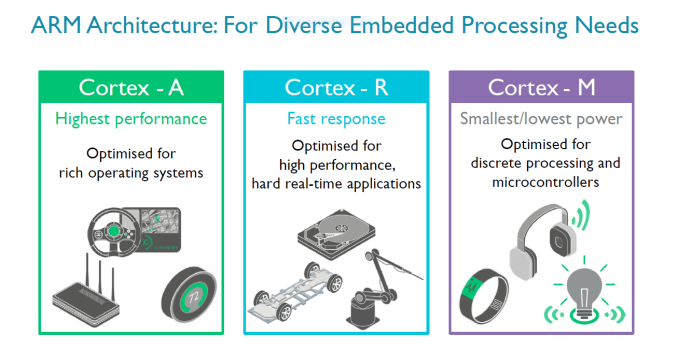
The Cortex-R profile of real-time processors on the other hand has seen relatively small coverage due to the fact that its use-cases are more specialized. Today with the announcement of the new Cortex-R8 we’ll be covering one well-established segment as well as an increasingly growing application of the real-time processors from ARM.
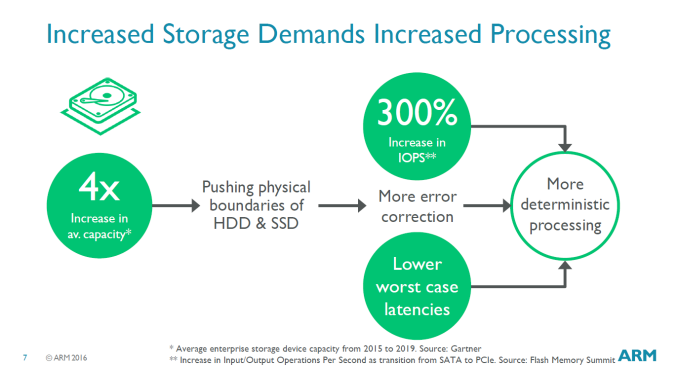
In storage devices such as disk drive microcontrollers the Cortex R processors are well established as such systems require response-times in the microsecond range. These systems use increasingly complex algorithms for things such as error correction and the control software. SSDs in particular require increasingly higher performance controllers as data-rates increase with each generation. ARM discloses that currently all major hard-drive and SSD manufacturers use controllers based on Cortex R processors, which is least to say an interesting market position.
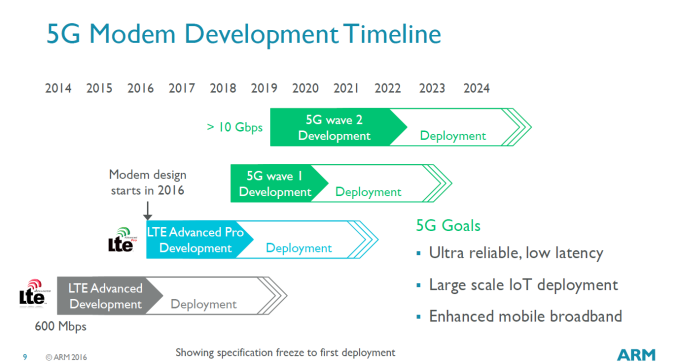
Today’s announcement of the Cortex R8 was particularly centred on the use of R-profile processors in the modem space with a focus on the increasing performance requirements required to run future cellular standards such as LTE Advanced Pro and 5G. Here the processors are used for scheduling the data-flows through the signal processing for reception and transmission and as well run the protocol stack’s software tasks. These are so-called hard real-time tasks in which the processor must respond to events in the communication channel with a microsecond granularity. New standards such as 5G will vastly increase the transmission speeds to gigabits with complex carrier frequency and MIMO configurations which will also increase the feature-set requirements and workloads for the modem processors.

ARM also discloses that modem designers are looking more and more to modems that manage Layer-1 scheduling activities to be done by software on the processor to provide more flexibility among different standards, something which requires a lot of investment and R&D to do in hardware.
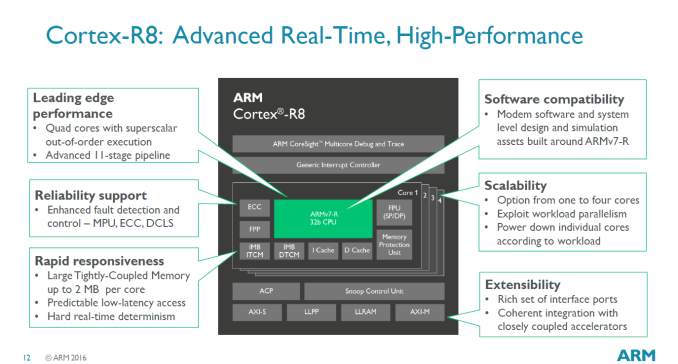
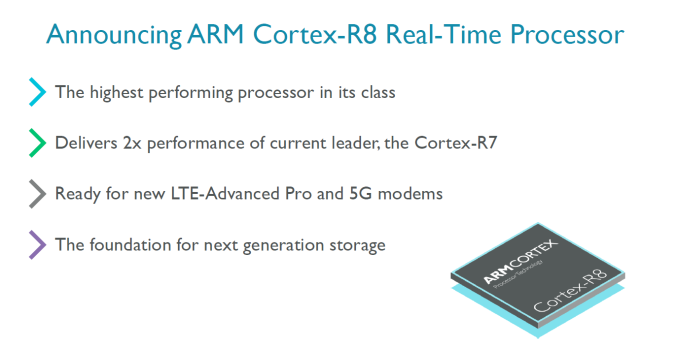
The Cortex-R8 is similar in architecture to the R7 – we still see usage of an 11-stage OoO (Out-of-Order) execution pipeline and clocks of up to 1.5GHz on a 28nm HPM process. The differences are found in the configuration options: The new core can now be deployed as a quad-core, versus the limited dual-core configuration of the R7, doubling the theoretical processing power over its predecesssor. The cores can also be run asymetrically and also each have their own power-plane, meaning they can be turned off for power savings and increased battery life. While concrete performance figures were a bit scarce, ARM talks about an example quad-core configuration on a 28nm or 16nm FinFET process being able to reach up to 15000 Dhrystone MIPS at 1.5GHz frequency.

Cortex-R processors are able to employ a low-latency on-CPU memory called Tightly-Coupled Memory (TCM) which is able to be used as a predictable and guaranteed memory subsystem that is able to service interrupts as quickly as possible with code and data, avoiding longer and less deterministic latency cycles when fetching data out of the cache memory system. The Cortex R8 now is able to significantly increase the size of the TCM and now provides up to 2MB (1MB instruction, 1MB data, up from 128KB instruction/data on the R7) of TCM per core for a maximum of 8MB for a quad-core configuration.

ARM disclosed one of the licensees being Huawei:

“The ARM architecture is the trusted standard for real-time high-performance processing in modems,” said Daniel Diao, deputy general manager, Turing Processor Business Unit, Huawei. “As a leader in cellular technology, Huawei is already working on 5G solutions and we welcome the significant performance uplift the Cortex-R8 will deliver. We expect it to be widely deployed in any device where low latency and high performance communication is a critical success factor.” 

Among other licensees we’ll also definitely see vendors such as Samsung who also currently deploy Cortex-R inside of their modems, such as the Shannon 333 found in last year’s Galaxy devices.
NVIDIA Announces Q4 FY 2016 Results: Record Quarter And Record Year

NVIDIA Announces Q4 FY 2016 Results: Record Quarter And Record Year

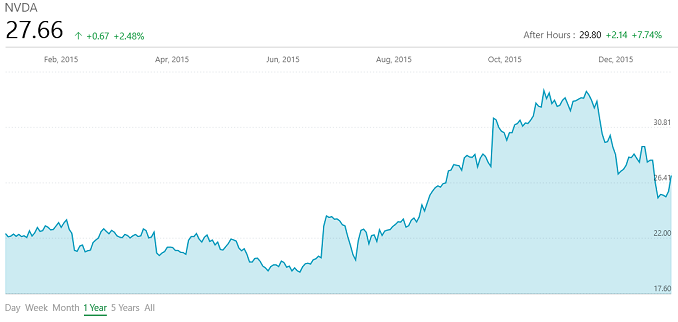
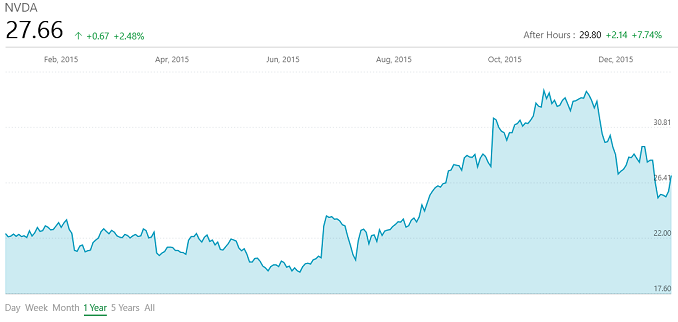
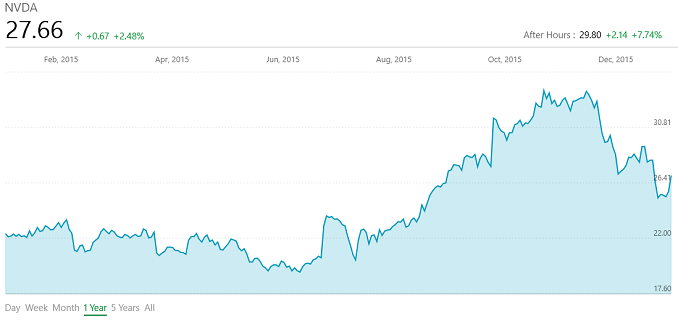
This afternoon, NVIDIA released their financial results for the fourth quarter of their 2016 fiscal year, and the company had not only a record quarter, but also a record year. Revenue for quarter was $1.401 billion, up 7% from last quarter and 12% from the same point last year. Margins were strong, with a 60 basis point gain to 56.5%. Operating income for Q4 was $252 million and net income was $207 million, up 9% and 7% respectively. This resulted in earnings per share of $0.35, which despite all the good news in the previous numbers, was actually flat year-over-year.

NVIDIA Q4 2016 Financial Results (GAAP)
  Q4’2016 Q3’2016 Q4’2015 Q/Q Y/Y
Revenue (in millions USD) $1401 $1305 $1251 +7% +12%
Gross Margin 56.5% 56.3% 55.9% +0.2% +0.6%
Operating Income (in millions USD) $252 $245 $231 +3% +9%
Net Income $207 $246 $193 -16% +7%
EPS $0.35 $0.44 $0.35 -20% flat

NVIDIA also released Non-GAAP results which exclude “stock-based compensation, product warranty charge, acquisition-related costs, restructuring and other charges, gains and losses from non-affiliated investments, interest expense related to amortization of debt discount, and the associated tax impact of these items, where applicable”. On a Non-GAAP basis compared to Q4 2015, gross margin was up 100 basis points to 57.2%, operating income was up 26% to $356 million, net income was up 23% to $297 million, and earnings per share were up 21% to $0.52.

NVIDIA Q4 2016 Financial Results (Non-GAAP)
  Q4’2016 Q3’2016 Q4’2015 Q/Q Y/Y
Revenue (in millions USD) $1401 $1305 $1251 +7% +12%
Gross Margin 57.2% 56.5% 56.2% +0.7% +1.0%
Operating Income (in millions USD) $356 $308 $283 +16% +26%
Net Income $297 $255 $241 +16% +23%
EPS $0.52 $0.46 $0.43 +13% +21%

For the full fiscal year 2016, NVIDIA had revenues of $5.010 billion, up 7% from FY 2015, with a gross margin up 60 basis points to 56.1%. Operating income was down 2% to $747 million, with net income down 3% to $614 million. Earnings per share for FY 2016 were down 4% to $1.08. On a Non-GAAP basis, gross margin was up 100 basis points to $56.8%, operating income was up 18% to $1.125 billion, net income was up 16% to $929 million, and earnings per share were up 18% to $1.67.

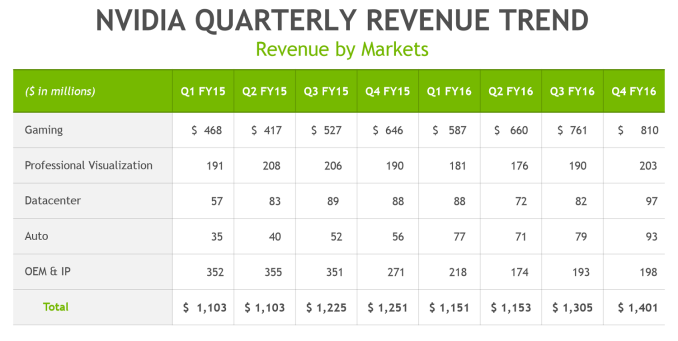
Much of the growth of NVIDIA was due to their recent successes with GPUs for gaming, professional visualization, and data center, but they’ve also seen some tremendous growth in Tegra in the automotive space, but at the same time they’ve seen very poor results in Tegra in the mobile arena.

NVIDIA Quarterly Revenue Comparison (GAAP)
In millions Q4’2016 Q3’2016 Q4’2015 Q/Q Y/Y
GPU $1178 $1110 $1073 +6% +10%
Tegra Processor $157 $129 $112 +22% +40%
Other $66 $66 $66 flat flat

GPU sales is still by far the largest part of NVIDIA, and they had GPU revenues of $1.18 billion, which is up 10% from a year ago. GeForce branded GPUs grew 21% in the same time frame. Quadro branded cards were up 7% year-over-year to $203 million. Datacenter GPUs, which include but Tesla and GRID, had revenues up $97 million, up 10% from Q4 2015.

Tegra processor revenue was $157 million for the quarter, which is up 40% from Q4 2015. The bulk of that is a massive 68% increase in revenue of Tegra for automotive, which is now $93 million for the quarter.

NVIDIA’s “Other” category is where they stick their $66 million that they get from Intel which is licensing for NVIDIA technology based on a settlement agreement the two parties made in January 2011. Intel would have made its final payment for this settlement in January 2016 though, so we’ll see how that changes NVIDIA’s results going forward.

For the quarter, NVIDIA paid $62 million in cash dividends and repurchased 4.3 million shares, and for the full fiscal year 2016, NVIDIA returned $800 million to investors through these two mechanisms. For FY 2017, NVIDIA intends to return $1.0 billion. The next dividend payout will be $0.115 per share on March 23, to all shareholders of record as of March 2.

Looking ahead to Q1 FY 2017, NVIDIA is expecting revenue of $1.26 billion, plus or minus 2%, with margins of 57.2% for GAAP and 57.5% for Non-GAAP, plus or minus 50 basis points.

NVIDIA’s Fiscal Year 2016 was certainly very strong, although large warranty claims of the SHIELD tablets, along with restructuring fees, have hurt their GAAP numbers somewhat. I’m very curious to see how they do now that the Intel payout is complete, although it may be averaged out on the books for FY 2017 still.

Source: NVIDIA Investor Relations

NVIDIA Announces Q4 FY 2016 Results: Record Quarter And Record Year

NVIDIA Announces Q4 FY 2016 Results: Record Quarter And Record Year

This afternoon, NVIDIA released their financial results for the fourth quarter of their 2016 fiscal year, and the company had not only a record quarter, but also a record year. Revenue for quarter was $1.401 billion, up 7% from last quarter and 12% from the same point last year. Margins were strong, with a 60 basis point gain to 56.5%. Operating income for Q4 was $252 million and net income was $207 million, up 9% and 7% respectively. This resulted in earnings per share of $0.35, which despite all the good news in the previous numbers, was actually flat year-over-year.

NVIDIA Q4 2016 Financial Results (GAAP)
  Q4’2016 Q3’2016 Q4’2015 Q/Q Y/Y
Revenue (in millions USD) $1401 $1305 $1251 +7% +12%
Gross Margin 56.5% 56.3% 55.9% +0.2% +0.6%
Operating Income (in millions USD) $252 $245 $231 +3% +9%
Net Income $207 $246 $193 -16% +7%
EPS $0.35 $0.44 $0.35 -20% flat

NVIDIA also released Non-GAAP results which exclude “stock-based compensation, product warranty charge, acquisition-related costs, restructuring and other charges, gains and losses from non-affiliated investments, interest expense related to amortization of debt discount, and the associated tax impact of these items, where applicable”. On a Non-GAAP basis compared to Q4 2015, gross margin was up 100 basis points to 57.2%, operating income was up 26% to $356 million, net income was up 23% to $297 million, and earnings per share were up 21% to $0.52.

NVIDIA Q4 2016 Financial Results (Non-GAAP)
  Q4’2016 Q3’2016 Q4’2015 Q/Q Y/Y
Revenue (in millions USD) $1401 $1305 $1251 +7% +12%
Gross Margin 57.2% 56.5% 56.2% +0.7% +1.0%
Operating Income (in millions USD) $356 $308 $283 +16% +26%
Net Income $297 $255 $241 +16% +23%
EPS $0.52 $0.46 $0.43 +13% +21%

For the full fiscal year 2016, NVIDIA had revenues of $5.010 billion, up 7% from FY 2015, with a gross margin up 60 basis points to 56.1%. Operating income was down 2% to $747 million, with net income down 3% to $614 million. Earnings per share for FY 2016 were down 4% to $1.08. On a Non-GAAP basis, gross margin was up 100 basis points to $56.8%, operating income was up 18% to $1.125 billion, net income was up 16% to $929 million, and earnings per share were up 18% to $1.67.

Much of the growth of NVIDIA was due to their recent successes with GPUs for gaming, professional visualization, and data center, but they’ve also seen some tremendous growth in Tegra in the automotive space, but at the same time they’ve seen very poor results in Tegra in the mobile arena.

NVIDIA Quarterly Revenue Comparison (GAAP)
In millions Q4’2016 Q3’2016 Q4’2015 Q/Q Y/Y
GPU $1178 $1110 $1073 +6% +10%
Tegra Processor $157 $129 $112 +22% +40%
Other $66 $66 $66 flat flat

GPU sales is still by far the largest part of NVIDIA, and they had GPU revenues of $1.18 billion, which is up 10% from a year ago. GeForce branded GPUs grew 21% in the same time frame. Quadro branded cards were up 7% year-over-year to $203 million. Datacenter GPUs, which include but Tesla and GRID, had revenues up $97 million, up 10% from Q4 2015.

Tegra processor revenue was $157 million for the quarter, which is up 40% from Q4 2015. The bulk of that is a massive 68% increase in revenue of Tegra for automotive, which is now $93 million for the quarter.

NVIDIA’s “Other” category is where they stick their $66 million that they get from Intel which is licensing for NVIDIA technology based on a settlement agreement the two parties made in January 2011. Intel would have made its final payment for this settlement in January 2016 though, so we’ll see how that changes NVIDIA’s results going forward.

For the quarter, NVIDIA paid $62 million in cash dividends and repurchased 4.3 million shares, and for the full fiscal year 2016, NVIDIA returned $800 million to investors through these two mechanisms. For FY 2017, NVIDIA intends to return $1.0 billion. The next dividend payout will be $0.115 per share on March 23, to all shareholders of record as of March 2.

Looking ahead to Q1 FY 2017, NVIDIA is expecting revenue of $1.26 billion, plus or minus 2%, with margins of 57.2% for GAAP and 57.5% for Non-GAAP, plus or minus 50 basis points.

NVIDIA’s Fiscal Year 2016 was certainly very strong, although large warranty claims of the SHIELD tablets, along with restructuring fees, have hurt their GAAP numbers somewhat. I’m very curious to see how they do now that the Intel payout is complete, although it may be averaged out on the books for FY 2017 still.

Source: NVIDIA Investor Relations

NVIDIA Announces Tom Clancy’s The Division Game Bundle for GeForce Video Cards

NVIDIA Announces Tom Clancy’s The Division Game Bundle for GeForce Video Cards

NVIDIA has announced that its partners will bundle a free copy of Tom Clancy’s The Division game with select high-end GeForce GTX graphics cards starting this week and for about a month. The campaign will run in the U.S., Canada, in most of European and a number of Asian countries.

To grab a free copy of Tom Clancy’s The Division, you will need to buy a GeForce GTX 970/980/980 Ti graphics card or a laptop featuring a GeForce GTX 970M/980M/980 graphics adapter made by an authorized producer and bought from a participating retailer. The campaign starts on February 17, 2016 and ends on March 21, 2016. The promotional code expires on April 30, 2016, or while supplies last. The offer is valid worldwide, excluding China, but since not all retailers participate, you may choose to buy a GeForce GTX graphics card in a different country (which in some cases causes troubles with activation). Early buyers will get a chance to try open beta of The Division on February 19 – 21, 2016.

NVIDIA Current Game Bundles
Video Card Bundle
GeForce GTX Titan X None
GeForce GTX 980Ti/980/970 Tom Clancy’s The Division
GeForce GTX 960/950 None
GeForce GTX 980 For Notebooks Tom Clancy’s The Division
GeForce GTX 980M/970M Tom Clancy’s The Division
GeForce GTX 965M And Below None

Tom Clancy’s The Division is an online open-world third-person shooter game with survival elements, which is set to be released on March 8, 2016. Gamers will have to fight their way through post-pandemic New York as part of The Division team of tactical operatives in a bid to find the source of the virus and restore order. The game features rather detailed destructive environments as well as dynamic time-based whether system. The official screenshots and videos released by Ubisoft look rather impressive and the game itself requires a powerful PC to play. Ubisoft itself recommends using an AMD Radeon R9 290 or an NVIDIA GeForce GTX 970 graphics card, hence, you will need something better if you want to play with all the effects enabled in 4K resolution.

The Division relies on NVIDIA’s proprietary GameWorks libraries to produce effects like HBAO+ (improved horizon-based ambient occlusion) and PCSS (percentage closer soft shadows) for additional eye candy. Hence, if you do not have a Maxwell-based graphics card, but want to experience the game in its full glory, NVIDIA’s offer to upgrade and get a free copy may make a lot of sense for you.

The list of participating retailers, board partners and PC makers in the U.S. is located here. Users in Asia and Europe should check this web-site for details about participating retailers. Terms and conditions are located here.

NVIDIA Announces Tom Clancy’s The Division Game Bundle for GeForce Video Cards

NVIDIA Announces Tom Clancy’s The Division Game Bundle for GeForce Video Cards

NVIDIA has announced that its partners will bundle a free copy of Tom Clancy’s The Division game with select high-end GeForce GTX graphics cards starting this week and for about a month. The campaign will run in the U.S., Canada, in most of European and a number of Asian countries.

To grab a free copy of Tom Clancy’s The Division, you will need to buy a GeForce GTX 970/980/980 Ti graphics card or a laptop featuring a GeForce GTX 970M/980M/980 graphics adapter made by an authorized producer and bought from a participating retailer. The campaign starts on February 17, 2016 and ends on March 21, 2016. The promotional code expires on April 30, 2016, or while supplies last. The offer is valid worldwide, excluding China, but since not all retailers participate, you may choose to buy a GeForce GTX graphics card in a different country (which in some cases causes troubles with activation). Early buyers will get a chance to try open beta of The Division on February 19 – 21, 2016.

NVIDIA Current Game Bundles
Video Card Bundle
GeForce GTX Titan X None
GeForce GTX 980Ti/980/970 Tom Clancy’s The Division
GeForce GTX 960/950 None
GeForce GTX 980 For Notebooks Tom Clancy’s The Division
GeForce GTX 980M/970M Tom Clancy’s The Division
GeForce GTX 965M And Below None

Tom Clancy’s The Division is an online open-world third-person shooter game with survival elements, which is set to be released on March 8, 2016. Gamers will have to fight their way through post-pandemic New York as part of The Division team of tactical operatives in a bid to find the source of the virus and restore order. The game features rather detailed destructive environments as well as dynamic time-based whether system. The official screenshots and videos released by Ubisoft look rather impressive and the game itself requires a powerful PC to play. Ubisoft itself recommends using an AMD Radeon R9 290 or an NVIDIA GeForce GTX 970 graphics card, hence, you will need something better if you want to play with all the effects enabled in 4K resolution.

The Division relies on NVIDIA’s proprietary GameWorks libraries to produce effects like HBAO+ (improved horizon-based ambient occlusion) and PCSS (percentage closer soft shadows) for additional eye candy. Hence, if you do not have a Maxwell-based graphics card, but want to experience the game in its full glory, NVIDIA’s offer to upgrade and get a free copy may make a lot of sense for you.

The list of participating retailers, board partners and PC makers in the U.S. is located here. Users in Asia and Europe should check this web-site for details about participating retailers. Terms and conditions are located here.