
News


CES 2016: MSI’s 27-inch 4K Gaming AIO with Full Sized Discrete GPU, the 27XT 6QE
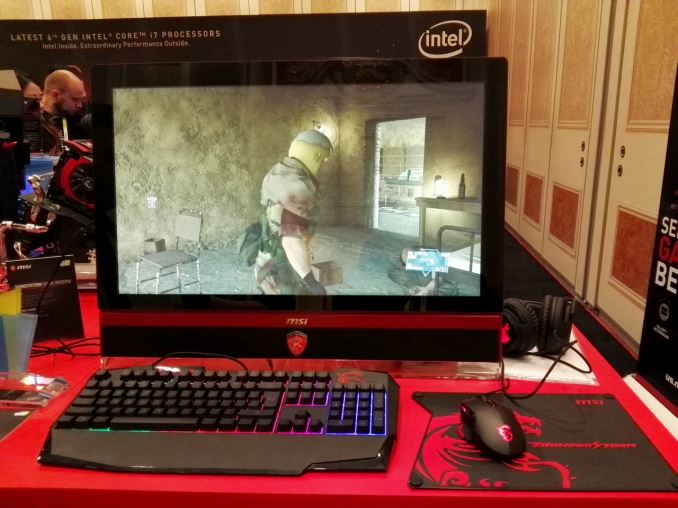
CES 2016: MSI’s 27-inch 4K Gaming AIO with Full Sized Discrete GPU, the 27XT 6QE

Back at Computex in 2015 we saw and reported on MSI’s first design ideas surrounding an all-in-one computer (where the PC is essentially in the frame of the monitor and not a separate ‘machine’) with a discrete GPU attached. At that time, it was more a proof of concept – they housed a mini-ITX system in the monitor chassis using a custom PCB and heatsink arrangement, and then extended the PCIe 3.0 x16 connection out to a bay on the back of the monitor that housed a discrete graphics card. This is more basic that something like Thunderbolt where you have to worry about hotplug, but you get a full PC in a monitor.  This year at CES we saw the concept in the final stages of design, and spoke to the key product managers behind this new 27XT 6QE model.

The unit on display was a H170 system with a Core i7-6700 processor, with support up to 64GB of DDR4-2133 using SO-DIMMs and graphics card support up to a GTX 980 Ti 6GB or Titan X 12GB – the graphics card requiring an external power brick that comes with the machine. The LCD panel will come in two forms – either 1920×1080 at 144 Hz, or 4K, featuring anti-flicker and subdued blue-light functionality with 10-point touch on some models. The system can house two PCIe M.2 SSDs in RAID as well as a full 3.5-inch drive.

Gallery: MSI Gaming 27XT

It is the design ID though which stands out. The clear plastic stand attached the VESA mount is sturdy, although does not allow much room for tilt/pitch/rotate. This is because the monitor is actually elongated at the bottom to accommodate the hardware inside – but MSI uses this extension to their advantage with the design, which means the system would look odd at 90 degrees. The rear housing for the GPU is in typical MSI Gaming style, mirroring the design patterns of their SLI bridges. The AIO supports alternative inputs or DP outputs to other monitors, in case you want to run another monitor alongside. I assume these are routed from the GPU for extending the display, with the inputs from other sources being handled by the monitor.

Pricing was not given, although put together a 27-inch 4K or FHD 144Hz with an i7-6700 and a GTX 980 Ti and we are approaching $2000 quite easy. MSI did not say if they will sell certain configurations at retailers, or if users will be able to configure, or if it will be sold as a barebones. I would imagine that system integrators could speak to MSI to create custom designs around it.

The Intel Compute Stick (Cherry Trail) Review

The success of ultra-compact form factor (UCFF) PCs have made vendors realize that small and power-efficient computing platforms are here to stay. ARM SoC manufacturers, finding that the tablet market had reached practical saturation, kick-started a new product category in the form of ‘HDMI sticks’. As a computing platform, they were smaller than the ultra-compact form factor PCs and looked like an oversized USB key. Intel joined the game in CES 2015 with the Bay Trail Compute Stick. The first iteration was, to put it kindly, a bit underwhelming. However, Intel showed its commitment to the form factor by announcing three new Compute Stick models at CES 2016. They included one Cherry Trail (Atom) and two Core M models, all aiming in that 2-4.5 watt SoC space. The Intel Compute Stick we are reviewing today is the Cherry Trail model that comes with Windows 10 Home (32-bit) pre-installed, making it ready to roll right out of the box. Read on for a performance review and our thoughts on the product.

The Intel Compute Stick (Cherry Trail) Review

The success of ultra-compact form factor (UCFF) PCs have made vendors realize that small and power-efficient computing platforms are here to stay. ARM SoC manufacturers, finding that the tablet market had reached practical saturation, kick-started a new product category in the form of ‘HDMI sticks’. As a computing platform, they were smaller than the ultra-compact form factor PCs and looked like an oversized USB key. Intel joined the game in CES 2015 with the Bay Trail Compute Stick. The first iteration was, to put it kindly, a bit underwhelming. However, Intel showed its commitment to the form factor by announcing three new Compute Stick models at CES 2016. They included one Cherry Trail (Atom) and two Core M models, all aiming in that 2-4.5 watt SoC space. The Intel Compute Stick we are reviewing today is the Cherry Trail model that comes with Windows 10 Home (32-bit) pre-installed, making it ready to roll right out of the box. Read on for a performance review and our thoughts on the product.

Samsung Announces Second-Gen 14nm Low Power Plus (14LPP) Process Now In Mass Production

Samsung Announces Second-Gen 14nm Low Power Plus (14LPP) Process Now In Mass Production

Today Samsung Semiconductor officialy announces mass production for its second generation 14nm FinFET manufacturing node. Early last year we saw Samsung announce mass production of its first generation FinFET process that was used in the Exynos 7420 which powered last year’s flagships from Samsung Mobile and Meizu.

“We are pleased to start production of our industry-leading, 2nd generation 14nm FinFET process technology that delivers the highest level of performance and power efficiency” said Charlie Bae, Executive Vice President of Sales & Marketing, System LSI Business, Samsung Electronics. “Samsung will continue to offer derivative processes of its advanced 14nm FinFET technology to maintain our technology leadership.”

The second generation process called 14LPP (Low-Power Plus) is advertised as bringing performance as well as power improvements over the 14LPE (Low-Power Early) predecessor. The new node is described as being able to increase switching speed of up to 15% and decreasing power consumption by up to 15%.

The improvements are made possible via transistor structure changes and process optimizations, for example we see usage of a taller fin height compared to that of 14LPE. Samsung has also improved silicon straining and describes usage of fully-depleted FinFET transistors being able to bring enhanced manufacturing capabilities.

The 14LPP process is confirmed to be used in Samsung LSI’s own Exynos 8890 as well as Qualcomm’s Snapdragon 820 SoCs, which we should be seeing more of in devices coming in the next months. As GlobalFoundries licenses Samsung’s process node as we should also see CPU and GPU products from AMD produced on the new manufacturing node.

Samsung Announces Second-Gen 14nm Low Power Plus (14LPP) Process Now In Mass Production

Samsung Announces Second-Gen 14nm Low Power Plus (14LPP) Process Now In Mass Production

Today Samsung Semiconductor officialy announces mass production for its second generation 14nm FinFET manufacturing node. Early last year we saw Samsung announce mass production of its first generation FinFET process that was used in the Exynos 7420 which powered last year’s flagships from Samsung Mobile and Meizu.

“We are pleased to start production of our industry-leading, 2nd generation 14nm FinFET process technology that delivers the highest level of performance and power efficiency” said Charlie Bae, Executive Vice President of Sales & Marketing, System LSI Business, Samsung Electronics. “Samsung will continue to offer derivative processes of its advanced 14nm FinFET technology to maintain our technology leadership.”

The second generation process called 14LPP (Low-Power Plus) is advertised as bringing performance as well as power improvements over the 14LPE (Low-Power Early) predecessor. The new node is described as being able to increase switching speed of up to 15% and decreasing power consumption by up to 15%.

The improvements are made possible via transistor structure changes and process optimizations, for example we see usage of a taller fin height compared to that of 14LPE. Samsung has also improved silicon straining and describes usage of fully-depleted FinFET transistors being able to bring enhanced manufacturing capabilities.

The 14LPP process is confirmed to be used in Samsung LSI’s own Exynos 8890 as well as Qualcomm’s Snapdragon 820 SoCs, which we should be seeing more of in devices coming in the next months. As GlobalFoundries licenses Samsung’s process node as we should also see CPU and GPU products from AMD produced on the new manufacturing node.