Vik


QNAP Releases Haswell-based TVS-x71 and Cortex-A15-based TS-x31+ NAS Lineups
QNAP Releases Haswell-based TVS-x71 and Cortex-A15-based TS-x31+ NAS Lineups

QNAP took the SMB / SOHO NAS market segment by storm with a host of CES announcements. The release of the AMD G-series SoC-based TVS-x63 was undoubtedly QNAP’s major announcement at the show. Though we didn’t specifically mention it in our initial coverage, QNAP tags the members of that lineup with the ‘Golden Cloud’ moniker. Keeping with the theme, two other new high-performance product lineups got a similar treatment

  • Thunder Cloud – Haswell Pentium/Core-based TVS-x71 Series
  • Edge Cloud – Haswell Core/Xeon-based TVS-ECx80 Series

In addition to the above two, QNAP also launched the TS-x31+ series, based on an Annapurna Labs SoC. Without further digression, let us get into the details of each of the lineups.

TVS-x71

COTS NAS vendors usually try to keep the breadth of hardware offerings to a minimum. We often see a lineup differentiating only on the basis of number of bays, with the core platform remaining a constant. On the x86 front, particularly, vendors usually have an Atom-based model. The next step up is usually a Pentium or a Core i3-based unit. Consumers wanting a bit more CPU horsepower have no option but to shell out for a Xeon-based unit beyond that.

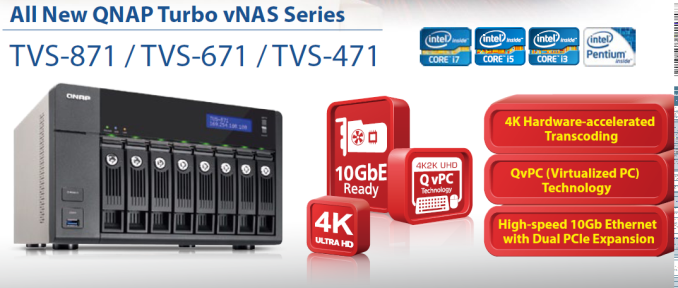
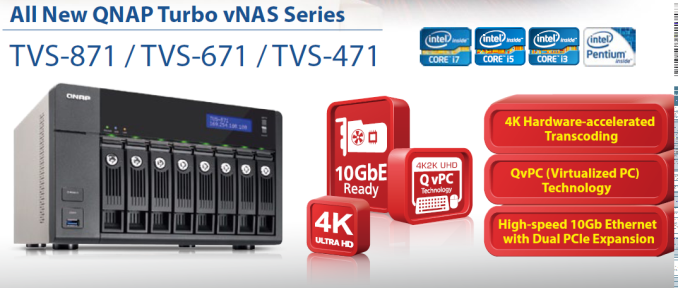
QNAP is aiming to fill this glaring hole in the market (not only in their own product stack, but also every other COTS NAS vendor) by populating the TVS-x71 series with processors ranging from a Pentium G3250 to a Core i7-4790S. The table below summarizes the various models in the lineup.
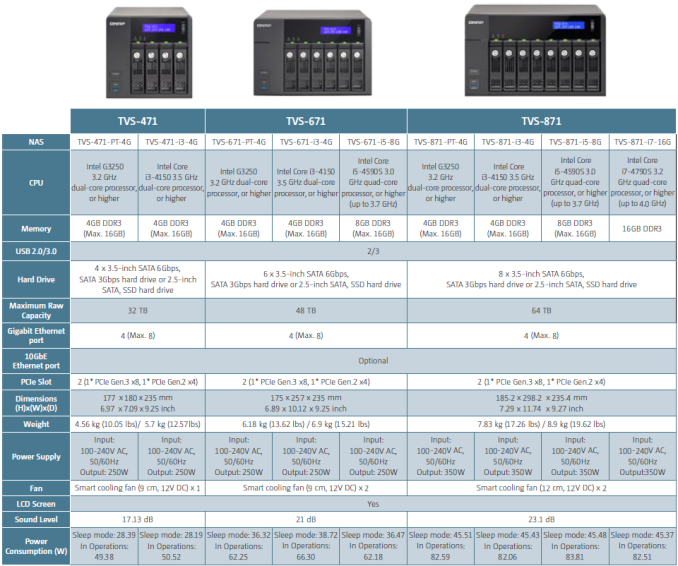
I am particularly excited by the 8-bay models with powerful quad-core processors. I am currently putting the QNAP TS-853 Pro through long term testing by running two virtual machines on it while using it as a media file server. Often, I have seen heavy activity in the VMs choke up the media serving capabilities (partially my fault for allocating two cores to each of the VMs, leaving very few CPU cycles for the primary functionality). Using a 4C/8T processor such as the Core i7-4790S ought to make scenarios such as the one I am testing out a walk in the park for the relevant unit.

All the Haswell models used in the TVS-x71 have an integrated Quick Sync engine and support VT-x. Full 4K decode and display is supported. All the Core-series CPUs used in the lineup also support AES-NI. So, other than the Pentium-based models, we should have hardware acceleration for encrypted volumes. Real-time transcoding for media serving is also available, as are the other QTS features that made the TS-x51 and TS-x53 Pro lineups stand out of the crowd. We don’t have any official pricing information for the TVS-x71 series yet, but hope that the highest end model can come in at less than $2000.

TVS-ECx80

QNAP had the 10-bay version (TVS-EC1080+) on display at their suite. The unit comes with a Xeon E3-1245 v3 processor and has 32 GB of ECC DDR3 memory. There are two mSATA ports populated with 128 GB mSATA modules for use with QTS’s SSD caching feature. This leaves all 10 bays available for primary storage. A PCIe card with two 10GbE ports is preinstalled and there are four native GbE ports on the motherboard. This tower unit targets enterprise customers and is priced at $3300.

The non ‘+’ models don’t have a pre-installed 10G PCIe card, and they come in 8- and 10-bay varieties with either the same Xeon processor or a Core i3-processor.

TS-x31+

I tweeted right after getting back from CES that Annapurna Labs was the surprise package of CES for those following the NAS platform vendors. Marvell seems to be taking things a bit too easy, opening up the doors for the startup to force its way into the market. Readers looking for information on Annapurna Labs would do well to peruse the Platform Details section in our piece covering the launch of the Synology DS2015xs.

Unlike Synology, QNAP has decided to use an Annapurna Labs SoC without the integrated 10G ports. We have two Cortex-A15 cores running at 1.4 GHz in the 28nm SoC that is part of the TS-231+ and TS-431+. The SoC also has two native GbE ports with enough performance for full-scale link aggregation.
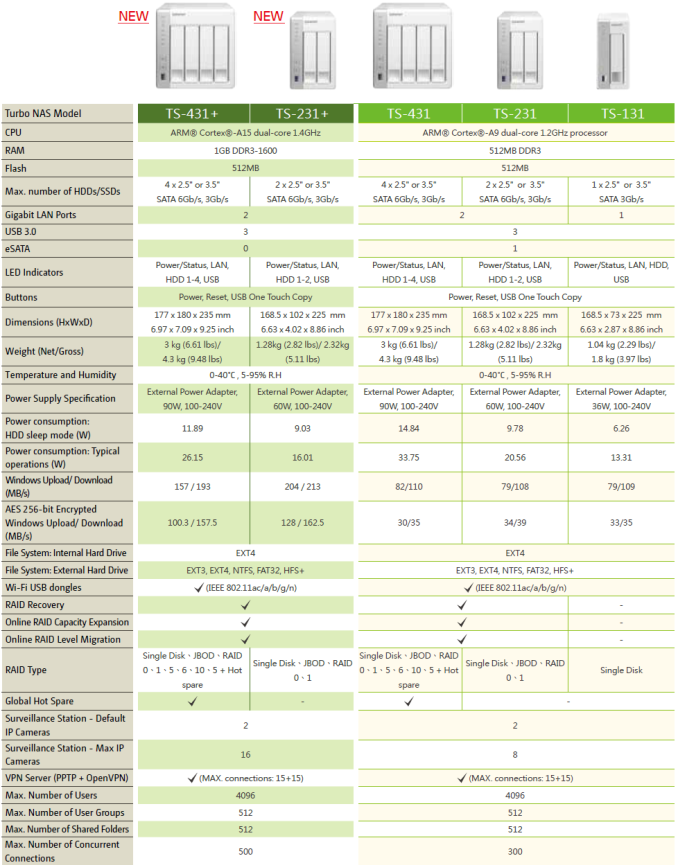
QNAP quotes transfer rates in the 200 MBps range for the TS-x31+ models. Marvell now seems relegated to the very low-end models such as the TS-x12P. Even Freescale has overtaken them with a dual-core Cortex-A9 platform in the TS-x31 series.

At the CES suite, QNAP also talked about an upcoming low-cost Bay Trail-based two-bay model without hot-swap support. We believe it will be used to address cost-sensitive markets and is unlikely to make it to the USA and EU. QNAP also updated us on their home automation initiative. Other than the publicly announced partners, QNAP is also attempting to act as a hub / one-stop interface for the multitude of home automation / security devices out in the market. Obviously, a good and consistent experience with any QPKG in this domain relies heavily on the said devices having open APIs and willing to be controlled locally. QNAP hopes to have something more concrete for announcement sometime in the later half of this year.

All in all, QNAP had a very busy CES, and, to be frank, we were overwhelmed (in a good way) by the number of announcements. In terms of sheer number of features available, QTS is well ahead of the rest of the COTS NAS OSs – they have the lead in hardware-accelerated media transcoding and creating a stable front-end for QEMU with the Virtualization Station package. However, the overall QTS user experience could do with some improvement. In addition, the challenge for QNAP will be to maintain a cohesive strategy moving forward and keep up with the need to maintain and support a wide variety of hardware platforms.

be quiet! CES Suite Tour

be quiet! CES Suite Tour

One of the companies I visited is a company that’s perhaps a bit less well known in the US, be quiet! (I joked with the representatives that they should change their name to “Shut Up!”, but that probably won’t happen.) Headquartered in Germany, be quiet! focuses on creating silent or at least low noise components for PCs, with a range of power supplies, CPU coolers, fans, and now cases. We’ve reviewed a few of their power supplies over the past couple of years, and most have performed well – though they were not necessarily “silent” during testing at high loads. Most of the products on display in their suite have been available for at least several months or more, so I’ll confine my comments to the three new products being shown.

Starting with what is perhaps the most interesting of their new releases, the Silent Base 800 is be quiet!’s first PC case. It’s a full-size ATX tower case, measuring 266mm x 559mm x 495mm (W x H x D) – 230mm x 542mm x 495mm without the stand. Keeping components cool without generating a lot of noise is often easier to do with a larger case, so it’s not too surprising that be quiet! went with a larger chassis. The design is clean and generally conservative in appearance, though the case is available with three accent colors – black (no accents, really), silver, or orange. MSRP is $139, and you can find the orange and silver cases on Newegg right now. be quiet! also mentioned that they’re trying to get more of their products to the US via other outlets (e.g. Amazon), which would certainly help with increasing brand recognition and pricing in the US.

The other new products are both CPU coolers, expanding the already large selection of be quiet! offerings. First is a top-down alternative of an existing cooler, the Dark Rock TF (TF = Top Flow). Of course, being top-down cooling instead of a tower with a side fan changes the appearance quite a bit, so other than name there’s not a lot in common between the two. The Dark Rock TF has six heat pipes, two 135mm SilentWings fans with fluid dynamic bearings, and it’s rated to cool up to 220W TDP, which means it’s enough for all the current CPUs from AMD and Intel.

The second CPU cooler is a low profile offering, the Shadow Rock LP. This cooler has four heat pipes, a Pure Wings 2 120mm PWM fan with rifle bearings, and a maximum TDP rating of 130W. It’s rated at a maximum of 25.5 dB(A) for noise, making this a great option for a compact and quiet build.

Both the Dark Rock TF and Shadow Rock LP should be available in the near future, but be quiet! was not able to provide pricing at this time. You can view the other products on display in the gallery below.

be quiet! CES Suite Tour

be quiet! CES Suite Tour

One of the companies I visited is a company that’s perhaps a bit less well known in the US, be quiet! (I joked with the representatives that they should change their name to “Shut Up!”, but that probably won’t happen.) Headquartered in Germany, be quiet! focuses on creating silent or at least low noise components for PCs, with a range of power supplies, CPU coolers, fans, and now cases. We’ve reviewed a few of their power supplies over the past couple of years, and most have performed well – though they were not necessarily “silent” during testing at high loads. Most of the products on display in their suite have been available for at least several months or more, so I’ll confine my comments to the three new products being shown.

Starting with what is perhaps the most interesting of their new releases, the Silent Base 800 is be quiet!’s first PC case. It’s a full-size ATX tower case, measuring 266mm x 559mm x 495mm (W x H x D) – 230mm x 542mm x 495mm without the stand. Keeping components cool without generating a lot of noise is often easier to do with a larger case, so it’s not too surprising that be quiet! went with a larger chassis. The design is clean and generally conservative in appearance, though the case is available with three accent colors – black (no accents, really), silver, or orange. MSRP is $139, and you can find the orange and silver cases on Newegg right now. be quiet! also mentioned that they’re trying to get more of their products to the US via other outlets (e.g. Amazon), which would certainly help with increasing brand recognition and pricing in the US.

The other new products are both CPU coolers, expanding the already large selection of be quiet! offerings. First is a top-down alternative of an existing cooler, the Dark Rock TF (TF = Top Flow). Of course, being top-down cooling instead of a tower with a side fan changes the appearance quite a bit, so other than name there’s not a lot in common between the two. The Dark Rock TF has six heat pipes, two 135mm SilentWings fans with fluid dynamic bearings, and it’s rated to cool up to 220W TDP, which means it’s enough for all the current CPUs from AMD and Intel.

The second CPU cooler is a low profile offering, the Shadow Rock LP. This cooler has four heat pipes, a Pure Wings 2 120mm PWM fan with rifle bearings, and a maximum TDP rating of 130W. It’s rated at a maximum of 25.5 dB(A) for noise, making this a great option for a compact and quiet build.

Both the Dark Rock TF and Shadow Rock LP should be available in the near future, but be quiet! was not able to provide pricing at this time. You can view the other products on display in the gallery below.

Samsung Launches SM951 M.2 PCIe 3.0 x4 SSD for OEMs/SIs

Samsung Launches SM951 M.2 PCIe 3.0 x4 SSD for OEMs/SIs

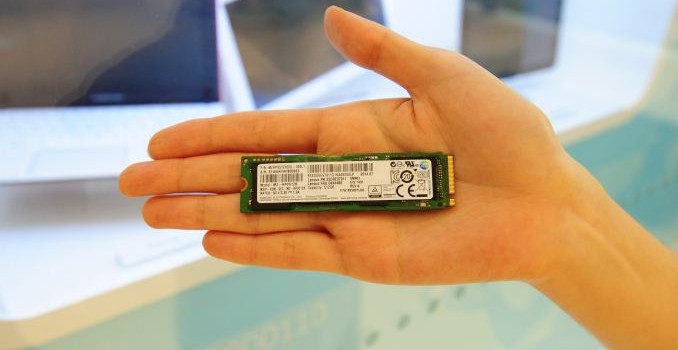
Back at Samsung SSD Global Summit in July, Samsung showed off the SM951 for the first time. The drive has then created a lot of interest because the Z97 and X99 chipsets finally brought proper boot support for the XP941 and many have decided to hold off their purchase and wait for the upcoming SM951. 

Similar to the XP941, the SM951 will come in M.2 2280 form factor with capacities ranging from 128GB to 512GB. In terms of the interface the SM951 moves to PCIe 3.0 x4, which doubles the available bandwidth from the XP941, and Samsung is claiming read speeds of up to 2,150MB/s with writes coming in at 1,550MB/s. Random performance isn’t as impressive but the SM951 is still capable of up to 130K random read and 85K random write IOPS.

In addition to increased performance, the SM951 also brings power savings. The drive includes support for L1.2 low power standby mode and according to Samsung the idle power consumption is under 2mW (i.e. within the DevSleep spec). The XP941, in turn, uses about 50mW as per Samsung’s data sheet, so it’s a fairly significant increase in power efficiency.

But now the bad news: the drive does not support NVMe nor does it come with 3D V-NAND. Back in July Samsung’s own presentation mentioned that the SM951 would be the world’s first client SSD with NVMe support, but those plans has then changed. Currently Samsung has no plans to bring NVMe to the SM951, which leads me to believe that the hardware is not NVMe compatible in the first place. Why that is the case, I don’t know for sure, but what I do know is that the current Haswell/Broadwell platforms aren’t really designed for PCIe/NVMe SSDs, which is why everyone is looking forward to Skylake before releasing their drives to the market. There are workarounds to get PCIe/NVMe SSDs to work on existing systems, but apparently Samsung decided to stay with AHCI for one more generation for increased compatibility (it’s an OEM drive after all, so I’m sure the PC OEMs have had their say about NVMe). 

As for the NAND, the SM951 uses 128Gbit 19nm MLC. That’s planar NAND, unfortunately, even though Samsung has been adopting V-NAND to nearly all of its other SSDs. I suspect that the reason behind the choice of planar NAND is PC OEMs and their unwillingness to pay the premium for V-NAND because the truth is that V-NAND is still not as cost efficient as modern planar NAND. Another reason might be the newness of 3D NAND as PC OEMs tend to prefer proven technologies to maximize reliability. 

Since the SM951 is an OEM drive, it won’t be available through the usual retail channels, but at least RamCity (the first XP941 retailer) will be carrying the drive. Stock should arrive around March time and I’ve also heard that there will be a TLC based version called the PM951. All in all, while the SM951 didn’t exactly meet my expectations on the specification frontier, I’m eagerly waiting for a review sample to see how the transition to PCIe 3.0 increases performance. We will be getting our review sample as soon as RamCity receives the first units, so look back for the review in about two months.

Samsung Launches SM951 M.2 PCIe 3.0 x4 SSD for OEMs/SIs

Samsung Launches SM951 M.2 PCIe 3.0 x4 SSD for OEMs/SIs

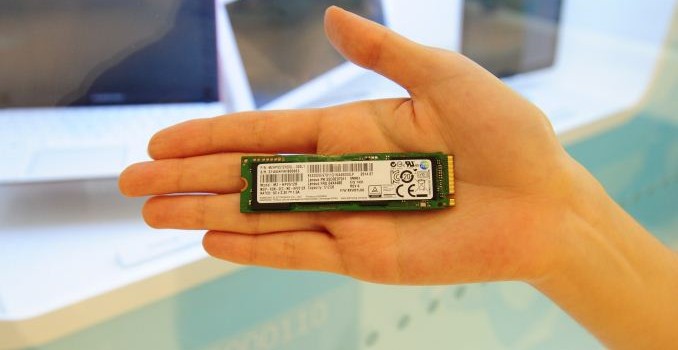
Back at Samsung SSD Global Summit in July, Samsung showed off the SM951 for the first time. The drive has then created a lot of interest because the Z97 and X99 chipsets finally brought proper boot support for the XP941 and many have decided to hold off their purchase and wait for the upcoming SM951. 

Similar to the XP941, the SM951 will come in M.2 2280 form factor with capacities ranging from 128GB to 512GB. In terms of the interface the SM951 moves to PCIe 3.0 x4, which doubles the available bandwidth from the XP941, and Samsung is claiming read speeds of up to 2,150MB/s with writes coming in at 1,550MB/s. Random performance isn’t as impressive but the SM951 is still capable of up to 130K random read and 85K random write IOPS.

In addition to increased performance, the SM951 also brings power savings. The drive includes support for L1.2 low power standby mode and according to Samsung the idle power consumption is under 2mW (i.e. within the DevSleep spec). The XP941, in turn, uses about 50mW as per Samsung’s data sheet, so it’s a fairly significant increase in power efficiency.

But now the bad news: the drive does not support NVMe nor does it come with 3D V-NAND. Back in July Samsung’s own presentation mentioned that the SM951 would be the world’s first client SSD with NVMe support, but those plans has then changed. Currently Samsung has no plans to bring NVMe to the SM951, which leads me to believe that the hardware is not NVMe compatible in the first place. Why that is the case, I don’t know for sure, but what I do know is that the current Haswell/Broadwell platforms aren’t really designed for PCIe/NVMe SSDs, which is why everyone is looking forward to Skylake before releasing their drives to the market. There are workarounds to get PCIe/NVMe SSDs to work on existing systems, but apparently Samsung decided to stay with AHCI for one more generation for increased compatibility (it’s an OEM drive after all, so I’m sure the PC OEMs have had their say about NVMe). 

As for the NAND, the SM951 uses 128Gbit 19nm MLC. That’s planar NAND, unfortunately, even though Samsung has been adopting V-NAND to nearly all of its other SSDs. I suspect that the reason behind the choice of planar NAND is PC OEMs and their unwillingness to pay the premium for V-NAND because the truth is that V-NAND is still not as cost efficient as modern planar NAND. Another reason might be the newness of 3D NAND as PC OEMs tend to prefer proven technologies to maximize reliability. 

Since the SM951 is an OEM drive, it won’t be available through the usual retail channels, but at least RamCity (the first XP941 retailer) will be carrying the drive. Stock should arrive around March time and I’ve also heard that there will be a TLC based version called the PM951. All in all, while the SM951 didn’t exactly meet my expectations on the specification frontier, I’m eagerly waiting for a review sample to see how the transition to PCIe 3.0 increases performance. We will be getting our review sample as soon as RamCity receives the first units, so look back for the review in about two months.