Vik


Fractal Design Launches New S24 and S36 Celsius AIO Liquid Coolers
Fractal Design Launches New S24 and S36 Celsius AIO Liquid Coolers

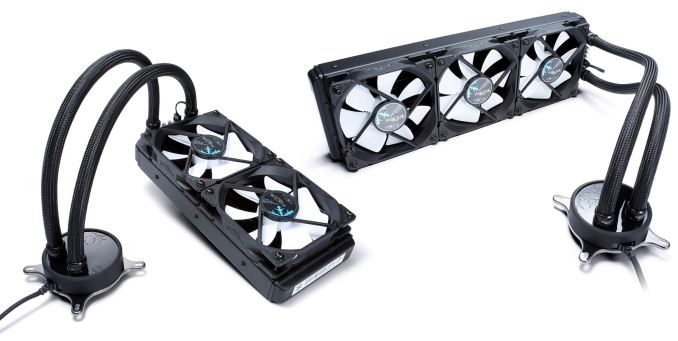
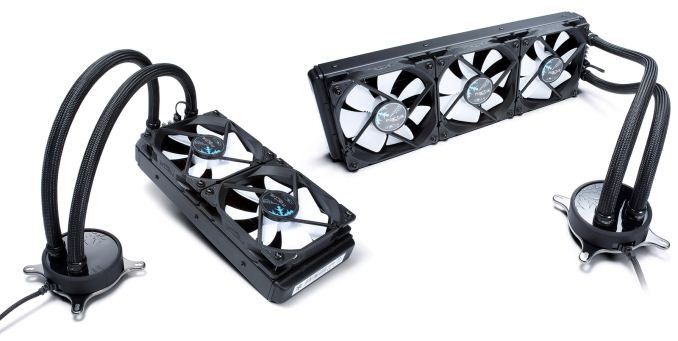
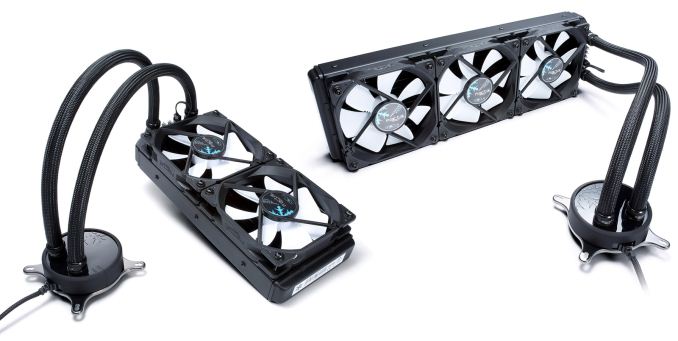
Fractal Design has just unveiled a different take on a new line of all-in-one liquid coolers, called the Celsius series. Unlike conventional AIOs, these new models are not actually closed-loop: they have threaded fittings on the radiator side in order to allow for expansion possibilities with common DIY liquid cooling components.

The two units being launched are the Celsius S24 and Celsius S36, which feature 240mm and 360mm radiators respectively. The radiators feature aluminium housings and fins, and they are both around 30mm thick. As mentioned above, it is the fittings that are the really interesting part of this new product line. While the CPU block fittings are non-removable, the radiator fittings are knurled metal and feature a standard G 1/4″ thread. Since the G 1/4″ fitting is so common in the custom liquid cooling market, the expansion options are vast. As long as you add additional coolant, you could loop in a second waterblock, a second radiator, or even a reservoir. As a result, you cannot consider these Celsius models to be strictly closed-loop coolers (CLCs), but instead something of a new hybrid.
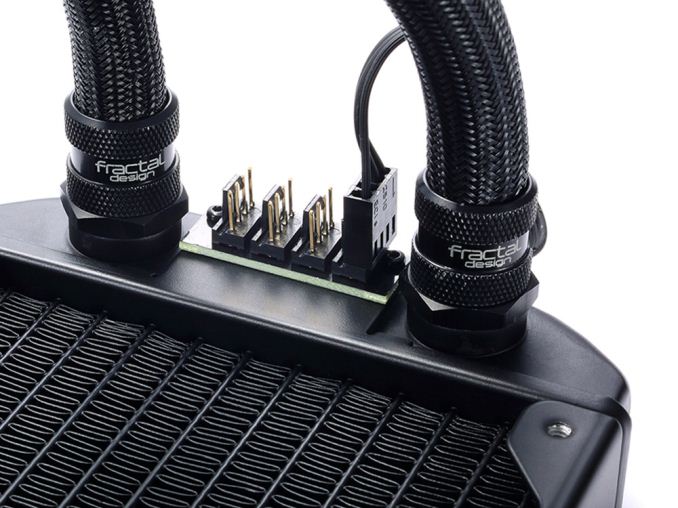
There is an integrated fan hub located between the radiator’s inlet and output ports, with two free 4-pin fan headers on the S24 model and three unoccupied 4-pin fan headers on the S36 model. Surprisingly, these fan headers are actually attached to a hardware fan controller that is built into the CPU block. Fractal Design has been incredibly clever and slipped the cable in between the sleeving and the rubber tubing, and they have run it the entire 400mm tubing length to the CPU block/pump/fan controller unit.

Gallery: Celsius S24

The fan controller has two user-selectable modes, either “auto” (which is based on the liquid temperature and handled by the cooler itself), or a “PWM” mode (which gives control to the motherboard and is based on the actual CPU temperature). In either mode, both the pump and the fan speeds will be increased/decreased since they are all PWM capable.

Speaking of fans, these Celsius coolers come with either two or three of the high-quality Dynamic X2 GP-12 PWM fans that Fractal Design launched last summer. They have rotational speeds of between 500-2000 RPM, and use “LLS” bearings, with a claimed 32.2 dB(A) full speed noise levels, a stated airflow of 87.6 CFM, 2.30mm H2O of static pressure, and they are rated for up to 100,000 hours of use.

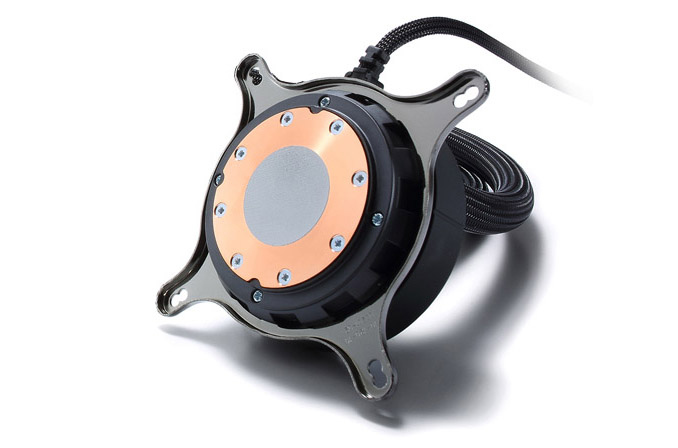
The pump, which is built into the CPU block housing, has a rotational speed of between 1950-3150 RPM, and a full speed noise level of 20.0 dB(A). This gives it a 50,000 hour MTBF (or 5.7 years full use). Total power consumption for the Celsius S36 is listed at 9.0W, while the smaller S24 clocks in at 6.6W. All of this is powered from a single fan header on your motherboard, so a dedicated water pump header with high amperage capabilities is probably a good thing. The CPU block has a copper base and features sound-dampening materials in order to reduce operating noise output. High thermal conductivity thermal paste is pre-applied.

These liquid coolers support all modern CPU sockets, including the latest AMD AM4 platform. We have no word on availability, but the Fractal Design Celsius S24 will retail for $109 USD and the larger Fractal Design Celsius S36 for $119 USD. Both of these units are covered by a five-year warranty.

Gallery: Celsius S36

Related Reading

Fractal Design Launches New S24 and S36 Celsius AIO Liquid Coolers

Fractal Design Launches New S24 and S36 Celsius AIO Liquid Coolers

Fractal Design has just unveiled a different take on a new line of all-in-one liquid coolers, called the Celsius series. Unlike conventional AIOs, these new models are not actually closed-loop: they have threaded fittings on the radiator side in order to allow for expansion possibilities with common DIY liquid cooling components.

The two units being launched are the Celsius S24 and Celsius S36, which feature 240mm and 360mm radiators respectively. The radiators feature aluminium housings and fins, and they are both around 30mm thick. As mentioned above, it is the fittings that are the really interesting part of this new product line. While the CPU block fittings are non-removable, the radiator fittings are knurled metal and feature a standard G 1/4″ thread. Since the G 1/4″ fitting is so common in the custom liquid cooling market, the expansion options are vast. As long as you add additional coolant, you could loop in a second waterblock, a second radiator, or even a reservoir. As a result, you cannot consider these Celsius models to be strictly closed-loop coolers (CLCs), but instead something of a new hybrid.

There is an integrated fan hub located between the radiator’s inlet and output ports, with two free 4-pin fan headers on the S24 model and three unoccupied 4-pin fan headers on the S36 model. Surprisingly, these fan headers are actually attached to a hardware fan controller that is built into the CPU block. Fractal Design has been incredibly clever and slipped the cable in between the sleeving and the rubber tubing, and they have run it the entire 400mm tubing length to the CPU block/pump/fan controller unit.

Gallery: Celsius S24

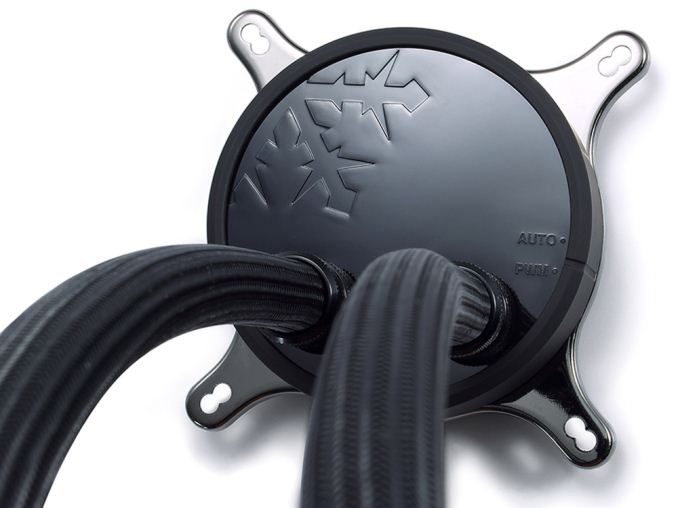
The fan controller has two user-selectable modes, either “auto” (which is based on the liquid temperature and handled by the cooler itself), or a “PWM” mode (which gives control to the motherboard and is based on the actual CPU temperature). In either mode, both the pump and the fan speeds will be increased/decreased since they are all PWM capable.
Speaking of fans, these Celsius coolers come with either two or three of the high-quality Dynamic X2 GP-12 PWM fans that Fractal Design launched last summer. They have rotational speeds of between 500-2000 RPM, and use “LLS” bearings, with a claimed 32.2 dB(A) full speed noise levels, a stated airflow of 87.6 CFM, 2.30mm H2O of static pressure, and they are rated for up to 100,000 hours of use.

The pump, which is built into the CPU block housing, has a rotational speed of between 1950-3150 RPM, and a full speed noise level of 20.0 dB(A). This gives it a 50,000 hour MTBF (or 5.7 years full use). Total power consumption for the Celsius S36 is listed at 9.0W, while the smaller S24 clocks in at 6.6W. All of this is powered from a single fan header on your motherboard, so a dedicated water pump header with high amperage capabilities is probably a good thing. The CPU block has a copper base and features sound-dampening materials in order to reduce operating noise output. High thermal conductivity thermal paste is pre-applied.
These liquid coolers support all modern CPU sockets, including the latest AMD AM4 platform. We have no word on availability, but the Fractal Design Celsius S24 will retail for $109 USD and the larger Fractal Design Celsius S36 for $119 USD. Both of these units are covered by a five-year warranty.

Gallery: Celsius S36

Related Reading

ASUS Announces ROG STRIX H270I & B250I Mini-ITX Motherboards

ASUS Announces ROG STRIX H270I & B250I Mini-ITX Motherboards

ASUS has just added to its Intel 200-series motherboard lineup with the announcement of two new mini-ITX motherboards. Dubbed the ROG Strix H270I Gaming and ROG Strix B250I Gaming, these two models differ when it comes to chipsets, but they are otherwise functionally identical in most respects.

Up until now, the ROG Strix Z270I was the only ‘high-end’ mini-ITX model in the ASUS LGA1151 product line, and given the absence of a Maximus IX Impact it has served as the spiritual successor to the Maximus VIII Impact that we reviewed back in December 2015. The lineage between the ROG Strix Z270I and these two latest models is much more obvious. Aside from one less MOSFET heatsink, the chipset, and some different VRM components, all three of these motherboards are all largely indistinguishable. Having said that, whereas the higher-end Z270-based model supports both CPU and memory overclocking, these two new more affordable models are aimed at those running stock-clocked CPUs. As such, they are also limited to memory speeds of DDR4-2400. While we are on the subject of memory, both motherboards clearly only have two memory slots and therefore system memory is limited to 32GB.

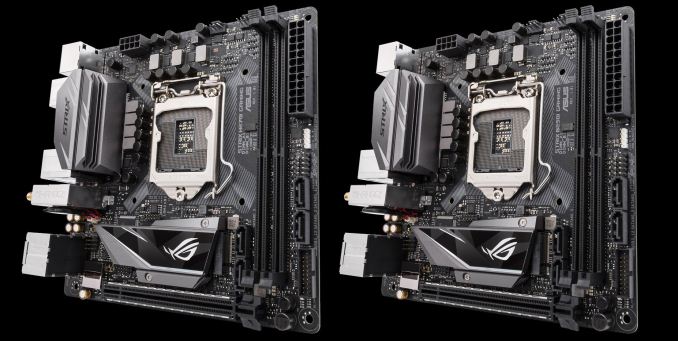
An interesting part of these mini-ITX models is that ASUS have managed to fit two M.2 connectors on a tiny PCB footprint. This is due to a double-decker heatsink design that allows an M.2 drive to be sandwiched between a top cover heatsink and a lower level PCH heatsink. The secondary M.2 connector is located on the back of the motherboard. Both M.2 connectors can handle full-speed PCIe 3.0 x4 NVMe SSDs, as well as Intel Optane Memory, but only one of them supports SATA-based M.2 solid state drives.

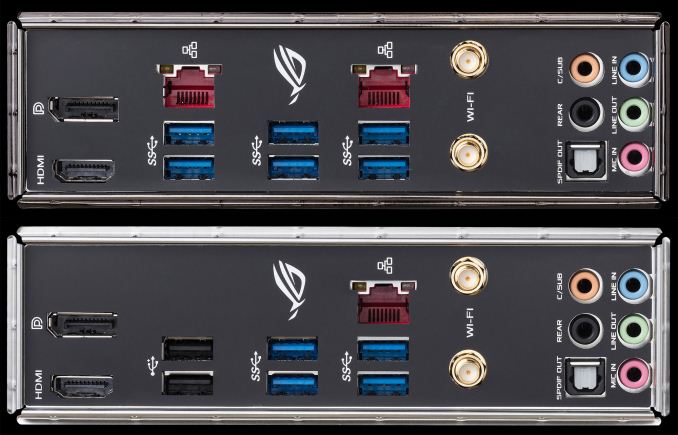
Both motherboards have four SATA 6Gb/s ports and support Intel Rapid Storage Technology, although only the Strix H270I has RAID 0, 1, 5, 10 and Intel SRT capabilities. There is a small divergence when it comes to USB connectivity, with the H270I supporting eight USB 3.0 ports (six rear, one header) and the B250I supporting six USB 3.0 ports (four rear, one header) and two USB 2.0 ports (two rear).

The H270-based model also has two gigabit LAN ports (one powered by an Intel I219V and the other a Realtek RTL8111H) while the B250-based model only has a single gigabit LAN port courtesy of an Intel I219V controller. All of these LAN ports are protected by LANGuard surge protectors and can be managed using the ASUS GameFirst IV traffic management software. Both models also have onboard dual-band 802.11ac Wi-Fi with MU-MIMO, Bluetooth 4.1, and an included 2×2 external antenna. For those planning to use integrated graphics, both motherboards feature HDMI 1.4 and DisplayPort 1.2 video outputs.

Given the obvious size constraints, the Strix H270I and Strix B250I only have one PCIe 3.0 x16 slot, and it is SafeSlot metal-reinforced (additional PCIe rigidity for heavy GPUs). Onboard audio duties are handled by an ROG SupremeFX eight-channel HD audio solution, which is based on the Realtek ALC1220A codec. There are dual headphone amplifiers, which means additional power and impedance sensing for both the front and rear headphone outputs. This onboard audio implementation also benefits from the ASUS audio software suite that consists of Sonic Studio III and Sonic Radar III.

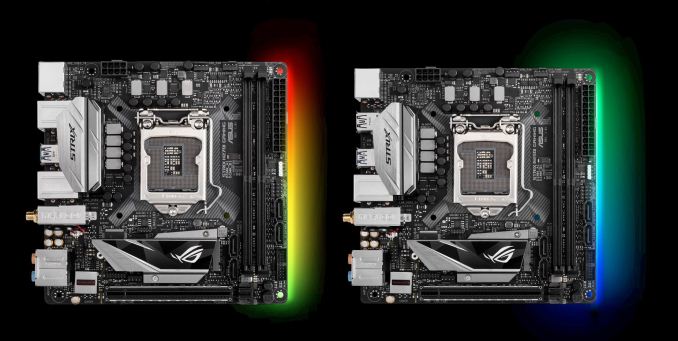
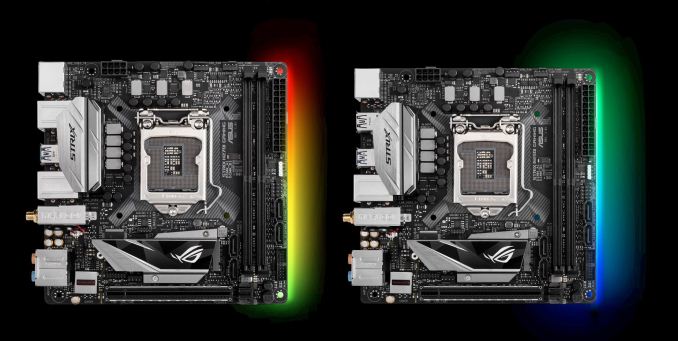
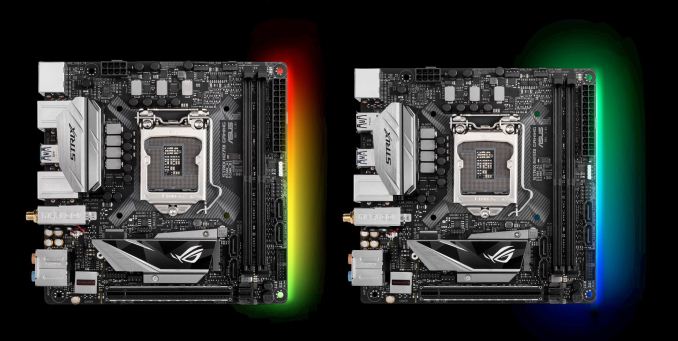
Since it is apparently the must-have feature of the second half of the decade, ASUS has added AURA RGB lighting to both of these models, in the form of a series of LEDs placed along the entire right side. There is also one RGB header that can power an LED light strip. Due to the Aura Sync feature, all of the lighting is controllable from within the AURA utility. While we are on the topic of cool features (Ed: Punny…), there are three total fan headers – one which can handle a water pump or high amperage fan – and all of which can be managed by the excellent Fan Xpert 4 UEFI and/or software fan controls.

There’s no word on availability or pricing, other than the fact that we expect the Strix H270I will cost a little bit more than the Strix B250I.

Gallery: ROG Strix H270I

Gallery: ROG Strix B250I

Related Reading

ASUS Announces ROG STRIX H270I & B250I Mini-ITX Motherboards

ASUS Announces ROG STRIX H270I & B250I Mini-ITX Motherboards

ASUS has just added to its Intel 200-series motherboard lineup with the announcement of two new mini-ITX motherboards. Dubbed the ROG Strix H270I Gaming and ROG Strix B250I Gaming, these two models differ when it comes to chipsets, but they are otherwise functionally identical in most respects.

Up until now, the ROG Strix Z270I was the only ‘high-end’ mini-ITX model in the ASUS LGA1151 product line, and given the absence of a Maximus IX Impact it has served as the spiritual successor to the Maximus VIII Impact that we reviewed back in December 2015. The lineage between the ROG Strix Z270I and these two latest models is much more obvious. Aside from one less MOSFET heatsink, the chipset, and some different VRM components, all three of these motherboards are all largely indistinguishable. Having said that, whereas the higher-end Z270-based model supports both CPU and memory overclocking, these two new more affordable models are aimed at those running stock-clocked CPUs. As such, they are also limited to memory speeds of DDR4-2400. While we are on the subject of memory, both motherboards clearly only have two memory slots and therefore system memory is limited to 32GB.

An interesting part of these mini-ITX models is that ASUS have managed to fit two M.2 connectors on a tiny PCB footprint. This is due to a double-decker heatsink design that allows an M.2 drive to be sandwiched between a top cover heatsink and a lower level PCH heatsink. The secondary M.2 connector is located on the back of the motherboard. Both M.2 connectors can handle full-speed PCIe 3.0 x4 NVMe SSDs, as well as Intel Optane Memory, but only one of them supports SATA-based M.2 solid state drives.

Both motherboards have four SATA 6Gb/s ports and support Intel Rapid Storage Technology, although only the Strix H270I has RAID 0, 1, 5, 10 and Intel SRT capabilities. There is a small divergence when it comes to USB connectivity, with the H270I supporting eight USB 3.0 ports (six rear, one header) and the B250I supporting six USB 3.0 ports (four rear, one header) and two USB 2.0 ports (two rear).

The H270-based model also has two gigabit LAN ports (one powered by an Intel I219V and the other a Realtek RTL8111H) while the B250-based model only has a single gigabit LAN port courtesy of an Intel I219V controller. All of these LAN ports are protected by LANGuard surge protectors and can be managed using the ASUS GameFirst IV traffic management software. Both models also have onboard dual-band 802.11ac Wi-Fi with MU-MIMO, Bluetooth 4.1, and an included 2×2 external antenna. For those planning to use integrated graphics, both motherboards feature HDMI 1.4 and DisplayPort 1.2 video outputs.

Given the obvious size constraints, the Strix H270I and Strix B250I only have one PCIe 3.0 x16 slot, and it is SafeSlot metal-reinforced (additional PCIe rigidity for heavy GPUs). Onboard audio duties are handled by an ROG SupremeFX eight-channel HD audio solution, which is based on the Realtek ALC1220A codec. There are dual headphone amplifiers, which means additional power and impedance sensing for both the front and rear headphone outputs. This onboard audio implementation also benefits from the ASUS audio software suite that consists of Sonic Studio III and Sonic Radar III.

Since it is apparently the must-have feature of the second half of the decade, ASUS has added AURA RGB lighting to both of these models, in the form of a series of LEDs placed along the entire right side. There is also one RGB header that can power an LED light strip. Due to the Aura Sync feature, all of the lighting is controllable from within the AURA utility. While we are on the topic of cool features (Ed: Punny…), there are three total fan headers – one which can handle a water pump or high amperage fan – and all of which can be managed by the excellent Fan Xpert 4 UEFI and/or software fan controls.

There’s no word on availability or pricing, other than the fact that we expect the Strix H270I will cost a little bit more than the Strix B250I.

Gallery: ROG Strix H270I

Gallery: ROG Strix B250I

Related Reading

AOC Releases the I1659FWUX: a 15.6-inch 1080P Portable USB Monitor

AOC Releases the I1659FWUX: a 15.6-inch 1080P Portable USB Monitor

AOC have just introduced a new high definition 15.6-inch portable USB monitor for those who need more screen real estate than their laptop can provide without worrying too much about having the right display connector. USB monitors are popular for users when giving presentations, or for multi-window work.


Labelled as the I1659FWUX, this 15.6-inch display has a resolution of 1920 x 1080 with a conventional refresh rate of 60Hz. It features an IPS panel with a matte anti-glare coating, a brightness of 220 cd/m2, a contrast ratio of 700:1, and a 25ms response time. The viewing angles are listed as 160° (CR>10) horizontal and 160° (CR>10) vertical. The “CR>10” part means that you can view 160° of the screen while retaining a contrast ratio of at least 10:1. Those viewing angles don’t sound great for an IPS display, but given the specific metric that AOC is using it’s hard to accurately judge it compared to other monitors.

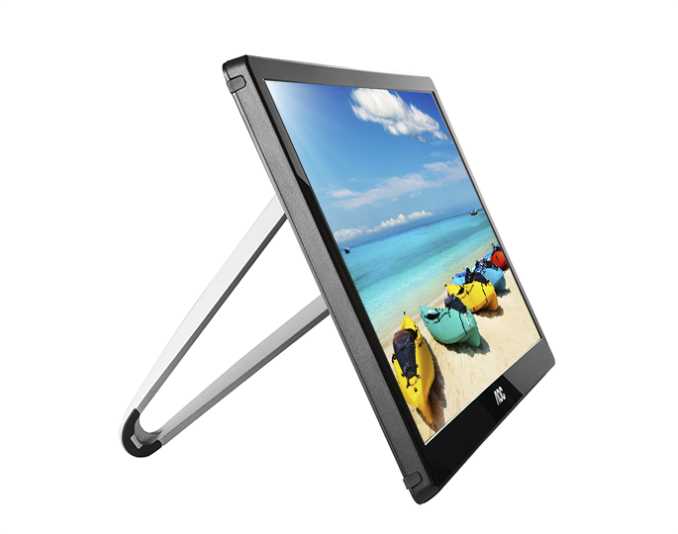
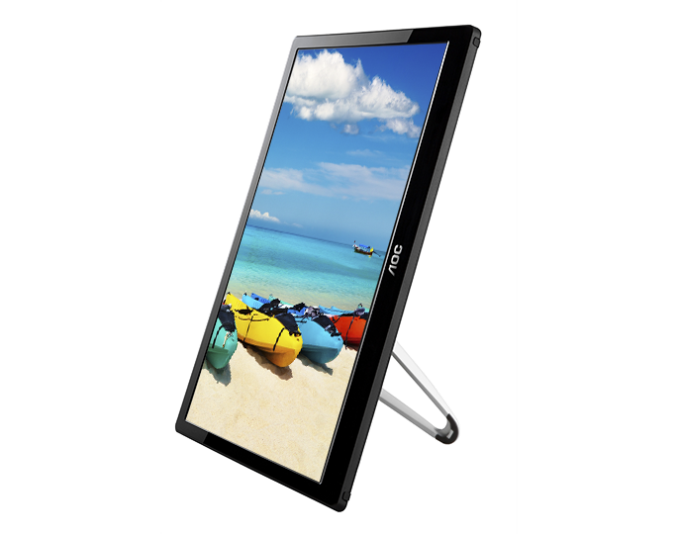
The entire enclosure is made of a glossy piano black plastic (which may attract fingerprints), while the panel itself is framed by a half-inch bezel on all sides. Integrated into the enclosure is a foldable silver stand that can rotate the display into either portrait or landscape mode and there is an auto-rotation feature built-in. While the monitor is portable in the literal sense, the I1659FWUX is 35.5mm (1.4-inch) thick and weighs 1.2 kg, so it is no compact featherweight product. Thankfully, a protective carrying case is included, so that will help when it to comes to travelling with the display. You’re essentially carrying another laptop, in other words.


One of the key selling points of this monitor – portability aside – is that it receives both data and power via a single USB 3.0 cable, which means no additional bulky power adapter to carry. Power consumption is listed at 0.5W standby and 8W typical, so probably you won’t be able to power it with just a single USB 3.0 port – most can’t deliver more than 4.5W – but the included Y cable splits the load across two USB ports. Once the cable is plugged in, installation requires drivers and DisplayLink software that is compatible with both macOS and Windows.

AOC I1659FWUX
Product Page Link
Panel 15.6″ IPS
Native Resolution 1920 × 1080 (16:9)
Maximum Refresh Rate 60 Hz
Response Time 25 ms
Brightness 220 cd/m²
Contrast 700:1
Viewing Angles 160° (CR>10) / 160° (CR>10)
horizontal/vertical
Pixel Density 141 pixels per inch
Display Colors 292K
Stand Tilt (15° to 30°)
Auto Pivot
Inputs 1 × USB 3.0
Audio None
Dimensions 232.7mm x 371.9mm x 35.5mm (WxHxD)
Weight 1.20 kg
Price $149.90

It should be noted that while AOC already has a similar product with a very similar model name (E1659FWUX). This previous model features a TN panel which is brighter and has a lower response time, but worse contrast and viewing angles than this newer IPS version.

The AOC I1659FWUX is available for pre-order on Amazon.com for $149.90 USD with a stated in-stock date of May 13th.

Gallery: I1659FWUX

Related Reading