Vik


Intel to Acquire Mobileye for $15 Billion
Intel to Acquire Mobileye for $15 Billion

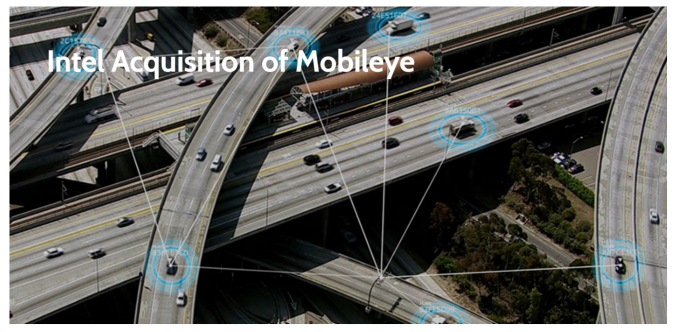
In an interesting announcement today, Intel and Mobileye have entered into an agreement whereby Intel will commence a tender offer for all issued and outstanding ordinary shared of Mobileye. At $63.54 per share, this will equate to a value of approximately $15 billion.

Mobileye is currently one of a number of competitors actively pursuing the visual computing space, and the high item on that agenda is automotive. We’ve seen Mobileye announcements over the last few years, with relationships with car manufacturers on the road to fully autonomous vehicles. Intel clearly wants a piece of that action, aside from its own movement into automotive as well as cloud computing required for various automotive tasks.

Intel estimates that vehicle systems, data, and the services market for automotive to have a value around $70 billion by 2030, including edge cases through backhaul into cloud. This includes predictions such that 4TB of data per day per vehicle will be generated, which is going to require planning in infrastructure. Intel’s expertise in elements such as the RealSense technology and high-performance general compute will be an interesting match to Mobileye’s portfolio.

“This acquisition is a great step forward for our shareholders, the automotive industry, and consumers,” said Brian Krzanich, Intel CEO. “Intel provides critical foundational technologies for autonomous driving including plotting the car’s path and making real-time driving decisions. Mobileye brings the industry’s best automotive-grade computer vision and strong momentum with automakers and suppliers. Together, we can accelerate the future of autonomous driving with improved performance in a cloud-to-car solution at a lower cost for automakers.”

The acquisition will combine into a single organization under Intel’s Automated Driving Group, to be HQ in Israel and led by Prof Shashua, Mobileye’s co-founder, Chairman and CEO. All current contracts under Mobileye for automotive OEMs and tier-one suppliers will be retained under the single group, which will also be under Doug Davis, Intel’s SVP of Intel’s Automotive.

Mobileye currently offers on its roadmap products such as the EyeQ4 and EyeQ 5 SoCs, for level 3/4 autonomy in 2018 and 2020 respectively, as well as high-performance FPGAs for vision analytical techniques. The acquisition of Altera by Intel over a year ago as a step into the FPGA market may come into play here, as well as Intel’s semiconductor manufacturing facilities. As with Altera, it will likely take some time before full integration between Intel’s resources and Mobileye’s technology occurs.

There will be an investor call webcast on 3/13 at 8:30 am (ET) about this announcement at this link here. The full transaction is expected to close within nine months, subject to regulatory approval, and is not subject to any financing conditions. Intel intends to fund the acquisition with cash from the balance sheet.

As we get more information we will let you know.

Additional 1: For scope, Intel’s purchase of Altera was $16.7 billion, as we reported here.

Additional 2: Here is the Investor Call slide deck.

Additional 3: It will require purchasing 95% of the ordinary stock, and will use offshore cash that Intel has not repatriated into the US.

Intel to Acquire Mobileye for $15 Billion

Intel to Acquire Mobileye for $15 Billion

In an interesting announcement today, Intel and Mobileye have entered into an agreement whereby Intel will commence a tender offer for all issued and outstanding ordinary shared of Mobileye. At $63.54 per share, this will equate to a value of approximately $15 billion.

Mobileye is currently one of a number of competitors actively pursuing the visual computing space, and the high item on that agenda is automotive. We’ve seen Mobileye announcements over the last few years, with relationships with car manufacturers on the road to fully autonomous vehicles. Intel clearly wants a piece of that action, aside from its own movement into automotive as well as cloud computing required for various automotive tasks.

Intel estimates that vehicle systems, data, and the services market for automotive to have a value around $70 billion by 2030, including edge cases through backhaul into cloud. This includes predictions such that 4TB of data per day per vehicle will be generated, which is going to require planning in infrastructure. Intel’s expertise in elements such as the RealSense technology and high-performance general compute will be an interesting match to Mobileye’s portfolio.

“This acquisition is a great step forward for our shareholders, the automotive industry, and consumers,” said Brian Krzanich, Intel CEO. “Intel provides critical foundational technologies for autonomous driving including plotting the car’s path and making real-time driving decisions. Mobileye brings the industry’s best automotive-grade computer vision and strong momentum with automakers and suppliers. Together, we can accelerate the future of autonomous driving with improved performance in a cloud-to-car solution at a lower cost for automakers.”

The acquisition will combine into a single organization under Intel’s Automated Driving Group, to be HQ in Israel and led by Prof Shashua, Mobileye’s co-founder, Chairman and CEO. All current contracts under Mobileye for automotive OEMs and tier-one suppliers will be retained under the single group, which will also be under Doug Davis, Intel’s SVP of Intel’s Automotive.

Mobileye currently offers on its roadmap products such as the EyeQ4 and EyeQ 5 SoCs, for level 3/4 autonomy in 2018 and 2020 respectively, as well as high-performance FPGAs for vision analytical techniques. The acquisition of Altera by Intel over a year ago as a step into the FPGA market may come into play here, as well as Intel’s semiconductor manufacturing facilities. As with Altera, it will likely take some time before full integration between Intel’s resources and Mobileye’s technology occurs.

There will be an investor call webcast on 3/13 at 8:30 am (ET) about this announcement at this link here. The full transaction is expected to close within nine months, subject to regulatory approval, and is not subject to any financing conditions. Intel intends to fund the acquisition with cash from the balance sheet.

As we get more information we will let you know.

Additional 1: For scope, Intel’s purchase of Altera was $16.7 billion, as we reported here.

Additional 2: Here is the Investor Call slide deck.

Additional 3: It will require purchasing 95% of the ordinary stock, and will use offshore cash that Intel has not repatriated into the US.
SD Association Announces UHS-III (up to 624 MB/s), A2 Class, LV Signaling

SD Association Announces UHS-III (up to 624 MB/s), A2 Class, LV Signaling

The SD Association has made three important announcements in the course of the past couple of weeks. First is the introduction of its UHS-III bus that increases the potential maximum throughput of SD cards. Second is the announcement of the Application Performance Class 2 standard, for devices that meet a new set of criteria that relate to IOPS. Third is a new Low-Voltage Signaling specification (LVS) that has potential to reduce complexity and power consumption of future applications featuring SD memory cards. Both the A2 and the LVS are parts of the SD 6.0 specification.

UHS-III: Up to 624 MB/s

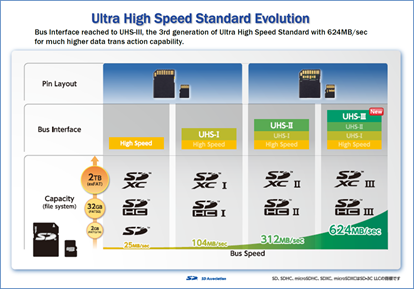
As 4K, 8K and 360° content are becoming more widespread, the performance requirements for storage on cameras and similar devices is ever increasing. To support them, the SDA is introducing a new UHS-III interface bus that increases potential read/write bandwidth up to 624 MB/s (double that of the UHS-II). The UHS-III high-speed interface signals are assigned to the second row of SD card pins that are also present on the UHS-II cards, which means that the upcoming UHS-III cards will be backward compatible with UHS-II and UHS devices as well as any other SD hosts.

Comparison of UHS Bus Performance
UHS-I UHS-II UHS-III
50 – 104 MB/s 156 MB/s full duplex
312 MB/s half duplex
up to 624 MB/s (full duplex)

Since the SD Association only manages standards, it cannot make announcements regarding the availability of devices and memory cards supporting UHS-III. Given the fact that the new bus requires a redesign of SoCs currently in the market (the addition of a faster PHY may not be too hard from an engineering point of view, but it is time consuming), qualification and other efforts, it is logical to expect UHS-III applications about a year from now, if not later. Keep in mind that a couple of years passed between the announcement of the UHS-II and commercial availability of cards supporting the standard.

The SDA expects the camera industry, as well as various emerging devices that need high data throughput, to adopt UHS-III first with others following sometimes later. Not many smartphones currently support even UHS-II, so it remains to be seen when mobile devices adopt the UHS-III.

A2 Class: Higher Performance and New Functionality

Last November the SDA introduced its Application Performance Class set of requirements for SD cards and kicked off with the A1 class that guarantees minimum write IOPS of 500, minimum read IOPS of 1500 and sustained throughput of at least 10 MB/s. Today, A1-compliant SD and microSD cards are on the market and are available from various manufacturers.

Application Performance Class
Minimum Performance Requirements
  Sequential Read IOPS Write IOPS
A1 10 MB/s 1500 500
A2 4000 2000

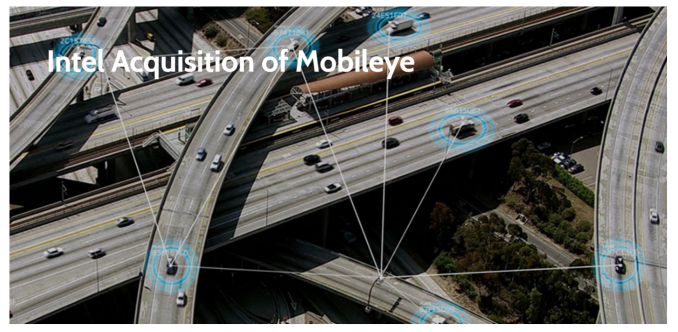
At MWC 2017 the SDA expanded the application performance class with a new A2 rating. This rating requires SD cards to provide a random performance of 2000 write IOPS and 4000 read IOPS, while leaving sustained sequential read/write speed at 10 MB/s.

The A2 Class is a part of the SD 6.0 protocol specification and this means that apart from higher random and sequential numbers, some of the A2 cards will are mandated to support such functions as command queuing (with a minumum depth que of 2 and maximum depth que of 32) and caching to hit the performance targets as well as ‘self-maintenance’ and low-voltage signaling (LVS). For example, command queuing could optimize random read performance, whereas support for caching could improve random write performance as SD cards can use higher-speed NAND flash cache to write data (in a manner similar to what TLC-based SSDs do with their pSLC cache). High-performance random writes are important not only for computer programs installed on cards, but also for devices that write data intensively (e.g., 360° cameras).

The SDA does not explain much about the ‘self-maintenance’ element to the standard, but it says that it contributes to “better memory access performance” and allows “internal background data management.” In general, it looks like the upcoming SD 6.0-compliant cards will support some sort of garbage collection, akin to that performed by SSDs. Keep in mind that some of the already available SD cards can hit the A2 performance requirements today.

Update 3/12: The mimimum depth que that the A2 Class cards are mandated to support is 2 (not 1, as we were told at the time of writing, which essentially means that the tech was not used and all cards could “support” it). Meanwhile, the maximum depth que is 32 commands. Therefore, all the A2 Class cards will have to feature new controllers featuring Command Queue and Cache functions and that means the logotypes will not be put on existing products despite their compliancy with the performance numbers. That said, it will take some time before A2 Class cards hit the market.

At present, multiple makers of SD cards are developing sampling their A2-rated products and it is expected that they are going to release commercial A2 products in the coming months quarters. Meanwhile, since command queuing and caching enable cards to hit the performance targets and are mandatory features, all A2 cards will come with this functionality. Keep in mind that today’s hosts do not support the SD 6.0 spec, so, certain cards with the A2 logotype may not demonstrate all of their advantages on hosts compatible with the SD 5.0 and the SD 5.1 specs.

LVS: Bringing the Voltage Down

When the Secure Digital standard was designed in the late 1990s, the developers decided to use 3.3 V signaling because at the time it was considered low enough even for mobile devices. Eventually, the SDA added 1.8 V signaling to UHS and UHS-II modes, but kept 3.3 V signals for initialization and operations with legacy hosts. As a result, modern hosts also had to support both voltages. The SD 6.0 introduces low voltage (LV) signaling cards that need to support either 1.8 V or 3.3 V signaling with auto detection mechanism, eliminating any needs for upcoming hosts to support both and thus decreasing complexity and saving some power because of reduced signaling voltage. The new cards will carry the LV logo and will be backward compatible with existing hosts, but LV hosts will only work with LV cards.

Putting It All Together

Despite the somewhat confusing mess surrounding SD cards, performance and metrics, the three announcements made by the SDA are independent of each other. Some new cards coming to the market will be UHS-III-only, some cards will be UHS-III with LVS, and others will be A2 with LV, others will be LV without A2. As always, host support will be critical.