Vik


Samsung Launch the Galaxy Book 10.6-inch and 12-inch: Windows Tablets with Kaby Lake
Samsung Launch the Galaxy Book 10.6-inch and 12-inch: Windows Tablets with Kaby Lake

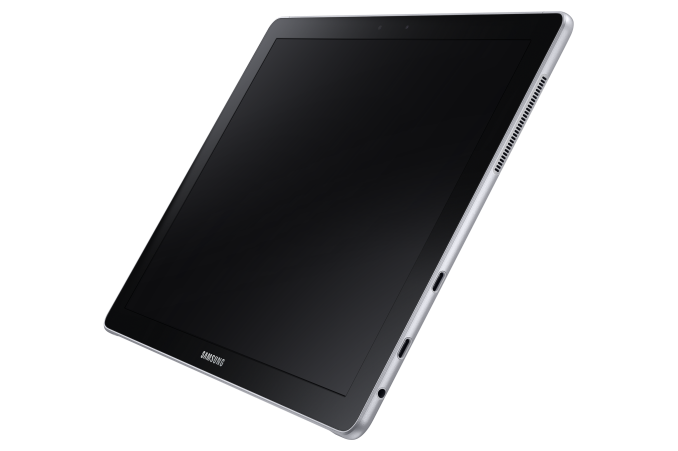
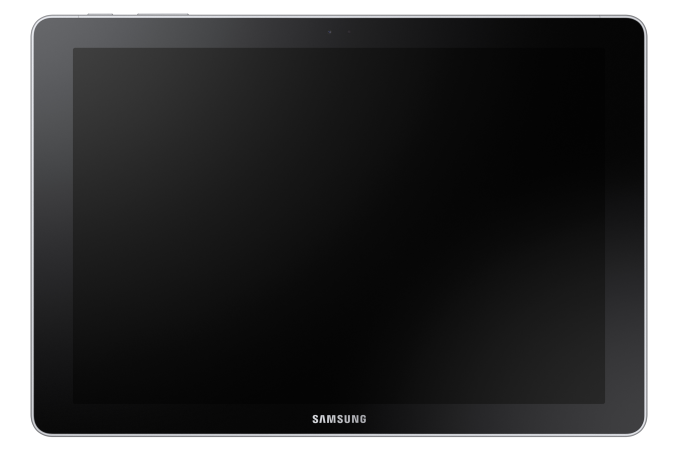
The announcements this year from Samsung are notably muted without the launch of a new Galaxy smartphone, but despite this being a mobile-focused conference in Barcelona this week, there were a few new Samsung devices to whet the appetite. The first is actually more of a PC, in a Windows-10 based tablet called the Galaxy Book, available in either 10.6-inch LCD or 12-inch Super AMOLED display, firing in the line of the Microsoft Surface range. Samsung is primarily aiming these new devices with a nod towards the professional market, but are keen to say that they’re suitable for consumers as well.
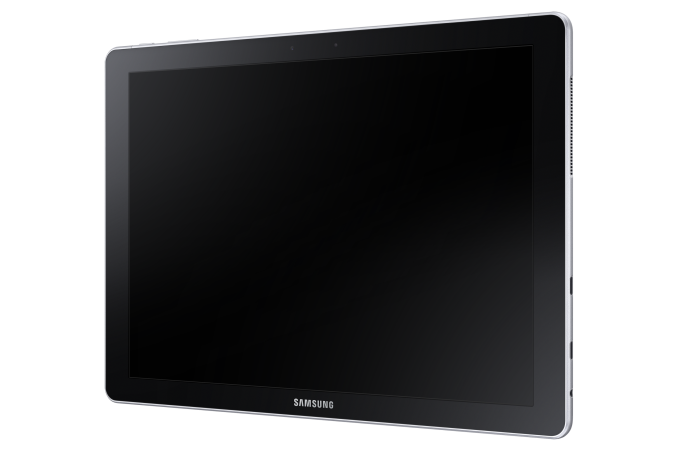
At the heart of each tablet is a Kaby-Lake CPU based on Core m for the 10.6-inch or Core i5 on the 12-inch, supported in various configurations of DRAM and storage but both having an integrated LTE Cat 6 modem for wireless support. Aside from the Core i5, and offering an 8GB DRAM/256GB storage model, the key element of the 12-inch device is the Super AMOLED display running at 2160×1440 which Samsung states supports videos in HDR 10-bit. The 10.6-inch version will use a 1920×1280 TFT LCD display.
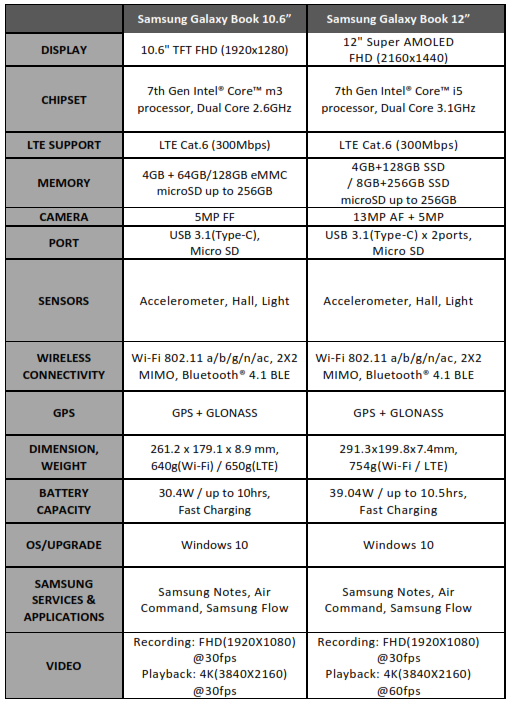
The larger device will use a 13MP rear camera with autofocus, and both units have a 5MP front facing camera. Aside from microSD support, users will also get USB 3.1 Type-C ports. Both units will come with Windows 10, support for the next generation S Pen using a new 0.7mm tip and in ‘screen off’ mode which allows for note taking without the display being on.
Battery for the units comes in at 30.4 Wh for the smaller one, and 39.04 Wh for the larger display. Samsung is quoting around 10 hours of use for both and both will have access to fast charging. It is worth noting that with the specifications, Samsung lists the 10.6-inch display as supporting 4K30 playback but the bigger unit, with a faster processor, can handle 4K60 playback. Both units have vents for fans, it must be noted.

We’re awaiting more information about the modem support, pricing and availability. There might also be a chance for some hands-on time with the units, as it will be interesting to see how well that bezel measures up in normal use.

Edit – it seems the Core i5 is a U-series product. That’s 15W normal, or 7W/9.5W in cTDP down mode.

Edit 2: The CAT 6 LTE modems are from Intel. Source: Brian Krzanich Twitter

Edit 3: All Books will come with a keyboard and S-Pen as standard.

Samsung Launch the Galaxy Book 10.6-inch and 12-inch: Windows Tablets with Kaby Lake

Samsung Launch the Galaxy Book 10.6-inch and 12-inch: Windows Tablets with Kaby Lake

The announcements this year from Samsung are notably muted without the launch of a new Galaxy smartphone, but despite this being a mobile-focused conference in Barcelona this week, there were a few new Samsung devices to whet the appetite. The first is actually more of a PC, in a Windows-10 based tablet called the Galaxy Book, available in either 10.6-inch LCD or 12-inch Super AMOLED display, firing in the line of the Microsoft Surface range. Samsung is primarily aiming these new devices with a nod towards the professional market, but are keen to say that they’re suitable for consumers as well.

At the heart of each tablet is a Kaby-Lake CPU based on Core m for the 10.6-inch or Core i5 on the 12-inch, supported in various configurations of DRAM and storage but both having an integrated LTE Cat 6 modem for wireless support. Aside from the Core i5, and offering an 8GB DRAM/256GB storage model, the key element of the 12-inch device is the Super AMOLED display running at 2160×1440 which Samsung states supports videos in HDR 10-bit. The 10.6-inch version will use a 1920×1280 TFT LCD display.

The larger device will use a 13MP rear camera with autofocus, and both units have a 5MP front facing camera. Aside from microSD support, users will also get USB 3.1 Type-C ports. Both units will come with Windows 10, support for the next generation S Pen using a new 0.7mm tip and in ‘screen off’ mode which allows for note taking without the display being on.

Battery for the units comes in at 30.4 Wh for the smaller one, and 39.04 Wh for the larger display. Samsung is quoting around 10 hours of use for both and both will have access to fast charging. It is worth noting that with the specifications, Samsung lists the 10.6-inch display as supporting 4K30 playback but the bigger unit, with a faster processor, can handle 4K60 playback. Both units have vents for fans, it must be noted.

We’re awaiting more information about the modem support, pricing and availability. There might also be a chance for some hands-on time with the units, as it will be interesting to see how well that bezel measures up in normal use.

Edit – it seems the Core i5 is a U-series product. That’s 15W normal, or 7W/9.5W in cTDP down mode.

Edit 2: The CAT 6 LTE modems are from Intel. Source: Brian Krzanich Twitter

Edit 3: All Books will come with a keyboard and S-Pen as standard.

Intel Announces Xeon D-1500 Network Series SoCs with QuickAssist, Four 10 GbE Ports

Intel Announces Xeon D-1500 Network Series SoCs with QuickAssist, Four 10 GbE Ports

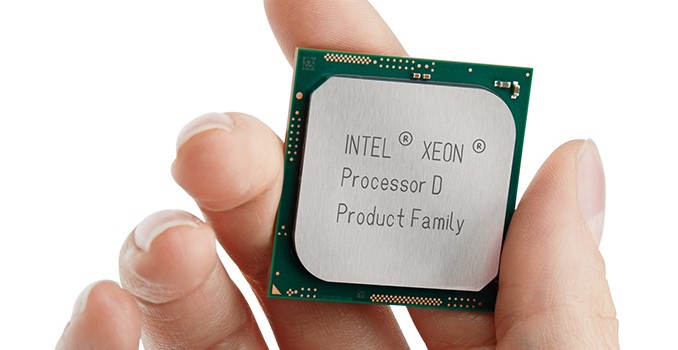
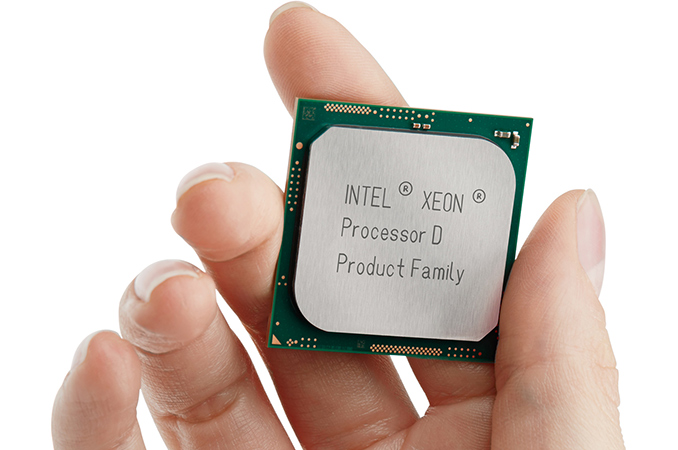
Intel’s Xeon D SoCs and supporting platforms for storage, web hosting and networking applications seem to be getting traction with actual hardware manufacturers as well as end users. This month Intel announced expansion of the lineup of these processors with several new models supporting QuickAssist accelerator and increased amount of 10 GbE ports. The new Xeon D SoCs for networking applications simplify creation of various devices due to higher integration.

The newest Intel Xeon D-1500-series products use Intel’s prowess in highly integrated SoCs, this time powered by up to 16 of the company’s high-performance Broadwell cores, featuring a dual-channel DDR3L/DDR4 memory controller as well as rich I/O capabilities (up to 24 PCIe 3.0 lanes, 6 SATA ports, two 10 GbE ports, USB, etc.). The Xeon D SoCs support the majority of RAS capabilities of the Xeon E5 v3 processors, including ECC, MCA, PCIe ECRC (end-to-end CRC), SMM and so on. At present, Intel offers two application-specific lineups of its Xeon D SoCs: for web hosting servers and for networking devices. The latter is going to receive several new models with improved feature-set in the coming months.

Firstly, Intel plans to integrate its QuickAssist accelerator with up to 40 Gbps of compression/encryption throughput into the new Xeon D SoCs. Today, developers of network equipment have to use Intel’s discrete QuickAssist hardware to speed up compression/encryption operations, which means larger footprint, higher power consumption and additional costs. The integration of the accelerator will enable designers to reduce dimensions of their motherboards and will reduce power consumption a bit, assuming they can feed it. Since Intel does not announce prices of the new SoCs right now, it is hard to tell how the integration affects the cost of the platforms (Intel does not mention that in its documents), but usually the elimination of one component can lead to the elimination of some other parts too, so BOMs get lower.

Secondly, Intel intends to integrate four 10 GbE controllers (at present, we do not know whether they can be grouped for 40 Gbps or split for 2.5 or 5 Gbps ports) into the new Xeon D SoCs, doubling the amount of 10 GbE ports supported by today’s Xeon D processors. Obviously, for applications that need over four 10 GbE ports, Intel’s FM10000 Ethernet PHYs will still be required, but for other devices having the integration will help to reduce extra chip count. Again, the integration here could mean a reduced footprint, lower chip count and power consumption.

The new Intel Xeon D-1500 SoCs with enhanced networking capabilities are currently sampling with Intel’s customers. The chipmaker expects its clients to start launching their products based on the new processors by mid-2017. 

(Ian: It’s worth noting that Xeon D-1500, as a family, has been around for a few years now. No news yet on updates to Xeon-D using Skylake or Kaby Lake cores.)

Related Reading: