Vik


AMD Launches Ryzen: 52% More IPC, Eight Cores for Under $330, Pre-order Today, On Sale March 2nd

AMD Launches Ryzen: 52% More IPC, Eight Cores for Under $330, Pre-order Today, On Sale March 2nd

The biggest x86 launch for AMD in five years is today: Ryzen is here. As always before a major launch, AMD gives a ‘Tech Day’ for relevant press and analysts, and through this event AMD’s CEO, Dr. Lisa Su lifted the lid on one of the most anticipated products in the semiconductor industry. AMD knows how to control the level of enthusiasm for its fans, and today is the end result, with processors going on pre-order from major retailers today at 1pm EST, ready for a general hard launch on March 2nd.

In a similar vein to launches of recent smartphones, AMD is doing a staggered announcement/launch with the products on their new microarchitecture. Where Samsung/Apple might give all the details for a product a few weeks before it’s available to buy, today on February 22nd marks the day where AMD is giving consumers information about Ryzen, and specifically the Ryzen 7 family of eight-core products. All the information today is from AMD, and AMD’s internal testing, and pre-orders also start from today for users ready to put down their money for a launch day part. Reviews of the CPUs, as well as when the CPUs will ship to customers, is on March 2nd. This also happens to be right in the middle of two annual shows, Game Developer Conference (GDC) and Mobile World Congress (MWC), making the time between receiving pre-launch samples and being able to provide independent verification of AMD’s performance claims relatively frantic. We’ll do our best!

The Ryzen Family

With a new processor launch, naming the parts and positioning them within the market is critical. So with Ryzen, the processor stack will be split into three based on performance and price: Ryzen 7 at the high end, Ryzen 5 in the middle, and Ryzen 3 for more price-conscious consumers. Both Ryzen 5 and Ryzen 3 are set to be launched later, and Ryzen 7 is the first portion of the family to be released.
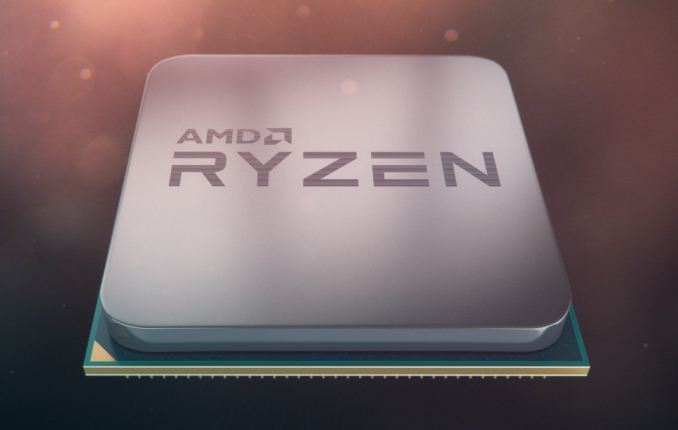
Ryzen 7 will have three CPUs to start, all having eight cores and supporting simultaneous multi-threading:

  • Ryzen 7 1800X: 8C/16T, 3.6 GHz base, 4.0 GHz turbo, 95W, $499
  • Ryzen 7 1700X: 8C/16T, 3.4 GHz base, 3.8 GHz turbo, 95W, $399
  • Ryzen 7 1700: 8C/16T, 3.0 GHz base, 3.7 GHz turbo, $329

Ryzen 7 1800X will be the high-end part, featuring a base clock of 3.6 GHz and a turbo of 4.0 GHz, within a TDP of 95W, and for $499. Next to this is Ryzen 7 1700X, launching at $399, with a base/turbo of 3.4/3.8 GHz. The final part for the launch is the Ryzen 7 1700, providing eight cores and sixteen threads for $329 at 3.0/3.7 GHz frequencies.

Processors will initially be available for pre-order from 185 retailers and OEMs worldwide, either as individual parts or pre-built systems.

What, not 40% IPC? 52% IPC??

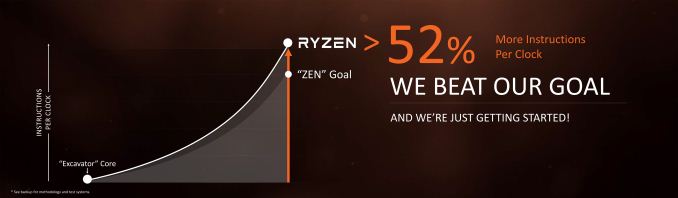
Enthusiasts and analysts use the term IPC, or ‘Instructions Per Clock’, as a measure of how much the underlying microarchitecture improves from generation to generation. Two decades ago, a good design on a smaller node could net a healthy double-digit gain, whereas in recent years 5-10% gain has become the norm. When AMD initially announced that the new Zen microarchitecture they were developing was aiming for a 40% IPC gain, despite the low IPC they were starting from, users remained skeptical. AMD rehired Jim Keller to work alongside long-term AMD architect Mike Clark and produce a team with several goals in mind: high-performance x86, simultaneous multithreading, and a product to be relevant in the computing, PC, server and mobile space again. So despite this, 40% IPC always seemed a somewhat lofty goal, because Bulldozer was so underwhelming, and despite this low starting point. For the Ryzen launch today, AMD is stating that the final result of that goal is a 52% gain in IPC.
This is something we will need to test in due course!

The Ryzen Silicon, and the Future

AMD pointed out that the new 8-core silicon design runs 4.8 billion transistors and features 200m of wiring. Through previous announcements we’ve examined parts of the microarchitecture including cache sizes, threading, front-end/back-end design, and so on.

AMD Zen Microarchiture Part 2: Extracting Instruction-Level Parallelism
AMD Gives More Zen Details: Ryzen, 3.4 GHz+, NVMe, Neural Net Prediction, & 25 MHz Boost Steps
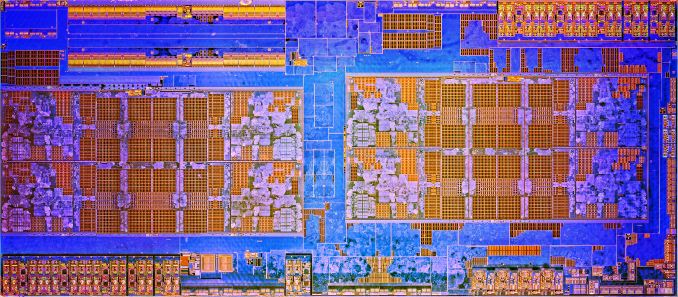
AMD’s CEO was keen to point out that this is a from-scratch design for AMD, using the knowledge gained from features developed for previous products but ultimately under the hood it looks like ‘a typical x86 high-performance core’, with AMD-specific features and tweaks. We were told that AMD’s roadmap extends into the multi-year range, so while the focus for 2017 will be on this family of products, back at HQ the next two generations are in various stages of development.

BENCHMARKS PLEASE

So despite the 82+ motherboards going to be available, 19 initial PC system builders moving into 200+ through the first half of 2017, the big question on everyone’s lips is how exactly does it perform?

Well, AMD gave us the following numbers:
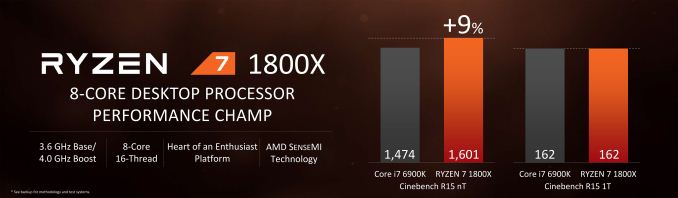
AMD’s benchmarks showed that the top Ryzen 7 1800X, compared to the 8-core Intel Core i7-6900K, both at out-of-the-box frequencies, gives an identical score on the single threaded test and a +9% in the multi-threaded test. AMD put this down to the way their multi-threading works over the Intel design. Also, the fact that the 1800X is half of the price of the i7-6900K.
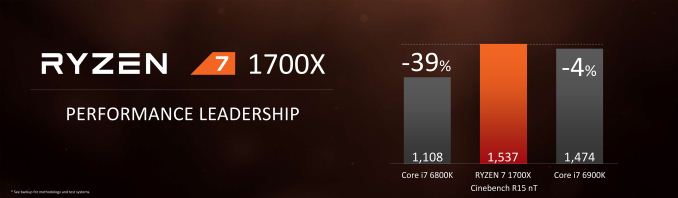
In a similar vein, again with the Cinebench 15 multi-threaded test, the Ryzen 7 1700X scores over and above the Core i7-6800K (its price competition) and higher than the Core i7-6900K which costs 2.5 times as much.

We’ll tell you what our benchmarks say, with official retail processors. But you will have to wait until March 2nd. Sorry.

AMD Launches Ryzen: 52% More IPC, Eight Cores for Under $330, Pre-order Today, On Sale March 2nd

AMD Launches Ryzen: 52% More IPC, Eight Cores for Under $330, Pre-order Today, On Sale March 2nd

The biggest x86 launch for AMD in five years is today: Ryzen is here. As always before a major launch, AMD gives a ‘Tech Day’ for relevant press and analysts, and through this event AMD’s CEO, Dr. Lisa Su lifted the lid on one of the most anticipated products in the semiconductor industry. AMD knows how to control the level of enthusiasm for its fans, and today is the end result, with processors going on pre-order from major retailers today at 1pm EST, ready for a general hard launch on March 2nd.

In a similar vein to launches of recent smartphones, AMD is doing a staggered announcement/launch with the products on their new microarchitecture. Where Samsung/Apple might give all the details for a product a few weeks before it’s available to buy, today on February 22nd marks the day where AMD is giving consumers information about Ryzen, and specifically the Ryzen 7 family of eight-core products. All the information today is from AMD, and AMD’s internal testing, and pre-orders also start from today for users ready to put down their money for a launch day part. Reviews of the CPUs, as well as when the CPUs will ship to customers, is on March 2nd. This also happens to be right in the middle of two annual shows, Game Developer Conference (GDC) and Mobile World Congress (MWC), making the time between receiving pre-launch samples and being able to provide independent verification of AMD’s performance claims relatively frantic. We’ll do our best!

The Ryzen Family

With a new processor launch, naming the parts and positioning them within the market is critical. So with Ryzen, the processor stack will be split into three based on performance and price: Ryzen 7 at the high end, Ryzen 5 in the middle, and Ryzen 3 for more price-conscious consumers. Both Ryzen 5 and Ryzen 3 are set to be launched later, and Ryzen 7 is the first portion of the family to be released.

Ryzen 7 will have three CPUs to start, all having eight cores and supporting simultaneous multi-threading:

  • Ryzen 7 1800X: 8C/16T, 3.6 GHz base, 4.0 GHz turbo, 95W, $499
  • Ryzen 7 1700X: 8C/16T, 3.4 GHz base, 3.8 GHz turbo, 95W, $399
  • Ryzen 7 1700: 8C/16T, 3.0 GHz base, 3.7 GHz turbo, $329

Ryzen 7 1800X will be the high-end part, featuring a base clock of 3.6 GHz and a turbo of 4.0 GHz, within a TDP of 95W, and for $499. Next to this is Ryzen 7 1700X, launching at $399, with a base/turbo of 3.4/3.8 GHz. The final part for the launch is the Ryzen 7 1700, providing eight cores and sixteen threads for $329 at 3.0/3.7 GHz frequencies.

Processors will initially be available for pre-order from 185 retailers and OEMs worldwide, either as individual parts or pre-built systems.

What, not 40% IPC? 52% IPC??

Enthusiasts and analysts use the term IPC, or ‘Instructions Per Clock’, as a measure of how much the underlying microarchitecture improves from generation to generation. Two decades ago, a good design on a smaller node could net a healthy double-digit gain, whereas in recent years 5-10% gain has become the norm. When AMD initially announced that the new Zen microarchitecture they were developing was aiming for a 40% IPC gain, despite the low IPC they were starting from, users remained skeptical. AMD rehired Jim Keller to work alongside long-term AMD architect Mike Clark and produce a team with several goals in mind: high-performance x86, simultaneous multithreading, and a product to be relevant in the computing, PC, server and mobile space again. So despite this, 40% IPC always seemed a somewhat lofty goal, because Bulldozer was so underwhelming, and despite this low starting point. For the Ryzen launch today, AMD is stating that the final result of that goal is a 52% gain in IPC.

This is something we will need to test in due course!

The Ryzen Silicon, and the Future

AMD pointed out that the new 8-core silicon design runs 4.8 billion transistors and features 200m of wiring. Through previous announcements we’ve examined parts of the microarchitecture including cache sizes, threading, front-end/back-end design, and so on.

AMD Zen Microarchiture Part 2: Extracting Instruction-Level Parallelism
AMD Gives More Zen Details: Ryzen, 3.4 GHz+, NVMe, Neural Net Prediction, & 25 MHz Boost Steps

AMD’s CEO was keen to point out that this is a from-scratch design for AMD, using the knowledge gained from features developed for previous products but ultimately under the hood it looks like ‘a typical x86 high-performance core’, with AMD-specific features and tweaks. We were told that AMD’s roadmap extends into the multi-year range, so while the focus for 2017 will be on this family of products, back at HQ the next two generations are in various stages of development.

BENCHMARKS PLEASE

So despite the 82+ motherboards going to be available, 19 initial PC system builders moving into 200+ through the first half of 2017, the big question on everyone’s lips is how exactly does it perform?

Well, AMD gave us the following numbers:

AMD’s benchmarks showed that the top Ryzen 7 1800X, compared to the 8-core Intel Core i7-6900K, both at out-of-the-box frequencies, gives an identical score on the single threaded test and a +9% in the multi-threaded test. AMD put this down to the way their multi-threading works over the Intel design. Also, the fact that the 1800X is half of the price of the i7-6900K.

In a similar vein, again with the Cinebench 15 multi-threaded test, the Ryzen 7 1700X scores over and above the Core i7-6800K (its price competition) and higher than the Core i7-6900K which costs 2.5 times as much.

We’ll tell you what our benchmarks say, with official retail processors. But you will have to wait until March 2nd. Sorry.

MSI Adds Low-Profile AMD Radeon RX 460 Graphics Cards to Lineup

MSI Adds Low-Profile AMD Radeon RX 460 Graphics Cards to Lineup

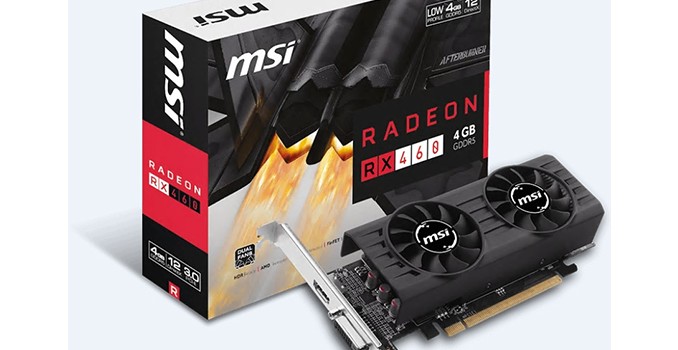
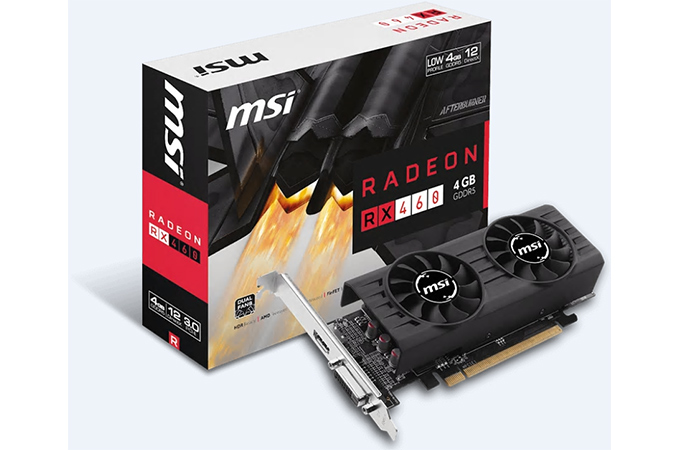
MSI has quietly added two low-profile AMD Radeon RX 460 graphics adapters to its product family. The add-in-boards (AIBs) are powered by AMD’s latest entry-level GPU, Polaris 11. As these are base RX 460 models. they do not require PCIe power and are compatible with a wide range of computers that have enough space for a dual-slot card. The new adapters will be among the most affordable discrete graphics options today and will be aimed at those upgrading entry-level systems as well as building SFF HTPCs.

The MSI Radeon RX 460 4GT LP and Radeon RX 460 2GT LP are based on AMD’s Baffin (Polaris 11) graphics chip (896 stream processors, 56 texture units, 16 raster operations pipelines, 128-bit memory bus) clocked at up to 1.2 GHz (base/boost) and carry 2 or 4 GB of GDDR5 memory at 7 Gbps. As for connectivity, the boards have one DL-DVI-D and one HDMI 2.0 output with HDCP 2.2 support (HDCP 2.2 is required for playback of protected UHD video). When it comes to cooling, the AIBs use dual-slot cooling systems with two fans, the same as the company installed on other low-profile graphics cards. As an added bonus, MSI states that it uses MIL-STD-810G certified components to ensure a long lifespan for its LP adapters.

Over the past couple of months, MSI and a number of other companies (GIGABYTE, GALAX) have introduced low-profile graphics adapters based on NVIDIA’s GPUs – MSI is one of the first with similar LP RX 460 cards and extending its range of contemporary LP AIBs to four models. The addition of two low-profile cards to the lineup may indicate that demand for such products is relatively significant and rather stable.

Both AMD Polaris 11 (Baffin) and NVIDIA GP107 GPUs outperform integrated graphics cores of mainstream desktop CPUs and also support modern functionality like DirectX 12 and Vulkan APIs. Furthermore, the two graphics processors support hardware-accelerated decoding and encoding of HEVC (H.265) and VP9 video at 4Kp60 as well as HDR10. Finally, the GPUs consume up to 75 W of power and do not need any auxiliary PCIe power connectors, which makes them compatible with virtually all modern PCs with a PCIe 3.0 x16 slot, including those from various large brands that sometimes do not have any spare connectors left.

MSI’s Radeon RX 460 Low Profile Graphics Cards
  RX 460 4GT LP RX 460 2GT LP
GPU AMD Polaris 11 (Baffin)
Stream Processors 896
Texture Units 56
ROPs 16
Core Clock (MHz) 1090
Boost Clock (MHz) 1200
Memory Capacity 4 GB 2 GB
Type GDDR5
Clock 7 Gbps
Bus Width 128 bit
Outputs DisplayPort 0
DVI 1 × DVI-D
HDMI 2.0b 1
TFLOPS (FP32) 1.95
TDP 75 W
Launch Date 2/2017 2/2017

MSI has not announced MSRPs forthe new cards, and since the AIBs were added to the company’s product family in the last week, they are no yet available at Amazon or Newegg. Given the positioning of the adapters, it is unlikely that their price will be substantially different from $109 (2 GB version) and $139 (4 GB version) recommended by AMD.

Related Reading: