Vik


Western Digital Announces SanDisk Skyhawk Enterprise NVMe SSDs
Western Digital Announces SanDisk Skyhawk Enterprise NVMe SSDs

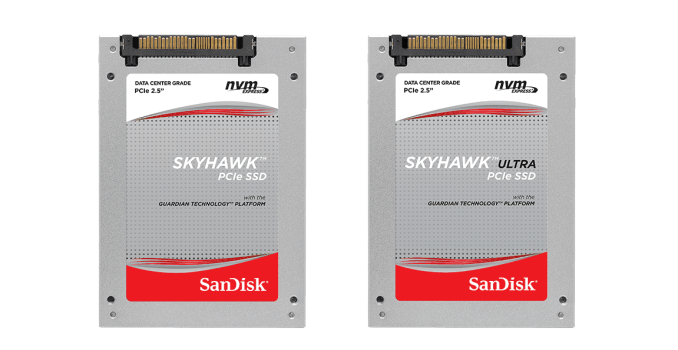
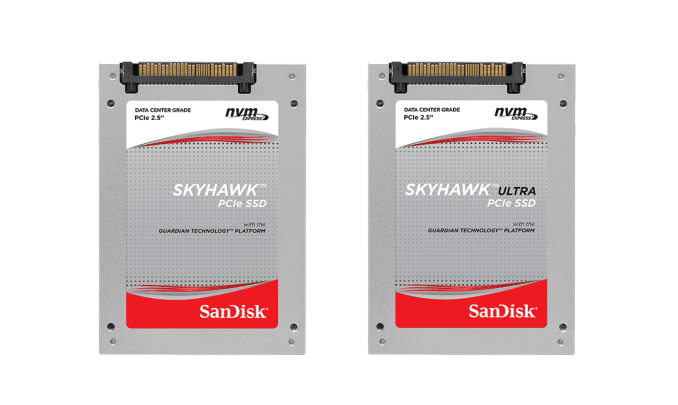
Today Western Digital announced the first enterprise NVMe SSDs under their SanDisk brand. The new SanDisk Skyhawk series are 2.5″ U.2 SSDs intended for datacenter use. While Western Digital’s HGST division already has NVMe SSDs like the Ultrastar SN200 series and their consumer-oriented WD brand recently added the WD Black M.2 NVMe SSD, SanDisk’s previous PCIe SSDs have been based on their proprietary Fusion-IO architecture.

The SanDisk Skyhawk series includes 2TB and 4TB class drives. The standard Skyhawk models have usable capacities of 1920GB and 3840GB, while the Skyhawk Ultra models reserve more spare area and offer usable capacities of 1600GB and 3200GB. All four SKUs are based on a common platform with an unspecified PCIe 3.0 NVMe 1.2 controller. Performance and power consumption ratings are substantially lower than the HGST Ultrastar SN200 series, which use Microsemi’s Flashtec controllers and draw up to 25 W compared to just 10.5 W average and 12 W maximum for the Skyhawk. The SanDisk Skyhawk SSDs do not support the U.2 dual-port mode that top of the line enterprise SSDs like the HGST Ultrastar SN200 and Intel SSD DC D3600 and D3700 are capable of using, but otherwise the SanDisk Skyhawk has the usual features expected of a datacenter SSD.

 Series Specifications
  Skyhawk Skyhawk Ultra
Capacities 1,920 GB 3,840 GB 1,600 GB 3,200 GB
Form Factor 2.5″/15mm U.2
Interface PCIe 3.0 x4 (NVMe 1.2)
Controller unspecified
NAND 15nm MLC
Sequential Read (128 kB QD128) up to 1500 MB/s up to 1700 MB/s
Sequential Write (128 kB QD128) up to 1170 MB/s up to 1200 MB/s
Random Read (4 kB QD128) IOPS up to 250k IOPS up to 250k IOPS
Random Write (4 kB QD128) IOPS up to 47k IOPS up to 83k IOPS
Mixed Random Read/Write
( 70%R/30%W, 4kB QD128)
up to 99k IOPS up to 150k IOPS
Average Random Read Latency (4kB QD32) 128 µs 127 µs 125 µs 126 µs
Average Random Write Latency (4kB QD32) 718 µs 1331 µs 351 µs 693 µs
Power Idle 5.6 W
Operating 10.5 W
Endurance 0.6 DWPD 0.5 DWPD 1.7 DWPD 1.2 DWPD
Encryption None
Power Loss Protection Full in-flight data protection
MTBF 2 million hours
Warranty 5 years

Pricing for the SanDisk Skyhawk SSDs has not been announced. The drives are currently sampling to select OEMs and will be generally available in Q2.
Palit Announces KalmX: A Passively-Cooled GeForce GTX 1050 Ti Graphics Card

Palit Announces KalmX: A Passively-Cooled GeForce GTX 1050 Ti Graphics Card

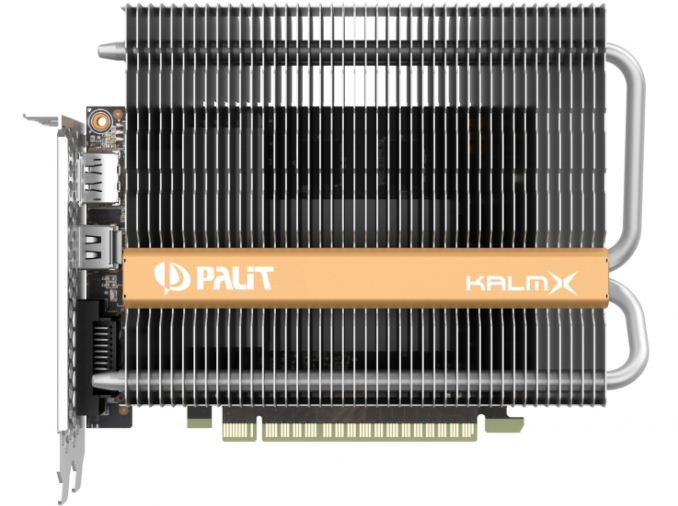
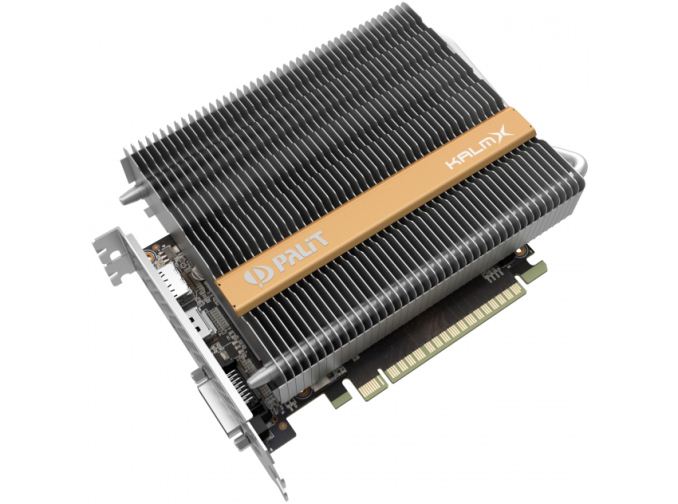
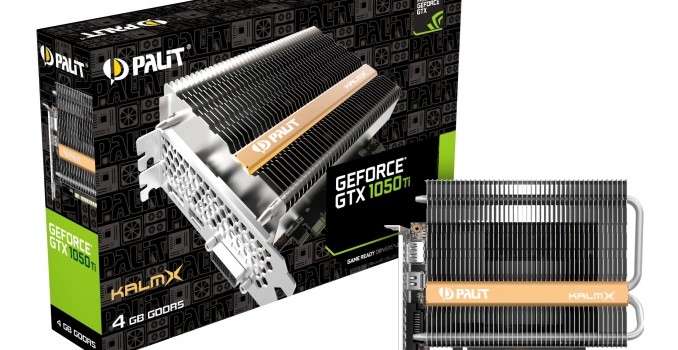
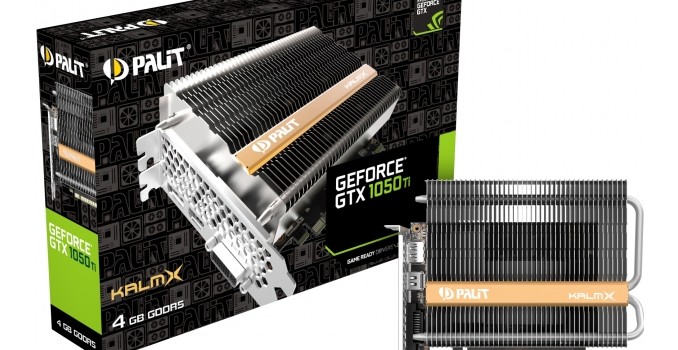
Palit has quietly launched a passively-cooled graphics card based on NVIDIA’s GeForce GTX 1050 Ti GPU. The sizeable board uses a large aluminum heatsink with heat pipes and requires substantial height clearance in a case. Meanwhile, its indisputable trump card is a lack of any noise.

Producers of graphics cards nowadays tend to differentiate from each other by using different cooling systems and increasing performance of their products by boosting GPU frequencies beyond the recommendations of GPU developers. Modern high-end graphics cards use coolers with two or even three fans with a low rotation speed to reduce noise levels, but it is hard to find a passively-cooled graphics board that produces no noise at all. Palit decided to go head first into this and developed a video card with a passive cooler featuring a contemporary GPU powered by NVIDIA’s Pascal architecture under the brand KalmX.

The Palit GeForce GTX 1050 Ti KalmX uses a unique PCB design and has a dual-slot aluminum heatsink that features two heat pipes. The card runs at reference frequencies (1290/1392 MHz base/boost for the GP107 GPU) and is equipped with 4 GB of GDDR5 memory operating at 7000 MT/s. The board does not require any additional power connectors as it consumes no more than 75 W, but its cooler is large and may not fit into some compact computers. As for connectivity, the board features an HDMI 2.0b output, a DisplayPort 1.4 as well as a dual-link DVI-D header.

Palit did not announce MSRP of the GeForce GTX 1050 Ti KalmX and it is unclear whether the producer plans to charge a premium versus NVIDIA’s MSPR for the GTX 1050 Ti ($139) for passive cooling. At press time, one of Amazon’s partners was selling Palit’s passively-cooled GeForce GTX 750 Ti KalmxX Silent 2 GB for $238, but such overprice is not common. If we get updated pricing, we’ll update this news.

Related Reading:

Palit Announces KalmX: A Passively-Cooled GeForce GTX 1050 Ti Graphics Card

Palit Announces KalmX: A Passively-Cooled GeForce GTX 1050 Ti Graphics Card

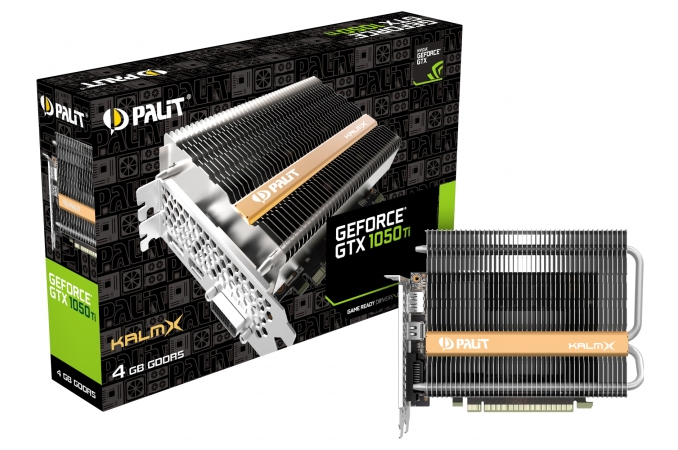
Palit has quietly launched a passively-cooled graphics card based on NVIDIA’s GeForce GTX 1050 Ti GPU. The sizeable board uses a large aluminum heatsink with heat pipes and requires substantial height clearance in a case. Meanwhile, its indisputable trump card is a lack of any noise.

Producers of graphics cards nowadays tend to differentiate from each other by using different cooling systems and increasing performance of their products by boosting GPU frequencies beyond the recommendations of GPU developers. Modern high-end graphics cards use coolers with two or even three fans with a low rotation speed to reduce noise levels, but it is hard to find a passively-cooled graphics board that produces no noise at all. Palit decided to go head first into this and developed a video card with a passive cooler featuring a contemporary GPU powered by NVIDIA’s Pascal architecture under the brand KalmX.

The Palit GeForce GTX 1050 Ti KalmX uses a unique PCB design and has a dual-slot aluminum heatsink that features two heat pipes. The card runs at reference frequencies (1290/1392 MHz base/boost for the GP107 GPU) and is equipped with 4 GB of GDDR5 memory operating at 7000 MT/s. The board does not require any additional power connectors as it consumes no more than 75 W, but its cooler is large and may not fit into some compact computers. As for connectivity, the board features an HDMI 2.0b output, a DisplayPort 1.4 as well as a dual-link DVI-D header.

Palit did not announce MSRP of the GeForce GTX 1050 Ti KalmX and it is unclear whether the producer plans to charge a premium versus NVIDIA’s MSPR for the GTX 1050 Ti ($139) for passive cooling. At press time, one of Amazon’s partners was selling Palit’s passively-cooled GeForce GTX 750 Ti KalmxX Silent 2 GB for $238, but such overprice is not common. If we get updated pricing, we’ll update this news.

Related Reading:

ASRock Beebox-S 7200U Kaby Lake UCFF PC Review

The Kaby Lake-U (KBL-U) series with 15W TDP CPUs was introduced along with the 4.5W Kaby Lake-Y ones in Q3 2016. The first set of products with Kaby Lake-U were ultrabooks. However, ultra-compact form-factor (UCFF) PCs were not long behind. There are already three vendors in the market with Kaby Lake UCFF PCs – ASRock (Beebox-S), GIGABYTE (BRIX), and MSI (Cubi 2). We have already reviewed the MSI Cubi 2 – a no-frills Kaby Lake ‘NUC’ The ASRock Beebox-S differentiates itself by including a USB 3.1 Gen 2 bridge, as well as a LSPCon (for HDMI 2.0 / HDCP 2.2 support) on the motherboard. This review takes a look at how the ASRock Beebox-S 7200U fares in typical UCFF PC workloads.

ASRock Beebox-S 7200U Kaby Lake UCFF PC Review

The Kaby Lake-U (KBL-U) series with 15W TDP CPUs was introduced along with the 4.5W Kaby Lake-Y ones in Q3 2016. The first set of products with Kaby Lake-U were ultrabooks. However, ultra-compact form-factor (UCFF) PCs were not long behind. There are already three vendors in the market with Kaby Lake UCFF PCs – ASRock (Beebox-S), GIGABYTE (BRIX), and MSI (Cubi 2). We have already reviewed the MSI Cubi 2 – a no-frills Kaby Lake ‘NUC’ The ASRock Beebox-S differentiates itself by including a USB 3.1 Gen 2 bridge, as well as a LSPCon (for HDMI 2.0 / HDCP 2.2 support) on the motherboard. This review takes a look at how the ASRock Beebox-S 7200U fares in typical UCFF PC workloads.