Vik


Seagate to Shut Down One of Its Largest HDD Assembly Plants

Seagate to Shut Down One of Its Largest HDD Assembly Plants

As a part of its cost-cutting efforts, Seagate has decided to shut down its HDD manufacturing plant in Suzhou, China. The factory is one of the company’s largest production assets and its closure will significantly reduce the company’s HDD output. Seagate intends to lay off ~2200 employees, but it is unclear what it intends to do with the facility, which it owns.

The factory in Suzhou, China, assemblies hard drives and performs their final testing before shipping. The plant does not produce HDD subassemblies and thus is not vertically integrated, but at 1.1 million square feet (102 thousand square meters), this is one of Seagate’s largest manufacturing assets and the largest drive assembly facility. The company got the factory from Maxtor, when it acquired it in 2006. According to a media report, the plant no longer makes products and the last employees will be laid off on January 18, 2017.

“As part of our continual optimization of operational efficiencies, Seagate has made the difficult decision to shut down its factory in Suzhou, China,” an alleged statement by Seagate reads. “We regret that our Suzhou employees will be affected by this action, which reflects our ongoing commitment to reduce Seagate’s global manufacturing footprint and better align the business with current and expected demand trends.”

Last year Seagate announced intentions to optimize its manufacturing capacities from around 55-60 million drives per quarter to approximately 35-40 million drives per quarter. In 2016, the company already fired about 8,000 employees from different locations, but that was only a part of the strategy. With the plan to shut down the plant in Suzhou, the company actually reduces its ability to produce the drives.
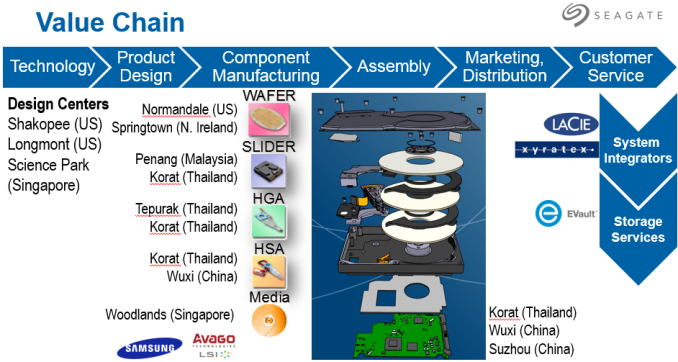
After Seagate shuts down its plant in Suzhou, China, it will have two vertically integrated HDD production facilities in Wuxi, China, and Korat, Thailand. Both factories product drive subassemblies and actual HDDs, hence, by using only these two plants the company optimizes logistics (as it no longer has to transport drive subassemblies to Suzhou) and cuts its per drive manufacturing costs. Meanwhile, it remains to be seen what happens to Seagate’s factories that only produce drive subassemblies (sliders and HGAs).

Seagate’s Manufacturing, Development, Marketing and Administrative Facilities
Location Primary Use Approximate Area Ownership
USA California Product Development

Marketing

Administrative

842,000 ft² Owned/Leased
Colorado Product Development 664,000 ft²
Minnesota Product Development

Production of Recording Heads

1,144,000 ft²
Northern Ireland Springtown Production of Recording Heads 479,000 ft² Owned
China Suzhou Production of Drives 1,103,000 ft²
Wuxi Production of Drives and Drive Subassemblies (Head Stack Assembly) 704,000 ft² Leased
Malaysia Johor Production of Substrates 631,000 ft² Owned
Penang Production of Drive Subassemblies
(Sliders)
402,000 ft²
Seremban Production of Test Equipment and Systems 299,000 ft² Owned/Leased
Singapore Woodlands Production of Media 1,504,000 ft²
Science Park Product Development 410,000 ft²
Ang Mo Kio Marketing

Administrative

225,000 ft² Leased
Thailand Korat Production of Drives and Drive Subassemblies
(Sliders, Heads Gimbal Assembly, Head Stack Assembly)
1,767,000 ft² Owned/Leased
Teparuk Production of Drive Subassemblies
(Heads Gimbal Assembly)
362,000 ft²
Korea Suwon Product Development 220,000 ft² Owned

It is important to note that while Seagate cuts down HDD assembly capacities, it does nothing to plants that produce heads, media and substrates. Over the past few years, unit shipments of HDDs have declined, but their average capacities increased (especially capacities of HDDs for datacenters) due to strong demand for high-capacity SKUs. Therefore Seagate may not need to produce a lot of drives, but it needs to pack about the same amount of heads and platters into fewer HDDs. Moreover, in the coming years, the company will need more heads because of new manufacturing technologies (TDMR, HAMR, etc.) and more media because it can now pack more platters into high-end helium-filled drives.

What remains to be seen is what Seagate plans to do with its manufacturing assets from the Suzhou facility. The fab is so large that it does not seem that all of its equipment could be relocated to other facilities. Moreover, the building itself is huge and it is unclear what will happen to it.

Related Reading:

Sources: Seagate, BestChinaNews, Reuters, The Register.

Seagate to Shut Down One of Its Largest HDD Assembly Plants

Seagate to Shut Down One of Its Largest HDD Assembly Plants

As a part of its cost-cutting efforts, Seagate has decided to shut down its HDD manufacturing plant in Suzhou, China. The factory is one of the company’s largest production assets and its closure will significantly reduce the company’s HDD output. Seagate intends to lay off ~2200 employees, but it is unclear what it intends to do with the facility, which it owns.

The factory in Suzhou, China, assemblies hard drives and performs their final testing before shipping. The plant does not produce HDD subassemblies and thus is not vertically integrated, but at 1.1 million square feet (102 thousand square meters), this is one of Seagate’s largest manufacturing assets and the largest drive assembly facility. The company got the factory from Maxtor, when it acquired it in 2006. According to a media report, the plant no longer makes products and the last employees will be laid off on January 18, 2017.

“As part of our continual optimization of operational efficiencies, Seagate has made the difficult decision to shut down its factory in Suzhou, China,” an alleged statement by Seagate reads. “We regret that our Suzhou employees will be affected by this action, which reflects our ongoing commitment to reduce Seagate’s global manufacturing footprint and better align the business with current and expected demand trends.”

Last year Seagate announced intentions to optimize its manufacturing capacities from around 55-60 million drives per quarter to approximately 35-40 million drives per quarter. In 2016, the company already fired about 8,000 employees from different locations, but that was only a part of the strategy. With the plan to shut down the plant in Suzhou, the company actually reduces its ability to produce the drives.

After Seagate shuts down its plant in Suzhou, China, it will have two vertically integrated HDD production facilities in Wuxi, China, and Korat, Thailand. Both factories product drive subassemblies and actual HDDs, hence, by using only these two plants the company optimizes logistics (as it no longer has to transport drive subassemblies to Suzhou) and cuts its per drive manufacturing costs. Meanwhile, it remains to be seen what happens to Seagate’s factories that only produce drive subassemblies (sliders and HGAs).

Seagate’s Manufacturing, Development, Marketing and Administrative Facilities
Location Primary Use Approximate Area Ownership
USA California Product Development

Marketing

Administrative

842,000 ft² Owned/Leased
Colorado Product Development 664,000 ft²
Minnesota Product Development

Production of Recording Heads

1,144,000 ft²
Northern Ireland Springtown Production of Recording Heads 479,000 ft² Owned
China Suzhou Production of Drives 1,103,000 ft²
Wuxi Production of Drives and Drive Subassemblies (Head Stack Assembly) 704,000 ft² Leased
Malaysia Johor Production of Substrates 631,000 ft² Owned
Penang Production of Drive Subassemblies
(Sliders)
402,000 ft²
Seremban Production of Test Equipment and Systems 299,000 ft² Owned/Leased
Singapore Woodlands Production of Media 1,504,000 ft²
Science Park Product Development 410,000 ft²
Ang Mo Kio Marketing

Administrative

225,000 ft² Leased
Thailand Korat Production of Drives and Drive Subassemblies
(Sliders, Heads Gimbal Assembly, Head Stack Assembly)
1,767,000 ft² Owned/Leased
Teparuk Production of Drive Subassemblies
(Heads Gimbal Assembly)
362,000 ft²
Korea Suwon Product Development 220,000 ft² Owned

It is important to note that while Seagate cuts down HDD assembly capacities, it does nothing to plants that produce heads, media and substrates. Over the past few years, unit shipments of HDDs have declined, but their average capacities increased (especially capacities of HDDs for datacenters) due to strong demand for high-capacity SKUs. Therefore Seagate may not need to produce a lot of drives, but it needs to pack about the same amount of heads and platters into fewer HDDs. Moreover, in the coming years, the company will need more heads because of new manufacturing technologies (TDMR, HAMR, etc.) and more media because it can now pack more platters into high-end helium-filled drives.

What remains to be seen is what Seagate plans to do with its manufacturing assets from the Suzhou facility. The fab is so large that it does not seem that all of its equipment could be relocated to other facilities. Moreover, the building itself is huge and it is unclear what will happen to it.

Related Reading:

Sources: Seagate, BestChinaNews, Reuters, The Register.
OWC Previews DEC Add-On For MacBook Pro

OWC Previews DEC Add-On For MacBook Pro

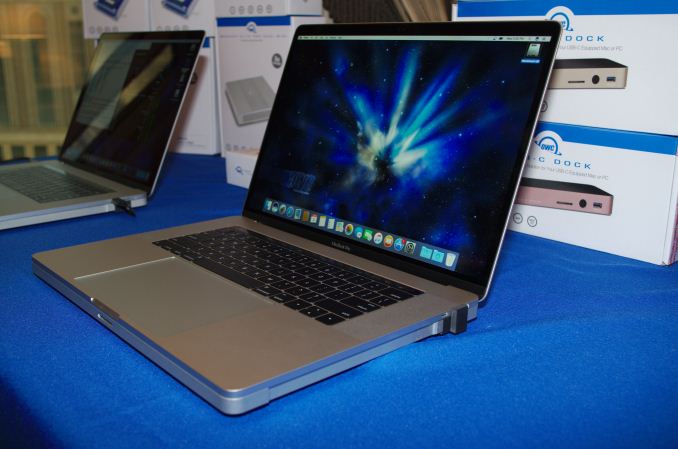
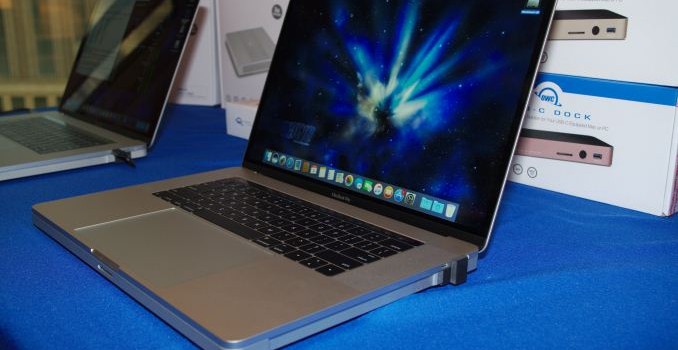
At CES, Mac accessory and upgrade supplier Other World Computing (OWC) showcased prototypes of an upcoming add-on for Apple’s latest MacBook Pro models. The OWC DEC is in many ways similar to their existing line of USB and Thunderbolt docks, with one big difference: the DEC is intended to travel around with the computer instead of staying at the desk.

The DEC is OWC’s answer to the declining expandability, upgradability and connectivity of the MacBook Pro. The DEC occupies the same footprint as the MacBook Pro and attaches to the bottom by replacing the screws that hold the bottom cover of the MacBook Pro in place. To install the OWC DEC, users will not have to open up their MacBook Pro, only remove Apple’s screws and screw the DEC on to the bottom of the machine. The DEC’s data connection will be provided by a small bridge connector between one of the MacBook Pro’s USB-C connectors and the DEC.

OWC has been working on the idea of the DEC for several years, but the latest generation of the MacBook Pro has made the DEC a priority. The DEC will provide many expansion options that have been removed from the MacBook Pro line over the years, at the expense of making the machine heavier and thicker—but no worse than what the MacBook Pro itself was several years ago. The exact configuration of ports has not been finalized, but at a minimum the DEC will provide USB type A ports, gigabit Ethernet and a SD card reader.

The DEC will also offer internal storage expandability by accommodating 2.5″ drives and potentially M.2 SATA SSDs. OWC is also considering a version of the DEC that will use a Thunderbolt 3 connection to the host machine rather than USB, which would make M.2 PCIe storage possible but also make the DEC substantially more expensive.

The fit and finish of the prototypes OWC had at CES was poor, but only because the prototypes were very early mock-ups. Despite the obvious tool marks on the bare aluminum and the use of a black plastic covering for the bridge connector, the DEC felt solid and showed attention to detail with recessed sides that don’t block the speakers or vents and an overall shape that matches Apple’s industrial design.

The first version of the DEC will be available this spring for the 2016 MacBook Pro with Touch Bar, bot 13″ and 15″ models. OWC is also working on a model that will include an extra battery and deliver power to the host system through the USB-C connection. This model is expected to be available later in the year. Pricing has not been announced, but the base model will almost certainly be more expensive than OWC’s existing USB-C docks that retail for about $150.

OWC Previews DEC Add-On For MacBook Pro

OWC Previews DEC Add-On For MacBook Pro

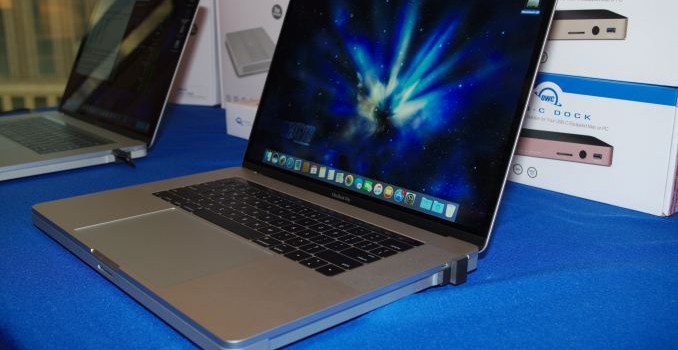
At CES, Mac accessory and upgrade supplier Other World Computing (OWC) showcased prototypes of an upcoming add-on for Apple’s latest MacBook Pro models. The OWC DEC is in many ways similar to their existing line of USB and Thunderbolt docks, with one big difference: the DEC is intended to travel around with the computer instead of staying at the desk.

The DEC is OWC’s answer to the declining expandability, upgradability and connectivity of the MacBook Pro. The DEC occupies the same footprint as the MacBook Pro and attaches to the bottom by replacing the screws that hold the bottom cover of the MacBook Pro in place. To install the OWC DEC, users will not have to open up their MacBook Pro, only remove Apple’s screws and screw the DEC on to the bottom of the machine. The DEC’s data connection will be provided by a small bridge connector between one of the MacBook Pro’s USB-C connectors and the DEC.

OWC has been working on the idea of the DEC for several years, but the latest generation of the MacBook Pro has made the DEC a priority. The DEC will provide many expansion options that have been removed from the MacBook Pro line over the years, at the expense of making the machine heavier and thicker—but no worse than what the MacBook Pro itself was several years ago. The exact configuration of ports has not been finalized, but at a minimum the DEC will provide USB type A ports, gigabit Ethernet and a SD card reader.

The DEC will also offer internal storage expandability by accommodating 2.5″ drives and potentially M.2 SATA SSDs. OWC is also considering a version of the DEC that will use a Thunderbolt 3 connection to the host machine rather than USB, which would make M.2 PCIe storage possible but also make the DEC substantially more expensive.

The fit and finish of the prototypes OWC had at CES was poor, but only because the prototypes were very early mock-ups. Despite the obvious tool marks on the bare aluminum and the use of a black plastic covering for the bridge connector, the DEC felt solid and showed attention to detail with recessed sides that don’t block the speakers or vents and an overall shape that matches Apple’s industrial design.

The first version of the DEC will be available this spring for the 2016 MacBook Pro with Touch Bar, bot 13″ and 15″ models. OWC is also working on a model that will include an extra battery and deliver power to the host system through the USB-C connection. This model is expected to be available later in the year. Pricing has not been announced, but the base model will almost certainly be more expensive than OWC’s existing USB-C docks that retail for about $150.

OWC Previews DEC Add-On For MacBook Pro

OWC Previews DEC Add-On For MacBook Pro

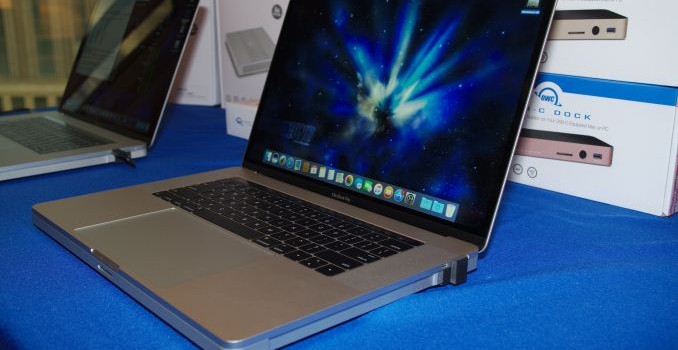
At CES, Mac accessory and upgrade supplier Other World Computing (OWC) showcased prototypes of an upcoming add-on for Apple’s latest MacBook Pro models. The OWC DEC is in many ways similar to their existing line of USB and Thunderbolt docks, with one big difference: the DEC is intended to travel around with the computer instead of staying at the desk.

The DEC is OWC’s answer to the declining expandability, upgradability and connectivity of the MacBook Pro. The DEC occupies the same footprint as the MacBook Pro and attaches to the bottom by replacing the screws that hold the bottom cover of the MacBook Pro in place. To install the OWC DEC, users will not have to open up their MacBook Pro, only remove Apple’s screws and screw the DEC on to the bottom of the machine. The DEC’s data connection will be provided by a small bridge connector between one of the MacBook Pro’s USB-C connectors and the DEC.

OWC has been working on the idea of the DEC for several years, but the latest generation of the MacBook Pro has made the DEC a priority. The DEC will provide many expansion options that have been removed from the MacBook Pro line over the years, at the expense of making the machine heavier and thicker—but no worse than what the MacBook Pro itself was several years ago. The exact configuration of ports has not been finalized, but at a minimum the DEC will provide USB type A ports, gigabit Ethernet and a SD card reader.

The DEC will also offer internal storage expandability by accommodating 2.5″ drives and potentially M.2 SATA SSDs. OWC is also considering a version of the DEC that will use a Thunderbolt 3 connection to the host machine rather than USB, which would make M.2 PCIe storage possible but also make the DEC substantially more expensive.

The fit and finish of the prototypes OWC had at CES was poor, but only because the prototypes were very early mock-ups. Despite the obvious tool marks on the bare aluminum and the use of a black plastic covering for the bridge connector, the DEC felt solid and showed attention to detail with recessed sides that don’t block the speakers or vents and an overall shape that matches Apple’s industrial design.

The first version of the DEC will be available this spring for the 2016 MacBook Pro with Touch Bar, bot 13″ and 15″ models. OWC is also working on a model that will include an extra battery and deliver power to the host system through the USB-C connection. This model is expected to be available later in the year. Pricing has not been announced, but the base model will almost certainly be more expensive than OWC’s existing USB-C docks that retail for about $150.