Vik


Western Digital Announces WD Black PCIe SSD
Western Digital Announces WD Black PCIe SSD

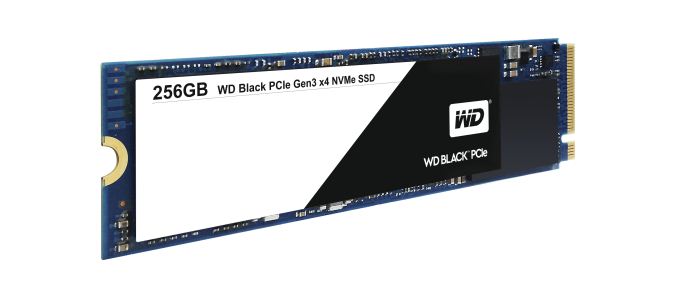
Western Digital has announced the WD Black PCIe SSD, their first PCIe SSD for the consumer market. While the WD Green and WD Blue SSDs introduced last fall were relatively minor updates to existing SanDisk products, the WD Black is an all-new product. The WD Black is aimed at the cheaper half of the M.2 PCIe SSD market rather than competing for the highest performance: it will be available in 256GB and 512GB capacities for $109 and $199.99 respectively, making it cheaper than any currently available M.2 PCIe SSD except the Intel 600p. The WD Black most likely uses the Marvell 88SS1093 controller and 15nm TLC NAND, a combination that will also be found in Plextor’s upcoming M8Se (albeit with different firmware).

Write endurance ratings are 80 TB and 160 TB for the 256GB and 512GB models respectively, which are the lowest for this product class. On the other hand, the WD Black will carry a 5-year warranty and 1.75M hour MTTF rating.

WD Black PCIe SSD Series Specifications
Capacity 256GB 512GB
Form Factor M.2 2280
Interface PCIe 3.0 x4 NVMe
Controller Marvell 88SS1093 ?
NAND SanDisk 15nm TLC ?
Sequential Read 2050 MB/s
Sequential Write 700 MB/s 800 MB/s
Random Read (4 KB) IOPS 170k 170k
Random Write (4 KB) IOPS 130k 134k
Power Peak 8.25 W
Idle 5.5 mW
Endurance 80 TBW 160 TBW
Encryption none
Warranty 5 years
Price $109 $199.99

The WD Black does not appear to include any heatspreaders, but Western Digital’s firmware includes advanced power and thermal management algorithms that WD claims will allow for consistent performance and low power consumption. The WD Black is rated for operating temperatures up to 70°C, so it may engage thermal throttling at a lower temperature than some other PCIe SSD. (For example, the OCZ RD400 throttles around 80°C.)

The WD Black PCIe SSD will be available in the first half of 2017. With this announcement, Micron’s Crucial is now the only major consumer SSD brand that does not have any PCIe SSDs. Last summer Micron abandoned plans for a Balistix TX3 product based on their 3D TLC NAND and Silicon Motion’s SM2260 controller.
Western Digital Announces WD Black PCIe SSD

Western Digital Announces WD Black PCIe SSD

Western Digital has announced the WD Black PCIe SSD, their first PCIe SSD for the consumer market. While the WD Green and WD Blue SSDs introduced last fall were relatively minor updates to existing SanDisk products, the WD Black is an all-new product. The WD Black is aimed at the cheaper half of the M.2 PCIe SSD market rather than competing for the highest performance: it will be available in 256GB and 512GB capacities for $109 and $199.99 respectively, making it cheaper than any currently available M.2 PCIe SSD except the Intel 600p. The WD Black most likely uses the Marvell 88SS1093 controller and 15nm TLC NAND, a combination that will also be found in Plextor’s upcoming M8Se (albeit with different firmware).

Write endurance ratings are 80 TB and 160 TB for the 256GB and 512GB models respectively, which are the lowest for this product class. On the other hand, the WD Black will carry a 5-year warranty and 1.75M hour MTTF rating.

WD Black PCIe SSD Series Specifications
Capacity 256GB 512GB
Form Factor M.2 2280
Interface PCIe 3.0 x4 NVMe
Controller Marvell 88SS1093 ?
NAND SanDisk 15nm TLC ?
Sequential Read 2050 MB/s
Sequential Write 700 MB/s 800 MB/s
Random Read (4 KB) IOPS 170k 170k
Random Write (4 KB) IOPS 130k 134k
Power Peak 8.25 W
Idle 5.5 mW
Endurance 80 TBW 160 TBW
Encryption none
Warranty 5 years
Price $109 $199.99

The WD Black does not appear to include any heatspreaders, but Western Digital’s firmware includes advanced power and thermal management algorithms that WD claims will allow for consistent performance and low power consumption. The WD Black is rated for operating temperatures up to 70°C, so it may engage thermal throttling at a lower temperature than some other PCIe SSD. (For example, the OCZ RD400 throttles around 80°C.)

The WD Black PCIe SSD will be available in the first half of 2017. With this announcement, Micron’s Crucial is now the only major consumer SSD brand that does not have any PCIe SSDs. Last summer Micron abandoned plans for a Balistix TX3 product based on their 3D TLC NAND and Silicon Motion’s SM2260 controller.

Netgear Launches CM1000 DOCSIS 3.1 Cable Modem, New Switches at CES 2017

Netgear Launches CM1000 DOCSIS 3.1 Cable Modem, New Switches at CES 2017

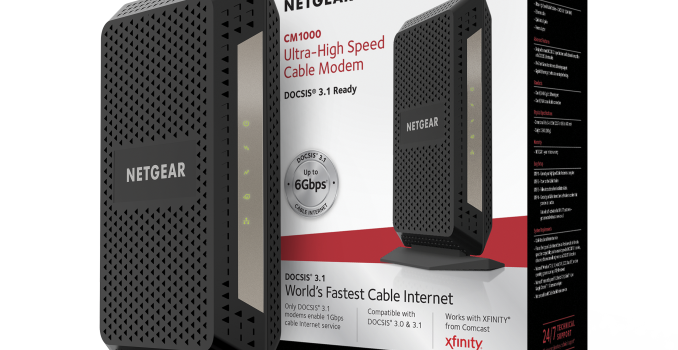
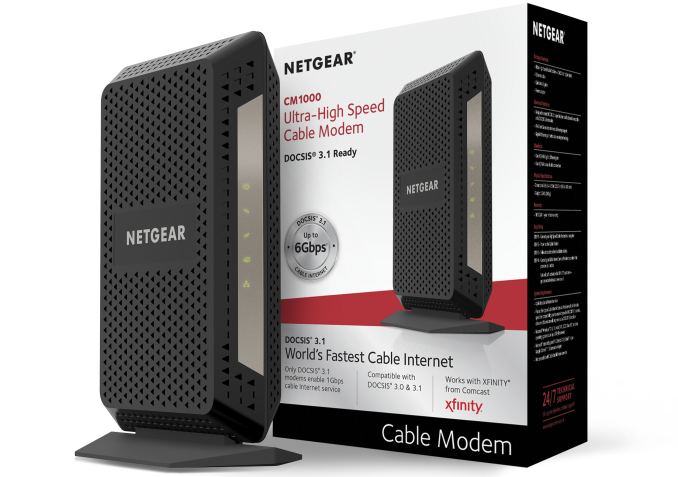
Netgear became one of the first vendors to bring a DOCSIS 3.1 cable modem to the market last month with the availability of the CM1000. It is based on the Broadcom BCM3390 cable modem SoC announced at CES 2015.

DOCSIS 3.1 is one of the most awaited developments in the cable modem industry, allowing ISPs to provide consumers with gigabit and higher speeds without altering existing infrastructure. The specifications support speeds up to 10 Gbps, but, the first generation chipsets like the BCM3390 support only speeds up to 6 Gbps. Compared to the 6- and 8 MHz-wide channels in DOCSIS 3.0, DOCSIS 3.1 uses 20-50 kHz-wide OFDM subcarriers. These can be bonded together in 200 MHz-wide blocks. Note that DOCSIS 3.1 is still not symmetric – while download speeds can go as high as 10 Gbps, upstream rates have a 1 Gbps ceiling.

The CM1000 supports 32 downstream and 8 upstream SC-QAM channels for theoretical downlink speeds of 6 Gbps. Its Ethernet port is still 1 Gbps, and doesn’t take full advantage of the capabilities of the BCM3390.

This CableLabs-certified modem is supported by Xfinity, Cox and Time Warner in the US market. It is also backwards-compatible with existing DOCSIS 3.0 networks. Customer experience with the modem is heavily reliant on the equipment being used by the ISP in the area, with many early adopters reporting activation issues. The firmware on the latest units supposedly fixes these problems. If one wants the latest and greatest in cable modem technology, or, is interested in the gigabit-tier services from the cable ISPs, the Netgear CM1000 ($180) looks like the only choice in the retail market right now.

In related news, Netgear is also launching the C7100v – the Nighthawk AC1900 Wi-Fi Cable Modem Router with voice capabilities. It is based on a Broadcom platform, and has a 24×8 modem (up to 960 Mbps downstream speeds) along with a 3×3 802.11ac router (similar to the Nighthawk R7000, but, with a 1.6 GHz SoC). There are two integrated voice lines that get automatic priority over data. The device is meant for the retail market, and will have a MSRP of $300 at launch later this year.

On the switch front, we have the Nighthawk S8000 8-port gaming and media switch (GS808E) meant for prosumers in the home environment with Layer 2 switching and web management (Plus) capabilities. The industrial design shows the Nighthawk branding clearly. It handles appropriate QoS settings for traffic from games and media streaming services such as Netflix. There is a web-based GUI appropriate for the target market, with pre-configured settings available for each port. The switch also allows teaming of up to four ports with dynamic link aggregation. This 8-port switch is expected to become available towards the end of this quarter for $100.

Netgear is also expanding its PoE switch offerings. The ‘mount-anywhere’ web-managed (Plus) switches became hugely popular after their introduction last year. As part of the CES product launches, Netgear is adding the GSS108EPP and GS408EPP with 8 Gigabit ports each. The GSS108EPP comes in the Click format and has four PoE+ ports (total 47W), while the GS408EPP comes in a easy-mount form factor (such that two switches can be placed back to back in a 1U rack slot) and has 8 PoE+ ports (seven active at a time, with one used for uplink) with a 124W power budget. Both are web-managed Plus switches with L2 management capabilities. One of the innovative features is the ability to configure the power budget for each port. The GSS108EPP is passively cooled. It will have a MSRP of $150, while the GS408EPP will have a MSRP of $270.

Netgear Launches CM1000 DOCSIS 3.1 Cable Modem, New Switches at CES 2017

Netgear Launches CM1000 DOCSIS 3.1 Cable Modem, New Switches at CES 2017

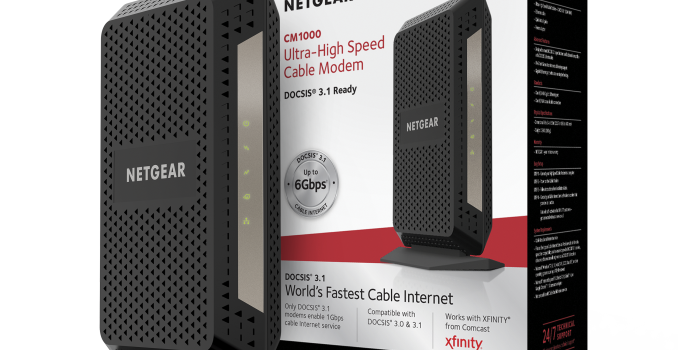
Netgear became one of the first vendors to bring a DOCSIS 3.1 cable modem to the market last month with the availability of the CM1000. It is based on the Broadcom BCM3390 cable modem SoC announced at CES 2015.

DOCSIS 3.1 is one of the most awaited developments in the cable modem industry, allowing ISPs to provide consumers with gigabit and higher speeds without altering existing infrastructure. The specifications support speeds up to 10 Gbps, but, the first generation chipsets like the BCM3390 support only speeds up to 6 Gbps. Compared to the 6- and 8 MHz-wide channels in DOCSIS 3.0, DOCSIS 3.1 uses 20-50 kHz-wide OFDM subcarriers. These can be bonded together in 200 MHz-wide blocks. Note that DOCSIS 3.1 is still not symmetric – while download speeds can go as high as 10 Gbps, upstream rates have a 1 Gbps ceiling.

The CM1000 supports 32 downstream and 8 upstream SC-QAM channels for theoretical downlink speeds of 6 Gbps. Its Ethernet port is still 1 Gbps, and doesn’t take full advantage of the capabilities of the BCM3390.

This CableLabs-certified modem is supported by Xfinity, Cox and Time Warner in the US market. It is also backwards-compatible with existing DOCSIS 3.0 networks. Customer experience with the modem is heavily reliant on the equipment being used by the ISP in the area, with many early adopters reporting activation issues. The firmware on the latest units supposedly fixes these problems. If one wants the latest and greatest in cable modem technology, or, is interested in the gigabit-tier services from the cable ISPs, the Netgear CM1000 ($180) looks like the only choice in the retail market right now.

In related news, Netgear is also launching the C7100v – the Nighthawk AC1900 Wi-Fi Cable Modem Router with voice capabilities. It is based on a Broadcom platform, and has a 24×8 modem (up to 960 Mbps downstream speeds) along with a 3×3 802.11ac router (similar to the Nighthawk R7000, but, with a 1.6 GHz SoC). There are two integrated voice lines that get automatic priority over data. The device is meant for the retail market, and will have a MSRP of $300 at launch later this year.

On the switch front, we have the Nighthawk S8000 8-port gaming and media switch (GS808E) meant for prosumers in the home environment with Layer 2 switching and web management (Plus) capabilities. The industrial design shows the Nighthawk branding clearly. It handles appropriate QoS settings for traffic from games and media streaming services such as Netflix. There is a web-based GUI appropriate for the target market, with pre-configured settings available for each port. The switch also allows teaming of up to four ports with dynamic link aggregation. This 8-port switch is expected to become available towards the end of this quarter for $100.

Netgear is also expanding its PoE switch offerings. The ‘mount-anywhere’ web-managed (Plus) switches became hugely popular after their introduction last year. As part of the CES product launches, Netgear is adding the GSS108EPP and GS408EPP with 8 Gigabit ports each. The GSS108EPP comes in the Click format and has four PoE+ ports (total 47W), while the GS408EPP comes in a easy-mount form factor (such that two switches can be placed back to back in a 1U rack slot) and has 8 PoE+ ports (seven active at a time, with one used for uplink) with a 124W power budget. Both are web-managed Plus switches with L2 management capabilities. One of the innovative features is the ability to configure the power budget for each port. The GSS108EPP is passively cooled. It will have a MSRP of $150, while the GS408EPP will have a MSRP of $270.

Netgear Launches CM1000 DOCSIS 3.1 Cable Modem, New Switches at CES 2017

Netgear Launches CM1000 DOCSIS 3.1 Cable Modem, New Switches at CES 2017

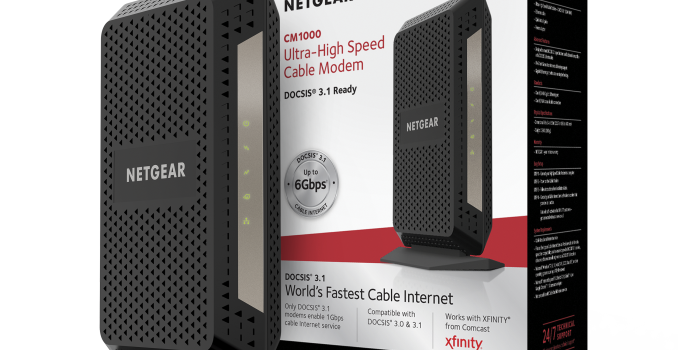
Netgear became one of the first vendors to bring a DOCSIS 3.1 cable modem to the market last month with the availability of the CM1000. It is based on the Broadcom BCM3390 cable modem SoC announced at CES 2015.

DOCSIS 3.1 is one of the most awaited developments in the cable modem industry, allowing ISPs to provide consumers with gigabit and higher speeds without altering existing infrastructure. The specifications support speeds up to 10 Gbps, but, the first generation chipsets like the BCM3390 support only speeds up to 6 Gbps. Compared to the 6- and 8 MHz-wide channels in DOCSIS 3.0, DOCSIS 3.1 uses 20-50 kHz-wide OFDM subcarriers. These can be bonded together in 200 MHz-wide blocks. Note that DOCSIS 3.1 is still not symmetric – while download speeds can go as high as 10 Gbps, upstream rates have a 1 Gbps ceiling.

The CM1000 supports 32 downstream and 8 upstream SC-QAM channels for theoretical downlink speeds of 6 Gbps. Its Ethernet port is still 1 Gbps, and doesn’t take full advantage of the capabilities of the BCM3390.

This CableLabs-certified modem is supported by Xfinity, Cox and Time Warner in the US market. It is also backwards-compatible with existing DOCSIS 3.0 networks. Customer experience with the modem is heavily reliant on the equipment being used by the ISP in the area, with many early adopters reporting activation issues. The firmware on the latest units supposedly fixes these problems. If one wants the latest and greatest in cable modem technology, or, is interested in the gigabit-tier services from the cable ISPs, the Netgear CM1000 ($180) looks like the only choice in the retail market right now.

In related news, Netgear is also launching the C7100v – the Nighthawk AC1900 Wi-Fi Cable Modem Router with voice capabilities. It is based on a Broadcom platform, and has a 24×8 modem (up to 960 Mbps downstream speeds) along with a 3×3 802.11ac router (similar to the Nighthawk R7000, but, with a 1.6 GHz SoC). There are two integrated voice lines that get automatic priority over data. The device is meant for the retail market, and will have a MSRP of $300 at launch later this year.

On the switch front, we have the Nighthawk S8000 8-port gaming and media switch (GS808E) meant for prosumers in the home environment with Layer 2 switching and web management (Plus) capabilities. The industrial design shows the Nighthawk branding clearly. It handles appropriate QoS settings for traffic from games and media streaming services such as Netflix. There is a web-based GUI appropriate for the target market, with pre-configured settings available for each port. The switch also allows teaming of up to four ports with dynamic link aggregation. This 8-port switch is expected to become available towards the end of this quarter for $100.

Netgear is also expanding its PoE switch offerings. The ‘mount-anywhere’ web-managed (Plus) switches became hugely popular after their introduction last year. As part of the CES product launches, Netgear is adding the GSS108EPP and GS408EPP with 8 Gigabit ports each. The GSS108EPP comes in the Click format and has four PoE+ ports (total 47W), while the GS408EPP comes in a easy-mount form factor (such that two switches can be placed back to back in a 1U rack slot) and has 8 PoE+ ports (seven active at a time, with one used for uplink) with a 124W power budget. Both are web-managed Plus switches with L2 management capabilities. One of the innovative features is the ability to configure the power budget for each port. The GSS108EPP is passively cooled. It will have a MSRP of $150, while the GS408EPP will have a MSRP of $270.