Vik


Amped Wireless Launches AC2200 HELIOS Family with Qualcomm's Tri-Radio 802.11ac Solution

Amped Wireless Launches AC2200 HELIOS Family with Qualcomm’s Tri-Radio 802.11ac Solution
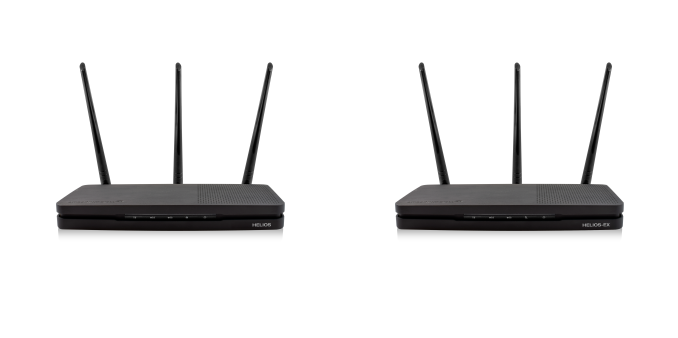
At Computex 2016, Qualcomm Atheros announced the availability of a tri-radio 802.11ac platform with Wave 2 MU-MIMO capabilities. The firmware in the platform also supported Wi-Fi SON (Self-Organizing Networks), which is fast becoming an essential requirement in mesh networks. The announcement had a quote from Amped Wireless, indicating support for the new platform. We were expecting their mesh system – ALLY – to ship with that platform, but the ALLY had no dedicated backhaul channel to provide the best possible performance. Instead, Amped Wireless has chosen CES 2017 to announce the first set of products based on the Qualcomm tri-radio platform – the HELIOS family.

At the heart of the Qualcomm announcement was a highly integrated network processor SoC, the IPQ40x9. It integrates two 2×2 radios. While one radio is always set to operate in the 5 GHz band, the other one can be configured in either 2.4 or 5 GHz mode. The SoC also includes a PC interface to further connect additional radios. The Qualcomm announcement included two platforms:

  • AC2200 class of products with a 2×2 802.11ac radio such as the QCA9886 connected to the PCIe interface (resulting platform has a 2×2 2.4 GHz radio (400 Mbps with 256QAM) and two 2×2 5 GHz radios (866 Mbps + 866 Mbps))
  • AC3000 class of products with a 4×4 802.11ac radio such as the QCA9984 connected to the PCIe interface (resulting platform has a 2×2 2.4 GHz radio (400 Mbps with 256QAM), a 2×2 5 GHz radio (866 Mbps) and a discrete 4×4 5 GHz radio (1733 Mbps))

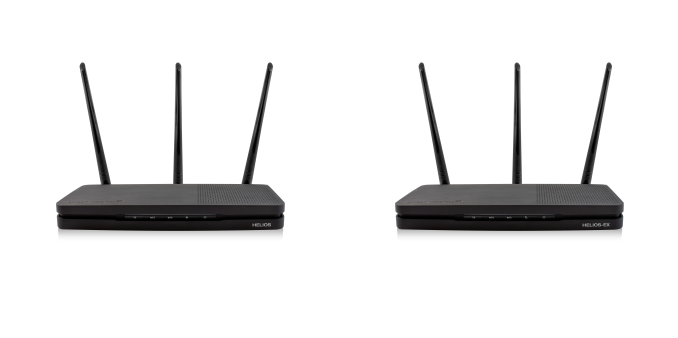
The HELIOS family (a HELIOS router and a HELIOS-EX extender) adopt the AC2200 platform. The router operates with two 5 GHz SSIDs and one 2.4 GHz SSID, with traffic allowed to be spread across the bands. The extender, on the other hand, uses one of the 5 GHz bands as a dedicated backhaul to connect to the main router (in that way, it is similar to the Orbi’s backhaul connection – except that it is 2×2 instead of the Orbi’s 4×4). Amped Wireless has given the tag ‘DirectLink’ to this dedicated backhaul connection.

The HELIOS-EX (RE2200T) and the HELIOS router (RTA2200T) will have a MSRP of $180. The extender is slated to become available in February 2017, while the router will make its entry towards the end of this quarter.

Amped Wireless Launches AC2200 HELIOS Family with Qualcomm's Tri-Radio 802.11ac Solution

Amped Wireless Launches AC2200 HELIOS Family with Qualcomm’s Tri-Radio 802.11ac Solution

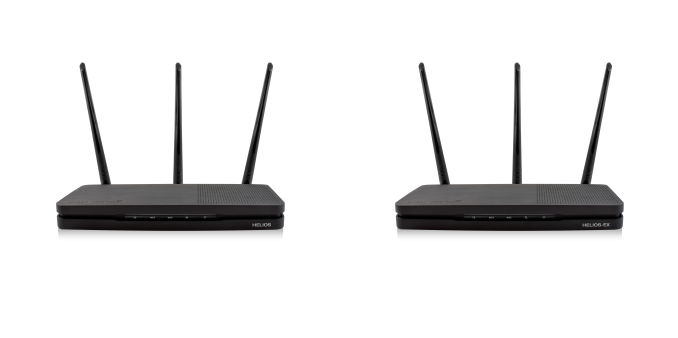
At Computex 2016, Qualcomm Atheros announced the availability of a tri-radio 802.11ac platform with Wave 2 MU-MIMO capabilities. The firmware in the platform also supported Wi-Fi SON (Self-Organizing Networks), which is fast becoming an essential requirement in mesh networks. The announcement had a quote from Amped Wireless, indicating support for the new platform. We were expecting their mesh system – ALLY – to ship with that platform, but the ALLY had no dedicated backhaul channel to provide the best possible performance. Instead, Amped Wireless has chosen CES 2017 to announce the first set of products based on the Qualcomm tri-radio platform – the HELIOS family.

At the heart of the Qualcomm announcement was a highly integrated network processor SoC, the IPQ40x9. It integrates two 2×2 radios. While one radio is always set to operate in the 5 GHz band, the other one can be configured in either 2.4 or 5 GHz mode. The SoC also includes a PC interface to further connect additional radios. The Qualcomm announcement included two platforms:

  • AC2200 class of products with a 2×2 802.11ac radio such as the QCA9886 connected to the PCIe interface (resulting platform has a 2×2 2.4 GHz radio (400 Mbps with 256QAM) and two 2×2 5 GHz radios (866 Mbps + 866 Mbps))
  • AC3000 class of products with a 4×4 802.11ac radio such as the QCA9984 connected to the PCIe interface (resulting platform has a 2×2 2.4 GHz radio (400 Mbps with 256QAM), a 2×2 5 GHz radio (866 Mbps) and a discrete 4×4 5 GHz radio (1733 Mbps))

The HELIOS family (a HELIOS router and a HELIOS-EX extender) adopt the AC2200 platform. The router operates with two 5 GHz SSIDs and one 2.4 GHz SSID, with traffic allowed to be spread across the bands. The extender, on the other hand, uses one of the 5 GHz bands as a dedicated backhaul to connect to the main router (in that way, it is similar to the Orbi’s backhaul connection – except that it is 2×2 instead of the Orbi’s 4×4). Amped Wireless has given the tag ‘DirectLink’ to this dedicated backhaul connection.

The HELIOS-EX (RE2200T) and the HELIOS router (RTA2200T) will have a MSRP of $180. The extender is slated to become available in February 2017, while the router will make its entry towards the end of this quarter.

Amped Wireless Launches AC2200 HELIOS Family with Qualcomm's Tri-Radio 802.11ac Solution

Amped Wireless Launches AC2200 HELIOS Family with Qualcomm’s Tri-Radio 802.11ac Solution

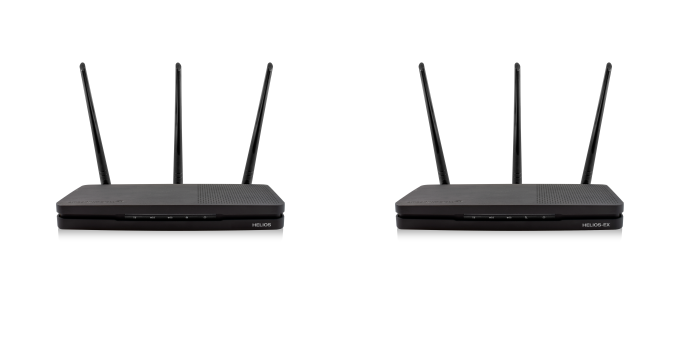
At Computex 2016, Qualcomm Atheros announced the availability of a tri-radio 802.11ac platform with Wave 2 MU-MIMO capabilities. The firmware in the platform also supported Wi-Fi SON (Self-Organizing Networks), which is fast becoming an essential requirement in mesh networks. The announcement had a quote from Amped Wireless, indicating support for the new platform. We were expecting their mesh system – ALLY – to ship with that platform, but the ALLY had no dedicated backhaul channel to provide the best possible performance. Instead, Amped Wireless has chosen CES 2017 to announce the first set of products based on the Qualcomm tri-radio platform – the HELIOS family.

At the heart of the Qualcomm announcement was a highly integrated network processor SoC, the IPQ40x9. It integrates two 2×2 radios. While one radio is always set to operate in the 5 GHz band, the other one can be configured in either 2.4 or 5 GHz mode. The SoC also includes a PC interface to further connect additional radios. The Qualcomm announcement included two platforms:

  • AC2200 class of products with a 2×2 802.11ac radio such as the QCA9886 connected to the PCIe interface (resulting platform has a 2×2 2.4 GHz radio (400 Mbps with 256QAM) and two 2×2 5 GHz radios (866 Mbps + 866 Mbps))
  • AC3000 class of products with a 4×4 802.11ac radio such as the QCA9984 connected to the PCIe interface (resulting platform has a 2×2 2.4 GHz radio (400 Mbps with 256QAM), a 2×2 5 GHz radio (866 Mbps) and a discrete 4×4 5 GHz radio (1733 Mbps))

The HELIOS family (a HELIOS router and a HELIOS-EX extender) adopt the AC2200 platform. The router operates with two 5 GHz SSIDs and one 2.4 GHz SSID, with traffic allowed to be spread across the bands. The extender, on the other hand, uses one of the 5 GHz bands as a dedicated backhaul to connect to the main router (in that way, it is similar to the Orbi’s backhaul connection – except that it is 2×2 instead of the Orbi’s 4×4). Amped Wireless has given the tag ‘DirectLink’ to this dedicated backhaul connection.

The HELIOS-EX (RE2200T) and the HELIOS router (RTA2200T) will have a MSRP of $180. The extender is slated to become available in February 2017, while the router will make its entry towards the end of this quarter.
G.Skill Announces Trident Z DDR4 DIMMs for Kaby Lake CPUs

G.Skill Announces Trident Z DDR4 DIMMs for Kaby Lake CPUs

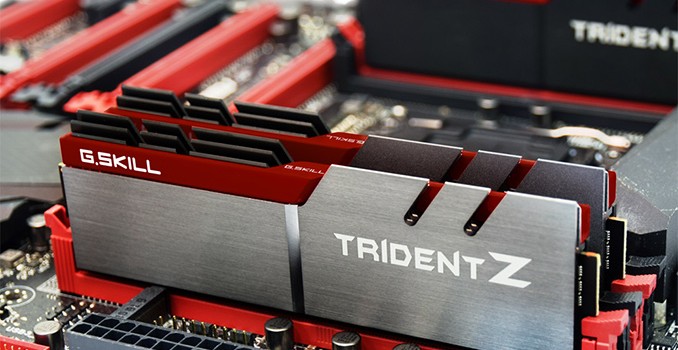
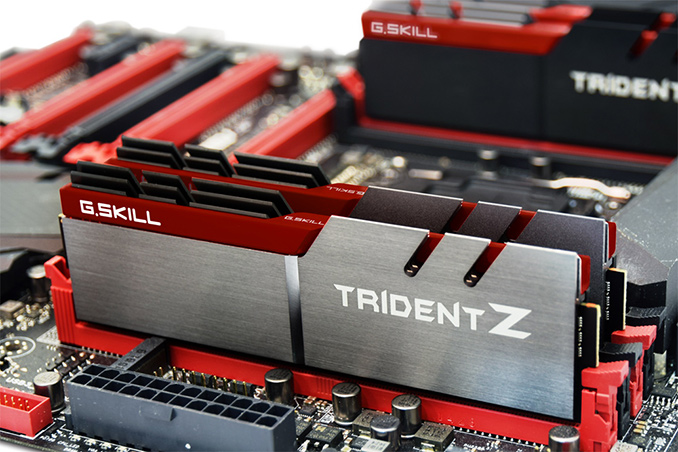
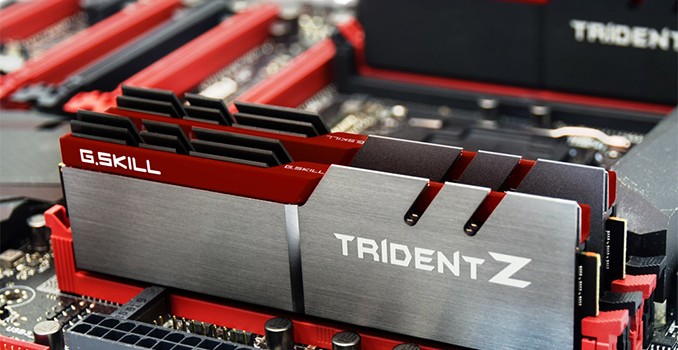
G.Skill on Wednesday introduced its new high-end DDR4 memory modules tested for compatibility with Intel’s new Core processors featuring the Kaby Lake microarchitecture. The new Trident Z modules come in 8 GB and 16 GB sizes and are rated for operations at data rates beyond 3600 MT/s per pin.

For Intel’s Kaby Lake and Z270 launch, G.Skill now offers various dual-channel kits with 16 GB (2×8 GB), 32 GB (4×8 GB, 2×16 GB) and 64 GB (4×16 GB) capacities designed to run in DDR4-3600, DDR4-3866, DDR4-4000, DDR4-4133 and DDR4-4266 modes at 1.35 V or 1.4 V (the top-of-the-range kit only). Due to rather high data rates, the new Trident Z kits come with rather looser CL17, CL18 or even CL19 timings. The modules support XMP 2.0 technology that simplifies setting of correct sub-timings on platforms that support this feature.

For about a year now G.Skill has been using Samsung’s 8 Gb B-die ICs for its high-end DDR4 memory modules. Keeping in mind that companies tend to be cautious with new platforms and memory controllers, it is not surprising that the new DIMMs designed for the brand new CPUs are based on familiar chips made using 20 nm process technology.

G.Skill’s Memory Modules Designed for Intel’s Kaby Lake Platform
Speed CL Timing Voltage Kit Configuration Kit Capacity
DDR4-3600 CL17 19-19-39 1.35 V 2×16 GB
4×16 GB
32 GB
64 GB
DDR4-3866 CL18 19-19-39 2×8 GB
4×8 GB
16 GB
32 GB
DDR4-3866 CL18 18-18-38 2×16 GB 32 GB
DDR4-4000 CL18 19-19-39 2×8 GB
4×8 GB
16 GB
32 GB
DDR4-4133 CL19 19-19-39 2×8 GB 16 GB
DDR4-4133 CL19 21-21-41 4×8 GB 32 GB
DDR4-4266 CL19 19-19-39 1.4 V 2×8 GB 16 GB

Initially G.Skill will offer Kaby Lake-optimized memory modules with its regular aluminum heat spreaders, but eventually the company will expand the lineup with DIMMs featuring RGB lighting and other enhancements.

G.Skill has tested its new memory modules (DDR4-4133 32 GB kit to be exact) on the ASUS ROG Maximus IX Formula motherboard and the Intel Core i5-7600K processor to ensure compatibility with the new CPUs, but everything should work on other Kaby Lake/Z270 configurations that plan to support high speed memory.

Newegg already sells G.Skill’s Kaby Lake-optimized 16 GB DDR4-4266 memory kits (F4-4266C19D-16GTZ series) for $229.99. Other modules will hit the market shortly from now and more retailers will follow.

G.Skill Announces Trident Z DDR4 DIMMs for Kaby Lake CPUs

G.Skill Announces Trident Z DDR4 DIMMs for Kaby Lake CPUs

G.Skill on Wednesday introduced its new high-end DDR4 memory modules tested for compatibility with Intel’s new Core processors featuring the Kaby Lake microarchitecture. The new Trident Z modules come in 8 GB and 16 GB sizes and are rated for operations at data rates beyond 3600 MT/s per pin.

For Intel’s Kaby Lake and Z270 launch, G.Skill now offers various dual-channel kits with 16 GB (2×8 GB), 32 GB (4×8 GB, 2×16 GB) and 64 GB (4×16 GB) capacities designed to run in DDR4-3600, DDR4-3866, DDR4-4000, DDR4-4133 and DDR4-4266 modes at 1.35 V or 1.4 V (the top-of-the-range kit only). Due to rather high data rates, the new Trident Z kits come with rather looser CL17, CL18 or even CL19 timings. The modules support XMP 2.0 technology that simplifies setting of correct sub-timings on platforms that support this feature.

For about a year now G.Skill has been using Samsung’s 8 Gb B-die ICs for its high-end DDR4 memory modules. Keeping in mind that companies tend to be cautious with new platforms and memory controllers, it is not surprising that the new DIMMs designed for the brand new CPUs are based on familiar chips made using 20 nm process technology.

G.Skill’s Memory Modules Designed for Intel’s Kaby Lake Platform
Speed CL Timing Voltage Kit Configuration Kit Capacity
DDR4-3600 CL17 19-19-39 1.35 V 2×16 GB
4×16 GB
32 GB
64 GB
DDR4-3866 CL18 19-19-39 2×8 GB
4×8 GB
16 GB
32 GB
DDR4-3866 CL18 18-18-38 2×16 GB 32 GB
DDR4-4000 CL18 19-19-39 2×8 GB
4×8 GB
16 GB
32 GB
DDR4-4133 CL19 19-19-39 2×8 GB 16 GB
DDR4-4133 CL19 21-21-41 4×8 GB 32 GB
DDR4-4266 CL19 19-19-39 1.4 V 2×8 GB 16 GB

Initially G.Skill will offer Kaby Lake-optimized memory modules with its regular aluminum heat spreaders, but eventually the company will expand the lineup with DIMMs featuring RGB lighting and other enhancements.

G.Skill has tested its new memory modules (DDR4-4133 32 GB kit to be exact) on the ASUS ROG Maximus IX Formula motherboard and the Intel Core i5-7600K processor to ensure compatibility with the new CPUs, but everything should work on other Kaby Lake/Z270 configurations that plan to support high speed memory.

Newegg already sells G.Skill’s Kaby Lake-optimized 16 GB DDR4-4266 memory kits (F4-4266C19D-16GTZ series) for $229.99. Other modules will hit the market shortly from now and more retailers will follow.