Vik


G.Skill Announces Trident Z DDR4 DIMMs for Kaby Lake CPUs
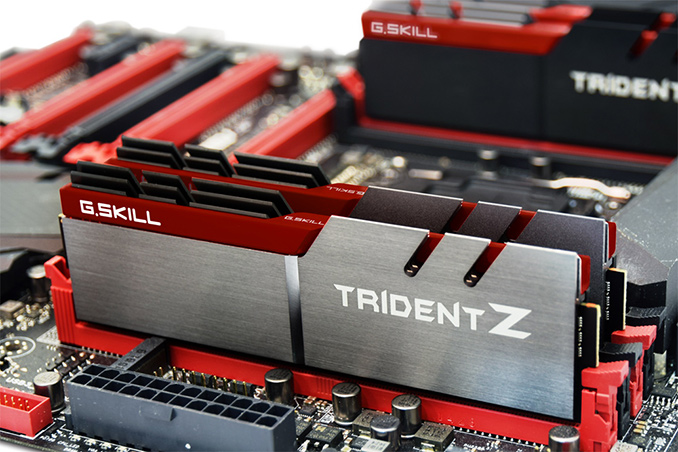
G.Skill Announces Trident Z DDR4 DIMMs for Kaby Lake CPUs

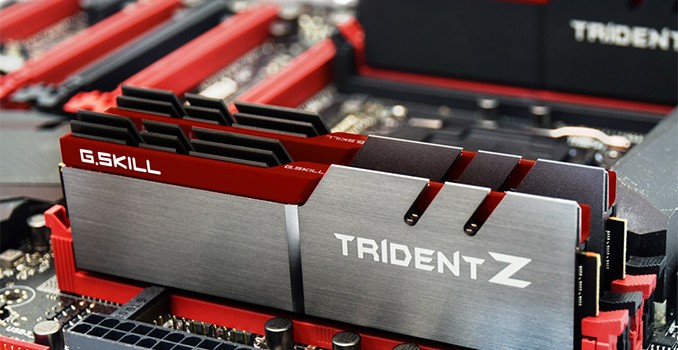
G.Skill on Wednesday introduced its new high-end DDR4 memory modules tested for compatibility with Intel’s new Core processors featuring the Kaby Lake microarchitecture. The new Trident Z modules come in 8 GB and 16 GB sizes and are rated for operations at data rates beyond 3600 MT/s per pin.

For Intel’s Kaby Lake and Z270 launch, G.Skill now offers various dual-channel kits with 16 GB (2×8 GB), 32 GB (4×8 GB, 2×16 GB) and 64 GB (4×16 GB) capacities designed to run in DDR4-3600, DDR4-3866, DDR4-4000, DDR4-4133 and DDR4-4266 modes at 1.35 V or 1.4 V (the top-of-the-range kit only). Due to rather high data rates, the new Trident Z kits come with rather looser CL17, CL18 or even CL19 timings. The modules support XMP 2.0 technology that simplifies setting of correct sub-timings on platforms that support this feature.

For about a year now G.Skill has been using Samsung’s 8 Gb B-die ICs for its high-end DDR4 memory modules. Keeping in mind that companies tend to be cautious with new platforms and memory controllers, it is not surprising that the new DIMMs designed for the brand new CPUs are based on familiar chips made using 20 nm process technology.

G.Skill’s Memory Modules Designed for Intel’s Kaby Lake Platform
Speed CL Timing Voltage Kit Configuration Kit Capacity
DDR4-3600 CL17 19-19-39 1.35 V 2×16 GB
4×16 GB
32 GB
64 GB
DDR4-3866 CL18 19-19-39 2×8 GB
4×8 GB
16 GB
32 GB
DDR4-3866 CL18 18-18-38 2×16 GB 32 GB
DDR4-4000 CL18 19-19-39 2×8 GB
4×8 GB
16 GB
32 GB
DDR4-4133 CL19 19-19-39 2×8 GB 16 GB
DDR4-4133 CL19 21-21-41 4×8 GB 32 GB
DDR4-4266 CL19 19-19-39 1.4 V 2×8 GB 16 GB

Initially G.Skill will offer Kaby Lake-optimized memory modules with its regular aluminum heat spreaders, but eventually the company will expand the lineup with DIMMs featuring RGB lighting and other enhancements.

G.Skill has tested its new memory modules (DDR4-4133 32 GB kit to be exact) on the ASUS ROG Maximus IX Formula motherboard and the Intel Core i5-7600K processor to ensure compatibility with the new CPUs, but everything should work on other Kaby Lake/Z270 configurations that plan to support high speed memory.

Newegg already sells G.Skill’s Kaby Lake-optimized 16 GB DDR4-4266 memory kits (F4-4266C19D-16GTZ series) for $229.99. Other modules will hit the market shortly from now and more retailers will follow.

LaCie Launches Rugged and d2 Thunderbolt 3 Storage Devices

LaCie Launches Rugged and d2 Thunderbolt 3 Storage Devices

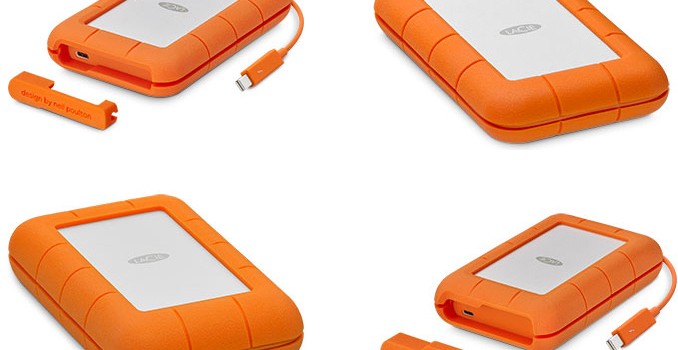
LaCie at CES introduced its new storage devices with Thunderbolt 3 interface. The new LaCie Rugged Thunderbolt USB-C and the LaCie d2 Thunderbolt 3 support 2.5” and 3.5” storage devices, use Intel’s DSL6540 Thunderbolt 3 chips and can expand storage capacities of contemporary PCs up to 10 TB.

The LaCie Rugged Thunderbolt USB-C: 500 GB to 5 TB Capacity, TB3 Compatibility

The LaCie Rugged Thunderbolt USB-C drives can be connected to almost any modern computer with a USB 3.0 Type-A, USB 3.0 Type-C and Thunderbolt 3 ports using a USB or a TB cable. Furthermore, the drives feature previous-generation Thunderbolt connectors to maintain compatibility and offer high performance with systems like Apple’s Mac Pro. The LaCie Rugged Thunderbolt USB-C will be available in two versions: the thinner one will support SSDs and HDDs up to 1 TB and 2 TB respectively, another is for 2.5″/15 mm HDDs and will use Seagate BarraCuda HDDs with 4 or 5 TB capacity. When it comes to performance, the SSD-based Rugged Thunderbolt USB-C will offer a maximum read speed of up to 510 MB/s, whereas HDD-based drives will offer up to 130 MB/s transfer rates.

LaCie Rugged Thunderbolt USB-C
Capacity Model Number Thickness Width Depth Weight
500 GB STFS500400 0.984in
25mm
3.5in
88.9mm
5.516in
140.1mm
0.882lb
0.4kg
1 TB STFS1000401
2 TB Apple STFS2000800
2 TB STFS2000400
4 TB Apple STFS4000800 1.339in
34mm
3.579in
90.9mm
5.843in
148.4mm
1.323lb
0.6kg
4 TB STFS4000400
5 TB Apple STFS5000800
5 TB STFS5000400

Traditionally, the LaCie Rugged drives come in IP54-rated white and orange enclosure that protects against shocks, dust and water. In addition, the drives support AES-256 software encryption.

The new LaCie Rugged Thunderbolt USB-C drives will be available this quarter starting at $249.99.

The LaCie d2: Up to 10 TB Capacity, TB3 Compatibility

The LaCie d2 are a bit less flexible storage devices compared to their rugged brethren when it comes to compatibility (they do not feature older Thunderbolt connectors), but they offer higher capacities and higher performance compared to HDD-based versions of the Rugged Thunderbolt USB-C.

LaCie Rugged Thunderbolt USB-C
Capacity Model Number Thickness Height Depth Weight
6 TB STFY6000400 2.362in
60mm
8.543in
217mm
5.118in
130mm
4.85lb
2.2kg
8 TB STFY8000400
10 TB STFY10000400

The LaCie d2 drives pack Seagate’s BarraCuda 3.5” HDDs with 6, 8 and 10 TB capacities (so, the top-of-the-range model is helium-filled), come with a Thunderbolt 3 interface only and are compatible with systems featuring TB3, USB 3.1/3.0 Type-C and USB 3.0 Type-A ports (with an appropriate adapter). The LaCie d2 feature two TB3 headers and can be daisy-chained with other TB3-supporting devices. When it comes to performance, the high-end model offers up to 240 MB/s data rate, the more affordable devices will be a little slower.

Since the d2 drives use premium BarraCuda HDDs, they are backed by a five-year warranty. As for the pricing, it starts at $429.99 for a 6 TB model.

Gallery:

Securifi's Almond Routers Get Subscription-based IoT Device Security Service

Securifi’s Almond Routers Get Subscription-based IoT Device Security Service

We have been following Securifi’s offerings in the home networking space over the last few years. They have stood out in the crowded consumer Wi-Fi market by being one of the pioneers in using the network router to support both IP as well as home automation devices.

The consumer Wi-Fi market is a crowded one, and it is difficult to stand out. While established vendors like Netgear, Linksys etc. can make do with revenue on the hardware alone, companies that don’t have the reach or resources to have a comprehensive product line need to be creative in finding ways to drive up revenue. The services / subscription model is widely adopted in the SMB / SME area, but, has typically not found much traction in the consumer market (except for services like TV / Internet / home alarm systems and the like). Securifi is hoping to tap the services market with a new category – subscription-based cybersecurity for the connected home.

Today’s smart home has a large number of IoT devices, almost all of which communicate with cloud servers. I would personally avoid anything that requires the cloud to provide its basic functionality, but, given the success enjoyed by IoT devices like the Nest Thermostat and Amazon Echo / Alexa, it is clear that I am in a minority. Digression aside, it is clear that the average consumer has no idea about the servers that are being communicated with by the IoT devices in the household. Often, compromised devices can lead to IoT devices becoming part of botnets (as evident from the recent Mirai DDoS attacks). Securifi’s solution to this issue involves a multi-pronged approach:

  • Analysis of network devices to look for those having ports open to the Internet and/or weak login credentials, and reporting of the same to the user via the Almond app.
  • Analysis of traffic pattern of the network devices (just the destination server addresses, and not deep-packet inspection or inspection of the content itself) to ensure that popular IoT devices are communicating only with their vendors’ servers.
  • Detection of network devices exhibiting traffic patterns indicative of being a botnet member
  • Optional monitoring of the websites browsed by selected devices (with the intent of ensuring safe surfing behavior for kids)

It must be noted that some of the above captured data is stored in Securifi’s servers because they need to send push notifications to the user’s smartphone even if it is away from the primary network. Securifi is utilizing machine learning to provide part of this functionality (based on the behavior of IoT devices with multiple consumers over time). Users are offered fine grained control over the data stored for this purpose.

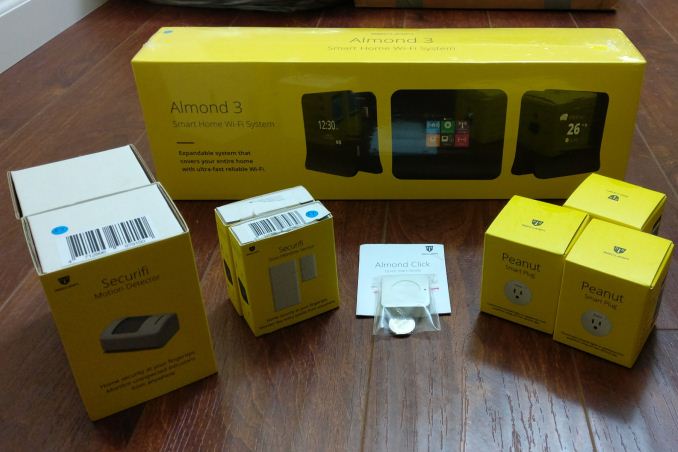
Securifi plans to roll out the service to the public starting on January 23, 2017 with a free 30-day trial. Subscription rates start at $4/month, with plans to increase to $10/month after the roll-out of additional features. The service will initially be open only for Almond 3 users. The eventual plan is to roll it out for the Almond and Almond+ users also. Given that this is a cloud-based subscription service, it is not a surprise.

As the number of IoT devices in the household increase, Securifi’s subscription-based approach to driving up revenue might serve them well. I can definitely see the average consumer signing up for these types of services. That said, I do want to see more value being provided even with just a $4/month fee. If Securifi can get in some UTM functionality to provide firewall, anti-virus, anti-spam and other services, this type of subscription offering can tempt power users also.