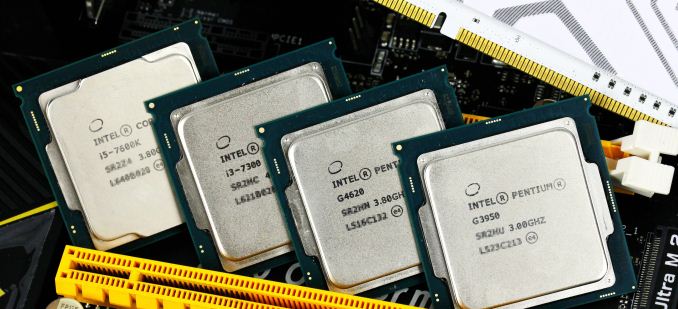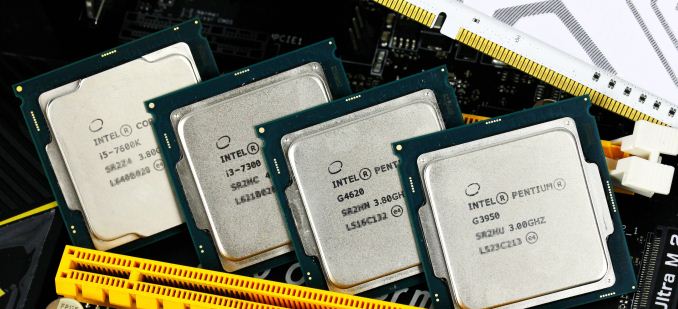
Intel has already started to sell low-power dual-core Core i5/i7 Kaby Lake microprocessors for notebooks, but desktop parts with four cores and high frequencies are due in early 2017, as Intel announced back at IDF and the Kaby Lake-Y/U launch. In advance of the desktop launch, as is typical with how CPUs are launched, Intel has to send out qualification and near-retail samples to partners for pre-testing of release systems. Typically this is kept under wraps, without official public announcements (it’s up to you how many of the leaks you want to believe), but late last week Intel sent out a ‘Product Change Notification‘ through its online/public channels, with details about a good portion (no way to tell if it is all the SKUs) of Intel’s Core i7 and Core i5-7000 series parts.
Within the PCN, Intel notified its customers about an additional assembly/packaging site for its desktop Kaby Lake-S chips in Vietnam and therefore had to disclose model numbers of the CPUs as well as some of the specifications. In addition, in a separate PCN detailing package adjustments for how chipset ICs are shipped, it would seem that Intel has also mentioned names of its upcoming 200-series chipsets.
According to Intel’s document for partners, the company intends to release at least 11 quad-core processors for desktops based on the Kaby Lake microarchitecture in Q1. What is noteworthy is that the company wants its customers to get ready to receive the first shipments of the KBL-S chips assembled in Vietnam starting from November 4, 2016, this week (which means that the final specs of the new processors have been set and will only be changed in extreme circumstances). The initial KBL-S lineup would seem to include three Core i7 SKUs, seven Core i5 CPUs as well as one Xeon E3 v6 product. (The fact that a Xeon v6 is included in this is interesting, given that Intel removed standard chipset support for Xeon E3 CPUs with Skylake and v5, meaning that both consumer and enterprise platforms are due to land in January.)

All the Kaby Lake-S processors will use the B0 stepping of the core, and will have 100-300 MHz higher base frequency compared to their Skylake-S counterparts. The PCN does not explicitly state the TDP, however we do not expect much to change given the slightly improved 14+ nm technology and the increased frequencies (same thing applies to cache size, which has been consistent for several generations). We have already observed that mobile Kaby Lake CPUs have higher clock rates compared to their predecessors due to enhancements of Intel’s 14+ nm process technology, and we see that their desktop brethren also have improvements on this front. We do not have the final Turbo frequencies at hand, but we expect them to be considerably higher than the base clock rates.
| Basic Specifications of Quad-Core Intel Core i5/i5 and Xeon E3 |
| Kaby Lake-S |
Skylake-S |
| Model |
Cores
/Threads |
Freq.
(Base) |
TDP |
Product
Code |
S-Spec |
Model |
Freq.
(Base) |
| i7-7700K |
4/8 |
4.2 GHz |
95W |
CM8067702868535 |
SR33A |
i7-6700K |
4.0GHz |
| i7-7700 |
3.6 GHz |
65W |
CM8067702868314 |
SR338 |
i7-6700 |
3.4GHz |
| i7-7700T |
2.9 GHz |
35W |
CM8067702868416 |
SR339 |
i7-6700T |
2.8GHz |
| i5-7600K |
4/4 |
3.8 GHz |
95W |
CM8067702868219 |
SR32V |
i5-6600K |
3.5GHz |
| i5-7600 |
3.5 GHz |
65W |
CM8067702868011 |
SR334 |
i5-6600 |
3.3GHz |
| i5-7600T |
2.8 GHz |
35W |
CM8067702868117 |
SR336 |
i5-6600T |
2.7GHz |
| i5-7500 |
3.4 GHz |
65W |
CM8067702868012 |
SR335 |
i5-6500 |
3.2GHz |
| i5-7500T |
2.7 GHz |
35W |
CM8067702868115 |
SR337 |
i5-6500T |
2.5GHz |
| i5-7400 |
3.0 GHz |
65W |
CM8067702867050 |
SR32W |
i5-6400 |
2.7GHz |
| i5-7400T |
2.4 GHz |
35W |
CM8067702867915 |
SR332 |
i5-6400T |
2.2GHz |
| E3-1205v6 |
?/? |
3.0 GHz |
? |
CM8067702871025 |
SR32D |
– |
– |
| Additional Info from Other Sources |
| i3-7300* |
2/4 |
4.0 GHz |
65W |
? |
SR2MC |
i3-6300 |
3.8 GHz |
| Pentium G4620* |
2/2 |
3.8 GHz |
51W |
? |
SR2HN |
Pentium G4520 |
3.6 GHz |
| Pentium G3950* |
2/2 |
3.0 GHz |
51W |
? |
SR2MU |
Pentium G3920 |
2.9 GHz |
*CPU details taken from this piece at PCOnline
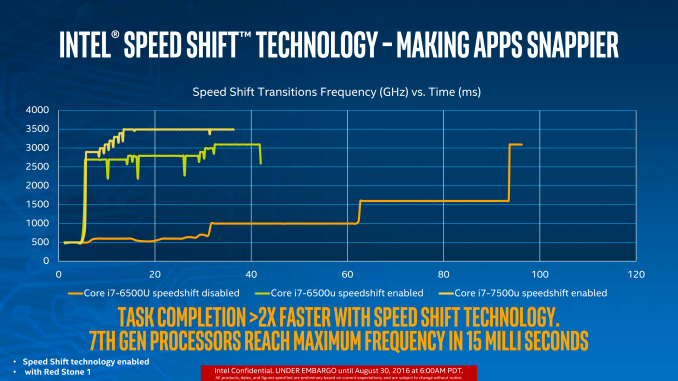
Aside from the 14+ process offering higher frequencies, the base microarchitecture of Kaby Lake-S, as explained at the release of Kaby Lake-Y/U in September, is essentially the same as Skylake. However, on top of increasing the frequencies, Intel is also adding in Speed Shift v2 which allows for much quicker adjustments in CPU frequency over Skylake (down to 10ms rather than 30ms).
It remains to be seen is whether the new 14+ process technology will also enable considerably higher overclocking potential compared to existing CPUs. If it does, then the new chips have a chance to become rather popular among enthusiasts, potentially toppling the i7-2600K as a long term favorite.
It might be noted is that Intel’s Kaby Lake-S will have to compete not only against their predecessors, but also against AMD’s Zen products due in Q1. That being said, some would argue that given AMD’s recent presentation of certain benchmark metrics, Zen is geared more towards the high-end desktop crowd. Nevertheless, it looks like early 2017 is going to be an interesting time for microprocessors.
200-Series Chipsets
In addition to model numbers of its Kaby Lake CPUs, Intel also revealed the names of its 200-series chipsets in another document it sent to partners. As expected, the lineup will include the Z270 PCH for enthusiast-class PCs with overclocking capabilities; Q270, H270 and H250 for mainstream systems and B250 for office/business computers.
| Intel 200-Series Chipsets |
| Name |
Socket |
Stepping |
Product Code |
S-Spec |
| Intel H270 |
LGA1151 |
A0 |
GL82H270 |
SR2WA |
| Intel Z270 |
GL82Z270 |
SR2WB |
| Intel B250 |
GL82B250 |
SR2WC |
| Intel Q250 |
GL82Q250 |
SR2WD |
| Intel Q270 |
GL82Q270 |
SR2WE |
| |
| Intel C422 |
LGA1151? |
A0 |
GL82C422 |
SR2WG |
| Intel X299 |
?!? |
A0 |
GL82X299 |
SR2Z2 |
Also in the list of chipsets were a couple of unknowns as well.
Listed in the PCN is C422, which because it has a ‘C’ in the name means that this is typically geared towards workstations and Xeon platforms. This may be in line with the E3-1205 v6 CPU SKU as seen in the processor list.
Also is X299, which really throws up a few question marks. The X-series chipsets are typically for Intel’s High-End Desktop Platform (HEDT), and we’ve had X58, X79 and X99 in the last decade, from Nehalem up to Broadwell-E which was released back in May. This means either one of two things – either Intel is bringing the X nomenclature to Kaby Lake, the mainstream platform, or this is the next chipset for HEDT and the future Skylake-E series of processors. The first option in making X299 a Kaby Lake-related platform seems a little odd. However the second one, with Skylake-E, makes sense. After X99, the X119 name doesn’t have the same marketability (if Intel was to keep parity with number jumps), but by pushing Skylake-E onto the 200-series naming as X299, it moves both mainstream and HEDT chipset naming strategies onto the same track. Note that we don’t have a time-frame for Skylake-E as of yet.
Intel’s motherboard customers, given the Q1 launch, must be ready to receive the 200-series PCH ICs on new reels. According to the PCN, these will come with additional protections bands starting from December 2, 2016. Intel may or may not announce the whole 200-series (not X) lineup at CES, given this late in the day adjustment to core components for the motherboards.
As for improvements of the Intel 200-series chipsets, we are still waiting on official confirmation as to exactly what to expect. Various unconfirmed leaks have indicated additional PCIe 3.0 chipset lanes, some new platform features and support for Intel’s Optane SSDs, however we will be here for the official launch when the time comes. It might be worth noting that almost all the motherboard manufacturers have now formally announced new 100-series BIOS support for Kaby Lake CPUs, meaning not all enthusiasts will have to get new motherboards.
Sources: Intel, PCOnline