Vik


Desktop Kaby Lake-S i7/i5 Lineup and 200-Series Chipsets Leaked
Desktop Kaby Lake-S i7/i5 Lineup and 200-Series Chipsets Leaked

Intel has already started to sell low-power dual-core Core i5/i7 Kaby Lake microprocessors for notebooks, but desktop parts with four cores and high frequencies are due in early 2017, as Intel announced back at IDF and the Kaby Lake-Y/U launch. In advance of the desktop launch, as is typical with how CPUs are launched, Intel has to send out qualification and near-retail samples to partners for pre-testing of release systems. Typically this is kept under wraps, without official public announcements (it’s up to you how many of the leaks you want to believe), but late last week Intel sent out a ‘Product Change Notification‘ through its online/public channels, with details about a good portion (no way to tell if it is all the SKUs) of Intel’s Core i7 and Core i5-7000 series parts.

Within the PCN, Intel notified its customers about an additional assembly/packaging site for its desktop Kaby Lake-S chips in Vietnam and therefore had to disclose model numbers of the CPUs as well as some of the specifications. In addition, in a separate PCN detailing package adjustments for how chipset ICs are shipped, it would seem that Intel has also mentioned names of its upcoming 200-series chipsets.

According to Intel’s document for partners, the company intends to release at least 11 quad-core processors for desktops based on the Kaby Lake microarchitecture in Q1. What is noteworthy is that the company wants its customers to get ready to receive the first shipments of the KBL-S chips assembled in Vietnam starting from November 4, 2016, this week (which means that the final specs of the new processors have been set and will only be changed in extreme circumstances). The initial KBL-S lineup would seem to include three Core i7 SKUs, seven Core i5 CPUs as well as one Xeon E3 v6 product. (The fact that a Xeon v6 is included in this is interesting, given that Intel removed standard chipset support for Xeon E3 CPUs with Skylake and v5, meaning that both consumer and enterprise platforms are due to land in January.)

All the Kaby Lake-S processors will use the B0 stepping of the core, and will have 100-300 MHz higher base frequency compared to their Skylake-S counterparts. The PCN does not explicitly state the TDP, however we do not expect much to change given the slightly improved 14+ nm technology and the increased frequencies (same thing applies to cache size, which has been consistent for several generations). We have already observed that mobile Kaby Lake CPUs have higher clock rates compared to their predecessors due to enhancements of Intel’s 14+ nm process technology, and we see that their desktop brethren also have improvements on this front. We do not have the final Turbo frequencies at hand, but we expect them to be considerably higher than the base clock rates.

Basic Specifications of Quad-Core Intel Core i5/i5 and Xeon E3
Kaby Lake-S Skylake-S
Model Cores
/Threads
Freq.
(Base)
TDP Product
Code
S-Spec Model Freq.
(Base)
i7-7700K 4/8 4.2 GHz 95W CM8067702868535 SR33A i7-6700K 4.0GHz
i7-7700 3.6 GHz 65W CM8067702868314 SR338 i7-6700 3.4GHz
i7-7700T 2.9 GHz 35W CM8067702868416 SR339 i7-6700T 2.8GHz
i5-7600K 4/4 3.8 GHz 95W CM8067702868219 SR32V i5-6600K 3.5GHz
i5-7600 3.5 GHz 65W CM8067702868011 SR334 i5-6600 3.3GHz
i5-7600T 2.8 GHz 35W CM8067702868117 SR336 i5-6600T 2.7GHz
i5-7500 3.4 GHz 65W CM8067702868012 SR335 i5-6500 3.2GHz
i5-7500T 2.7 GHz 35W CM8067702868115 SR337 i5-6500T 2.5GHz
i5-7400 3.0 GHz 65W CM8067702867050 SR32W i5-6400 2.7GHz
i5-7400T 2.4 GHz 35W CM8067702867915 SR332 i5-6400T 2.2GHz
E3-1205v6 ?/? 3.0 GHz ? CM8067702871025 SR32D
Additional Info from Other Sources
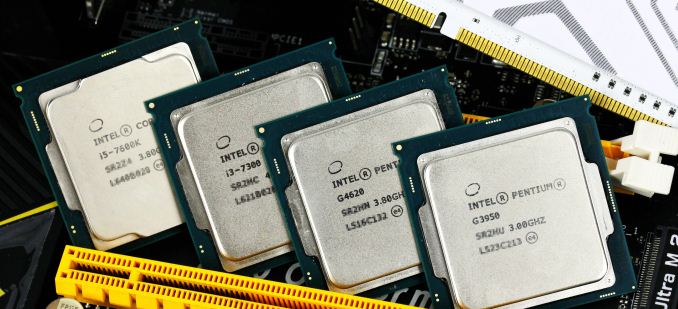
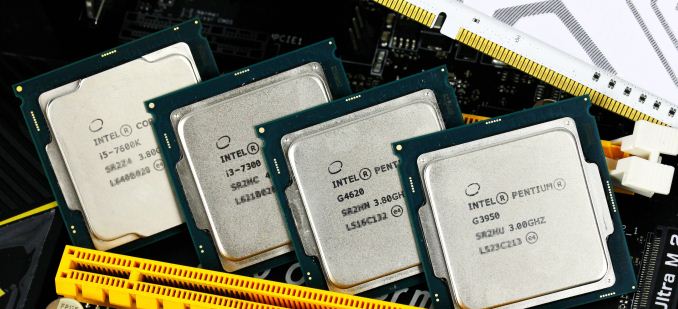
i3-7300* 2/4 4.0 GHz 65W ? SR2MC i3-6300 3.8 GHz
Pentium G4620* 2/2 3.8 GHz 51W ? SR2HN Pentium G4520 3.6 GHz
Pentium G3950* 2/2 3.0 GHz 51W ? SR2MU Pentium G3920 2.9 GHz

*CPU details taken from this piece at PCOnline

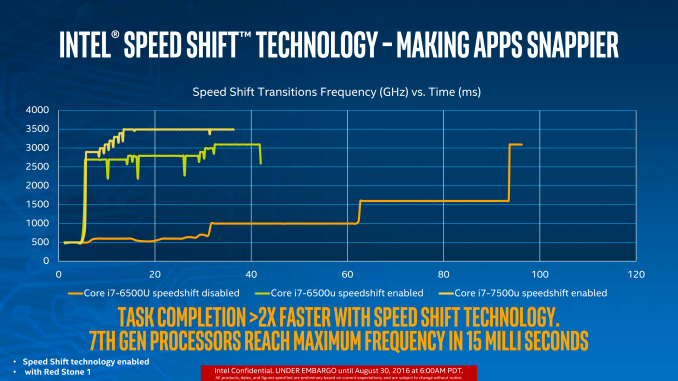
Aside from the 14+ process offering higher frequencies, the base microarchitecture of Kaby Lake-S, as explained at the release of Kaby Lake-Y/U in September, is essentially the same as Skylake. However, on top of increasing the frequencies, Intel is also adding in Speed Shift v2 which allows for much quicker adjustments in CPU frequency over Skylake (down to 10ms rather than 30ms).
It remains to be seen is whether the new 14+ process technology will also enable considerably higher overclocking potential compared to existing CPUs. If it does, then the new chips have a chance to become rather popular among enthusiasts, potentially toppling the i7-2600K as a long term favorite.

It might be noted is that Intel’s Kaby Lake-S will have to compete not only against their predecessors, but also against AMD’s Zen products due in Q1. That being said, some would argue that given AMD’s recent presentation of certain benchmark metrics, Zen is geared more towards the high-end desktop crowd. Nevertheless, it looks like early 2017 is going to be an interesting time for microprocessors.

200-Series Chipsets

In addition to model numbers of its Kaby Lake CPUs, Intel also revealed the names of its 200-series chipsets in another document it sent to partners. As expected, the lineup will include the Z270 PCH for enthusiast-class PCs with overclocking capabilities; Q270, H270 and H250 for mainstream systems and B250 for office/business computers. 

Intel 200-Series Chipsets
Name Socket Stepping Product Code S-Spec
Intel H270 LGA1151 A0 GL82H270 SR2WA
Intel Z270 GL82Z270 SR2WB
Intel B250 GL82B250 SR2WC
Intel Q250 GL82Q250 SR2WD
Intel Q270 GL82Q270 SR2WE
 
Intel C422 LGA1151? A0 GL82C422 SR2WG
Intel X299 ?!? A0 GL82X299 SR2Z2

Also in the list of chipsets were a couple of unknowns as well.

Listed in the PCN is C422, which because it has a ‘C’ in the name means that this is typically geared towards workstations and Xeon platforms. This may be in line with the E3-1205 v6 CPU SKU as seen in the processor list.

Also is X299, which really throws up a few question marks. The X-series chipsets are typically for Intel’s High-End Desktop Platform (HEDT), and we’ve had X58, X79 and X99 in the last decade, from Nehalem up to Broadwell-E which was released back in May. This means either one of two things – either Intel is bringing the X nomenclature to Kaby Lake, the mainstream platform, or this is the next chipset for HEDT and the future Skylake-E series of processors. The first option in making X299 a Kaby Lake-related platform seems a little odd. However the second one, with Skylake-E, makes sense. After X99, the X119 name doesn’t have the same marketability (if Intel was to keep parity with number jumps), but by pushing Skylake-E onto the 200-series naming as X299, it moves both mainstream and HEDT chipset naming strategies onto the same track. Note that we don’t have a time-frame for Skylake-E as of yet.

Intel’s motherboard customers, given the Q1 launch, must be ready to receive the 200-series PCH ICs on new reels. According to the PCN, these will come with additional protections bands starting from December 2, 2016. Intel may or may not announce the whole 200-series (not X) lineup at CES, given this late in the day adjustment to core components for the motherboards. 

As for improvements of the Intel 200-series chipsets, we are still waiting on official confirmation as to exactly what to expect. Various unconfirmed leaks have indicated additional PCIe 3.0 chipset lanes, some new platform features and support for Intel’s Optane SSDs, however we will be here for the official launch when the time comes. It might be worth noting that almost all the motherboard manufacturers have now formally announced new 100-series BIOS support for Kaby Lake CPUs, meaning not all enthusiasts will have to get new motherboards.

Sources: Intel, PCOnline

Wi-Fi Alliance Begins to Certify 802.11ad WiGig Devices

Wi-Fi Alliance Begins to Certify 802.11ad WiGig Devices

The Wi-Fi Alliance this week began to certify products featuring wireless modules compatible with the 802.11ad standard (aka WiGig). The certification will help to ensure that all WiGig-branded devices, which have been around for some time, can flawlessly operate with each other and deliver expected multi-gigabit performance over 60 GHz spectrum.

The WiGig technology (IEEE 802.11ad) is a short range communication standard that enables compatible devices to communicate at up to 7–8 Gb/s data rates and with minimal latencies, using the 60 GHz spectrum at distances of up to ten meters. Since 60 GHz signals cannot penetrate walls, the technology can be used to connect devices that are in direct line of sight. Given the limitation, WiGig cannot replace Wi-Fi or even Bluetooth, but it can enable devices like wireless docking stations, wireless AR/VR head-mounted displays, wireless high-performance storage devices, wireless displays, and others devices which need a lot of bandwidth.

To date, Intel and Qualcomm have released several tri-band chipsets that support the 2.4 GHz, 5 GHz and 60 GHz spectrums as well as Wi-Fi, Bluetooth and WiGig technologies. The Wi-Fi Alliance has already certified Intel’s Tri-Band Wireless 18260 (Maple Peak) and Qualcomm’s QCA9500 802.11ad-compatible chipsets as well as multiple devices that use them (including Dell’s Latitude E7450/70 as well as 802.11ad 60 GHz USB adapters from Peraso and Socionext). Going forward, the organization will certify other products, including smartphones and docking stations.

It should be noted that the start of WiGig certification on its own isn’t going to be the catalyst to cause WiGig adoption to take off, but it will increase chipset developers’, device makers’, and end users’ confidence in the standard. Designers of Wi-Fi chipsets and manufacturers of actual systems have been reluctant to adopt 802.11ad so far because the infrastructure is absent and so is demand, a classic chicken and egg dilemma. With the official certification process things will likely get a little better, mainly because of added confidence.

Meanwhile, analysts from ABI Research believe that 180 million of WiGig-enabled chipsets will ship inside smartphones already next year with 1.5 billion WiGig devices shipping in 2021.

Image Source: Blu Wireless Technology.

Wi-Fi Alliance Begins to Certify 802.11ad WiGig Devices

Wi-Fi Alliance Begins to Certify 802.11ad WiGig Devices

The Wi-Fi Alliance this week began to certify products featuring wireless modules compatible with the 802.11ad standard (aka WiGig). The certification will help to ensure that all WiGig-branded devices, which have been around for some time, can flawlessly operate with each other and deliver expected multi-gigabit performance over 60 GHz spectrum.

The WiGig technology (IEEE 802.11ad) is a short range communication standard that enables compatible devices to communicate at up to 7–8 Gb/s data rates and with minimal latencies, using the 60 GHz spectrum at distances of up to ten meters. Since 60 GHz signals cannot penetrate walls, the technology can be used to connect devices that are in direct line of sight. Given the limitation, WiGig cannot replace Wi-Fi or even Bluetooth, but it can enable devices like wireless docking stations, wireless AR/VR head-mounted displays, wireless high-performance storage devices, wireless displays, and others devices which need a lot of bandwidth.

To date, Intel and Qualcomm have released several tri-band chipsets that support the 2.4 GHz, 5 GHz and 60 GHz spectrums as well as Wi-Fi, Bluetooth and WiGig technologies. The Wi-Fi Alliance has already certified Intel’s Tri-Band Wireless 18260 (Maple Peak) and Qualcomm’s QCA9500 802.11ad-compatible chipsets as well as multiple devices that use them (including Dell’s Latitude E7450/70 as well as 802.11ad 60 GHz USB adapters from Peraso and Socionext). Going forward, the organization will certify other products, including smartphones and docking stations.

It should be noted that the start of WiGig certification on its own isn’t going to be the catalyst to cause WiGig adoption to take off, but it will increase chipset developers’, device makers’, and end users’ confidence in the standard. Designers of Wi-Fi chipsets and manufacturers of actual systems have been reluctant to adopt 802.11ad so far because the infrastructure is absent and so is demand, a classic chicken and egg dilemma. With the official certification process things will likely get a little better, mainly because of added confidence.

Meanwhile, analysts from ABI Research believe that 180 million of WiGig-enabled chipsets will ship inside smartphones already next year with 1.5 billion WiGig devices shipping in 2021.

Image Source: Blu Wireless Technology.

Qualcomm to Acquire NXP, Creates A Massive Semiconductor Company

Qualcomm to Acquire NXP, Creates A Massive Semiconductor Company

Qualcomm and NXP Semiconductors on Thursday announced that they had signed an agreement, under which Qualcomm will acquire NXP. The boards of both companies have already unanimously approved the all-cash deal representing a total enterprise value of about $47 billion. The new entity will be able to address thousands of devices and the combined expertise of both companies will be particularly important for automotive, mobile and IoT industries, which are poised for growth. The combined company will be one of the world’s largest suppliers of semiconductors in general, with revenues comparable to those of Samsung and Intel. However, it is not going to be easy to combine the assets of Qualcomm and NXP under one company.

The Biggest Semiconductor Transaction Ever

Qualcomm intends to pay $110 for every NXP share, or for $37.88 billion (according to estimates by Reuters, based on the company’s 344.4 million diluted shares as of early October), which represents around 10% premium compared to the stock price of around $98.66 at close on Wednesday. When NXP’s debt is included, the enterprise value goes up to around $47 billion in total. Last week several media outlets reported that the NXP management wanted to get $120 per share, but agreed to $110 proposed by Qualcomm. In fact, given that the NXPI stock was trading in the range between $61.61 and $107.54 in the last 12 months, $110 seems to be a rather fair price.


Qualcomm headquarters. Photo by Coolcaesar at en.wikipedia

What is interesting is that Qualcomm intends to buy NXP in an all-cash deal, which means that the company will have to borrow money, as it has around $17 billion in cash and other short-term assets its pockets today (according to U.S. regulators). Even adding in long-term securities only brings Qualcomm’s piggy bank to around $30 billion in total. Qualcomm’s total debt as of today is $11.77 billion and with a new multi-billion loan (or loans) as well as NXP’s debt, its total debt will be well over $20 billion. The company does not reveal the names of its creditors right now, but it admits that it will have to borrow money to pay to NXP shareholders as well as liabilities of the company eventually.

Qualcomm and NXP intend to close the deal by the end of calendar 2017, after regulators in various jurisdictions approve the buyout. What is noteworthy is that the two companies are starting their integration effort today, well before they get all the approvals they need, which shows their confidence in the deal closing, and confirms that it will not be easy to merge the two multi-billion corporations. If everything goes as planned, the transaction valued at approximately $47 billion will be the largest semiconductor takeover ever. Last year Avago paid $37 billion for Broadcom and earlier this year Softbank bought ARM for $32 billion.

From an economics points of view, large chip-related acquisitions in the recent years are not surprising. Electronics get more complex and more expensive to develop. As a result, semiconductor companies need to expand their businesses to gain access to and volume in various existing and emerging devices. Moreover, by taking over other companies, chip developers not only get IP they need, but can also cut down certain costs and/or get rid of competitors. Finally, as companies get bigger, it gets easier for them to negotiate with their suppliers because now they need to get more goods or services.

Qualcomm and NXP: More Than the Sum of All Parts?

Qualcomm will create a rather formidable force in the semiconductor world by combining two very different companies with 72,000 employees in total. However, the giant machine that Qualcomm and NXP are going to create may be worth more than the sum of their capitalizations if everything goes according to plan.

Right now Qualcomm is the world’s largest supplier of SoCs for mobile devices and telecom equipment. Last fiscal year the company earned $25 billion in revenue: $17B from selling chips and $8B from technology licensing. In the recent years Qualcomm has been trying to diversify its business and offered various solutions for automotive, IoT, healthcare and even datacenter industries. While the company has been gradually expanding its product portfolio with various solutions, mobile SoCs has remained its bread and butter for products sold. Moreover, some of the markets and products categories hard to break into due factors such as conservative approach of manufacturers, very long development cycles, etc. For example, despite of having CPU, GPU, sensors and other IP, Qualcomm has never made into Top 10 suppliers of automotive semiconductors (according to IHS).

By contrast, NXP has been focusing on mixed-signal semiconductors as well as various specialized microprocessors and microcontrollers. NXPs chips are used inside automobiles, in healthcare equipment, NFC equipment (in fact, NXP was one of the inventors of the technology) and in hundreds of other devices. Based on data from IHS, NXP earned $9.72 billion in revenue last year.

While Qualcomm and NXP overlap in certain areas, they aren’t direct rivals in any significant sense of the word; the sum of their revenues come from different markets. Therefore, the acquisition will be complementary for Qualcomm because it greatly expands its addressable markets (potentially up to $138 billion in 2020) and brings thousands of new clients (Qualcomm says that NXP serves 25K direct and indirect customers). The combined company will have revenue of well over $30 billion and will be the world’s No. 3 supplier of semiconductors after Intel ($51 billion in 2015) and Samsung ($40 billion), based on rankings from IHS. Keep in mind that Samsung sells tons of commodity DRAM and NAND flash memory, whereas the new Qualcomm will specialize on various general purpose, automotive, IoT and special purpose computing solutions. In fact, the new Qualcomm will be a rather unique company with no direct rivals of comparable sizes, as companies like Avago (together with Broadcom), MediaTek, Texas Instruments, Renesas and other earn considerably less.

During the conference call with investors and financial analysts, the management of Qualcomm and NXP emphasized multiple times that the new company will not only be able to develop unique solutions thanks to massive amount of IP available to leverage (some of which goes back to semi IP from Motorola and Philips), but will be able to address automotive and IoT industries better than its competitors. In the best case scenario, Qualcomm will be able to offer highly-integrated platforms for hundreds of emerging devices from smart wearables to 5G-enabled IoT equipment to self-driving automobiles with wireless charging, in addition to more advanced platforms for hardware we use today, such as smartphones, routers or servers. At the same time, while the management teams accentuate that the transaction is not about cutting costs or synergies, it is inevitable that there will be redundancies and optimizations. Therefore, some existing projects are expected to be cancelled (it will be interesting to see what happens to Freescale’s CPUs, for example) and some will be merged. Qualcomm predicts that two years after the two firms merge, the new company will save at least $500 million annually.

The Road Ahead

The acquisition of NXP clearly makes a lot of sense for Qualcomm, but the integration of the two companies is not going to be easy. Firstly, NXP is still integrating Freescale Semiconductor (the deal closed last December). Secondly, NXP has its own semiconductor fabs (all of which are outdated and Qualcomm has never had its own fabs). Thirdly, NXP has more employees than Qualcomm itself (45K vs 27K). Finally, the new company will have to remain very agile to remain competitive on rapidly developing markets, such as smartphones.

Executives of Qualcomm said on Thursday that the combined company would be managed by execs from both firms, who know how certain businesses work. For example, Qualcomm plans to use NXP’s sales teams to sell Qualcomm-branded devices for IoT because these people know the market and know how to address it. In the meantime, Qualcomm does not have immediate plans to get rid of NXP’s semiconductor production facilities and NXP’s execs will continue to manage them. But in longer term, the company may reconsider its approach to manufacturing as Qualcomm has long based its business around being a fabless semiconductor. Overall, while the integration efforts are underway, there are things that may change between now and late 2017, when the deal is expected to close. Therefore, only time will tell how the combined company will look like and how it will be managed.

No matter how optimistic execs from Qualcomm and NXP sound today about the prospects of the merged company, it will be a very tough job to blend the two firms. Nevertheless, the importance of connected devices will only grow in the coming years (one may call it the 5G era) and therefore having the whole package of IP needed to build different kinds of devices (from water quality sensors to smart cars and smart buildings) is clearly important.

Qualcomm to Acquire NXP, Creates A Massive Semiconductor Company

Qualcomm to Acquire NXP, Creates A Massive Semiconductor Company

Qualcomm and NXP Semiconductors on Thursday announced that they had signed an agreement, under which Qualcomm will acquire NXP. The boards of both companies have already unanimously approved the all-cash deal representing a total enterprise value of about $47 billion. The new entity will be able to address thousands of devices and the combined expertise of both companies will be particularly important for automotive, mobile and IoT industries, which are poised for growth. The combined company will be one of the world’s largest suppliers of semiconductors in general, with revenues comparable to those of Samsung and Intel. However, it is not going to be easy to combine the assets of Qualcomm and NXP under one company.

The Biggest Semiconductor Transaction Ever

Qualcomm intends to pay $110 for every NXP share, or for $37.88 billion (according to estimates by Reuters, based on the company’s 344.4 million diluted shares as of early October), which represents around 10% premium compared to the stock price of around $98.66 at close on Wednesday. When NXP’s debt is included, the enterprise value goes up to around $47 billion in total. Last week several media outlets reported that the NXP management wanted to get $120 per share, but agreed to $110 proposed by Qualcomm. In fact, given that the NXPI stock was trading in the range between $61.61 and $107.54 in the last 12 months, $110 seems to be a rather fair price.


Qualcomm headquarters. Photo by Coolcaesar at en.wikipedia

What is interesting is that Qualcomm intends to buy NXP in an all-cash deal, which means that the company will have to borrow money, as it has around $17 billion in cash and other short-term assets its pockets today (according to U.S. regulators). Even adding in long-term securities only brings Qualcomm’s piggy bank to around $30 billion in total. Qualcomm’s total debt as of today is $11.77 billion and with a new multi-billion loan (or loans) as well as NXP’s debt, its total debt will be well over $20 billion. The company does not reveal the names of its creditors right now, but it admits that it will have to borrow money to pay to NXP shareholders as well as liabilities of the company eventually.

Qualcomm and NXP intend to close the deal by the end of calendar 2017, after regulators in various jurisdictions approve the buyout. What is noteworthy is that the two companies are starting their integration effort today, well before they get all the approvals they need, which shows their confidence in the deal closing, and confirms that it will not be easy to merge the two multi-billion corporations. If everything goes as planned, the transaction valued at approximately $47 billion will be the largest semiconductor takeover ever. Last year Avago paid $37 billion for Broadcom and earlier this year Softbank bought ARM for $32 billion.

From an economics points of view, large chip-related acquisitions in the recent years are not surprising. Electronics get more complex and more expensive to develop. As a result, semiconductor companies need to expand their businesses to gain access to and volume in various existing and emerging devices. Moreover, by taking over other companies, chip developers not only get IP they need, but can also cut down certain costs and/or get rid of competitors. Finally, as companies get bigger, it gets easier for them to negotiate with their suppliers because now they need to get more goods or services.

Qualcomm and NXP: More Than the Sum of All Parts?

Qualcomm will create a rather formidable force in the semiconductor world by combining two very different companies with 72,000 employees in total. However, the giant machine that Qualcomm and NXP are going to create may be worth more than the sum of their capitalizations if everything goes according to plan.

Right now Qualcomm is the world’s largest supplier of SoCs for mobile devices and telecom equipment. Last fiscal year the company earned $25 billion in revenue: $17B from selling chips and $8B from technology licensing. In the recent years Qualcomm has been trying to diversify its business and offered various solutions for automotive, IoT, healthcare and even datacenter industries. While the company has been gradually expanding its product portfolio with various solutions, mobile SoCs has remained its bread and butter for products sold. Moreover, some of the markets and products categories hard to break into due factors such as conservative approach of manufacturers, very long development cycles, etc. For example, despite of having CPU, GPU, sensors and other IP, Qualcomm has never made into Top 10 suppliers of automotive semiconductors (according to IHS).

By contrast, NXP has been focusing on mixed-signal semiconductors as well as various specialized microprocessors and microcontrollers. NXPs chips are used inside automobiles, in healthcare equipment, NFC equipment (in fact, NXP was one of the inventors of the technology) and in hundreds of other devices. Based on data from IHS, NXP earned $9.72 billion in revenue last year.

While Qualcomm and NXP overlap in certain areas, they aren’t direct rivals in any significant sense of the word; the sum of their revenues come from different markets. Therefore, the acquisition will be complementary for Qualcomm because it greatly expands its addressable markets (potentially up to $138 billion in 2020) and brings thousands of new clients (Qualcomm says that NXP serves 25K direct and indirect customers). The combined company will have revenue of well over $30 billion and will be the world’s No. 3 supplier of semiconductors after Intel ($51 billion in 2015) and Samsung ($40 billion), based on rankings from IHS. Keep in mind that Samsung sells tons of commodity DRAM and NAND flash memory, whereas the new Qualcomm will specialize on various general purpose, automotive, IoT and special purpose computing solutions. In fact, the new Qualcomm will be a rather unique company with no direct rivals of comparable sizes, as companies like Avago (together with Broadcom), MediaTek, Texas Instruments, Renesas and other earn considerably less.

During the conference call with investors and financial analysts, the management of Qualcomm and NXP emphasized multiple times that the new company will not only be able to develop unique solutions thanks to massive amount of IP available to leverage (some of which goes back to semi IP from Motorola and Philips), but will be able to address automotive and IoT industries better than its competitors. In the best case scenario, Qualcomm will be able to offer highly-integrated platforms for hundreds of emerging devices from smart wearables to 5G-enabled IoT equipment to self-driving automobiles with wireless charging, in addition to more advanced platforms for hardware we use today, such as smartphones, routers or servers. At the same time, while the management teams accentuate that the transaction is not about cutting costs or synergies, it is inevitable that there will be redundancies and optimizations. Therefore, some existing projects are expected to be cancelled (it will be interesting to see what happens to Freescale’s CPUs, for example) and some will be merged. Qualcomm predicts that two years after the two firms merge, the new company will save at least $500 million annually.

The Road Ahead

The acquisition of NXP clearly makes a lot of sense for Qualcomm, but the integration of the two companies is not going to be easy. Firstly, NXP is still integrating Freescale Semiconductor (the deal closed last December). Secondly, NXP has its own semiconductor fabs (all of which are outdated and Qualcomm has never had its own fabs). Thirdly, NXP has more employees than Qualcomm itself (45K vs 27K). Finally, the new company will have to remain very agile to remain competitive on rapidly developing markets, such as smartphones.

Executives of Qualcomm said on Thursday that the combined company would be managed by execs from both firms, who know how certain businesses work. For example, Qualcomm plans to use NXP’s sales teams to sell Qualcomm-branded devices for IoT because these people know the market and know how to address it. In the meantime, Qualcomm does not have immediate plans to get rid of NXP’s semiconductor production facilities and NXP’s execs will continue to manage them. But in longer term, the company may reconsider its approach to manufacturing as Qualcomm has long based its business around being a fabless semiconductor. Overall, while the integration efforts are underway, there are things that may change between now and late 2017, when the deal is expected to close. Therefore, only time will tell how the combined company will look like and how it will be managed.

No matter how optimistic execs from Qualcomm and NXP sound today about the prospects of the merged company, it will be a very tough job to blend the two firms. Nevertheless, the importance of connected devices will only grow in the coming years (one may call it the 5G era) and therefore having the whole package of IP needed to build different kinds of devices (from water quality sensors to smart cars and smart buildings) is clearly important.